Elastic and plastic behaviour · Comportamento elástico e plástico
| English | Português |
|---|---|
| elastic/ɪˈlæstɪk/ | elástica |
| plastic/ˈplæstɪk/ | plástico |
| limit of proportionality/ˈlɪmɪt ɒv prəˌpɔːʃəˈnælɪti/ | limite de proporcionalidade |
| elastic limit/ɪˈlæstɪk ˈlɪmɪt/ | limite elástico |
| permanent extension/ˈpɜːmənənt ekˈstenʃn/ | extensão permanente |
The paperclip test
- Bend a paperclip a little and it springs back — elastic 弹性.
- Bend it far and it stays bent — plastic 塑性.
- The same material can do both, depending on how hard you push it.
O teste do clipe de papel
- Dobre um clipe de papel levemente e ele volta à posição — elástico 弹性.
- Dobre-o muito e ele fica dobrado — plástico 塑性.
- O mesmo material pode fazer ambas, dependendo de quão forte você empurrar.
Three stages of stretching
- Elastic and straight — obeys Hooke's law; returns to shape.
- Elastic but curved — past the limit of proportionality 比例极限; still returns to shape.
- Plastic — past the elastic limit 弹性极限; a permanent change is left.
A stress-strain graph, straight up to the limit of proportionality P
Três estágios de alongamento
- Elástico e reto — obedece à Lei de Hooke; retorna à forma.
- Elástico mas curvo — passado o limite de proporcionalidade 比例极限; ainda retorna à forma.
- Plástico — passado o limite elástico 弹性极限;留下永久变形。
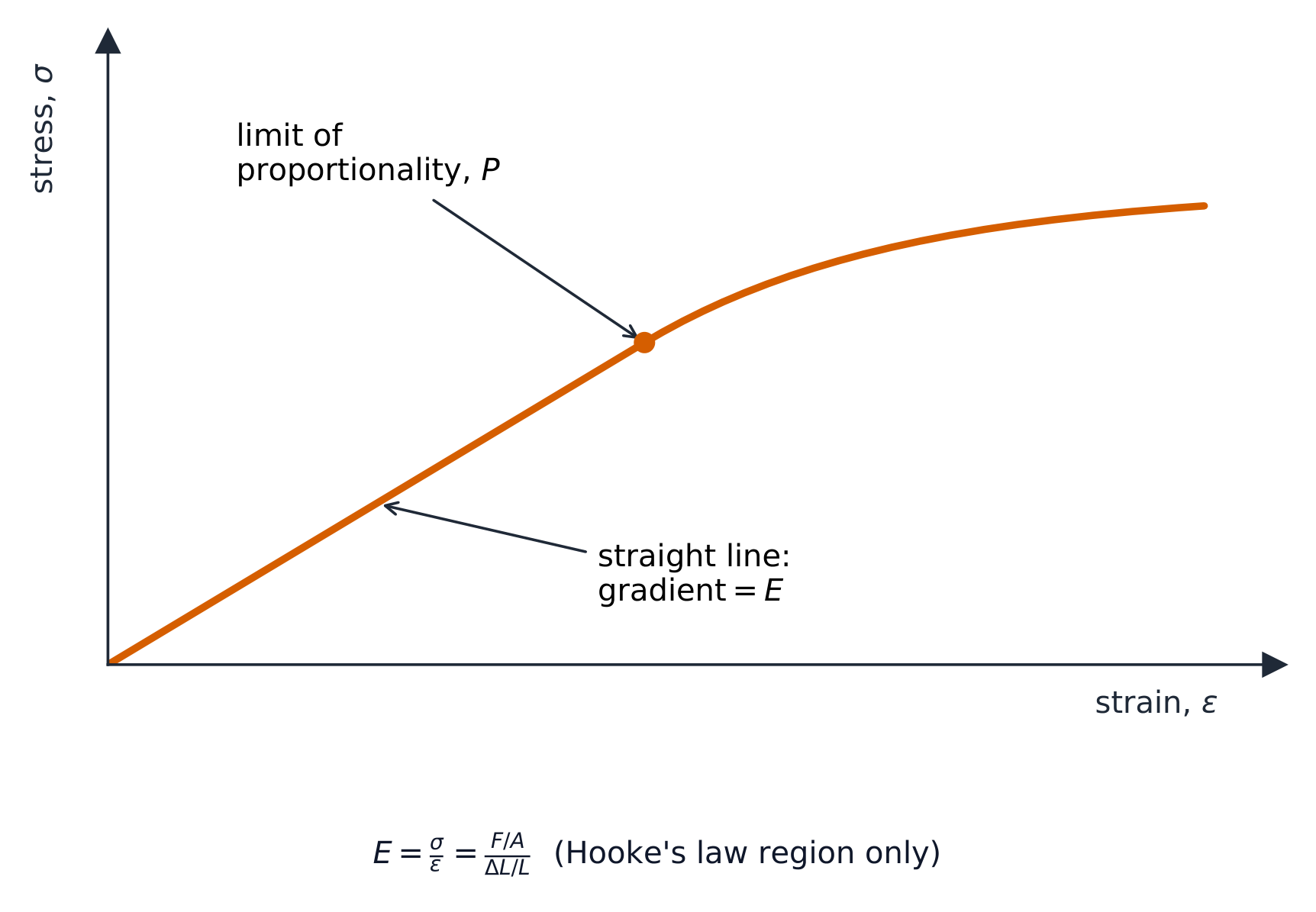
Um gráfico tensão-deformação, reto até o limite de proporcionalidade P
Hooke's law · Lei de Hooke
F = kx
Up to the limit, extension is proportional to force — the gradient is the spring constant k. · Até o limite, a extensão é proporcional à força — o gradiente é a constante da mola k.
Match each stage of stretching to what happens. · Associe cada etapa de esticamento ao que acontece.
Elastic = returns to its first length on unloading; plastic = a permanent change once you pass the elastic limit. · Elástico = retorna ao seu primeiro comprimento ao descarregar; plástico = uma mudança permanente após passar o limite elástico.
Loading and unloading
- Stretch past the elastic limit, then remove the load.
- The unloading line is parallel to the first line but shifted — leaving a permanent extension 永久伸长.
Carregamento e descarregamento
- Alongue passado o limite elástico, então remova a carga.
- A linha de descarregamento é paralela à primeira linha, mas deslocada — deixando uma extensão permanente 永久伸长。
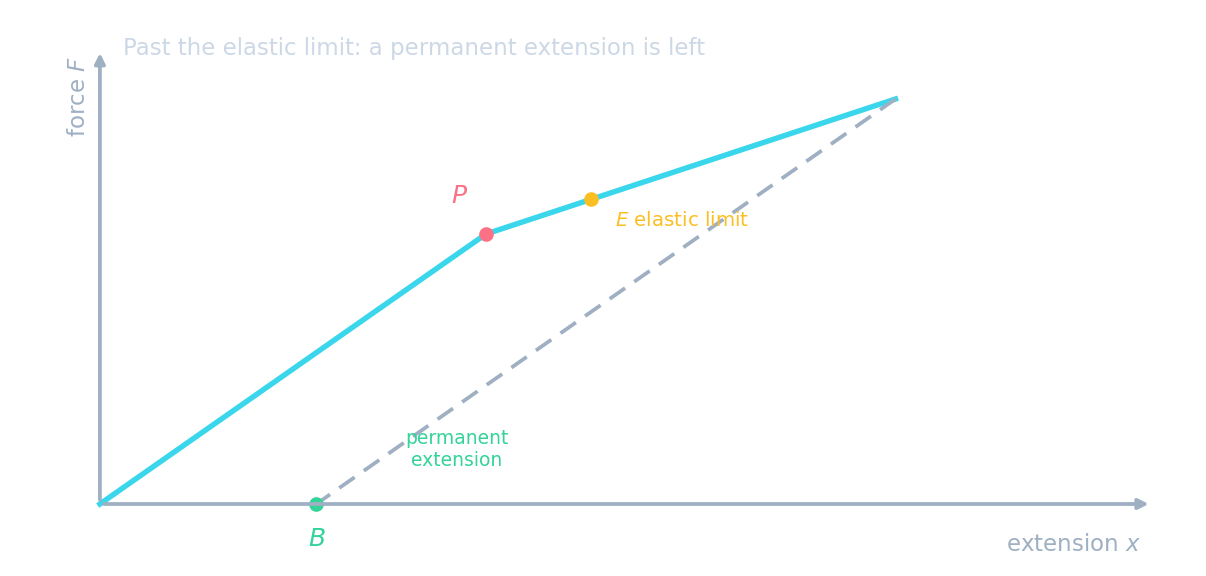
Past the elastic limit, an object returns to its original length when the load is removed. · Passado o limite elástico, um objeto retorna ao seu comprimento original quando a carga é removida.
No — in the plastic region a permanent extension stays after unloading. · Não — na região plástica, uma extensão permanente permanece após o descarregamento.
Match each term to the definition the examiner marks. · Combine cada termo com a definição que o avaliador marca.
The elastic limit sits a little beyond the limit of proportionality, so a material can stop obeying Hooke's law while still being elastic. · O limite elástico fica um pouco além do limite de proporcionalidade, então um material pode deixar de obedecer à Lei de Hooke enquanto ainda é elástico.
Energy = area under the graph
- The work done stretching a material is the area under its force–extension graph.
Energia = área sob o gráfico
- O trabalho realizado ao esticar um material é a área sob seu gráfico força-extensão.
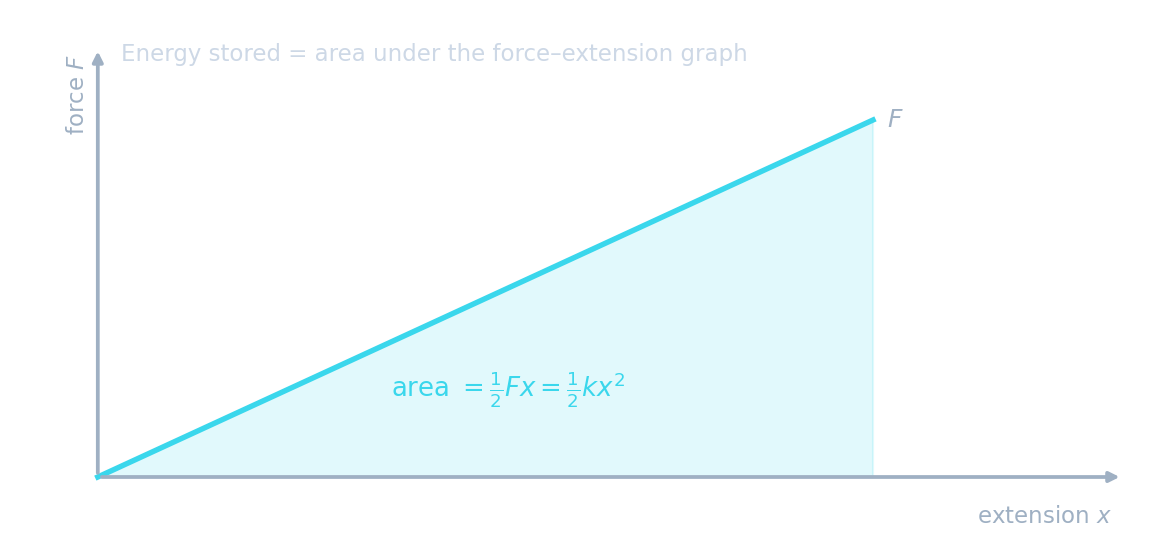
The energy stored in a stretched material equals the ____ under the force–extension graph. · A energia armazenada em um material esticado é igual ao ____ sob o gráfico de força vs. extensão.
Work done = area under the force–extension graph (a triangle for a Hooke material). · Trabalho feito = área sob o gráfico de força vs. extensão (um triângulo para um material de Hooke).
Stored elastic energy
- For a Hooke's-law material the area is a triangle: $E_{\text{P}} = \tfrac{1}{2}Fx = \tfrac{1}{2}kx^{2}$.
- An equal form is $E_{\text{P}} = \dfrac{F^{2}}{2k}$.
Force-extension past the elastic limit: P and E marked, with a permanent extension B left after unloading
Energia elástica armazenada
- Para um material que obedece à Lei de Hooke, a área é um triângulo: $E_{\text{P}} = \tfrac{1}{2}Fx = \tfrac{1}{2}kx^{2}$.
- Uma forma equivalente é $E_{\text{P}} = \dfrac{F^{2}}{2k}$.
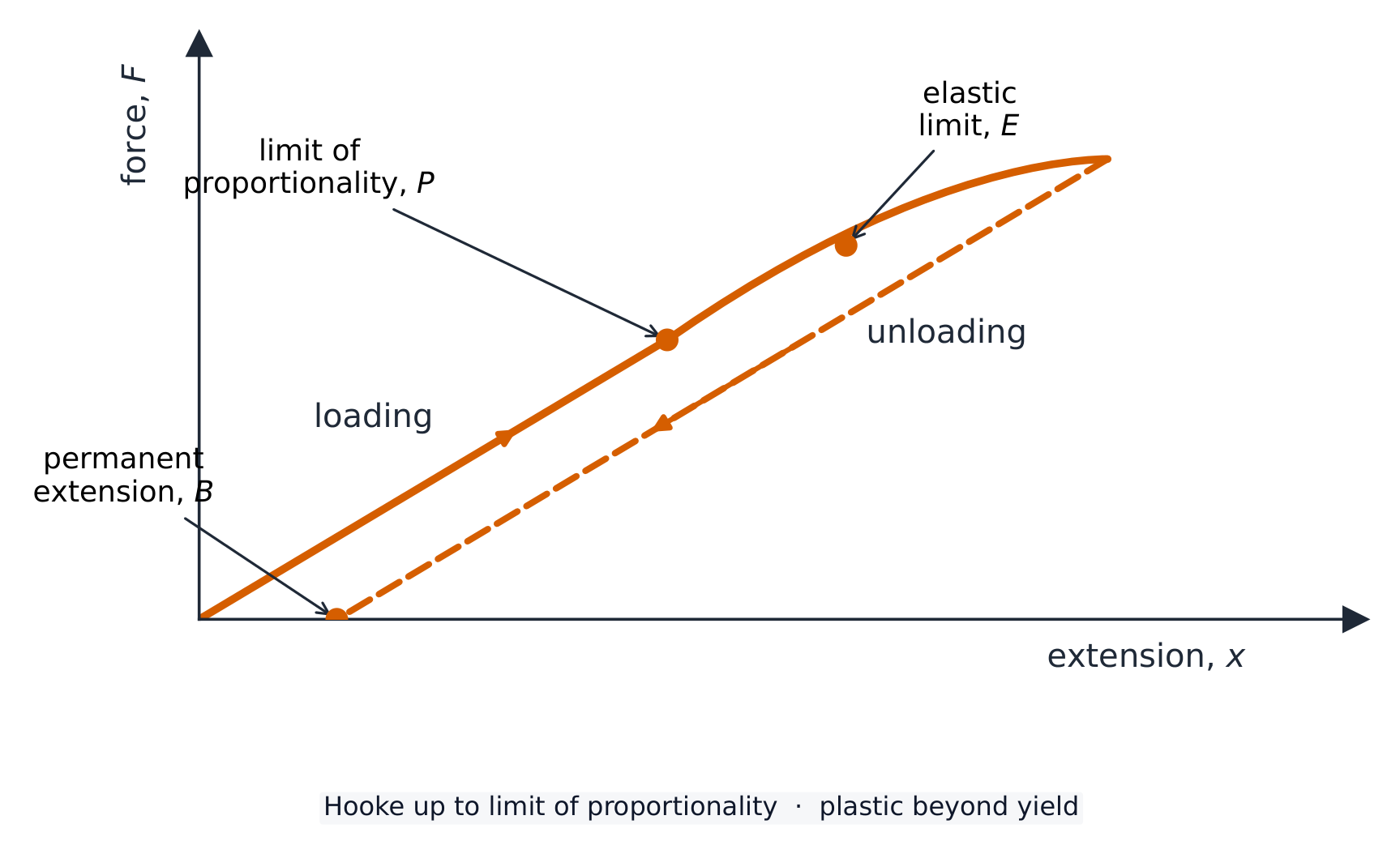
Força-extensão passado o limite elástico: P e E marcados, com uma extensão permanente B deixada após a descarga
A spring of constant $200\ \dfrac{\text{N}}{\text{m}}$ is stretched by $0.10\ \text{m}$. How much elastic PE is stored? · Uma mola de constante $200\ \dfrac{\text{N}}{\text{m}}$ é esticada em $0.10\ \text{m}$. Quanto PE elástica é armazenado?
$E_{\text{P}} = \tfrac{1}{2}kx^{2} = \tfrac{1}{2} \times 200 \times 0.10^{2} = 1.0\ \text{J}$.
When it's not a straight line
- For rubber, or a spring past its limit, the graph is a curve.
- Find the area by counting squares or using trapezia — the rule is the same.
Quando não é uma linha reta
- Para borracha, ou uma mola passada seu limite, o gráfico é uma curva.
- Encontre a área contando quadrados ou usando trapézios — a regra é a mesma.
Comparing and releasing
- Same force, softer spring (smaller $k$) → bigger $x$ → more energy stored.
- Released onto a mass, the elastic PE becomes kinetic energy: $\tfrac{1}{2}kx^{2} = \tfrac{1}{2}mv^{2}$.
Comparando e liberando
- Mesma força, mola mais macia (menor $k$) → maior $x$ → mais energia armazenada.
- Liberado sobre uma massa, a PE elástica torna-se energia cinética: $\tfrac{1}{2}kx^{2} = \tfrac{1}{2}mv^{2}$.
Two springs are pulled with the same force. The softer spring (smaller $k$) stores: · Duas molas são puxadas com a mesma força. A mola mais mole (menor $k$) armazena:
Same $F$, smaller $k$ → larger extension $x$ → larger area $\tfrac{1}{2}Fx$, so more energy is stored. · Mesmo $F$, menor $k$ → maior extensão $x$ → maior área $\tfrac{1}{2}Fx$, logo mais energia é armazenada.
When a stretched spring is released onto a mass, its elastic PE becomes ____ energy. · Quando uma mola esticada é liberada sobre uma massa, sua PE elástica torna-se ____ energia.
Set · Definir $\tfrac{1}{2}kx^{2} = \tfrac{1}{2}mv^{2}$ (plus $mgh$ if it rises) to find the speed. · Igual $\tfrac{1}{2}kx^{2} = \tfrac{1}{2}mv^{2}$ (mais $mgh$ se ele subir) para encontrar a velocidade.
Worked example: energy from a graph
- A spring of spring constant $40\ \text{N/m}$ is stretched by $0.10\ \text{m}$. Find the energy stored, and the extra energy needed to stretch it to $0.20\ \text{m}$.
- Energy stored is the area under the force-extension line, a triangle: $E = \tfrac{1}{2}kx^2 = \tfrac{1}{2}(40)(0.10)^2 = 0.20\ \text{J}$.
- At $0.20\ \text{m}$: $E = \tfrac{1}{2}(40)(0.20)^2 = 0.80\ \text{J}$.
- The extra energy is the difference, $0.80 - 0.20 = 0.60\ \text{J}$, not $0.20\ \text{J}$ again.
- Energy goes as $x^2$: doubling the extension gives four times the energy, so the second half of a stretch always costs more than the first.
Exemplo resolvido: energia de um gráfico
- Uma mola de constante elástica $40\ \text{N/m}$ é esticada por $0.10\ \text{m}$. Encontre a energia armazenada, e a energia extra necessária para esticá-la até $0.20\ \text{m}$.
- A energia armazenada é a área sob a linha de força versus extensão, um triângulo: $E = \tfrac{1}{2}kx^2 = \tfrac{1}{2}(40)(0.10)^2 = 0.20\ \text{J}$.
- Em $0.20\ \text{m}$: $E = \tfrac{1}{2}(40)(0.20)^2 = 0.80\ \text{J}$.
- A energia extra é a diferença, $0.80 - 0.20 = 0.60\ \text{J}$, não $0.20\ \text{J}$ novamente.
- A energia vai como $x^2$: dobrar a extensão dá quatro vezes a energia, então a segunda metade de um estiramento sempre custa mais que a primeira.
Marks that slip away
- On a force-extension graph the area is the energy and the gradient is the spring constant. Reading one for the other loses the whole question.
- Energy stored goes as $x^2$, not as $x$. The work between two extensions is the difference of two $\tfrac{1}{2}kx^2$ values.
- Elastic deformation returns to the original length when the force is removed; plastic deformation leaves a permanent extension.
- On a length-force graph only the part beyond the original length $L_0$ is extension. The area right down to the axis is not work.
- For a curved line the area must be estimated by counting squares, because $\tfrac{1}{2}kx^2$ assumes a straight line.
Marcas que escapam
- Num gráfico de força versus extensão, a área é a energia e o coeficiente angular é a constante da mola. Ler uma para obter a outra anula toda a questão.
- A energia armazenada vai como $x^2$, não como $x$. O trabalho entre duas extensões é a diferença de dois valores $\tfrac{1}{2}kx^2$.
- Deformação elástica retorna ao comprimento original quando a força é removida; deformação plástica deixa uma extensão permanente.
- Em um gráfico comprimento-força apenas a parte além do comprimento original $L_0$ é extensão. A área até o eixo não é trabalho.
- Para uma linha curva a área deve ser estimada contando quadrados, porque $\tfrac{1}{2}kx^2$ assume uma linha reta.
A spring of spring constant 40 N/m is stretched from 0.10 m to 0.20 m. How much extra energy does that take, in J? · Uma mola de constante elástica 40 N/m é esticada de 0.10 m para 0.20 m. Quanto energia extra isso requer, em J?
0.80 J minus 0.20 J = 0.60 J. Energy goes as x^2, so the second half of a stretch costs three times the first, not the same again. · 0.80 J menos 0.20 J = 0.60 J. A energia varia com x^2, então a segunda metade de uma extensão custa três vezes mais que a primeira, não o mesmo valor novamente.
On a force-extension graph for a spring, which are true? Select all · todos that apply. · Em um gráfico de força vs. extensão para uma mola, quais são verdadeiras? Selecione todas as que se aplicam.
Half k x squared assumes a straight line, so it is simply unavailable once the graph curves. Counting squares is then the only route. · Meio k x² assume uma linha reta, então está simplesmente indisponível quando o gráfico curva. Contar quadrados é então a única rota.
Doubling the extension of a spring doubles the energy stored in it. · Dobrar a extensão de uma mola dobra a energia armazenada nela.
It quadruples it, because the energy goes as x squared. Treating stored energy as proportional to extension is one of this topic's standard errors. · Quadruplica-a, porque a energia vai com x². Tratar a energia armazenada como proporcional à extensão é um dos erros padrão deste tópico.
You've got it
- elastic returns to shape; plastic leaves a permanent extension (past the elastic limit)
- energy stored = area under the force–extension graph
- for a Hooke material $E_{\text{P}} = \tfrac{1}{2}kx^{2}$
Entendeu?
- elástico volta à forma; plástico deixa uma extensão permanente (após o limite elástico)
- energia armazenada = área sob o gráfico força-extensão
- para um material de Hooke $E_{\text{P}} = \tfrac{1}{2}kx^{2}$