Kinetic and potential energy · Energia cinética e potencial
| English | Português |
|---|---|
| kinetic energy/kɪˈnetɪk ˈenədʒi/ | energia cinética |
| gravitational potential energy/ˌɡrævɪˈteɪʃənl pəˈtenʃl ˈenədʒi/ | energia potencial gravitacional |
| thermal energy/ˈθɜːml ˈenədʒi/ | energia térmica |
| momentum/məʊˈmentəm/ | momento |
| elastic potential energy/ɪˈlæstɪk pəˈtenʃl ˈenədʒi/ | energia potencial elástica |
| compression/kəmˈpreʃn/ | compressão |
The roller-coaster swap
- At the top of a drop a coaster crawls; at the bottom it races.
- Height has turned into speed — potential energy into kinetic energy 动能.
- Energy is just moving between two stores.
A troca do parque de diversões
- No topo de uma descida um carrinho arrasta; no fundo ele corre.
- Altura transformou-se em velocidade — energia potencial em energia cinética 动能.
- Energia apenas se move entre dois estoques.
Gravitational potential energy 重力势能
- Lifting a mass $m$ through a height $\Delta h$ stores $\Delta E_{\text{P}} = mg\Delta h$.
- It comes from the work done against gravity: $W = mg \times \Delta h$.
Gravitational PE depends only on the change in height Δh, not on the path taken
Wind turbines transfer the kinetic energy of the wind into electrical energy
Energia potencial gravitacional 重力势能
- Levantar uma massa $m$ através de uma altura $\Delta h$ armazena $\Delta E_{\text{P}} = mg\Delta h$.
- Procede do trabalho feito contra a gravidade: $W = mg \times \Delta h$.

A EP gravitacional depende apenas da mudança de altura Δh, não do caminho percorrido

As turbinas eólicas transferem a energia cinética do vento para energia elétrica
Kinetic & potential energy · Energia cinética e potencial
PE + KE = constant · PE + CE = constante
Potential · Potencial energy turns into kinetic energy — the total never changes. · Potencial energia se transforma em cinética energia — o total nunca muda.
A $2.0\ \text{kg}$ book is lifted $5.0\ \text{m}$. How much gravitational PE does it gain? (Use $g = 9.81\ \dfrac{\text{m}}{\text{s}^2}$.) · Um livro de $2.0\ \text{kg}$ é levantado $5.0\ \text{m}$. Quanto GPE gravitacional ele ganha? (Use $g = 9.81\ \dfrac{\text{m}}{\text{s}^2}$.)
$\Delta E_{\text{P}} = mg\Delta h = 2.0 \times 9.81 \times 5.0 \approx 98\ \text{J}$.
Kinetic energy
- A mass $m$ moving at speed $v$ has $E_{\text{K}} = \tfrac{1}{2}mv^{2}$.
- It comes from the work done to speed it up: $W = Fs = \tfrac{1}{2}mv^{2}$.
Energia cinética
- Uma massa $m$ movendo-se à velocidade $v$ possui $E_{\text{K}} = \tfrac{1}{2}mv^{2}$.
- Ela provém do trabalho realizado para acelerá-la: $W = Fs = \tfrac{1}{2}mv^{2}$.
A $4.0\ \text{kg}$ trolley moves at $3.0\ \dfrac{\text{m}}{\text{s}}$. What is its kinetic energy? · Um carrinho de massa $4.0\ \text{kg}$ move-se a $3.0\ \dfrac{\text{m}}{\text{s}}$. Qual é sua energia cinética?
$E_{\text{K}} = \tfrac{1}{2}mv^{2} = \tfrac{1}{2} \times 4.0 \times 3.0^{2} = 18\ \text{J}$.
Match each energy store to what it depends on. · Associe cada armazenamento de energia ao que ele depende.
Two of the three go as a square, which is why doubling a speed or an extension quadruples the energy while doubling a height only doubles it. · Duas das três variáveis aparecem ao quadrado, por isso dobrar a velocidade ou a extensão quadruplica a energia, enquanto dobrar a altura apenas dobra-a.
Two traps. Squaring: doubling the speed gives four times the kinetic energy, not two. Height: $\Delta h$ is the vertical change in height, never the distance along a slope — a ramp of length $3\ \text{m}$ that drops $1.5\ \text{m}$ uses $1.5\ \text{m}$.
Duas armadilhas. Elevação ao quadrado: dobrar a velocidade dá quatro vezes a energia cinética, não dois. Altura: $\Delta h$ é a mudança vertical na altura, nunca a distância ao longo de uma inclinação — uma rampa de comprimento $3\ \text{m}$ que cai $1.5\ \text{m}$ usa $1.5\ \text{m}$.
The energy swap
- On a frictionless ramp, GPE becomes KE: $mgh = \tfrac{1}{2}mv^{2}$, so $v = \sqrt{2gh}$.
- The mass cancels — every object reaches the same speed from the same height.
- With friction, some of it becomes thermal energy 热能 instead.
A troca de energia
- Em uma rampa sem atrito, a EPg transforma-se em EC: $mgh = \tfrac{1}{2}mv^{2}$, logo $v = \sqrt{2gh}$.
- A massa cancela-se — todos os objetos atingem a mesma velocidade partindo da mesma altura.
- Com atrito, parte disso torna-se energia térmica 热能.
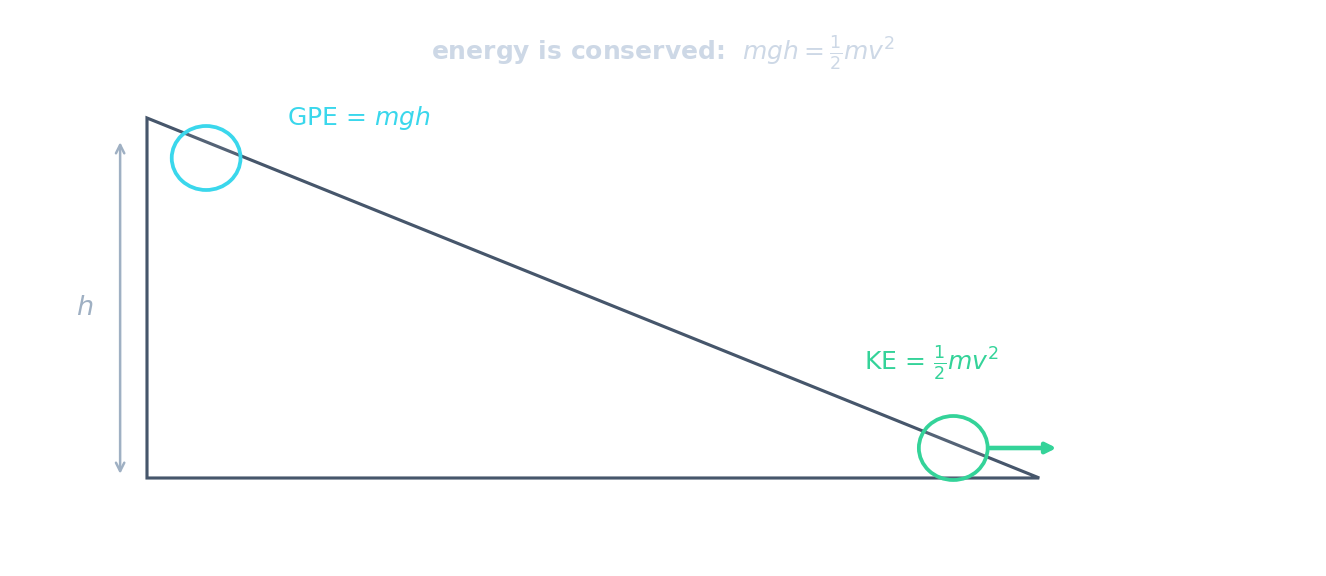
As a ball rolls down a frictionless ramp, its gravitational PE turns mainly into: · Ao rolar por um plano inclinado sem atrito, a GPE de uma bola converte-se principalmente em:
With no friction, all the lost GPE becomes kinetic energy: $mgh = \tfrac{1}{2}mv^{2}$. · Sem atrito, toda a GPE perdida torna-se energia cinética: $mgh = \tfrac{1}{2}mv^{2}$.
A 2.0 kg block slides from rest down a smooth ramp, dropping 1.5 m in height. What is its speed at the bottom, in m/s? (g = 9.81 m/s^2) · Um bloco de 2.0 kg desliza a partir do repouso por uma rampa lisa, caindo 1.5 m em altura. Qual é sua velocidade na parte inferior, em m/s? (g = 9.81 m/s^2)
mgh = mv^2/2, and the mass cancels: v = sqrt(2 x 9.81 x 1.5) = 5.4 m/s. Use the VERTICAL drop, never the distance along the ramp. · mgh = mv^2/2, e a massa se cancela: v = sqrt(2 x 9.81 x 1.5) = 5.4 m/s. Use a queda VERTICAL, nunca a distância ao longo da rampa.
In $mg\Delta h$ the height is the distance travelled along the slope. · Em $mg\Delta h$, a altura é a distância percorrida ao longo da rampa.
It is the VERTICAL height gained or lost. Using the slope distance always overestimates the energy change, by a factor of 1/sin(theta). · É a ALTURA VERTICAL ganha ou perdida. Usar a distância da rampa sempre superestima a mudança de energia, por um fator de 1/sen(theta).
Worked example: a ramp with friction
A $2.0\ \text{kg}$ trolley is released from rest at the top of a ramp $3.0\ \text{m}$ long that drops $1.5\ \text{m}$. It reaches the bottom at $4.0\ \dfrac{\text{m}}{\text{s}}$. Find the work done against friction and the average friction force.
- GPE lost: $mg\Delta h = 2.0 \times 9.81 \times 1.5 = 29\ \text{J}$.
- KE gained: $\tfrac{1}{2}mv^{2} = \tfrac{1}{2} \times 2.0 \times 4.0^{2} = 16\ \text{J}$.
- The difference is the work done against friction: $29 - 16 = 13\ \text{J}$.
- Friction force: work = force × distance along the ramp, so $F = \dfrac{13}{3.0} = 4.5\ \text{N}$.
- Check: without friction the speed would have been $\sqrt{2 \times 9.81 \times 1.5} = 5.4\ \dfrac{\text{m}}{\text{s}}$ — larger than $4.0$, as it must be.
Exemplo resolvido: uma rampa com atrito
Um carrinho de $2.0\ \text{kg}$ é solto do repouso no topo de uma rampa $3.0\ \text{m}$ de comprimento que desce $1.5\ \text{m}$. Ele atinge a base com $4.0\ \dfrac{\text{m}}{\text{s}}$. Encontre o trabalho realizado contra o atrito e a força de atrito média.
- EPg perdida: $mg\Delta h = 2.0 \times 9.81 \times 1.5 = 29\ \text{J}$.
- EC ganha: $\tfrac{1}{2}mv^{2} = \tfrac{1}{2} \times 2.0 \times 4.0^{2} = 16\ \text{J}$.
- A diferença é o trabalho realizado contra o atrito: $29 - 16 = 13\ \text{J}$.
- Força de atrito: trabalho = força × distância ao longo da rampa, logo $F = \dfrac{13}{3.0} = 4.5\ \text{N}$.
- Verificação: sem atrito a velocidade teria sido $\sqrt{2 \times 9.81 \times 1.5} = 5.4\ \dfrac{\text{m}}{\text{s}}$ — maior que $4.0$, como deve ser.
A trolley rolls down a rough ramp. Compared with a frictionless ramp, which statements are true? Select all that apply. · Um carrinho desce uma rampa com atrito. Comparado com uma rampa sem atrito, quais afirmações são verdadeiras? Selecione todas as que se aplicam.
The GPE lost is fixed by the height drop and is the same on both ramps. Friction takes some of it as thermal energy, so the KE at the bottom is smaller by exactly the work done against friction. · A GPE perdida é fixada pela queda de altura e é a mesma em ambas as rampas. O atrito leva parte dela como energia térmica, então a KE na base é menor exatamente pelo trabalho feito contra o atrito.
Energy and momentum 动量
- Combining $p = mv$ with $E_{\text{K}} = \tfrac{1}{2}mv^{2}$ gives $E_{\text{K}} = \dfrac{p^{2}}{2m}$.
- Handy when you know the momentum but not the speed.
Energia e momento 动量
- Combinar $p = mv$ com $E_{\text{K}} = \tfrac{1}{2}mv^{2}$ resulta em $E_{\text{K}} = \dfrac{p^{2}}{2m}$.
- Útil quando se conhece o momento, mas não a velocidade.
Kinetic energy written in terms of momentum $p$ is: · Energia cinética escrita em termos de momento $p$ é:
From $p = mv$ and · e $E_{\text{K}} = \tfrac{1}{2}mv^{2}$, substituting $v = p/m$ gives $E_{\text{K}} = \dfrac{p^{2}}{2m}$. · De $p = mv$ e $E_{\text{K}} = \tfrac{1}{2}mv^{2}$, substituindo $v = p/m$ resulta em $E_{\text{K}} = \dfrac{p^{2}}{2m}$.
Energy methods
- Write the energy at the start and end, then balance the books.
- Spring: a block's KE becomes elastic potential energy 弹性势能 $\tfrac{1}{2}kx^{2}$ at greatest compression 压缩.
- Bounce: the height ratio $\dfrac{h_2}{h_1}$ is the fraction of energy kept.
A stretched or compressed spring stores elastic PE ½kx², ready to become kinetic energy
Métodos energéticos
- Escreva a energia no início e no fim, depois equilibre as contas.
- Mola: a EC de um bloco torna-se energia potencial elástica 弹性势能 $\tfrac{1}{2}kx^{2}$ na compressão máxima 压缩.
- Quique: a razão de alturas $\dfrac{h_2}{h_1}$ é a fração de energia mantida.

Uma mola esticada ou comprimida armazena PE elástica ½kx², pronta para tornar-se energia cinética
A block slides into a spring on a frictionless surface. At greatest compression its kinetic energy has all become ____ potential energy. · Um bloco desliza sobre uma mola em uma superfície sem atrito. Na compressão máxima, sua energia cinética foi totalmente convertida em ____ energia potencial.
KE → elastic PE $= \tfrac{1}{2}kx^{2}$ at the point of greatest compression, then back to KE as the spring pushes it off. · KE → PE elástica $= \tfrac{1}{2}kx^{2}$ no ponto de compressão máxima, depois volta para KE quando a mola o empurra para fora.
When friction acts, some mechanical energy becomes thermal energy. · Quando o atrito atua, parte da energia mecânica torna-se energia térmica.
Yes — that "lost" energy is not destroyed; it heats the surfaces and surroundings. · Sim — essa energia "perdida" não é destruída; ela aquece as superfícies e o entorno.
Worked example: a block meets a spring
A block slides down a slope and hits a spring with $60\ \text{J}$ of kinetic energy. While the spring compresses to its maximum, the block's gravitational PE falls by a further $10\ \text{J}$. All the energy the block loses becomes elastic PE in the spring, whose constant is $k = 3500\ \dfrac{\text{N}}{\text{m}}$. Find the maximum compression and the force on the block there.
- Energy into the spring: $60 + 10 = 70\ \text{J}$ (the block loses both its KE and some GPE).
- Compression: $\tfrac{1}{2}kx^{2} = 70$, so $x^{2} = \dfrac{140}{3500} = 0.040$ and $x = 0.20\ \text{m}$.
- Force at maximum compression: $F = kx = 3500 \times 0.20 = 700\ \text{N}$.
- Check: on a force–compression graph the area under the line to $x = 0.20\ \text{m}$ is $\tfrac{1}{2} \times 700 \times 0.20 = 70\ \text{J}$ — the same energy, found the other way.
Exemplo resolvido: um bloco encontra uma mola
Um bloco desliza por uma rampa e bate em uma mola com $60\ \text{J}$ de energia cinética. Enquanto a mola comprime até seu máximo, a PE gravitacional do bloco cai mais $10\ \text{J}$. Toda a energia que o bloco perde torna-se PE elástica na mola, cuja constante é $k = 3500\ \dfrac{\text{N}}{\text{m}}$. Encontre a compressão máxima e a força sobre o bloco lá.
- Energia na mola: $60 + 10 = 70\ \text{J}$ (o bloco perde ambas sua EC e parte de sua EPg).
- Compressão: $\tfrac{1}{2}kx^{2} = 70$, logo $x^{2} = \dfrac{140}{3500} = 0.040$ e $x = 0.20\ \text{m}$.
- Força na compressão máxima: $F = kx = 3500 \times 0.20 = 700\ \text{N}$.
- Verificação: num gráfico de força vs. compressão, a área sob a linha até $x = 0.20\ \text{m}$ é $\tfrac{1}{2} \times 700 \times 0.20 = 70\ \text{J}$ — a mesma energia, encontrada de outra forma.
A block with $40\ \text{J}$ of kinetic energy hits a spring of constant $k = 2000\ \dfrac{\text{N}}{\text{m}}$ on a level surface. All its KE becomes elastic PE. What is the maximum compression, in m? · Um bloco com $40\ \text{J}$ de energia cinética atinge uma mola de constante $k = 2000\ \dfrac{\text{N}}{\text{m}}$ em uma superfície nivelada. Toda sua KE torna-se PE elástica. Qual é a compressão máxima, em m?
$\tfrac{1}{2}kx^{2} = 40$, so $x^{2} = \dfrac{80}{2000} = 0.040$ and · e $x = 0.20\ \text{m}$. · $\tfrac{1}{2}kx^{2} = 40$, logo $x^{2} = \dfrac{80}{2000} = 0.040$ e $x = 0.20\ \text{m}$.
You've got it
- gravitational PE $\Delta E_{\text{P}} = mg\Delta h$ (vertical height!); kinetic energy $E_{\text{K}} = \tfrac{1}{2}mv^{2}$
- on a frictionless ramp $mgh = \tfrac{1}{2}mv^{2}$, so $v = \sqrt{2gh}$; with friction the missing energy is the work done against it
- in momentum terms, $E_{\text{K}} = \dfrac{p^{2}}{2m}$; a spring stores $\tfrac{1}{2}kx^{2}$
Entendeu?
- EPg gravitacional $\Delta E_{\text{P}} = mg\Delta h$ (altura vertical!); energia cinética $E_{\text{K}} = \tfrac{1}{2}mv^{2}$
- numa rampa sem atrito $mgh = \tfrac{1}{2}mv^{2}$, logo $v = \sqrt{2gh}$; com atrito, a energia faltante é o trabalho realizado contra ele
- em termos de momento, $E_{\text{K}} = \dfrac{p^{2}}{2m}$; uma mola armazena $\tfrac{1}{2}kx^{2}$