Motion in two directions · Movimento em duas direções
| English | Português |
|---|---|
| vertical/ˈvɜːtɪkl/ | vertical |
| horizontal/ˌhɒrɪˈzɒntl/ | horizontal |
| parabola/pəˈræbələ/ | parábola |
| range/reɪndʒ/ | range |
| symmetric/sɪˈmetrɪk/ | simétrica |
| projectile/prəˈdʒektaɪl/ | projétil |
Drop one, throw one
- Drop a ball and throw another one sideways at the same instant.
- They hit the ground at the same time.
- The sideways motion does not change how fast it falls.
Solte um, lance outro
- Solte uma bola e lance outra horizontalmente ao mesmo instante.
- Elas acertam o solo ao mesmo tempo.
- O movimento lateral não altera a velocidade com que elas caem.
*Solte um, lance outro: elas compartilham toda a altura e aterrissam juntas — o movimento vertical é independente.
Two motions, side by side
- Horizontal 水平 and vertical 竖直 motion are independent.
- Treat each direction as its own SUVAT problem, linked only by the time $t$.
A high-speed train: its motion can be shown on a distance-time graph
Dois movimentos lado a lado
- Movimento horizontal 水平 e vertical 竖直 são independentes.
- Trate cada direção como seu próprio problema SUVAT, ligados apenas pelo tempo $t$.

Um trem de alta velocidade: seu movimento pode ser mostrado em um gráfico de distância-tempo
Launch a projectile · Lance um projétil
Fire the ball, then change the angle and speed. The horizontal motion is steady while gravity pulls it down — together they trace a parabola. Find the angle for the longest range, and try the Moon. · Dispare a bola, depois altere o ângulo e a velocidade. O movimento horizontal é constante enquanto a gravidade a puxa para baixo — juntos traçam uma parábola. Encontre o ângulo para o maior alcance, e tente a Lua.
A horizontal throw
- Horizontal: constant velocity $u_{\text{H}}$, so $x = u_{\text{H}}t$.
- Vertical: free fall from rest, so $y = \tfrac{1}{2}gt^{2}$.
- The time to land depends only on the height, not on $u_{\text{H}}$.
Displacement–time graph of a car on a test track
Um lançamento horizontal
- Horizontal: velocidade constante $u_{\text{H}}$, então $x = u_{\text{H}}t$.
- Vertical: queda livre do repouso, então $y = \tfrac{1}{2}gt^{2}$.
- O tempo para aterrissar depende apenas da altura, não de $u_{\text{H}}$.

Gráfico de deslocamento–tempo de um carro em uma pista de testes
A ball thrown horizontally and a ball dropped from the same height hit the ground at the same time (no air resistance). · Uma bola lançada horizontalmente e uma bola solta da mesma altura tocam o chão ao mesmo tempo (sem resistência do ar).
Yes — the vertical motion is the same free fall for both, and the horizontal speed does not change the fall time. · Sim — o movimento vertical é a mesma queda livre para ambas, e a velocidade horizontal não altera o tempo de queda.
Launched at an angle
- Split the launch velocity: horizontal $u\cos\theta$ (stays constant), vertical $u\sin\theta$.
- The vertical part slows, stops at the top, then grows downward — tracing a parabola 抛物线.
Lançado num ângulo
- Separe a velocidade de lançamento: horizontal $u\cos\theta$ (permanece constante), vertical $u\sin\theta$.
- A parte vertical desacelera, para no topo e depois cresce para baixo — traçando uma parábola 抛物线.

A projectile is launched at $20\ \dfrac{\text{m}}{\text{s}}$, $30^{\circ}$ above the horizontal. What is the vertical part of the launch velocity? · Um projétil é lançado a $20\ \dfrac{\text{m}}{\text{s}}$, $30^{\circ}$ acima da horizontal. Qual é a componente vertical da velocidade de lançamento?
Vertical part $= u\sin\theta = 20 \times \sin 30^{\circ} = 20 \times 0.5 = 10\ \dfrac{\text{m}}{\text{s}}$. · Componente vertical $= u\sin\theta = 20 \times \sin 30^{\circ} = 20 \times 0.5 = 10\ \dfrac{\text{m}}{\text{s}}$.
At the top and the range 射程
- At the highest point $v_{\text{V}} = 0$, but $v_{\text{H}} = u\cos\theta$ is unchanged.
- Time to the top $= \dfrac{u\sin\theta}{g}$; the flight is symmetric 对称, so total time is twice that.
Projectile 抛体 launched at angle $\theta$ — horizontal and vertical motions are independent
No topo e no alcance 射程
- No ponto mais alto $v_{\text{V}} = 0$, mas $v_{\text{H}} = u\cos\theta$ permanece inalterado.
- Tempo até o topo $= \dfrac{u\sin\theta}{g}$; o voo é simétrico 对称, então o tempo total é o dobro disso.
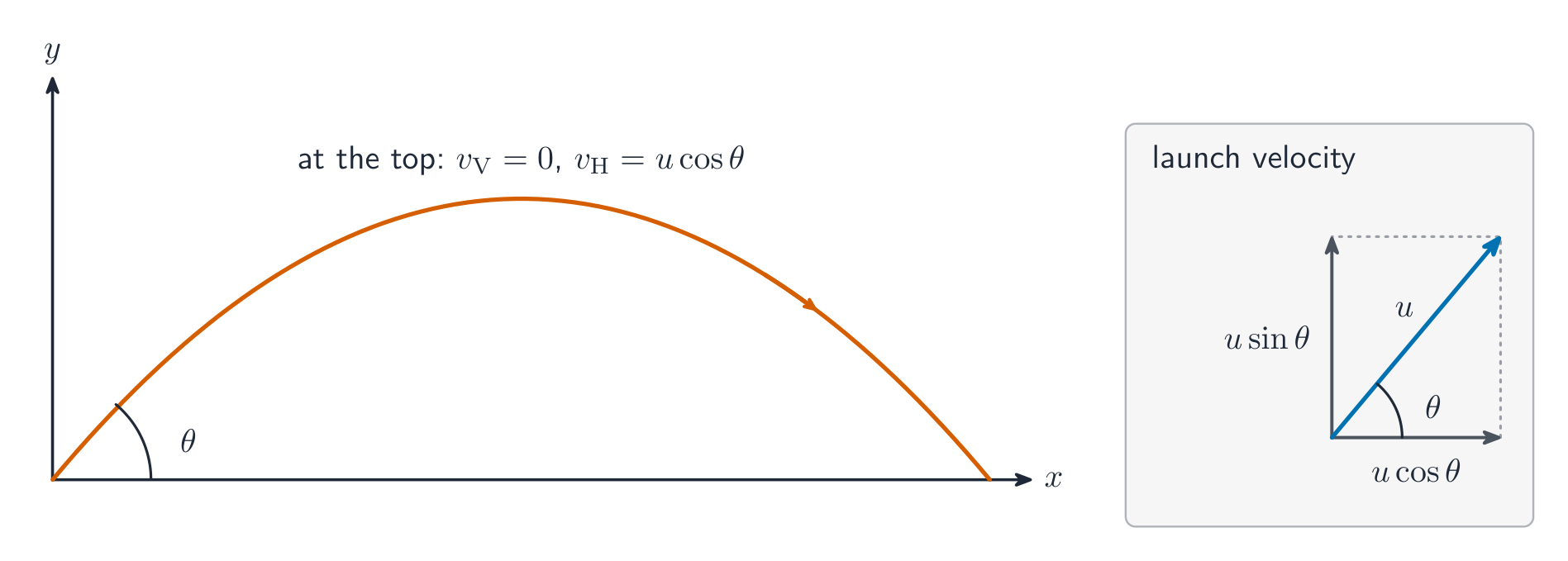
Projétil 抛体 lançado no ângulo $\theta$ — movimentos horizontal e vertical são independentes
Select all · todos the statements that are true for a projectile (ignore air). · Selecione todas as afirmações verdadeiras para um projétil (ignore o ar).
At the top only the vertical velocity is zero — the horizontal velocity $u\cos\theta$ carries on, so the ball keeps moving. Mass does not change free fall. · No topo apenas a velocidade vertical é zero — a velocidade horizontal $u\cos\theta$ continua, então a bola segue em movimento. A massa não altera a queda livre.
That projectile has a vertical launch velocity of $10\ \dfrac{\text{m}}{\text{s}}$. How long does it take to reach the top? (Use $g = 9.81\ \dfrac{\text{m}}{\text{s}^2}$.) · Aquela projétil tem uma velocidade de lançamento vertical de $10\ \dfrac{\text{m}}{\text{s}}$. Quanto tempo leva para atingir o topo? (Use $g = 9.81\ \dfrac{\text{m}}{\text{s}^2}$.)
Time to the top $= \dfrac{u\sin\theta}{g} = \dfrac{10}{9.81} \approx 1.0\ \text{s}$. · Tempo até o topo $= \dfrac{u\sin\theta}{g} = \dfrac{10}{9.81} \approx 1.0\ \text{s}$.
A bouncing ball
- Between bounces the velocity–time graph is a straight sloping line (constant $g$).
- Each bounce is a sudden jump: the velocity flips direction (and shrinks if energy is lost).
Uma bola quicando
- Entre os bates, o gráfico de velocidade–tempo é uma linha reta inclinada (aceleração constante $g$).
- Cada batida é um salto súbito: a velocidade inverte a direção (e diminui se houver perda de energia).
On the velocity–time graph of a bouncing ball, each bounce appears as: · No gráfico velocidade–tempo de uma bola quicando, cada quique aparece como:
At a bounce the velocity flips from downward to upward almost instantly — a sudden vertical jump on the graph (smaller if energy is lost). · Em um quiche a velocidade inverte de descendente para ascendente quase instantaneamente — um salto vertical súbito no gráfico (menor se houver perda de energia).
Two objects meeting
- Write a displacement equation for each, using the same start time and positive direction.
- They are level again when their displacements are equal — set $s_1 = s_2$ and solve.
Dois objetos se encontrando
- Escreva uma equação de deslocamento para cada um, usando o mesmo tempo inicial e direção positiva.
- Eles estão no mesmo nível novamente quando seus deslocamentos são iguais — defina $s_1 = s_2$ e resolva.
Two objects moving along the same line are level again when their ____ are equal. · Dois objetos movendo-se pela mesma linha estão nivelados novamente quando suas ____ são iguais.
Set the two displacement equations equal ($s_1 = s_2$) and solve for the time. · Igual as duas equações de deslocamento ($s_1 = s_2$) e resolva para o tempo.
Worked example: thrown off a cliff
- A ball is thrown horizontally at $15\ \text{m/s}$ from a cliff $20\ \text{m}$ high. Find the time to land and how far from the base it lands. Take $g = 9.81\ \text{m/s}^2$.
- Vertical, to get the time. The initial vertical velocity is zero, so $s = \tfrac{1}{2}gt^2$ gives $20 = \tfrac{1}{2}(9.81)t^2$ and $t = 2.02\ \text{s}$.
- Horizontal, to get the range. There is no horizontal acceleration, so $x = ut = 15 \times 2.02 = 30\ \text{m}$.
- The horizontal speed plays no part in finding the time. A ball dropped from the same cliff lands at exactly the same moment.
- Time is the only quantity the two motions share, and it is always the bridge between them.
Exemplo resolvido: lançado de um penhasco
- Uma bola é lançada horizontalmente a $15\ \text{m/s}$ de um penhasco de altura $20\ \text{m}$. Encontre o tempo para aterrissar e a distância do pé do penhasco. Adote $g = 9.81\ \text{m/s}^2$.
- Vertical, para obter o tempo. A velocidade vertical inicial é zero, então $s = \tfrac{1}{2}gt^2$ dá $20 = \tfrac{1}{2}(9.81)t^2$ e $t = 2.02\ \text{s}$.
- Horizontal, para obter o alcance. Não há aceleração horizontal, então $x = ut = 15 \times 2.02 = 30\ \text{m}$.
- A velocidade horizontal não tem nenhum papel ao encontrar o tempo. Uma bola solta do mesmo penhasco aterrissa exatamente no mesmo momento.
- O tempo é a única quantidade que os dois movimentos compartilham, e é sempre a ponte entre eles.
A ball is thrown horizontally at 15 m/s from a 20 m cliff. How long does it take to land, in seconds? (g = 9.81 m/s^2) · Uma bola é lançada horizontalmente a 15 m/s de um penhasco de 20 m. Quanto tempo leva para tocar o solo, em segundos? (g = 9.81 m/s^2)
Vertical only: 20 = 0.5 x 9.81 x t^2, so t = 2.02 s. The 15 m/s plays no part; a dropped ball lands at the same moment. · Verticalmente apenas: 20 = 0.5 x 9.81 x t^2, então t = 2.02 s. Os 15 m/s não têm influência; uma bola deixada cair aterrissa no mesmo instante.
That same ball, thrown horizontally at 15 m/s and landing after 2.02 s, lands how far from the base of the cliff, in metres? · Essa mesma bola, lançada horizontalmente a 15 m/s e que cai após 2.02 s, aterrissa a quantos metros da base do penhasco?
Horizontal has no acceleration, so x = ut = 15 x 2.02 = 30 m. Time is the bridge between the two directions. · A componente horizontal não tem aceleração, portanto x = ut = 15 x 2.02 = 30 m. O tempo é a ponte entre as duas direções.
Worked example: launched at an angle
- A ball leaves the ground at $18\ \text{m/s}$ at $60°$ to the horizontal. Show that it reaches its greatest height at $t = 1.6\ \text{s}$.
- Resolve first. Vertical: $u_y = 18\sin 60° = 15.6\ \text{m/s}$. Horizontal: $u_x = 18\cos 60° = 9.0\ \text{m/s}$.
- At the top the vertical velocity is zero, so $v = u + at$ gives $0 = 15.6 - 9.81t$ and $t = 1.59 \approx 1.6\ \text{s}$.
- The horizontal velocity is still $9.0\ \text{m/s}$ at the top. The speed there is $9.0\ \text{m/s}$, not zero.
- Total time of flight is twice this, $3.2\ \text{s}$, and the range is $u_x \times 3.2 = 29\ \text{m}$.
Exemplo resolvido: lançado num ângulo
- Uma bola sai do solo a $18\ \text{m/s}$ num $60°$ em relação à horizontal. Mostre que atinge sua maior altura em $t = 1.6\ \text{s}$.
- Resolva primeiro. Vertical: $u_y = 18\sin 60° = 15.6\ \text{m/s}$. Horizontal: $u_x = 18\cos 60° = 9.0\ \text{m/s}$.
- No topo a velocidade vertical é zero, então $v = u + at$ dá $0 = 15.6 - 9.81t$ e $t = 1.59 \approx 1.6\ \text{s}$.
- A velocidade horizontal ainda é $9.0\ \text{m/s}$ no topo. A rapidez lá é $9.0\ \text{m/s}$, não zero.
- O tempo total de voo é o dobro disso, $3.2\ \text{s}$, e o alcance é $u_x \times 3.2 = 29\ \text{m}$.
Put the method for a projectile launched at an angle in order. · Coloque em ordem o método para um projétil lançado em ângulo.
Time is the only quantity the two directions share, which is why it is always found from the vertical motion first. · O tempo é a única grandeza compartilhada pelas duas direções, razão pela qual é sempre encontrada primeiro pelo movimento vertical.
At the highest point of a projectile's flight, match each quantity to its value. · No ponto mais alto do voo de um projétil, combine cada grandeza com seu valor.
The speed at the top is the horizontal component, not zero. And the acceleration never pauses, not even for an instant at the top. · A velocidade no topo é a componente horizontal, não zero. E a aceleração nunca para, nem mesmo por um instante no topo.
Marks that slip away
- Resolve before you start. Every projectile question is two one-dimensional problems sharing a value of $t$.
- The horizontal velocity is constant and takes no part in the time calculation.
- At the highest point the vertical velocity is zero, not the speed. The horizontal component is unchanged.
- A ball thrown horizontally and a ball dropped from the same height land at the same time.
- Keep the sign convention for the whole flight. With up positive, $a = -9.81\ \text{m/s}^2$ on the way down too.
Marcas que escapam
- Resolva antes de começar. Toda questão de projétil são dois problemas unidimensionais compartilhando um valor de $t$.
- A velocidade horizontal é constante e não participa do cálculo do tempo.
- No ponto mais alto a velocidade vertical é zero, não a rapidez. A componente horizontal permanece inalterada.
- Uma bola lançada horizontalmente e uma bola solta da mesma altura aterrissam ao mesmo tempo.
- Mantenha a convenção de sinais para todo o voo. Com cima positivo, $a = -9.81\ \text{m/s}^2$ também se aplica na descida.
A ball thrown horizontally from a cliff lands later than a ball dropped from the same cliff at the same moment. · Uma bola lançada horizontalmente de um penhasco pousa mais tarde do que uma bola solta do mesmo penhasco no mesmo momento.
They land together. The vertical motion is identical, and the horizontal velocity has no effect on it, which is the whole point of treating the two directions separately. · Elas pousam juntas. O movimento vertical é idêntico, e a velocidade horizontal não tem efeito sobre ele, que é o ponto principal de tratar as duas direções separadamente.
You've got it
- horizontal and vertical motion are independent — share only the time $t$
- a horizontal throw lands in a time set only by its height
- resolve a launch: $u\cos\theta$ stays constant, $u\sin\theta$ behaves like a vertical throw
Entendeu?
- O movimento horizontal e vertical são independentes — compartilham apenas o tempo $t$
- Um lançamento horizontal cai em um tempo determinado apenas por sua altura
- Resolva um lançamento: $u\cos\theta$ permanece constante, $u\sin\theta$ comporta-se como um lançamento vertical