Errors and uncertainties · Erros e incertezas
| English | Português |
|---|---|
| uncertainty/ʌnˈsɜːtənti/ | incerteza |
| micrometer/maɪˈkrɒmɪtə/ | micrômetro |
| vernier calipers/ˈvɜːnɪə ˈkælɪpəz/ | paquímetro |
| systematic error/ˌsɪstəˈmætɪk ˈerə/ | erro sistemático |
| zero error/ˈzɪərəʊ ˈerə/ | erro de zero |
| calibration/ˌkælɪˈbreɪʃn/ | calibração |
| parallax/ˈpærəlæks/ | paralaxe |
| random error/ˈrændəm ˈerə/ | erro aleatório |
| precision/prɪˈsɪʒn/ | precisão |
| accuracy/ˈækjʊrəsi/ | exatidão |
| absolute uncertainty/ˈæbsəluːt ʌnˈsɜːtənti/ | incerteza absoluta |
| significant figures/sɪɡˈnɪfɪkənt ˈfɪɡəz/ | algarismos significativos |
How sure are you?
- Measure a wire twice and you might get $5.77\ \text{mm}$, then $5.79\ \text{mm}$.
- Neither is "wrong" — every measurement has some uncertainty 不确定度.
- Good physics means knowing how much you are unsure.
O quão seguro você está?
- Meça um fio duas vezes e pode obter $5.77\ \text{mm}$, depois $5.79\ \text{mm}$.
- Nenhuma das duas está "errada" — toda medição tem alguma incerteza 不确定度.
- Boa física significa saber quanto você tem dúvida.
Uncertainty lab · Laboratório de incerteza
Classify measurement problems by how they affect data. · Classifique problemas de medição pelo seu efeito nos dados.
Reading an instrument
- Every scale can only be read so finely.
- A micrometer 螺旋测微器 reads to $0.01\ \text{mm}$; vernier calipers 游标卡尺 to $0.1\ \text{mm}$.
- The smallest step the instrument shows sets a limit on your reading.
A vernier caliper measures length precisely, with a small uncertainty
Read the whole millimetres from the main scale, then add the tenths where the sliding scale lines up
Lendo um instrumento
- Toda escala só pode ser lida com tal finura.
- Um micrômetro 螺旋测微器 lê até $0.01\ \text{mm}$; paquímetro 游标卡尺 até $0.1\ \text{mm}$.
- O menor passo que o instrumento mostra estabelece um limite para sua leitura.

Um paquímetro mede comprimento com precisão, tendo pequena incerteza
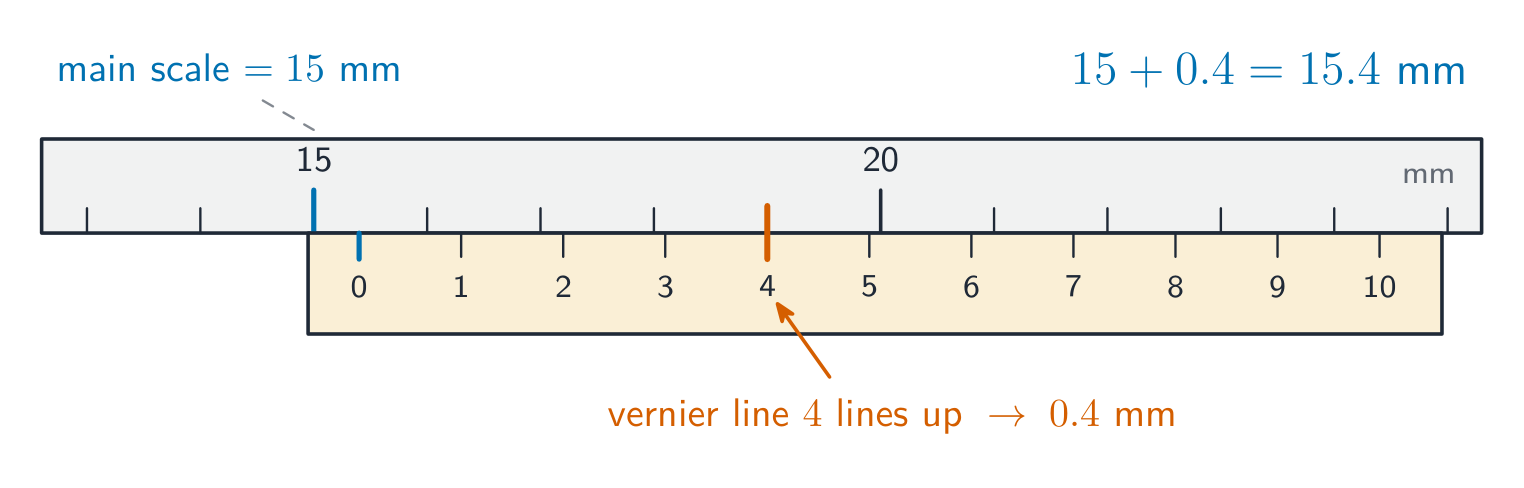
Leia os milímetros inteiros da escala principal, depois adicione os décimos onde as linhas da escala deslizante alinham
A careful enough measurement can be exactly correct, with zero uncertainty. · Uma medição cuidadosa pode ser exatamente correta, com incerteza zero.
No real measurement is exact — every reading has some uncertainty. The skill is estimating how big it is. · Nenhuma medição real é exata — toda leitura possui alguma incerteza. A habilidade está em estimar quão grande ela é.
Systematic errors 系统误差
- A systematic error shifts every reading by the same amount, the same way.
- Causes: a zero error 零点误差, a wrong calibration 校准, or parallax 视差 (reading from the side).
- Repeating the measurement does not remove it.
A micrometer screw gauge measures to the nearest 0.01 mm
Parallax: viewing a scale from an angle shifts the reading — a systematic error
Erros sistemáticos 系统误差
- Um erro sistemático desloca todas as leituras na mesma quantidade, da mesma forma.
- Causas: erro de zero 零点误差, calibração 校准 incorreta, ou paralaxe 视差 (leitura de lado).
- Repetir a medição não o remove.

Um paquímetro de micrômetro mede com precisão até 0.01 mm
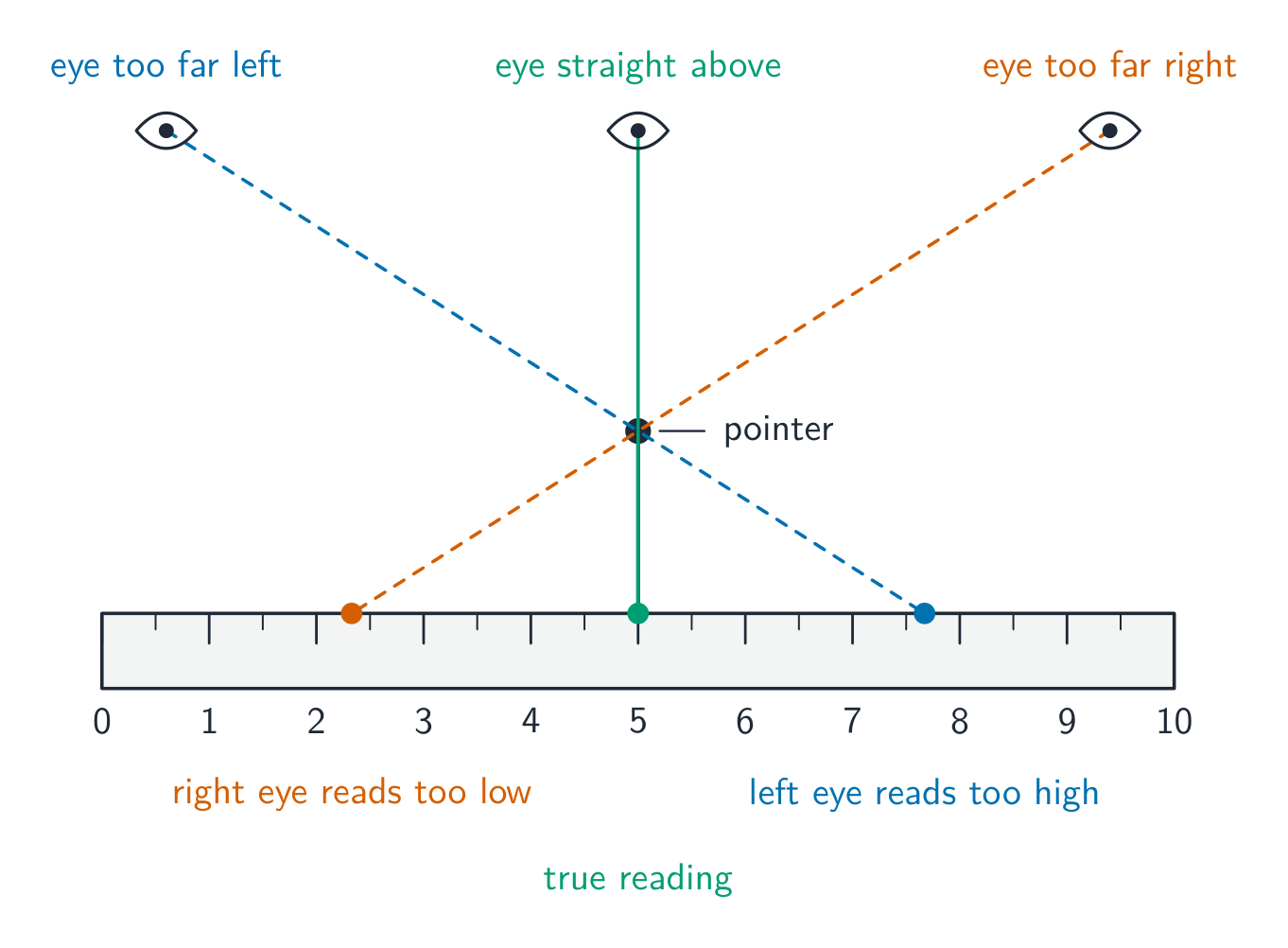
Paralaxe: observar uma escala de um ângulo desloca a leitura — um erro sistemático
Which of these is a systematic error? · Qual destes é um erro sistemático?
A zero error shifts every reading by the same amount in the same direction — that is systematic. The others vary randomly from reading to reading. · Um erro de zero desloca todas as leituras pela mesma quantidade na mesma direção — isso é sistemático. As outras variam aleatoriamente de leitura para leitura.
Random errors 随机误差
- A random error makes readings jump above and below, with no pattern.
- Repeat the measurement many times and take the mean — the scatter partly cancels.
Precision 精密度: how narrow the distribution is around the true value T
Erros aleatórios 随机误差
- Um erro aleatório faz as leituras oscilar acima e abaixo, sem padrão.
- Repita a medição muitas vezes e tire a média — a dispersão se cancela parcialmente.
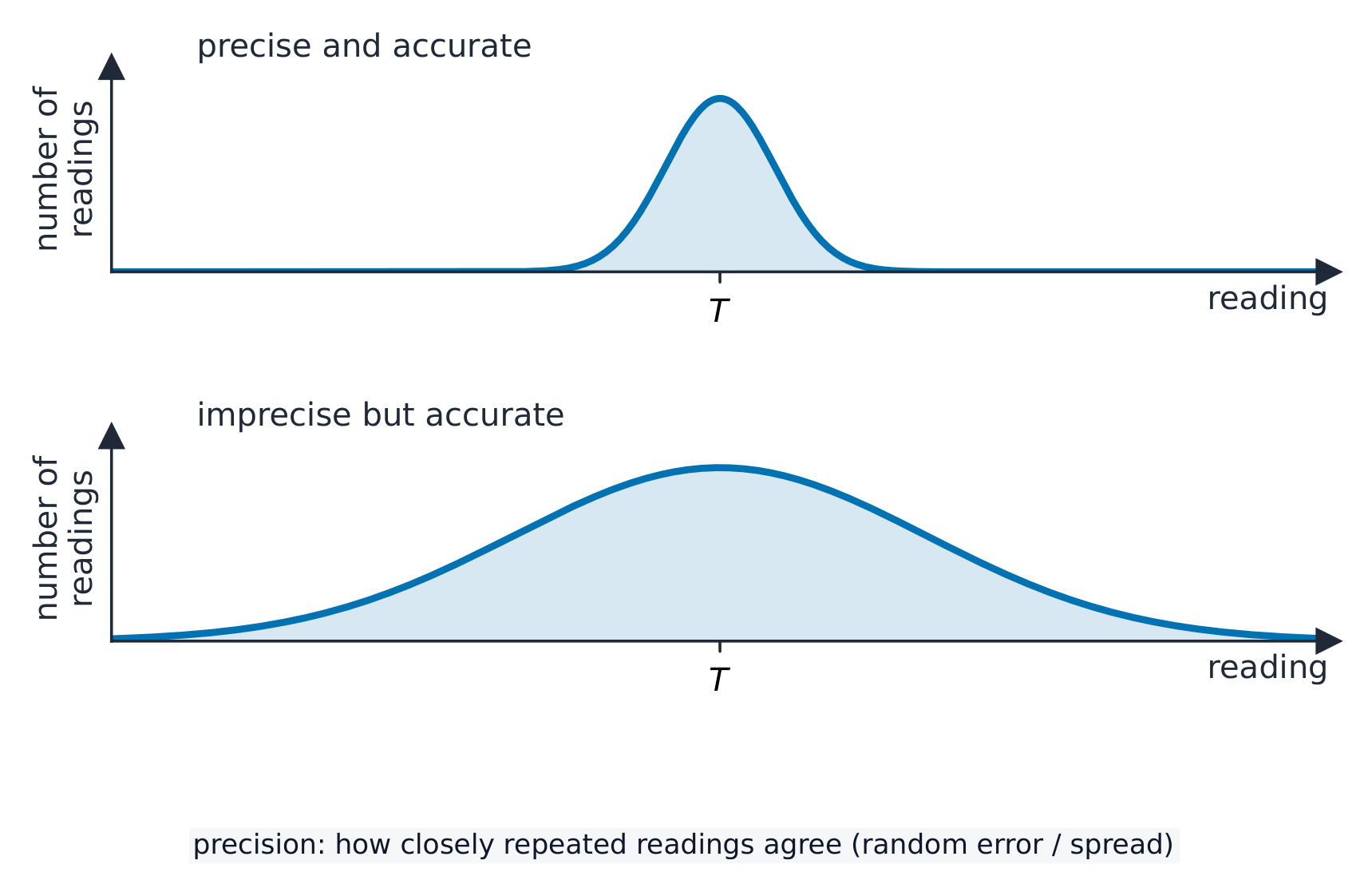
Precisão 精密度: quão estreita é a distribuição em torno do valor verdadeiro T
To reduce a random error, repeat the measurement and take the ____. · Para reduzir um erro aleatório, repita a medição e tire a ____.
Random errors scatter both ways, so the mean · média of many repeats partly cancels them. (A systematic error survives averaging.) · Erros aleatórios se dispersam em ambas as direções, então a média de muitas repetições as cancela parcialmente. (Um erro sistemático persiste após a média.)
Precision vs accuracy 准确度
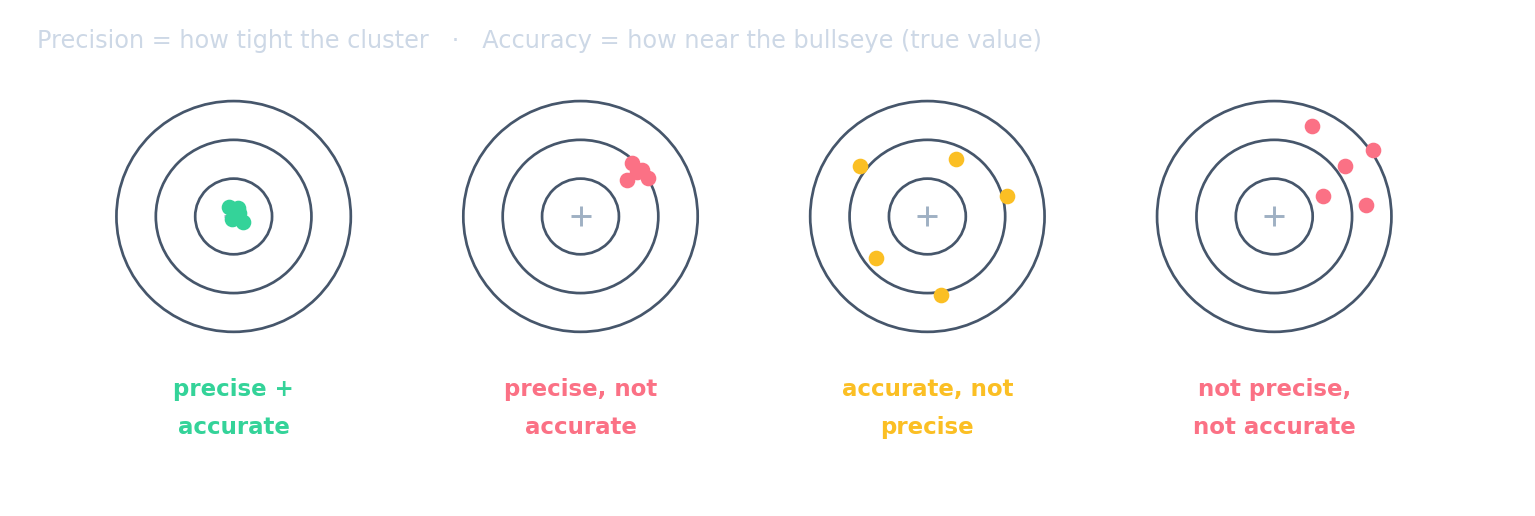
- Precision = how tightly repeated readings cluster.
- Accuracy = how close they are to the true value.
Precisão vs exatidão 准确度
- Precisão = quão apertados as leituras repetidas se agrupam.
- Exatidão = quão próximas elas estão do valor verdadeiro.
Match each term to the definition the examiner marks. · Combine cada termo com a definição que o avaliador marca.
Repeating fixes only the random half. A zero error makes readings precise and wrong, which is why the two words are not interchangeable. · Repetir corrige apenas a metade aleatória. Um erro de zero torna as leituras precisas e erradas, razão pela qual as duas palavras não são intercambiáveis.
Which error hurts which?
- A systematic error moves the whole cluster off-target → worse accuracy.
- A random error spreads the cluster out → worse precision.
Qual erro prejudica qual?
- Um erro sistemático move todo o grupo para longe do alvo → piora a exatidão.
- Um erro aleatório espalha o grupo → piora a precisão.
Match each pattern of repeated readings to its description. · Associe cada padrão de leituras repetidas à sua descrição.
Precision is how tight the cluster is; accuracy is how near the true value (the bullseye) it sits. · Precisão refere-se a quão apertado é o agrupamento; exatidão refere-se a quão perto do valor verdadeiro (o centro do alvo) ele está.
Writing an uncertainty
- We write a result as $x \pm \Delta x$, where $\Delta x$ is the absolute uncertainty 绝对不确定度.
- The percentage uncertainty is $\dfrac{\Delta x}{|x|} \times 100\%$.
Escrevendo uma incerteza
- Escrevemos um resultado como $x \pm \Delta x$, onde $\Delta x$ é a incerteza absoluta 绝对不确定度.
- A incerteza percentual é $\dfrac{\Delta x}{|x|} \times 100\%$.
A length is $(20.0 \pm 0.5)\ \text{cm}$. What is its percentage uncertainty? · Um comprimento é $(20.0 \pm 0.5)\ \text{cm}$. Qual é a sua incerteza percentual?
$\dfrac{\Delta x}{|x|} \times 100\% = \dfrac{0.5}{20.0} \times 100\% = 2.5\%$.
Combining: add or subtract
- If $y = a + b$ or $y = a - b$, add the absolute uncertainties.
- $\Delta y = \Delta a + \Delta b$.
Combinando: somar ou subtrair
- Se $y = a + b$ ou $y = a - b$, some as incertezas absolutas.
- $\Delta y = \Delta a + \Delta b$.
Combining: multiply or divide
- If $y = \dfrac{a \cdot b}{c}$, add the percentage uncertainties.
- $\dfrac{\Delta y}{|y|} = \dfrac{\Delta a}{|a|} + \dfrac{\Delta b}{|b|} + \dfrac{\Delta c}{|c|}$.
Combinando: multiplicar ou dividir
- Se $y = \dfrac{a \cdot b}{c}$, some as incertezas percentuais.
- $\dfrac{\Delta y}{|y|} = \dfrac{\Delta a}{|a|} + \dfrac{\Delta b}{|b|} + \dfrac{\Delta c}{|c|}$.
For · A favor $y = \dfrac{a \cdot b}{c}$, how do you combine the uncertainties? · Para $y = \dfrac{a \cdot b}{c}$, como você combina as incertezas?
For multiplying and dividing, add the percentage uncertainties: $\dfrac{\Delta y}{|y|} = \dfrac{\Delta a}{|a|} + \dfrac{\Delta b}{|b|} + \dfrac{\Delta c}{|c|}$. · Para multiplicação e divisão, some as incertezas percentuais: $\dfrac{\Delta y}{|y|} = \dfrac{\Delta a}{|a|} + \dfrac{\Delta b}{|b|} + \dfrac{\Delta c}{|c|}$.
Which rules for combining uncertainties are correct? Select all · todos that apply. · Quais regras para combinar incertezas estão corretas? Selecione todas as que se aplicam.
Uncertainties never cancel. Subtracting two similar values keeps the sum of their uncertainties over a much smaller result, which is why such a difference is so imprecise. · Incertezas nunca se cancelam. Subtrair dois valores semelhantes mantém a soma de suas incertezas sobre um resultado muito menor, razão pela qual tal diferença é tão imprecisa.
Combining: powers
- If $y = a^{n}$, multiply the percentage uncertainty by the power.
- $\dfrac{\Delta y}{|y|} = |n| \cdot \dfrac{\Delta a}{|a|}$.
Combinando: potências
- Se $y = a^{n}$, multiplique a incerteza percentual pela potência.
- $\dfrac{\Delta y}{|y|} = |n| \cdot \dfrac{\Delta a}{|a|}$.
A radius is measured with a $0.4\%$ uncertainty. A circle's area is $A = \pi r^{2}$. What is the percentage uncertainty in $A$? · Um raio é medido com uma incerteza de $0.4\%$. A área de um círculo é $A = \pi r^{2}$. Qual é a incerteza percentual em $A$?
For a power, multiply by the power: $A \propto r^{2}$, so the % uncertainty is $2 \times 0.4\% = 0.8\%$. · Para uma potência, multiplique pela potência: $A \propto r^{2}$, logo a % de incerteza é $2 \times 0.4\% = 0.8\%$.
A period T is measured with a 2.0% uncertainty. What is the percentage uncertainty in T squared? · Um período T é medido com uma incerteza relativa de 2.0%. Qual é a incerteza percentual em T ao quadrado?
Squaring doubles the percentage uncertainty; a square root halves it. Quoting 2.0% for T^2 is one of the commonest errors in this topic. · Elevar ao quadrado dobra a incerteza percentual; uma raiz quadrada a reduz pela metade. Informar 2.0% para T^2 é um dos erros mais comuns neste tópico.
Worked example: volume of a ball
- Diameter $d = (5.26 \pm 0.02)\ \text{cm}$, and volume $V \propto d^{3}$.
- % uncertainty in $d$: $\dfrac{0.02}{5.26} \times 100\% \approx 0.38\%$.
- Power rule: % uncertainty in $V = 3 \times 0.38\% \approx 1.1\%$.
- So $V = (76.2 \pm 0.9)\ \text{cm}^{3}$.
Exemplo resolvido: volume de uma esfera
- Diâmetro $d = (5.26 \pm 0.02)\ \text{cm}$, e volume $V \propto d^{3}$.
- % incerteza em $d$: $\dfrac{0.02}{5.26} \times 100\% \approx 0.38\%$.
- Regra da potência: % incerteza em $V = 3 \times 0.38\% \approx 1.1\%$.
- Então $V = (76.2 \pm 0.9)\ \text{cm}^{3}$.
Significant figures 有效数字
- Give an answer the same significant figures as the least precise measurement.
- Usually 2 or 3 in this course — too many makes it look more exact than it is.
Algarismos significativos 有效数字
- Dê uma resposta com as mesmas algarismos significativos da medida menos precisa.
- Geralmente 2 ou 3 neste curso — muitos demais parecem mais exatos do que são.
You've got it
- systematic error → shifts every reading (worse accuracy); random → scatter (worse precision)
- repeat and take the mean to beat random error
- combine uncertainties: add absolute for $+\,-$, add % for $\times\,\div$, × the power for $a^{n}$
Entendeu?
- erro sistemático → desloca cada leitura (piora exatidão); aleatório → dispersão (piora precisão)
- repita e tire a média para vencer o erro aleatório
- combine incertezas: some absolutas para $+\,-$, some % para $\times\,\div$, × a potência para $a^{n}$