Permutations and combinations · Permutações e combinações
| English | Português |
|---|---|
| permutation/ˌpɜːmjuːˈteɪʃn/ | permutação |
| combination/ˌkɒmbɪˈneɪʃn/ | combinação |
| factorial/fækˈtɔːrɪəl/ | fatorial |
| multiplication principle/ˌmʌltɪplɪˈkeɪʃn ˈprɪnsɪpl/ | princípio multiplicativo |
How many ways to arrange a bookshelf?
- You have 10 books and want to choose 3 to display. How many ways? If order matters, it's a permutation 排列. If you just want any 3, it's a combination 组合.
- Counting techniques are the foundation of probability — and they appear everywhere, from lottery odds to password security.
De quantas maneiras organizar uma estante?
- Você tem 10 livros e quer escolher 3 para exibir. De quantas maneiras? Se a ordem importa, é uma permutação 排列. Se você quiser apenas quaisquer 3, é uma combinação 组合.
- Técnicas de contagem são a base da probabilidade — e aparecem em toda parte, desde odds da loteria até segurança de senhas.
Permutation or combination lab · Laboratório de permutação ou combinação
Choose whether order matters in a counting problem. · Escolha se a ordem importa em um problema de contagem.
Permutations (order matters)
- A permutation is an arrangement where order matters: ${}^nP_r = \dfrac{n!}{(n-r)!}$.
- Example: arranging 3 books from 10: ${}^{10}P_3 = \dfrac{10!}{7!} = 10 \times 9 \times 8 = 720$.
Worked example. How many 3-letter codes can be made from 26 letters (no repeats)? ${}^{26}P_3 = 26 \times 25 \times 24 = 15\,600$.
Permutations: 3 books arrange in 3 × 2 × 1 = 6 different orders
Permutações (a ordem importa)
- Uma permutação é um arranjo onde a ordem importa: ${}^nP_r = \dfrac{n!}{(n-r)!}$.
- Exemplo: organizando 3 livros de 10: ${}^{10}P_3 = \dfrac{10!}{7!} = 10 \times 9 \times 8 = 720$.
Exemplo resolvido. Quantos códigos de 3 letras podem ser feitos de 26 letras (sem repetições)? ${}^{26}P_3 = 26 \times 25 \times 24 = 15\,600$.
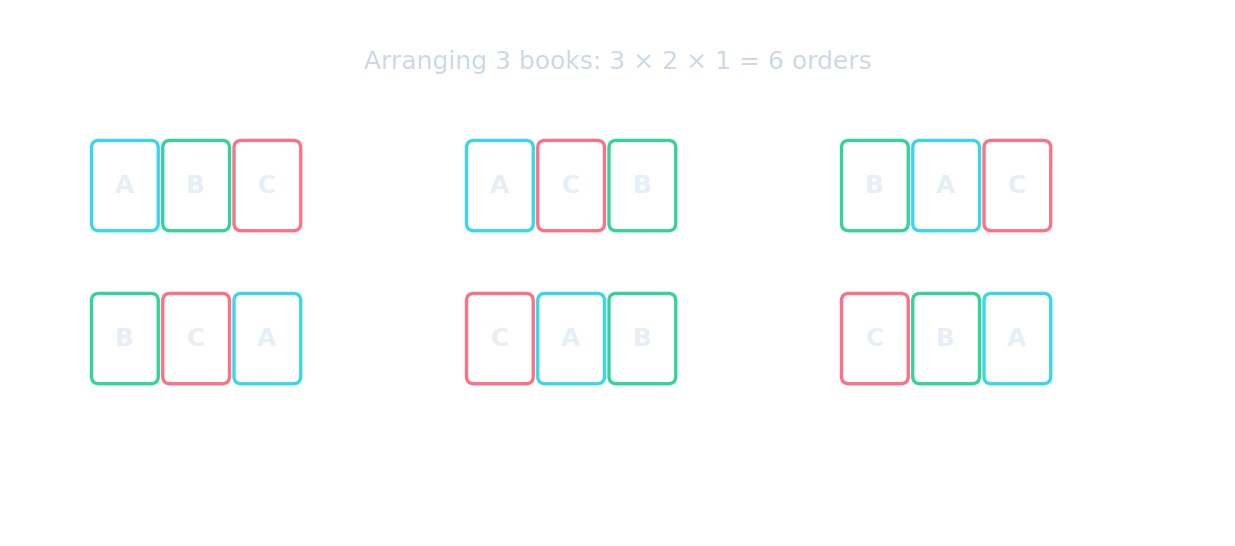
Permutações: 3 livros se organizam em 3 × 2 × 1 = 6 ordens diferentes
In a combination, the order of the chosen items: · Em uma combinação, a ordem dos itens escolhidos:
Combinations ignore order; permutations count order. · Combinações ignoram a ordem; permutações contam a ordem.
How many ways to arrange 3 books from 10 on a shelf (¹⁰P₃)? · De quantas maneiras dispor 3 livros de 10 em uma prateleira (¹⁰P₃)?
¹⁰P₃ = 10!/(10-3)! = 10!/7! = 10 × 9 × 8 = 720.
Combinations (order doesn't matter)
- A combination is a selection where order doesn't matter: ${}^nC_r = \dbinom{n}{r} = \dfrac{n!}{r!\,(n-r)!}$.
- Example: choosing 3 books from 10: ${}^{10}C_3 = \dfrac{10!}{3!\,7!} = \dfrac{720}{6} = 120$.
Permutation vs combination. Choosing a committee of 3 from 10 people is a combination (order doesn't matter). Choosing a president, vice-president, and secretary from 10 is a permutation (order matters — the roles are different).
Order matters for a permutation, but not for a combination
Combinações (a ordem não importa)
- Uma combinação é uma seleção onde a ordem não importa: ${}^nC_r = \dbinom{n}{r} = \dfrac{n!}{r!\,(n-r)!}$.
- Exemplo: escolhendo 3 livros de 10: ${}^{10}C_3 = \dfrac{10!}{3!\,7!} = \dfrac{720}{6} = 120$.
Permutação vs combinação. Escolher um comitê de 3 de 10 pessoas é uma combinação (a ordem não importa). Escolher um presidente, vice-presidente e secretário de 10 é uma permutação (a ordem importa — os papéis são diferentes).

A ordem importa para uma permutação, mas não para uma combinação
How many ways are there to choose 2 from 5 (⁵C₂)? · De quantas maneiras é possível escolher 2 de 5 (⁵C₂)?
⁵C₂ = 5!/(2!3!) = 120/(2×6) = 10.
⁵P₃ is greater than ⁵C₃. · ⁵P₃ é maior que ⁵C₃.
⁵P₃ = 60 (order matters), ⁵C₃ = 10 (order doesn't). Permutations always ≥ combinations. · ⁵P₃ = 60 (a ordem importa), ⁵C₃ = 10 (a ordem não importa). Permutações sempre ≥ combinações.
Arrangements with repeats
- To arrange a word with repeated letters, divide by the factorial 阶乘 of each repeat count.
- Example: NEEDLESS has 8 letters with 3 E's and 2 S's: arrangements $= \dfrac{8!}{3!\,2!} = \dfrac{40320}{12} = 3360$.
Arranjos com repetições
- Para organizar uma palavra com letras repetidas, divida pelo fatorial 阶乘 de cada contagem de repetição.
- Exemplo: NEEDLESS tem 8 letras com 3 E's e 2 S's: arranjos $= \dfrac{8!}{3!\,2!} = \dfrac{40320}{12} = 3360$.
How many arrangements of the letters of NEEDLESS? (8 letters: E×3, S×2 → 8!/(3!2!)) · Quantas disposições das letras de NEEDLESS? (8 letras: E×3, S×2 → 8!/(3!2!))
8!/(3!2!) = 40320/(6×2) = 40320/12 = 3360.
The multiplication principle 乘法原理
- If one choice can be made in $m$ ways and another in $n$ ways, both together can be made in $m \times n$ ways.
- Example: 3 shirts and 4 trousers → $3 \times 4 = 12$ outfits.
O princípio da multiplicação 乘法原理
- Se uma escolha pode ser feita de $m$ maneiras e outra de $n$ maneiras, ambas juntas podem ser feitas de $m \times n$ maneiras.
- Exemplo: 3 camisas e 4 calças → $3 \times 4 = 12$ conjuntos.
You have 3 shirts and 4 trousers. How many outfits can you make? · Você tem 3 camisas e 4 calças. Quantos conjuntos você pode montar?
3 × 4 = 12 outfits (multiplication principle). · 3 × 4 = 12 conjuntos (princípio multiplicativo).
You've got it
- permutation (order matters): ${}^nP_r = \dfrac{n!}{(n-r)!}$
- combination (order doesn't): ${}^nC_r = \dfrac{n!}{r!(n-r)!}$
- repeated letters: divide $n!$ by each repeat's factorial (NEEDLESS → $\dfrac{8!}{3!\,2!}$)
Entendeu?
- permutação (a ordem importa): ${}^nP_r = \dfrac{n!}{(n-r)!}$
- combinação (a ordem não importa): ${}^nC_r = \dfrac{n!}{r!(n-r)!}$
- letras repetidas: divida $n!$ pelo fatorial de cada repetição (NEEDLESS → $\dfrac{8!}{3!\,2!}$)