Vectors · Vetores
| English | Português |
|---|---|
| vector/ˈvektə/ | vetor |
| magnitude/ˈmæɡnɪtjuːd/ | magnitude |
| unit vector/ˈjuːnɪt ˈvektə/ | vetor unitário |
| parallel/ˈpærəlel/ | paralelo |
| intersect/ˌɪntəˈsekt/ | intersecção |
| skew/skjuː/ | assimetria |
| perpendicular/ˌpɜːpənˈdɪkjʊlə/ | perpendiculares |
| scalar product/ˈskeɪlə ˈprɒdʌkt/ | produto escalar |
Navigating in 3D
- GPS satellites track your position in three dimensions. Aircraft navigate using heading, pitch, and roll.
- Vectors 向量 are the mathematics of direction and magnitude 模长 in space — essential for physics, engineering, and computer graphics.
Navegando em 3D
- Satélites GPS rastreiam sua posição em três dimensões. Aeronaves navegam usando rumo, inclinação e rolagem.
- Vetores 向量 são a matemática da direção e magnitude 模长 no espaço — essenciais para física, engenharia e computação gráfica.
Vectors in 3D
- A vector has size and direction: $\mathbf{v} = x\mathbf{i} + y\mathbf{j} + z\mathbf{k}$.
- Magnitude $|\mathbf{v}| = \sqrt{x^2 + y^2 + z^2}$; a unit vector 单位向量 has magnitude 1.
Worked example. $\mathbf{v} = 3\mathbf{i} + 4\mathbf{j}$. Magnitude $= \sqrt{9 + 16} = 5$. Unit vector $= \dfrac{1}{5}(3\mathbf{i} + 4\mathbf{j})$.
Forces like wind and water are vectors, with size and direction
Vetores em 3D
- Um vetor tem tamanho e direção: $\mathbf{v} = x\mathbf{i} + y\mathbf{j} + z\mathbf{k}$.
- Magnitude $|\mathbf{v}| = \sqrt{x^2 + y^2 + z^2}$; um vetor unitário 单位向量 tem magnitude 1.
Exemplo resolvido. $\mathbf{v} = 3\mathbf{i} + 4\mathbf{j}$. Magnitude $= \sqrt{9 + 16} = 5$. Vetor unitário $= \dfrac{1}{5}(3\mathbf{i} + 4\mathbf{j})$.

Forças como vento e água são vetores, com tamanho e direção
What is the magnitude of the vector i + 2j + 2k? · Qual é a magnitude do vetor i + 2j + 2k?
|v| = √(1² + 2² + 2²) = √(1+4+4) = √9 = 3.
Vector equations of lines
- A line through point $\mathbf{a}$ in direction $\mathbf{b}$: $\mathbf{r} = \mathbf{a} + t\mathbf{b}$.
- Lines may be parallel 平行 (same direction), intersect 相交 (share a point), or be skew 异面 (neither).
Skew lines don't intersect and aren't parallel. In 3D, two lines can miss each other entirely — they're not in the same plane. This is impossible in 2D.
Equações vetoriais de retas
- Uma reta pelo ponto $\mathbf{a}$ na direção $\mathbf{b}$: $\mathbf{r} = \mathbf{a} + t\mathbf{b}$.
- Retas podem ser paralelas 平行 (mesma direção), se intersectarem 相交 (compartilham um ponto) ou serem reais 异面 (nenhuma das anteriores).
Retas reais não se intersectam nem são paralelas. Em 3D, duas retas podem passar totalmente sem se encontrar — elas não estão no mesmo plano. Isso é impossível em 2D.
The scalar product · O produto escalar
a · b = |a||b|cos θ
The · A dot product measures how much two vectors point the same way — it's zero when they're perpendicular. · O produto ponto mede o quanto dois vetores apontam na mesma direção — é zero quando são perpendiculares.
The vector equation of a line through point a in direction b is: · A equação vetorial de uma reta que passa pelo ponto a na direção b é:
r = a + tb, where t is a scalar parameter. · r = a + tb, onde t é um parâmetro escalar.
In 3D, two lines that don't intersect must be parallel. · Em 3D, duas retas que não se intersectam devem ser paralelas.
In 3D, lines can be skew — neither parallel nor intersecting. This is impossible in 2D. · Em 3D, retas podem ser reversas — nem paralelas nem concorrentes. Isso é impossível em 2D.
The scalar (dot) product
- So $\mathbf{a}\cdot\mathbf{b} = 0$ means the vectors are perpendicular 垂直.
- Use it to find the angle between two vectors: $\cos\theta = \dfrac{\mathbf{a}\cdot\mathbf{b}}{|\mathbf{a}||\mathbf{b}|}$.
The scalar product 数量积 gives the angle: a·b = |a||b|cos θ, so cos θ = (a·b)/(|a||b|).
O produto escalar (ponto)
- Então $\mathbf{a}\cdot\mathbf{b} = 0$ significa que os vetores são perpendiculares 垂直.
- Use-o para encontrar o ângulo entre dois vetores: $\cos\theta = \dfrac{\mathbf{a}\cdot\mathbf{b}}{|\mathbf{a}||\mathbf{b}|}$.
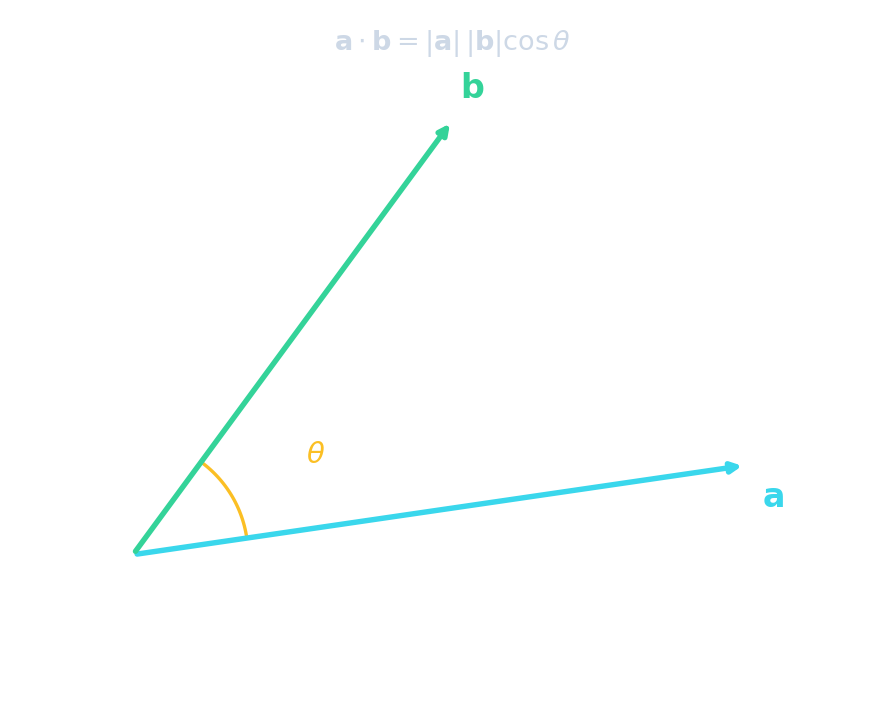
O produto escalar 数量积 dá o ângulo: a·b = |a||b|cos θ, logo cos θ = (a·b)/(|a||b|).
Find the scalar product (i + 2j + 2k)·(2i + 2j + k). · Encontre o produto escalar (i + 2j + 2k)·(2i + 2j + k).
(1)(2) + (2)(2) + (2)(1) = 2 + 4 + 2 = 8.
If a·b = 0, the two vectors are perpendicular. · Se a·b = 0, os dois vetores são perpendiculares.
cos θ = 0 gives θ = 90°, so a zero dot product means the vectors are perpendicular. · cos θ = 0 resulta em θ = 90°, logo um produto ponto zero significa que os vetores são perpendiculares.
If a·b = 6, |a| = 3, |b| = 4, what is cos θ? · Se a·b = 6, |a| = 3, |b| = 4, qual é cos θ?
cos θ = (a·b)/(|a||b|) = 6/(3×4) = 6/12 = 0.5.
Worked example — angle between vectors
- $\mathbf{a} = \mathbf{i} + 2\mathbf{j} + 2\mathbf{k}$, $\mathbf{b} = 2\mathbf{i} + \mathbf{j} - 2\mathbf{k}$.
- $\mathbf{a}\cdot\mathbf{b} = 2 + 2 - 4 = 0$. So $\mathbf{a}$ and $\mathbf{b}$ are perpendicular ($\theta = 90^{\circ}$).
allow_no_figure: Vectors are inherently 3D and difficult to represent clearly in a 2D static diagram — the algebraic notation and worked examples convey the concepts effectively.
- Use position vectors and displacement vectors, and unit vectors; the ratio theorem divides a line in a given ratio.
Exemplo resolvido — ângulo entre vetores
- $\mathbf{a} = \mathbf{i} + 2\mathbf{j} + 2\mathbf{k}$, $\mathbf{b} = 2\mathbf{i} + \mathbf{j} - 2\mathbf{k}$.
- $\mathbf{a}\cdot\mathbf{b} = 2 + 2 - 4 = 0$. Então $\mathbf{a}$ e $\mathbf{b}$ são perpendiculares ($\theta = 90^{\circ}$).
allow_no_figure: Vetores são inerentemente 3D e difíceis de representar claramente em um diagrama estático 2D — a notação algébrica e exemplos resolvidos transmitem os conceitos eficazmente.
- Use vetores de posição e vetores de deslocamento, e vetores unitários; o teorema da razão divide uma linha em uma dada proporção.
You've got it
- magnitude $|\mathbf{v}| = \sqrt{x^2+y^2+z^2}$; line: $\mathbf{r} = \mathbf{a} + t\mathbf{b}$
- scalar product $\mathbf{a}\cdot\mathbf{b} = a_1b_1 + a_2b_2 + a_3b_3 = |\mathbf a||\mathbf b|\cos\theta$
- $\mathbf{a}\cdot\mathbf{b} = 0$ → perpendicular
Entendeu?
- magnitude $|\mathbf{v}| = \sqrt{x^2+y^2+z^2}$; linha: $\mathbf{r} = \mathbf{a} + t\mathbf{b}$
- produto escalar $\mathbf{a}\cdot\mathbf{b} = a_1b_1 + a_2b_2 + a_3b_3 = |\mathbf a||\mathbf b|\cos\theta$
- $\mathbf{a}\cdot\mathbf{b} = 0$ → perpendicular