Algebra (modulus and polynomials) · Álgebra (módulo e polinômios)
| English | Português |
|---|---|
| modulus/ˈmɒdjʊləs/ | módulo |
| remainder theorem/rɪˈmeɪndə ˈθɪərəm/ | teorema do resto |
| polynomial/ˌpɒlɪˈnəʊmɪəl/ | polinomial |
| degree/dɪˈɡriː/ | grau |
| factor theorem/ˈfæktə ˈθɪərəm/ | teorema do fator |
The absolute value that saves bridges
- Engineers designing suspension cables need to know the maximum deviation from the ideal — whether above or below.
- The modulus 绝对值 (absolute value) measures distance from zero, ignoring direction. It appears everywhere: error bounds, tolerances, and inequalities.
O módulo que salva pontes
- Engenheiros que desenham cabos suspensos precisam saber o desvio máximo da ideal — seja acima ou abaixo.
- O módulo 绝对值 (valor absoluto) mede a distância de zero, ignorando a direção. Aparece em tudo: limites de erro, tolerâncias e desigualdades.
The modulus function
- The modulus $|x|$ is the size of a number, sign removed ($|x| \geq 0$). Its graph is a "V".
- Useful rules:
- $|a| = |b| \Leftrightarrow a^2 = b^2$,
- $|x - a| < b \Leftrightarrow a - b < x < a + b$.
The modulus function $y = |x - 2|$ creates a V-shape: everything below the axis is reflected above it.
Worked example. Solve $|2x - 3| = 7$. Either $2x - 3 = 7 \Rightarrow x = 5$, or $2x - 3 = -7 \Rightarrow x = -2$. Solutions: $x = 5$ or $x = -2$.
A função módulo
- O módulo $|x|$ é o tamanho de um número, sem sinal ($|x| \geq 0$). Seu gráfico é um "V".
- Regras úteis:
- $|a| = |b| \Leftrightarrow a^2 = b^2$,
- $|x - a| < b \Leftrightarrow a - b < x < a + b$.
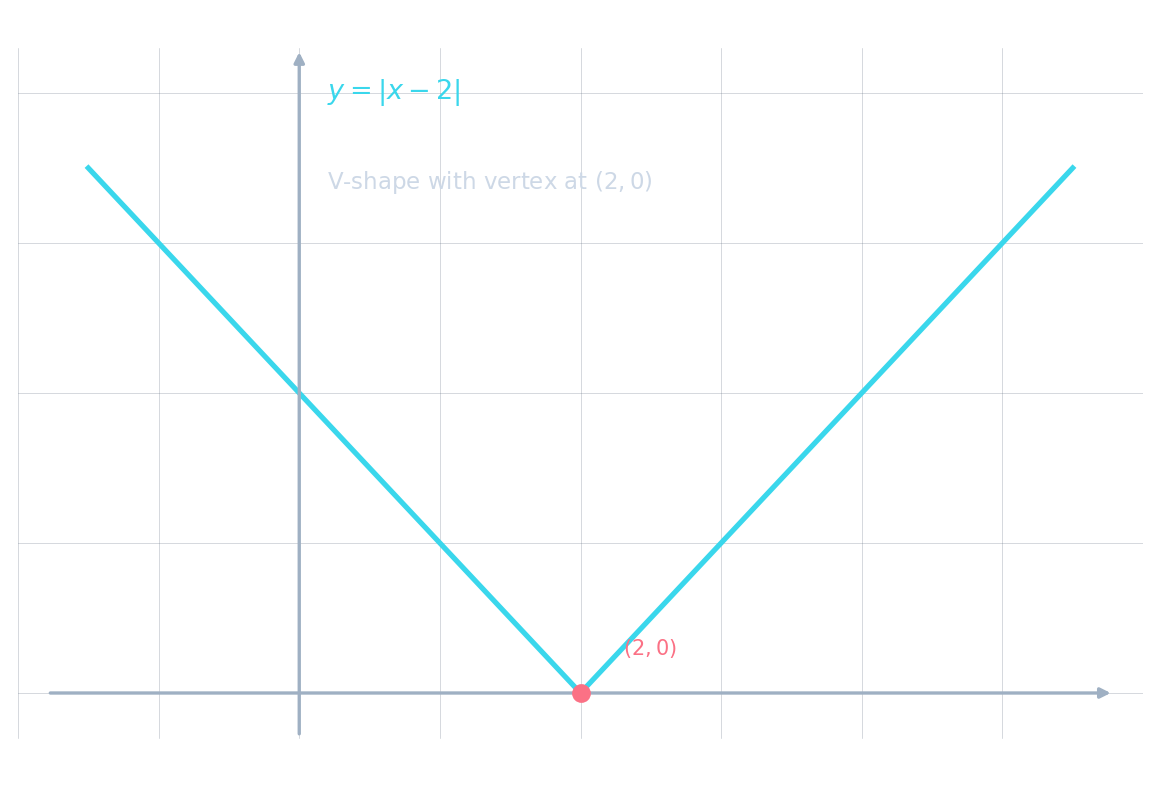
A função módulo $y = |x - 2|$ cria uma forma em V: tudo abaixo do eixo é refletido acima dele.
Exemplo resolvido. Resolva $|2x - 3| = 7$. Ou $2x - 3 = 7 \Rightarrow x = 5$, ou $2x - 3 = -7 \Rightarrow x = -2$. Soluções: $x = 5$ ou $x = -2$.
The modulus function · A função módulo
y = a|x − b| + c
The modulus makes a V-shape. Move its vertex · vértice with b and c; change how steep the arms are with a. · O módulo cria uma forma em V. Mova seu vértice com b e c; altere como as pernas são íngremes com a.
Solve |x − 2| < 3. The solution is −1 < x < ? What is the upper bound? · Resolva |x − 2| < 3. A solução é −1 < x < ? Qual é o limite superior?
|x − 2| < 3 means 2 − 3 < x < 2 + 3, i.e. −1 < x < 5. · |x − 2| < 3 significa 2 − 3 < x < 2 + 3, ou seja, −1 < x < 5.
Solve |2x − 3| = 7. What is the larger solution? · Resolva |2x − 3| = 7. Qual é a maior solução?
2x − 3 = 7 → x = 5; or 2x − 3 = −7 → x = −2. Larger is 5. · 2x − 3 = 7 → x = 5; ou 2x − 3 = −7 → x = −2. O maior é 5.
Factor & remainder theorems 余数定理
- A polynomial 多项式 is a sum of powers of $x$; its degree 次数 is the highest power.
- Remainder theorem: the remainder when $p(x) \div (x - a)$ is $p(a)$.
- Factor theorem 因式定理: $(x - a)$ is a factor exactly when $p(a) = 0$.
Don't confuse the two theorems. The remainder theorem gives the remainder for any divisor $(x - a)$. The factor theorem is a special case: when the remainder is zero, $(x - a)$ is a factor.
Taking the modulus folds the negative part of the line up into a V
Teoremas do fator e do resto 余数定理
- Um polinômio 多项式 é uma soma de potências de $x$; seu grau 次数 é a maior potência.
- Teorema do resto: o resto quando $p(x) \div (x - a)$ é $p(a)$.
- Teorema do fator 因式定理: $(x - a)$ é um fator exatamente quando $p(a) = 0$.
Não confunda os dois teoremas. O teorema do resto dá o resto para qualquer divisor $(x - a)$. O teorema do fator é um caso especial: quando o resto é zero, $(x - a)$ é um fator.
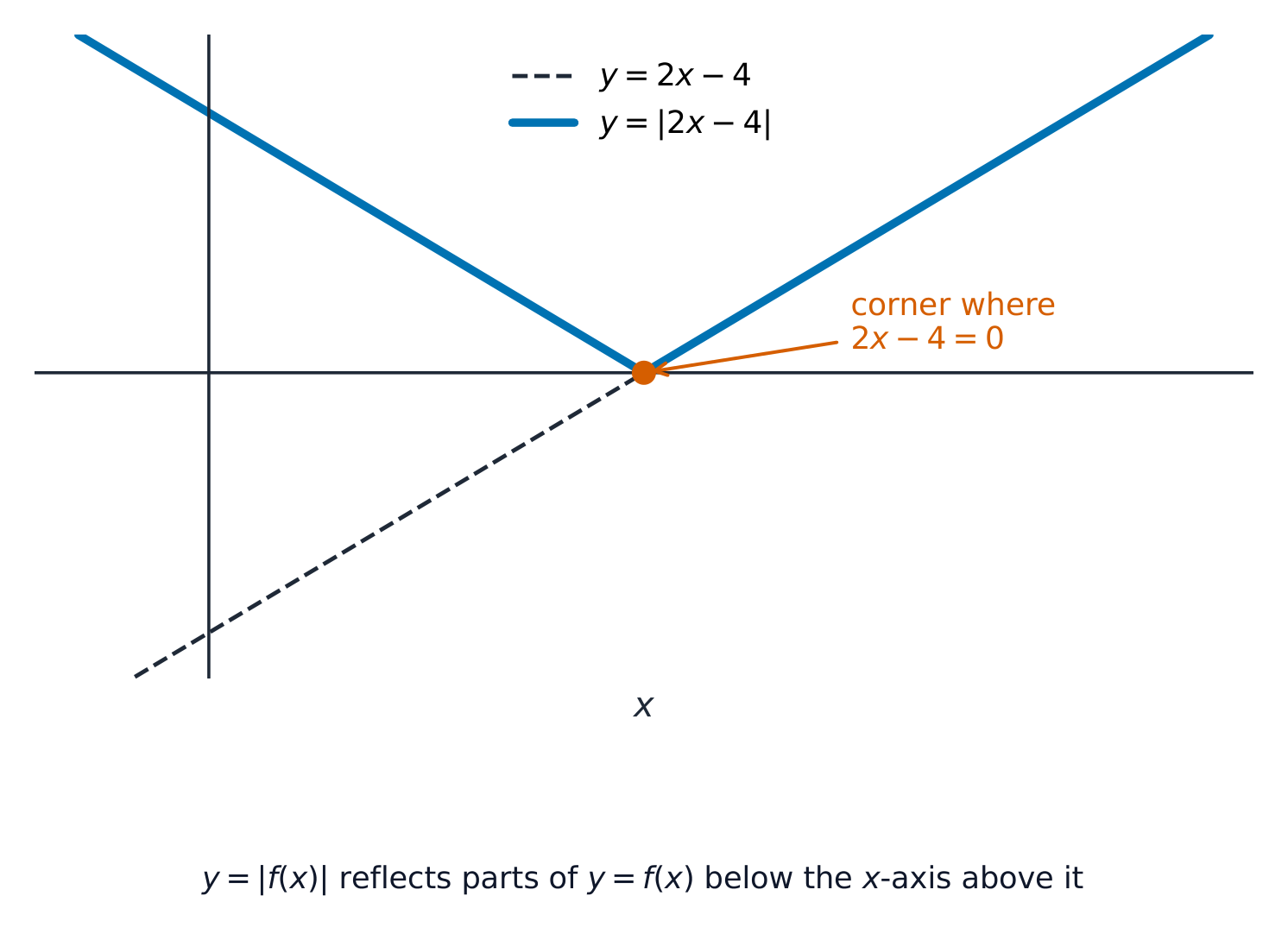
Tirar o módulo dobra a parte negativa da linha para cima formando um V
By the remainder theorem, what is the remainder when p(x) = x² + 3x + 2 is divided by (x − 1)? · Pelo teorema do resto, qual é o resto quando p(x) = x² + 3x + 2 é dividido por (x − 1)?
Remainder = p(1) = 1 + 3 + 2 = 6. · Resto = p(1) = 1 + 3 + 2 = 6.
(x − a) is a factor of p(x) exactly when: · (x − a) é fator de p(x) exatamente quando:
The factor theorem: (x − a) is a factor if and only if p(a) = 0. · Teorema do fator: (x − a) é fator se e somente se p(a) = 0.
Worked example — factor theorem
- Show that $(x - 2)$ is a factor of $p(x) = x^3 - 5x^2 + 2x + 8$.
- $p(2) = 8 - 20 + 4 + 8 = 0$. Since $p(2) = 0$, $(x - 2)$ is a factor.
- Divide: $x^3 - 5x^2 + 2x + 8 = (x - 2)(x^2 - 3x - 4) = (x - 2)(x - 4)(x + 1)$.
Opposite signs of f(a) and f(b) trap a root between a and b
Exemplo resolvido — teorema do fator
- Mostre que $(x - 2)$ é um fator de $p(x) = x^3 - 5x^2 + 2x + 8$.
- $p(2) = 8 - 20 + 4 + 8 = 0$. Como $p(2) = 0$, $(x - 2)$ é um fator.
- Divida: $x^3 - 5x^2 + 2x + 8 = (x - 2)(x^2 - 3x - 4) = (x - 2)(x - 4)(x + 1)$.
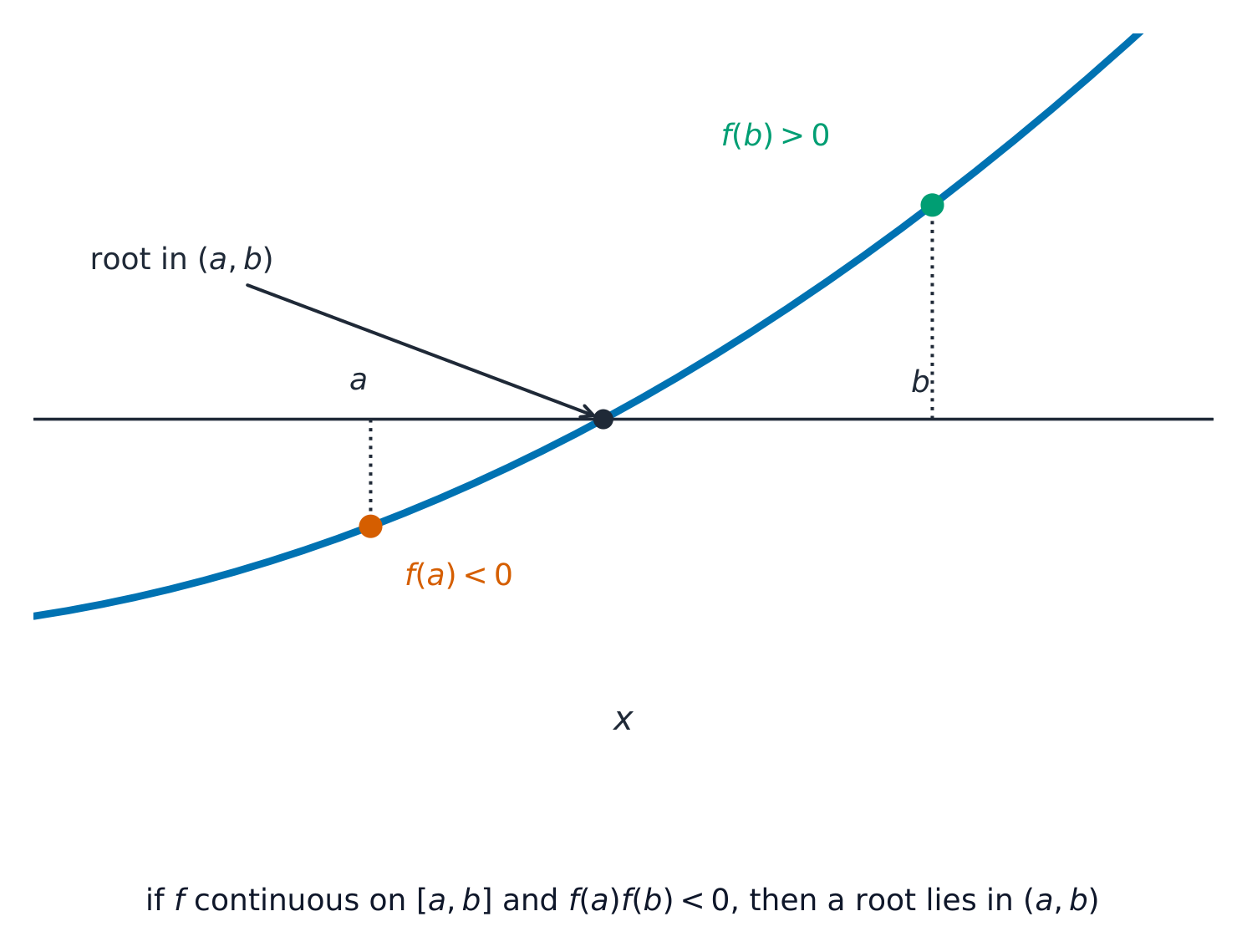
Sinais opostos de f(a) e f(b) aprisionam uma raiz entre a e b
If p(3) = 0, then (x − 3) is a factor of p(x). · Se p(3) = 0, então (x − 3) é fator de p(x).
By the factor theorem, p(a) = 0 means (x − a) is a factor. · Pelo teorema do fator, p(a) = 0 significa que (x − a) é fator.
Given p(x) = x³ − 6x² + 11x − 6 and p(1) = 0, factorise: p(x) = (x − 1)(x² + bx + c). What is c? · Dado p(x) = x³ − 6x² + 11x − 6 e p(1) = 0, fatore: p(x) = (x − 1)(x² + bx + c). Qual é c?
Dividing x³ − 6x² + 11x − 6 by (x − 1) gives x² − 5x + 6, so c = 6. · Dividindo x³ − 6x² + 11x − 6 por (x − 1) obtém-se x² − 5x + 6, logo c = 6.
Solving polynomial equations
- Use the factor theorem to find one root, then divide to reduce the degree.
- A cubic has at most 3 real roots; a quartic at most 4.
- Sketch the graph to check: the number of $x$-axis crossings matches the number of real roots.
- Differentiate a fraction with the quotient rule.
Resolvendo equações polinomiais
- Use o teorema do fator para encontrar uma raiz, depois divida para reduzir o grau.
- Um cúbico tem no máximo 3 raízes reais; um quártico tem no máximo 4.
- Esboce o gráfico para verificar: o número de cruzamentos com o eixo $x$ corresponde ao número de raízes reais.
- Derive uma fração usando a regra do quociente.
You've got it
- $|x|$ removes the sign; $|x - a| < b \Leftrightarrow a - b < x < a + b$
- remainder when $p(x) \div (x-a)$ is $p(a)$
- factor theorem: $(x-a)$ is a factor $\Leftrightarrow p(a) = 0$
- find one root, divide, then solve the remaining quadratic
Entendeu?
- $|x|$ remove o sinal; $|x - a| < b \Leftrightarrow a - b < x < a + b$
- resto quando $p(x) \div (x-a)$ é $p(a)$
- teorema do fator: $(x-a)$ é um fator $\Leftrightarrow p(a) = 0$
- encontre uma raiz, divida, depois resolva o quadrático restante