Functions · Funções
| English | Português |
|---|---|
| function/ˈfʌŋkʃn/ | função |
| domain/dəˈmeɪn/ | domínio |
| range/reɪndʒ/ | range |
| composition/ˌkɒmpəˈzɪʃn/ | composição |
| inverse/ɪnˈvɜːs/ | inverso |
| one-one/wʌn wʌn/ | um-para-um |
The vending machine test
- A vending machine takes one code and gives exactly one snack. If code A7 sometimes gives crisps and sometimes chocolate, it's broken.
- A function 函数 works the same way: each input maps to exactly one output. This simple rule underpins all of calculus.
O teste da máquina de venda
- Uma máquina de venda aceita um código e dá exatamente um lanche. Se o código A7 às vezes dá batatinhas e às vezes chocolate, ela está quebrada.
- Uma função 函数 funciona da mesma maneira: cada entrada mapeia para exatamente uma saída. Esta regra simples fundamenta todo o cálculo.
Functions, domain 定义域 and range 值域
- A function $f(x)$ sends each input to exactly one output.
- The domain = allowed inputs; the range = the outputs produced.
- Example: $f(x) = \sqrt{x}$ has domain $x \geq 0$ and range $f(x) \geq 0$.
Domain restrictions. $g(x) = \dfrac{1}{x-3}$ has domain $x \neq 3$ (division by zero is undefined). The range is all real numbers except $0$.
Funções, domínio 定义域 e imagem 值域
- Uma função $f(x)$ envia cada entrada para exatamente uma saída.
- O domínio = entradas permitidas; a imagem = as saídas produzidas.
- Exemplo: $f(x) = \sqrt{x}$ tem domínio $x \geq 0$ e imagem $f(x) \geq 0$.
Restrições de domínio. $g(x) = \dfrac{1}{x-3}$ tem domínio $x \neq 3$ (divisão por zero é indefinida). A imagem são todos os números reais exceto $0$.
Explore a function · Explorar uma função
y = ax³ + bx² + cx + d
A function turns each input · entrada into exactly one output · produção — drag the coefficients and watch where the curve rises and · e falls. · Uma função transforma cada entrada em exatamente uma saída — arraste os coeficientes e observe onde a curva sobe e desce.
The domain of f(x) = √(x − 4) is: · O domínio de f(x) = √(x − 4) é:
The expression under the square root must be non-negative: x − 4 ≥ 0, so x ≥ 4. · A expressão sob a raiz deve ser não negativa: x − 4 ≥ 0, logo x ≥ 4.
Composition 复合 and inverses 反函数
- A function is one-one 一一对应 if different inputs always give different outputs — only then does it have an inverse $f^{-1}$.
- Composition $fg(x) = f(g(x))$ — do $g$ first, then $f$.
Composição 复合 e inversas 反函数
- Uma função é injetora 一一对应 se entradas diferentes sempre dão saídas diferentes — só assim ela tem uma inversa $f^{-1}$.
- Composição $fg(x) = f(g(x))$ — faça $g$ primeiro, depois $f$.
If f(x) = x² and g(x) = x + 1, what is fg(2) = f(g(2))? · Se f(x) = x² e g(x) = x + 1, qual é fg(2) = f(g(2))?
g(2) = 3, then f(3) = 3² = 9. · g(2) = 3, então f(3) = 3² = 9.
Only a one-one function has an inverse function. · Somente uma função injetora possui função inversa.
If two inputs gave the same output, the reverse rule would be ambiguous — so only one-one functions are invertible. · Se duas entradas produzissem a mesma saída, a regra reversa seria ambígua — portanto, apenas funções injetoras são invertíveis.
Finding an inverse
- To find $f^{-1}$: write $y = f(x)$, make $x$ the subject, then swap letters.
- Example: $f(x) = 2x + 6$ → $x = \dfrac{y-6}{2}$ → $f^{-1}(x) = \dfrac{x-6}{2}$.
- The graph of $y = f^{-1}(x)$ is the reflection of $y = f(x)$ in the line $y = x$.
Inverse functions are reflections in $y = x$: the point $(a, b)$ on $f$ becomes $(b, a)$ on $f^{-1}$.
Not all functions have inverses. $f(x) = x^2$ is not one-one (both $2$ and $-2$ give $4$), so it has no inverse unless you restrict the domain to $x \geq 0$.
Encontrando uma inversa
- Para encontrar $f^{-1}$: escreva $y = f(x)$, isole $x$, depois troque as letras.
- Exemplo: $f(x) = 2x + 6$ → $x = \dfrac{y-6}{2}$ → $f^{-1}(x) = \dfrac{x-6}{2}$.
- O gráfico de $y = f^{-1}(x)$ é a reflexão de $y = f(x)$ na linha $y = x$.
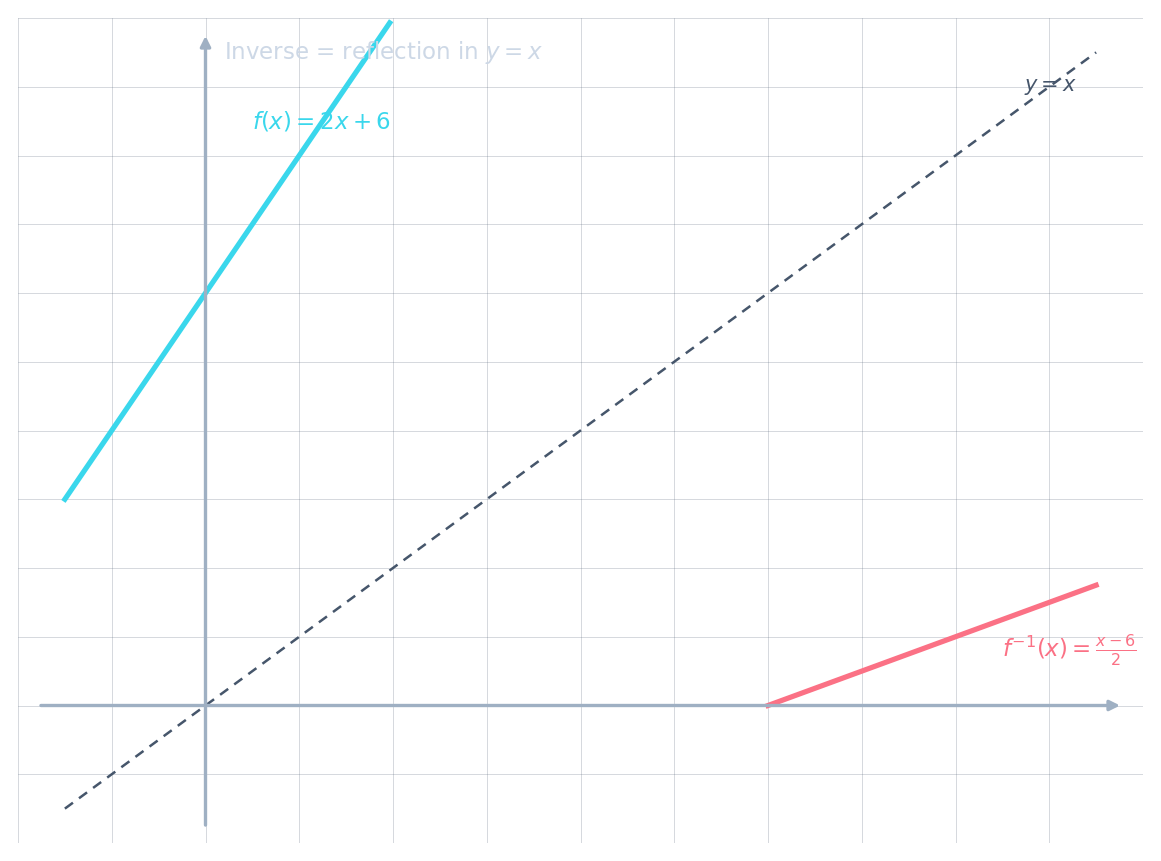
Funções inversas são reflexões em $y = x$: o ponto $(a, b)$ em $f$ torna-se $(b, a)$ em $f^{-1}$.
Nem todas as funções têm inversas. $f(x) = x^2$ não é injetora (ambos $2$ e $-2$ dão $4$), então não tem inversa a menos que você restrinja o domínio a $x \geq 0$.
For f(x) = 2x + 6, the inverse is f⁻¹(x) = (x − 6)/2. What is f⁻¹(10)? · Para f(x) = 2x + 6, a inversa é f⁻¹(x) = (x − 6)/2. Qual é f⁻¹(10)?
f⁻¹(10) = (10 − 6)/2 = 4/2 = 2.
The graph of y = f⁻¹(x) is the reflection of y = f(x) in the line: · O gráfico de y = f⁻¹(x) é o reflexo de y = f(x) na linha:
An inverse reflects the original graph in the line y = x; a point (a, b) becomes (b, a). · Uma inversa reflete o gráfico original na linha y = x; um ponto (a, b) torna-se (b, a).
Properties of inverses
- $f(f^{-1}(x)) = x$ and $f^{-1}(f(x)) = x$ — they undo each other.
- The domain of $f^{-1}$ is the range of $f$, and vice versa.
- Graphically: swap the axes.
- Know the composition of functions $fg(x)$ and graph transformations — a translation, a stretch, and reflections.
Adding to the output or input slides the curve; a multiplier stretches it
Propriedades das inversas
- $f(f^{-1}(x)) = x$ e $f^{-1}(f(x)) = x$ — elas se desfazem mutuamente.
- O domínio de $f^{-1}$ é a imagem de $f$, e vice-versa.
- Graficamente: troque os eixos.
- Conheça a composição de funções $fg(x)$ e grafique transformações — um deslocamento, um alongamento e reflexões.

Adicionar à saída ou entrada desliza a curva; um multiplicador a alonga
For any function f with an inverse, f(f⁻¹(x)) = x. · Para qualquer função f com inversa, f(f⁻¹(x)) = x.
Applying a function and then its inverse returns the original input — they undo each other. · Aplicar uma função e depois sua inversa retorna a entrada original — elas se cancelam mutuamente.
You've got it
- function: each input → exactly one output; domain = inputs, range = outputs
- one-one functions have inverses; find $f^{-1}$ by swapping and solving
- composition $fg(x) = f(g(x))$ — do $g$ first, then $f$
- the graph of $f^{-1}$ is the reflection of $f$ in $y = x$
Entendeu?
- função: cada entrada → exatamente uma saída; domínio = entradas, imagem = saídas
- funções injetoras têm inversas; encontre $f^{-1}$ trocando e resolvendo
- composição $fg(x) = f(g(x))$ — faça $g$ primeiro, depois $f$
- o gráfico de $f^{-1}$ é a reflexão de $f$ em $y = x$