Rational functions and graphs
Introduzido| English | Significado |
|---|---|
| polynomial/ˌpɒlɪˈnəʊmɪəl/ | polinômio |
| rational function/ˈræʃənl ˈfʌŋkʃn/ | função racional |
| denominator/dɪˈnɒmɪneɪtə/ | denominador |
| vertical asymptote/ˈvɜːtɪkl ˈæsɪmptəʊt/ | assíntota vertical |
| oblique asymptote/əˈbliːk ˈæsɪmptəʊt/ | assíntota oblíqua |
| quotient/ˈkwəʊʃənt/ | quociente |
| remainder/rɪˈmeɪndə/ | resto |
| turning points/ˈtɜːnɪŋ pɔɪnts/ | pontos de viragem |
| discriminant/dɪˈskrɪmɪnənt/ | discriminante |
Verifique uma curva ajustada antes de confiá-la
- Um programa pode ajustar uma razão de dois polinômios aos dados. Seu gráfico pode parecer suave na tela enquanto oculta uma entrada excluída ou um ramo separado.
- Para uma função racional $f(x)=P(x)/Q(x)$, comece com o denominador original: exija $Q(x)\ne0$. Em seguida, encontre as características que um esboço deve mostrar.
Uma entrada excluída pode ser um buraco
- Um denominador zero gera uma assíntota vertical apenas quando a expressão restante torna-se ilimitada ali. Fatore primeiro; a cancelamento pode deixar em vez disso um ponto ausente.
- Para $f(x)=(x^2-1)/(x-1)=x+1$, a restrição original $x\ne1$ permanece. Desenhe a linha com um ponto aberto em $(1,2)$, não uma assíntota vertical. Um zero do numerador é um intercepto apenas se o denominador original for não nulo ali.
A rational function is a fraction of two polynomials.
Dificuldade 1/5 · Moedas 100 + pequeno bônus na primeira conclusão hoje
That is the definition — one polynomial over another.
Sketch $(x^2-4)/(x-2)$ with its original domain. State whether x=2 is a vertical asymptote, and list its actual axis intersections.
The expression simplifies to x+2 only for x≠2. Draw that line with a hole at (2,4). The function is bounded near 2, so there is no vertical asymptote there. The actual intersections are (−2,0) and (0,2).
Assíntotas de grau e divisão
- Após o cancelamento, compare graus: um numerador de menor grau dá limite horizontal 0; graus iguais dão a razão dos coeficientes líderes. Uma assíntota oblíqua é uma linha inclinada, então o grau do numerador deve ser exatamente um maior.
- Divida para obter o quociente mais o restante sobre o denominador. Para $(x^2-1)/(x-2)$, isso é $x+2+3/(x-2)$. Assim $y=x+2$ é o limite inclinado quando $x\to\pm\infty$; $x=2$ é vertical.

Uma assíntota horizontal ou oblíqua descreve comportamento distante; pode ser cruzada em uma entrada finita. Para $f(x)=(x^2+x)/(x^2+1)$, a assíntota horizontal é $y=1$, e $f(1)=1$.
For a reduced rational function with a non-zero remainder, a sloping straight-line asymptote occurs when the numerator degree is:
Dificuldade 1/5 · Moedas 100 + pequeno bônus na primeira conclusão hoje
When the numerator's degree exceeds the denominator's, dividing out leaves a slant line the curve approaches.
You find an oblique asymptote by:
Dificuldade 1/5 · Moedas 100 + pequeno bônus na primeira conclusão hoje
Polynomial division gives the straight-line part the curve approaches far from the origin.
For f(x) = (x²−1)/(x−2), divide to get f(x) = x + 2 + 3/(x−2). The oblique asymptote is y = x + ?
Dificuldade 2/5 · Moedas 140 + pequeno bônus na primeira conclusão hoje
The quotient is x + 2, so the oblique asymptote is y = x + 2.
Pontos de inflexão e um esboço completo
- Para $f(x)=x+1/x$, $x\ne0$, $f'(x)=1-1/x^2$. Os pontos de virada são $(-1,-2)$, um máximo local, e $(1,2)$, um mínimo local, pois a derivada muda de sinal.
- Não há interseções com os eixos. Desenhe ambos os ramos com assíntota vertical $x=0$ e assíntota oblíqua $y=x$. O ramo esquerdo fica abaixo da reta oblíqua e o direito acima dela. Perto de zero, o ramo esquerdo desce até $-\infty$ e o direito sobe até $+\infty$.
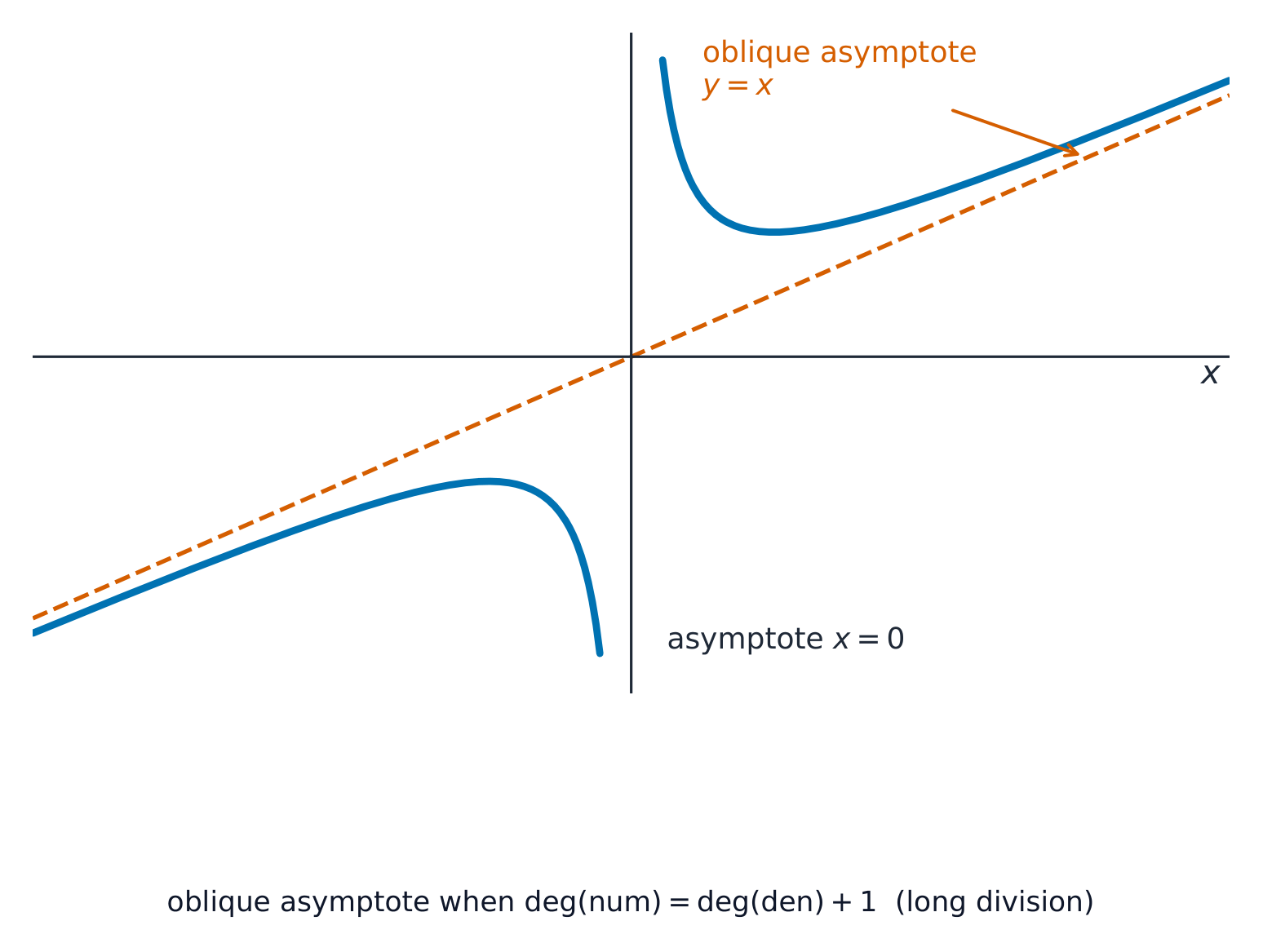
Nem toda curva racional possui pontos estacionários. Para $h(x)=(x+1)/(x^2+2x-2)$,
em cada entrada permitida. Seu numerador não pode ser zero, logo não tem pontos estacionários e decresce em cada intervalo do seu domínio. Não una ramos decrescentes através de um polo.
A favor $f(x)=(x^2+4)/(x-2)$, find the asymptotes, stationary coordinates, axis intersections and range, and draw a labelled sketch.
$f=x+2+8/(x-2)$, x≠2. Asymptotes x=2 and y=x+2. $f\prime=1-8/(x-2)^2$ gives x=2±2√2 and y=4±4√2; the left point is a maximum, the right a minimum. There are no real x-intercepts; the y-intercept is (0,−2). Range $(-\infty,4-4\sqrt2]\cup[4+4\sqrt2,\infty)$. Left branch lies below the slant line, right above.
A favor $h(x)=(2x+1)/(x^2+x-3)$, prove that there are no stationary points. State the separate intervals on which it decreases.
The original exclusions are $l=(-1-\sqrt{13})/2$ e $r=(-1+\sqrt{13})/2$. The derivative is $-(2x^2+2x+7)/(x^2+x-3)^2$. Its numerator before the minus sign is $2(x+1/2)^2+13/2>0$, while the denominator is positive on the domain. Thus the derivative is always negative and never zero. The function decreases separately on $(-\infty,l)$, $(l,r)$ e $(r,\infty)$.
Prove o conjunto imagem usando discriminante
- Reorganize $y=x+1/x$ como $x^2-yx+1=0$. Uma entrada real existe exatamente quando seu discriminante satisfaz $y^2-4\ge0$. O conjunto imagem é $y\le-2$ ou $y\ge2$, incluindo ambos os valores de virada.
- Verifique exclusões e qualquer caso em que a equação deixe de ser quadrática. Para $y=x/(x^2+1)$, a reorganização resulta em $yx^2-x+y=0$. Em $y=0$, esta é a equação linear válida $x=0$; não descarte esse valor do conjunto imagem.
Para a segunda função, $1-4y^2\ge0$ resulta em $-1/2\le y\le1/2$. Seu denominador nunca é zero para reais $x$, portanto todos esses valores ocorrem, incluindo $0$ e as duas extremidades.
Sketch $f(x)=(x^2-4)/(x^2-1)$ and find its range. Label poles, intercepts and its stationary point.
Domain x≠±1, vertical asymptotes x=±1, horizontal asymptote y=1. Intercepts (±2,0),(0,4). $f\prime=6x/(x^2-1)^2$, so (0,4) is a minimum on the middle branch. Put z=x²≥0, z≠1: $y=1-3/(z-1)$. For 0≤z<1, y≥4; for z>1, y<1. Range $(-\infty,1)\cup[4,\infty)$. All three branches must be shown.
Use a discriminant to find the range of $f(x)=(2x+1)/(x^2+1)$. Handle y=0 separately and identify the x-values where the range endpoints occur.
Rearrange to $yx^2-2x+(y-1)=0$. For y≠0, discriminant $4-4y(y-1)\ge0$ gives $(1-\sqrt5)/2\le y\le(1+\sqrt5)/2$. At y=0, x=−1/2 is valid. The denominator never vanishes. Equality gives a double input root x=1/y, so endpoint inputs are (−1−√5)/2 and (−1+√5)/2 respectively.
For a>0, sketch the features of $f_a(x)=(x^2+a^2)/(x-a)$: asymptotes, stationary coordinates and range. Explain what changes when a=0 in the original expression.
$f_a=x+a+2a^2/(x-a)$. Asymptotes x=a,y=x+a. Stationary points $(a\pm\sqrt2a,2a\pm2\sqrt2a)$; the minus point is a maximum and plus a minimum. Range $y\le2a-2\sqrt2a$ ou $y\ge2a+2\sqrt2a$. At a=0 the expression is x²/x=x for x≠0: a line with a hole at (0,0), no vertical asymptote and no stationary points. Its range is R without {0}.
Altere a saída: módulo e recíproco
- Pegue $f(x)=(x-1)/(x+1)$. Para $y=|f(x)|$, mantenha as partes não negativas e reflita as partes negativas acima do eixo $x$. A exclusão $x=-1$ permanece. Seu único zero é $x=1$.
- Para $y=1/f(x)=(x+1)/(x-1)$, exclua tanto $x=-1$ quanto $x=1$: o primeiro nunca esteve no domínio original e o segundo torna o recíproco indefinido. Há um buraco em $(-1,0)$ e uma assíntota vertical em $x=1$; o buraco não é um zero.
A favor $f(x)=(x-2)/(x+3)$, sketch y=1/f(x) with the domain inherited from f. Give its poles, holes, zeros and range.
$1/f=(x+3)/(x-2)$ for x≠−3,2. There is a vertical asymptote at x=2, a hole at (−3,0), and horizontal asymptote y=1. There are no actual zeros. Since $y=1+5/(x-2)$ omits 1, and the only input giving y=0 is excluded, its range is R without {0,1}.
Altere a entrada, ou eleve ao quadrado a saída
- Para $f(|x|)$, mantenha a metade direita original e reflita-a pelo eixo $y$. Aqui o denominador $|x|+1$ nunca se anula; o conjunto imagem é $[-1,1)$, com zeros em $x=\pm1$ e um canto em $(0,-1)$. Tal canto não é automático: se a inclinação original à direita em zero for zero, a junção pode ser suave.
- Para $y^2=f(x)$, mantenha apenas entradas originais onde $f(x)\ge0$, depois desenhe ambos $y=\sqrt{f(x)}$ e $y=-\sqrt{f(x)}$. Aqui $x<-1$ ou $x\ge1$; os dois ramos se encontram em $(1,0)$, e não existe gráfico para $-1<x<1$.
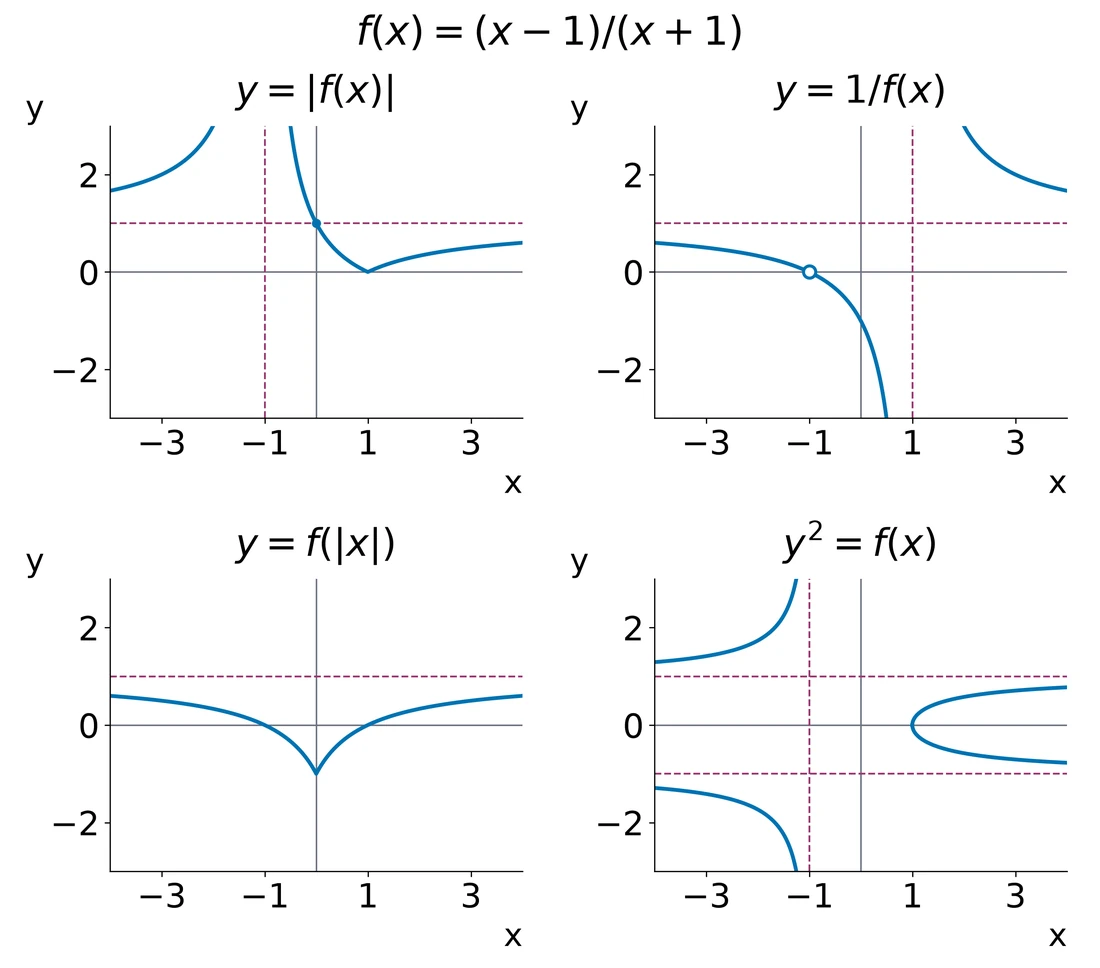
Uma junção suave é possível: para $h(x)=(x^2+4x+8)/(x+2)$, $h(0)=4$ e $h'(0)=0$. Refletir sua metade direita dá inclinações correspondentes 0 em ambos os lados, logo $h(|x|)$ é suave em $(0,4)$.
Explore a reciprocal curve
y = a/(x − b) + c
For a non-zero a, x=b is excluded and the curve approaches y=c at large |x|. Track the domain as well as the visible branches.
For y = 1/f(x), the zeros of f(x) become the zeros of y.
Dificuldade 1/5 · Moedas 100 + pequeno bônus na primeira conclusão hoje
A zero of f becomes an excluded input and usually a vertical asymptote of 1/f. Original domain exclusions remain; do not turn an original pole into a filled zero.
The graph of y = |f(x)| is obtained from y = f(x) by:
Dificuldade 1/5 · Moedas 100 + pequeno bônus na primeira conclusão hoje
The modulus reflects any part of the graph below the x-axis to above it.
A favor $f(x)=(x^2-4)/(x^2-1)$, sketch $y^2=f(x)$. State its real x-domain, axis intersections, vertical and horizontal limiting lines.
Require f≥0 in the original domain. This gives $x\le-2$ ou $-1<x<1$ ou $x\ge2$. Draw both signs of √f, symmetric about the x-axis (also even in x). Intersections (±2,0),(0,±2). Vertical asymptotes x=±1 approached from the central interval. As |x|→∞, the outer branches tend to y=±1. No points exist on (−2,−1) or (1,2).
A favor $g(x)=(x-2)/(x+1)$, sketch y=|g(x)| and y=g(|x|) separately. Compare domains, zeros, y-intercepts and the join at x=0. Would $h(|x|)$, for $h(x)=(x^2+4x+8)/(x+2)$, have the same type of join at zero?
For |g|, x≠−1, pole x=−1, sole zero x=2, y-intercept2; reflect original negative outputs upward. For g(|x|), the denominator |x|+1 is positive for every real x, zeros are ±2 and y-intercept−2. Copy only the right half of g and reflect left; the slopes at zero are −3 and +3, so there is a corner minimum there. Its range is [−2,1). For h, division gives $h=x+2+4/(x+2)$, so $h(0)=4$ e $h\prime(0)=1-4/4=0$. The reflected slopes both equal zero; its join at (0,4) is smooth, unlike the corner for g.
Resolva desigualdades a partir de fronteiras e ramos
- Para resolver $|(x-1)/(x+1)|<2$, encontre onde $f=2$ e $f=-2$: as entradas de fronteira são $-3$ e $-1/3$. Inclua o polo $-1$ no diagrama de sinais ou ramos.
- Teste os intervalos separados por esses valores. A resposta é $x<-3$ ou $x>-1/3$, com extremidades estritas excluídas. Não multiplique uma desigualdade por $x+1$ sem antes determinar seu sinal; multiplicar por $(x+1)^2$ é seguro apenas após excluir $x=-1$.
Solve $|(x-2)/(x+1)|<1/2$ exactly, showing boundaries and the excluded input.
Exclude x=−1. The boundaries f=−1/2 and f=1/2 occur at x=1 and x=5. On x<−1, f>1, so there is no solution there. On x>−1, f increases from −∞ to1, giving 1<x<5. An equivalent safe algebra route squares and multiplies by the positive (x+1)² after excluding −1.
Use simetria para resolver uma desigualdade de módulo de entrada
- Para $f(|x|)<1/2$, coloque $t=|x|\ge0$. Então $(t-1)/(t+1)<1/2$ tem denominador positivo e resulta em $t<3$.
- Traduza de volta para $-3<x<3$. O valor zero está incluído. Se um cálculo quadrático gerar uma fronteira negativa para $t$, não pode ser um valor de $|x|$; inspecione a semi-linha permitida antes de refletir o resultado.
Solve $((|x|)^2+4)/(|x|+2)<3$ exactly. Explain how the restriction on |x| affects the two quadratic boundary roots.
Put t=|x|≥0. Since t+2>0, the inequality becomes t²−3t−2<0. Its roots are (3±√17)/2, but the lower one is negative. Thus 0≤t<(3+√17)/2 and $-(3+\sqrt{17})/2<x<(3+\sqrt{17})/2$. Zero is included.
Construa o esboço a partir das evidências
- Registre o domínio, interceptações, assíntotas, coordenadas estacionárias e comportamento unilateral. Use um cálculo de intervalo para confirmar quais lacunas verticais são reais; uma assíntota horizontal não precisa ser um valor de saída excluído.
- Para um gráfico relacionado, declare o novo domínio antes de desenhar. Para uma desigualdade, marque todas as fronteiras e polos, teste os ramos e preserve as extremidades estritas ou inclusivas.
For (x squared plus 1) divided by (x minus 1), what is the oblique asymptote, and why is the remainder not that line?
Polynomial division writes the function as quotient plus remainder over divisor. Only the quotient survives as the oblique asymptote.
For (x²+1)/(x−1), what constant is added to x in its slant asymptote?
Dificuldade 1/5 · Moedas 100 + pequeno bônus na primeira conclusão hoje
The quotient is x plus 1, so the constant is 1. The remainder is 2.
Solve $|(x^2-4)/(x^2-1)|<1/2$ exactly. Give the intervals and show why multiplying by the denominator itself would require care.
Exclude x=±1. Squaring and multiplying by (x²−1)² gives $4(x^2-4)^2<(x^2-1)^2$, hence $3(x^2-3)(x^2-7)<0$. Thus 3<x²<7, so $-\sqrt7<x<-\sqrt3$ ou $\sqrt3<x<\sqrt7$. The excluded poles lie outside these intervals. Multiplication by x²−1 without a sign split is unsafe.