Fiscal policy · Política fiscal
| English | Português |
|---|---|
| fiscal policy/ˈfɪskl ˈpɒlɪsi/ | política fiscal |
| budget deficit/ˈbʌdʒɪt ˈdefɪsɪt/ | déficit orçamentário |
| budget surplus/ˈbʌdʒɪt ˈsɜːpləs/ | superávit orçamentário |
| expansionary/ekˈspænʃənəri/ | expansionista |
| contractionary/kənˈtrækʃənəri/ | contracionista |
| multiplier/ˌmʌltɪˈplaɪə/ | multiplicador |
| marginal propensity to consume/ˈmɑːdʒɪnl prəˈpensɪti tə kənˈsjuːm/ | propensão marginal a consumir |
| crowd out/kraʊd aʊt/ | efeito crowding out |
Spending and taxing to steer the economy
- When a recession hits, governments can spend more and tax less to revive demand. That's fiscal policy 财政政策 — the budget as a lever.
- It works through government spending (G) and taxation (T), two big slices of aggregate demand.
Gastos e tributação para orientar a economia
- Quando uma recessão atinge, os governos podem gastar mais e tributar menos para reanimar a demanda. Isso é política fiscal 财政政策 — o orçamento como alavanca.
- Funciona através de gastos governamentais (G) e tributação (T), duas grandes fatias da demanda agregada.
The government budget
- A budget deficit 预算赤字 = spending exceeds tax revenue (the government borrows).
- A budget surplus 预算盈余 = tax revenue exceeds spending.
- Expansionary 扩张性 fiscal policy (more G, lower T) boosts AD; contractionary 紧缩性 (less G, higher T) restrains it.
Expansionary fiscal policy (higher G or lower T) shifts AD right, raising real GDP — and, along an upward AS, the price level.
O orçamento do governo
- Déficit orçamentário 预算赤字 = gastos ultrapassam a receita tributária (o governo toma empréstimos).
- Superávit orçamentário 预算盈余 = receita tributária ultrapassa os gastos.
- Política fiscal expansiva 扩张性 (mais G, menor T) impulsiona a DA; contractionary 紧缩性 (menos G, maior T) a restringe.
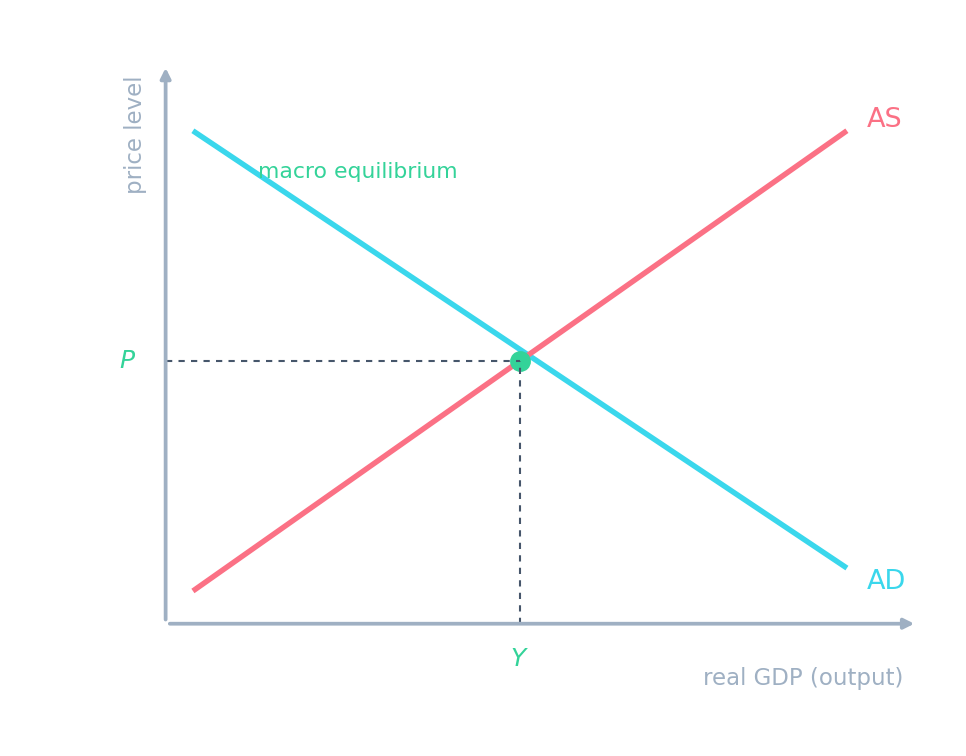
Política fiscal expansiva (maior G ou menor T) desloca a DA para a direita, aumentando o PIB real — e, ao longo de uma OF ascendente, o nível de preços.
Fiscal policy shifts AD · A política fiscal desloca a DA
Government spending and taxes move aggregate demand (AD). Drag AD to see real output and the price level change. · Governo gasta e cobra impostos movendo demanda agregada (DA). Arraste a DA para ver a produção real e o nível de preços mudarem.
A budget deficit occurs when: · Um déficit orçamentário ocorre quando:
Spending > revenue → the government borrows → a deficit. · Gasto > receita → o governo toma emprestado → um déficit.
Expansionary fiscal policy involves: · Política fiscal expansionista envolve:
More G and/or lower T raises AD — that's expansionary fiscal policy. · Mais G e/ou menores T aumentam a AD — isso é política fiscal expansionista.
The multiplier 乘数
- A change in spending has a multiplied effect: the initial spend becomes someone's income, which they re-spend, and so on.
- where MPC is the marginal propensity to consume 边际消费倾向.
Worked example. If MPC = 0.8, the multiplier $= \dfrac{1}{1 - 0.8} = \dfrac{1}{0.2} = 5$ — £1bn of spending raises GDP by £5bn.
Expansionary policy shifts AD right, raising output and prices
O multiplicador 乘数
- Uma mudança nos gastos tem um efeito multiplicado: o gasto inicial torna-se renda de alguém, que eles re gastam, e assim por diante.
- onde MPC é a propensão marginal a consumir 边际消费倾向.
Exemplo resolvido. Se a PMC = 0.8, o multiplicador $= \dfrac{1}{1 - 0.8} = \dfrac{1}{0.2} = 5$ — £1 bilhões de gastos elevam o PIB em £5 bilhões.
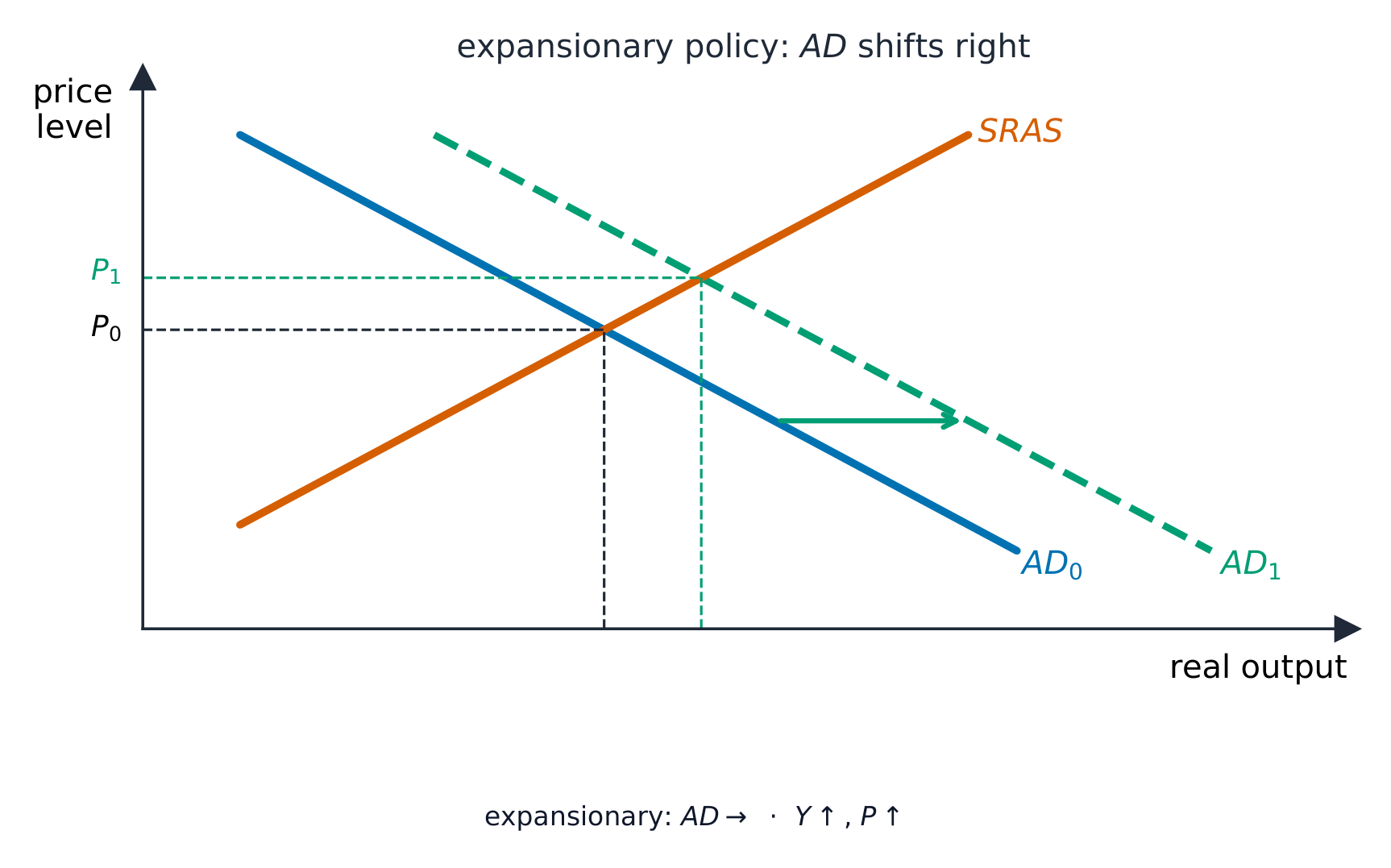
A política expansiva desloca a DA para a direita, aumentando a produção e os preços
The fiscal multiplier, round by round · O multiplicador fiscal, rodada por rodada
Set the MPC to 0.8 like the worked example — each spending round is MPC times the last, and the total settles at k × the injection. · Defina o PCM como 0.8, conforme o exemplo resolvido — cada rodada de gastos é PCM vezes a anterior, e o total se estabiliza em k × o injeção.
If the marginal propensity to consume (MPC) is 0.8, what is the multiplier = 1/(1 − MPC)? · Se a propensão marginal a consumir (PMC) é 0.8, qual é o multiplicador = 1/(1 − PMC)?
1 / (1 − 0.8) = 1 / 0.2 = 5.
The multiplier equals 1 divided by (1 − ______). · O multiplicador é igual a 1 dividido por (1 − ______).
Multiplier = 1/(1 − MPC). · Multiplicador = 1/(1 − MPC).
Drawbacks
- Deficits add to government debt; time lags delay the effect; and big spending can crowd out 挤出 private investment.
Desvantagens
- Déficits aumentam a dívida pública; lags temporais atrasam o efeito; e grandes gastos podem crowd out 挤出 investimentos privados.
Heavy government borrowing can crowd out private investment. · Fortes empréstimos governamentais podem causar efeito-tombamento sobre investimento privado.
Government borrowing can raise interest rates and reduce private investment — crowding out. · Empréstimos governamentais podem elevar taxas de juros e reduzir investimento privado — efeito tombamento.
You've got it
- fiscal policy = government spending and taxation; deficit = spend > tax
- expansionary (more G, less T) shifts AD right; contractionary restrains AD
- the multiplier $= \dfrac{1}{1 - MPC}$ magnifies a change in spending
Entendeu?
- política fiscal = gastos e tributação governamentais; déficit = gastos > impostos
- expansiva (mais G, menos T) desloca a DA para a direita; contractionary restringe a DA
- o multiplicador $= \dfrac{1}{1 - MPC}$ amplifica uma mudança nos gastos