Price elasticity of supply · Elasticidade-preço da oferta
| English | Português |
|---|---|
| price elasticity of supply/praɪs ɪlæˈstɪsɪti ɒv səˈplaɪ/ | elasticidade-preço da oferta |
| elastic/ɪˈlæstɪk/ | elástica |
| inelastic/ɪnɪˈlæstɪk/ | inelástica |
| spare capacity/speə kəˈpæsɪti/ | capacidade ociosa |
| mobility of factors/məʊˈbɪlɪti ɒv ˈfæktəz/ | mobilidade dos fatores |
Why farmers can't react overnight
- If strawberry prices jump, a factory can boost output in days — but a farmer must wait a whole growing season. Producers differ in how fast they respond.
- Price elasticity of supply 供给价格弹性 (PES) measures that responsiveness.
Por que agricultores não podem reagir instantaneamente
- Se os preços das morangos saltarem, uma fábrica pode aumentar a produção em dias — mas um agricultor deve esperar uma estação inteira de cultivo. Produtores diferem na velocidade de resposta.
- Elasticidade-preço da oferta (PES) mede essa resposta.
Measuring PES
- PES measures how quantity supplied responds to a price change:
- It is normally positive (price and quantity supplied move together).
Equilibrium price and quantity where demand meets supply
Medindo PES
- PES mede como a quantidade ofertada responde a uma mudança de preço:
- Geralmente é positivo (preço e quantidade ofertada se movem juntos).
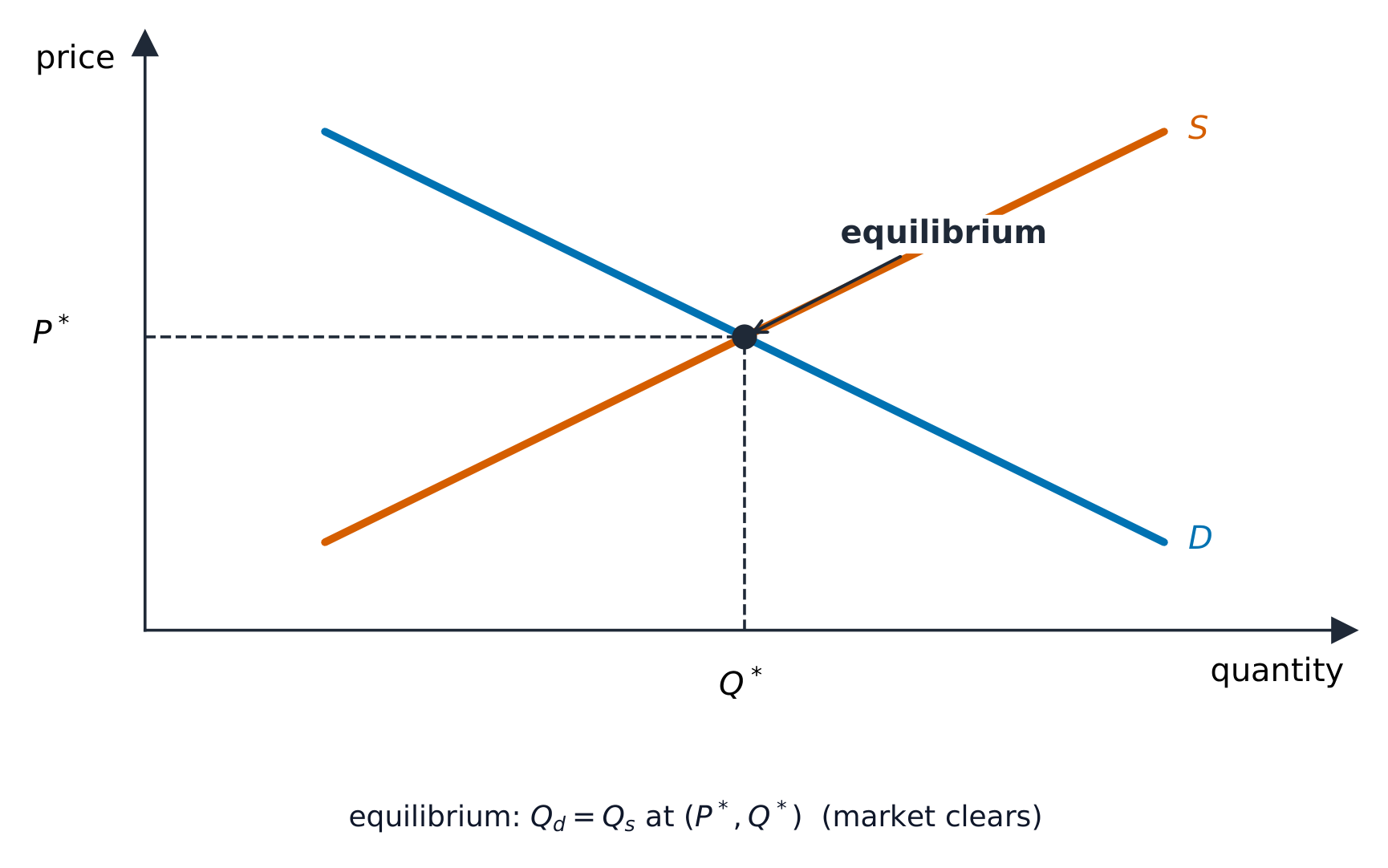
Preço e quantidade de equilíbrio onde a demanda encontra a oferta
Demand & supply · Demande & offre
Supply elasticity is how much quantity responds to price. · Elasticidade da oferta é o quanto a quantidade responde ao preço.
Price rises 20% and quantity supplied rises 30%. What is the PES? · O preço sobe 20% e a quantidade ofertada sobe 30%. Qual é a EPO?
PES = 30% / 20% = 1.5 — elastic. · PES = 30% / 20% = 1.5 — elástica.
PES = (% change in quantity supplied) ÷ (% change in ______). · EPO = (% variação na quantidade ofertada) ÷ (% variação em ______).
PES divides the % change in quantity supplied by the % change in price. · EPO divide a % variação na quantidade ofertada pela % variação no preço.
Elastic 富有弹性 vs inelastic 缺乏弹性 supply
- $\text{PES} > 1$ → elastic (output responds easily — spare capacity 闲置产能, easy to store).
- $\text{PES} < 1$ → inelastic (output is hard to change quickly — farming, limited capacity).
A steep supply curve is inelastic; a flat one is elastic. Spare capacity and time make supply more elastic.
Worked example. Price rises 20% and quantity supplied rises 30%. PES $= \dfrac{30\%}{20\%} = 1.5$ — elastic.
Oferta elástica vs inelástica
- $\text{PES} > 1$ → elástica (a produção responde facilmente — capacidade ociosa, fácil de armazenar).
- $\text{PES} < 1$ → inelástica (a produção é difícil de alterar rapidamente — agricultura, capacidade limitada).

*Uma curva de oferta íngreme é inelástica; uma plana é elástica. Capacidade ociosa e tempo tornam a oferta mais elástica.
Exemplo resolvido. O preço sobe 20% e a quantidade ofertada sobe 30%. PES $= \dfrac{30\%}{20\%} = 1.5$ — elástica.
Supply is elastic when PES is: · A oferta é elástica quando a EPO é:
PES > 1 means quantity supplied responds strongly to price. · EPO > 1 significa que a quantidade ofertada responde fortemente ao preço.
Why is the supply of a farm crop usually inelastic in the short run? · Por que a oferta de uma safra agrícola geralmente é inelástica no curto prazo?
Production takes a season, so quantity supplied can't respond quickly to price — inelastic. · A produção leva uma estação, então a quantidade ofertada não pode responder rapidamente ao preço — inelástica.
Time is the key
- The longer the time period, the more elastic supply becomes — firms can build capacity, hire, and adjust.
- Other determinants: spare capacity, ease of storing stock, and mobility of factors 要素流动性.
O tempo é a chave
- Quanto maior o período de tempo, mais elástica torna-se a oferta — as empresas podem construir capacidade, contratar e ajustar.
- Outros determinantes: capacidade ociosa, facilidade de armazenamento de estoques e mobilidade dos fatores.
Supply tends to be more elastic over a longer time period. · A oferta tende a ser mais elástica em um período de tempo mais longo.
Given time, firms can expand capacity, so supply responds more — more elastic. · Dado o tempo, as empresas podem expandir capacidade, então a oferta responde mais — mais elástica.
You've got it
- $\text{PES} = \dfrac{\%\Delta Q_s}{\%\Delta P}$, normally positive
- $\text{PES}>1$ elastic, $\text{PES}<1$ inelastic
- supply is more elastic with more time, spare capacity, and storable stock
Entendeu?
- $\text{PES} = \dfrac{\%\Delta Q_s}{\%\Delta P}$, geralmente positivo
- $\text{PES}>1$ elástica, $\text{PES}<1$ inelástica
- a oferta é mais elástica com mais tempo, capacidade ociosa e estoque estocável