Income and cross elasticity of demand
Introduzido| English | Significado |
|---|---|
| income elasticity/ˈɪŋkʌm ɪlæˈstɪsɪti/ | elasticidade-renda |
| cross elasticity/krɒs ɪlæˈstɪsɪti/ | elasticidade cruzada |
| normal good/ˈnɔːml ɡʊd/ | bem normal |
| luxury/ˈlʌkʃəri/ | bem de luxo |
| inferior good/ɪnˈfɪərɪə ɡʊd/ | A good people buy less of when their income rises. |
| substitutes/ˈsʌbstɪtjuːts/ | substitutos |
| complements/ˈkɒmplɪmənts/ | complementares |
Food budgets of Belgian families, 1857
- In 1857 the German statistician Ernst Engel studied the budgets of working-class families in Belgium. The poorer the family, the larger the share of its income spent on food; as income rose, spending on food rose too, but much more slowly than income. This pattern is now called Engel's law.
- How demand responds to income is the income elasticity 收入弹性 of demand (YED). How it responds to another good's price is cross elasticity 交叉弹性 (XED).
What did Engel find about food spending?
Dificuldade 1/5 · Moedas 100 + pequeno bônus na primeira conclusão hoje
Engel's law.
Income elasticity of demand
- $\text{YED} = \dfrac{\%\ \Delta Q_d}{\%\ \Delta \text{income}}$.
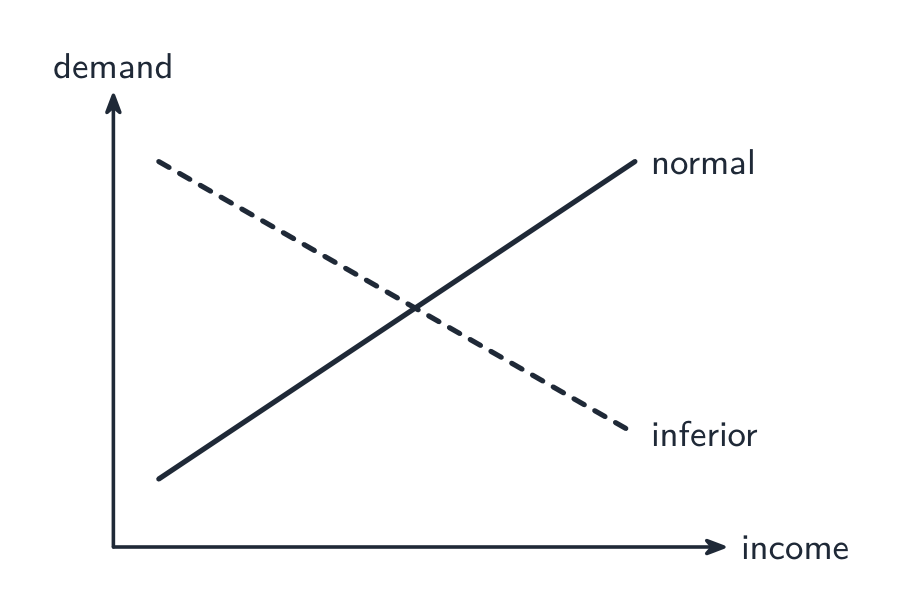
- A normal good 正常品 has positive YED; a luxury 奢侈品 has YED greater than 1 (demand rises proportionately more than income). An inferior good 劣等品 has negative YED: demand falls as income rises.
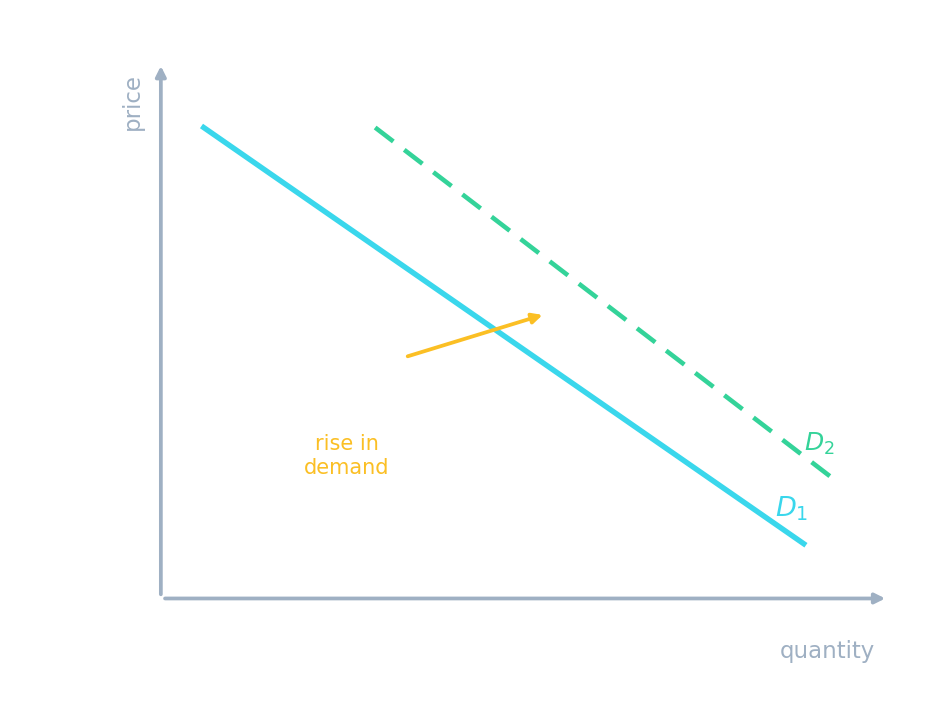
Elastic vs inelastic demand
A steep demand curve is inelastic (quantity barely responds to price); a shallow one is elástica. Shift the curves to compare.
Incomes rise 4% and demand for cinema tickets rises 6%. What is YED?
Dificuldade 2/5 · Moedas 140 + pequeno bônus na primeira conclusão hoje
6 ÷ 4.
Examples of YED
- Food in Engel's data: positive but below 1 — a normal necessity. Foreign holidays and restaurant meals: luxuries.
- Inferior goods depend on context: instant noodles or bus travel may be replaced by better options as income rises.
Match each YED to the type of good.
Dificuldade 2/5 · Moedas 140 + pequeno bônus na primeira conclusão hoje
Sign and size.
Cross elasticity of demand
- $\text{XED} = \dfrac{\%\ \Delta Q_d \text{ of good A}}{\%\ \Delta P \text{ of good B}}$.
- Substitutes 替代品 have positive XED (tea and coffee); complements 互补品 have negative XED (printers and ink cartridges); unrelated goods have XED near zero.
Match each XED to the relationship.
Dificuldade 2/5 · Moedas 140 + pequeno bônus na primeira conclusão hoje
Cross elasticity signs.
Worked example: calculate and interpret
- YED: average incomes rise 5%; demand for organic vegetables rises 8%. YED $= 8 \div 5 = +1.6$ → a luxury normal good.
- YED: incomes rise 5%; demand for second-hand clothes falls 2%. YED $= -2 \div 5 = -0.4$ → inferior.
- XED: the price of coffee rises 10%; demand for tea rises 3%. XED $= 3 \div 10 = +0.3$ → weak substitutes.
The price of games consoles rises 20% and demand for console games falls 10%. What is XED?
Dificuldade 2/5 · Moedas 140 + pequeno bônus na primeira conclusão hoje
−10 ÷ 20; complements.
Why firms care
- In a growing economy, sellers of luxuries expect fast growth; in a recession, sellers of inferior goods may gain.
- XED helps firms price against rivals (strong substitutes) and bundle complements (cheap printer, expensive ink).
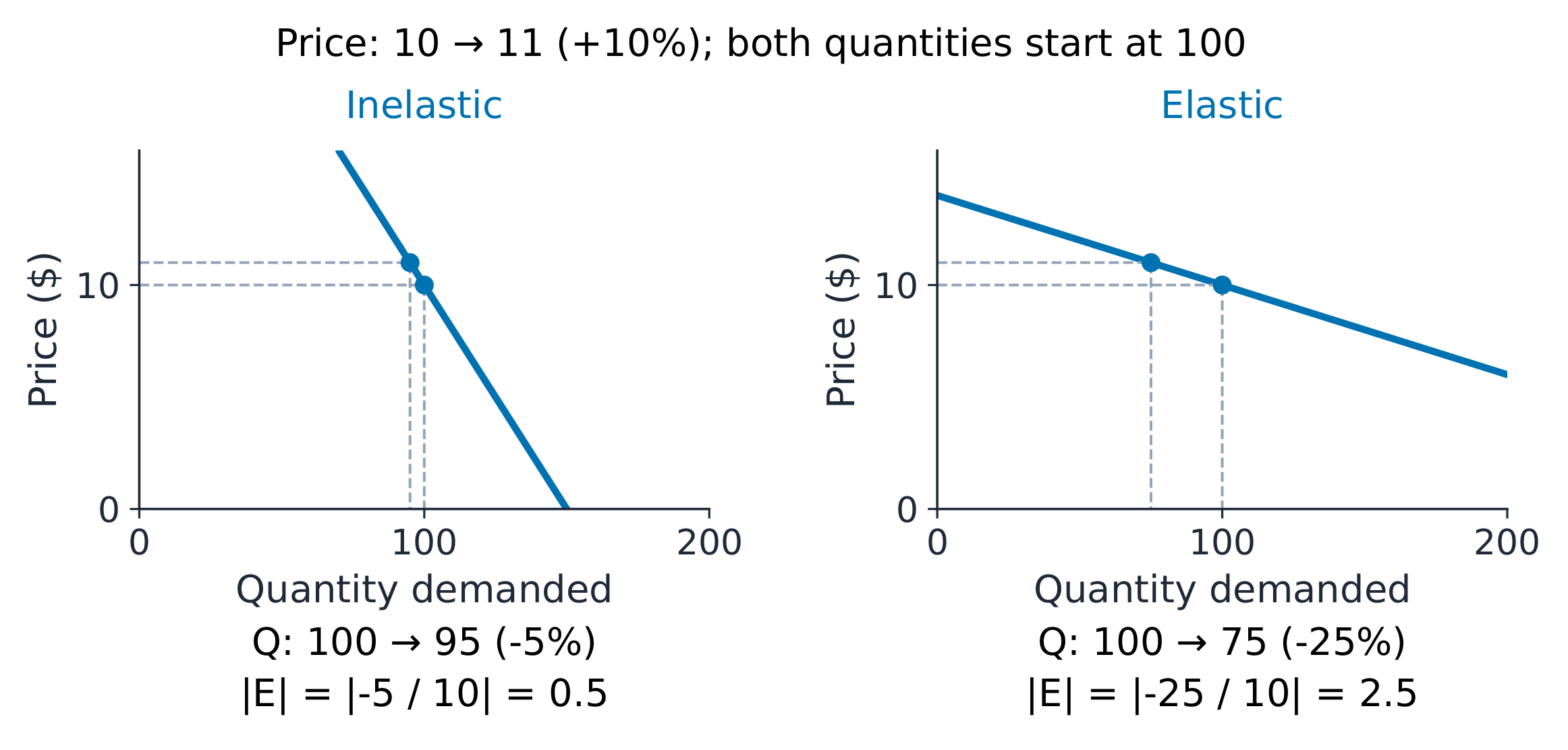
Sellers of inferior goods may gain in a recession.
Dificuldade 1/5 · Moedas 100 + pequeno bônus na primeira conclusão hoje
Demand rises as income falls.
The sign matters for YED and XED. Unlike PED, do not drop the sign: negative YED means inferior; negative XED means complements.
The sign of XED can be ignored, as with PED.
Dificuldade 1/5 · Moedas 100 + pequeno bônus na primeira conclusão hoje
It shows the relationship.
YED = %ΔQd ÷ %Δincome: positive for normal goods, above 1 for luxuries, negative for inferior goods. XED = %ΔQd of A ÷ %ΔP of B: positive for substitutes, negative for complements. Firms use both to plan for growth, recessions and rivals.
A supermarket expects average incomes to fall next year. Use YED to advise which product ranges it should expand.
Applying YED.