Production possibility curves
Introduzido| English | Significado |
|---|---|
| production possibility curve/prəˈdʌkʃn ˌpɒsəˈbɪlɪti kɜːv/ | fronteira de possibilidades produtivas |
| opportunity cost/ɒpəˈtjuːnɪti kɒst/ | custo de oportunidade |
| spare capacity/speə kəˈpæsɪti/ | capacidade ociosa |
| concave/kɒnˈkeɪv/ | côncavo |
| economic growth/ˌiːkəˈnɒmɪk ɡrəʊθ/ | crescimento econômico |
| technology/tekˈnɒlədʒi/ | tecnologia |
Guns or butter?
- A famous wartime choice: an economy can build weapons or make consumer goods — but with fixed resources, more of one means less of the other.
- The production possibility curve 生产可能性曲线 (PPC) draws that trade-off exactly.
Reading the curve
- The PPC shows the maximum combinations of two goods an economy can produce with all resources fully and efficiently used.
- Moving along the curve means making more of one good and less of the other: the amount given up is the opportunity cost.
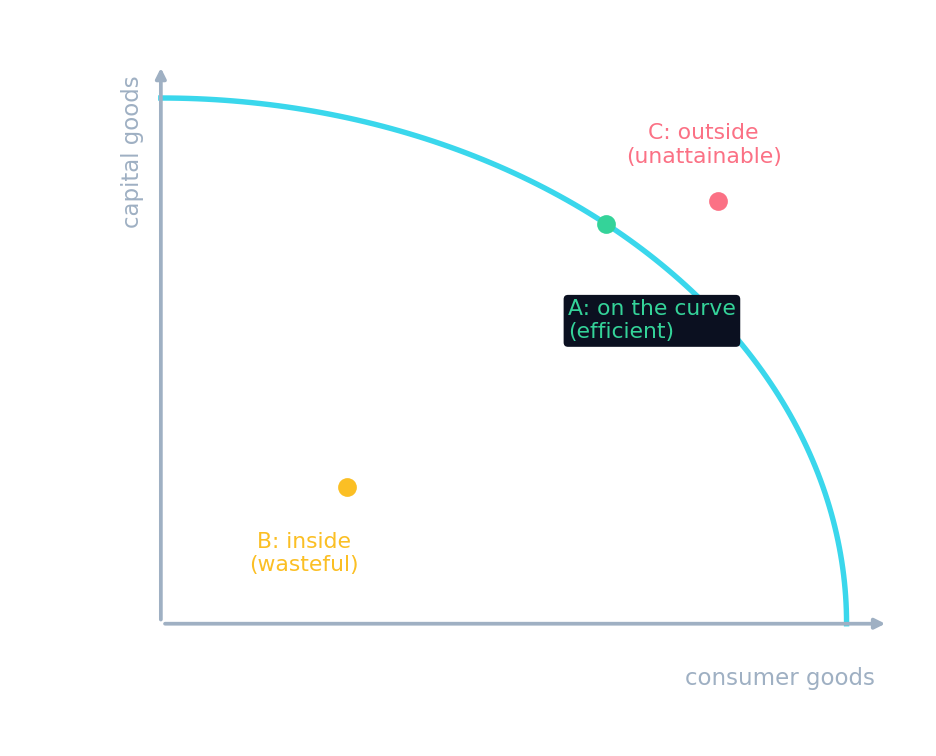
On the curve = efficient; inside = spare capacity 闲置产能; beyond = impossible with current resources.
A curva de possibilidade de produção
Frontier = maximum efficient combinations
The PPF is concave: making more of one good costs ever more of the other.
A point exactly on the PPC represents an economy that is:
Dificuldade 1/5 · Moedas 100 + pequeno bônus na primeira conclusão hoje
On the curve = full, efficient use; inside = spare capacity; beyond = unattainable.
Opportunity cost 机会成本 along the curve
- Moving along the PPC, gaining one good costs units of the other — that sacrifice is the opportunity cost.
- The curve bows outward (concave 凹形的) because resources aren't equally good at both jobs, so opportunity cost rises as you specialise.
The PPC bows outward because opportunity cost stays constant as an economy specialises in one good.
Dificuldade 1/5 · Moedas 100 + pequeno bônus na primeira conclusão hoje
False. A constant opportunity cost gives a straight-line PPC. It bows outward because resources are not equally suited to both goods, so each extra unit costs more of the other good.
An economy moves along its PPC and gains 10 tanks while losing 40 tractors. What is the opportunity cost of one tank (in tractors)?
Dificuldade 2/5 · Moedas 140 + pequeno bônus na primeira conclusão hoje
40 tractors ÷ 10 tanks = 4 tractors per tank.
Shifts: growth and decline
- The whole curve shifts outward with economic growth 经济增长 — more resources (labour, capital) or better technology 技术.
- It shifts inward after a disaster or war that destroys resources.
- A point moving from inside toward the curve = using up spare capacity (recovery), not growth.
Movement along ≠ shift of the curve. Producing a different mix is a move along the PPC; only more/better resources or technology shift the whole curve outward.
Which causes the whole PPC to shift outward?
Dificuldade 1/5 · Moedas 100 + pequeno bônus na primeira conclusão hoje
More/better resources or technology shift the curve out; changing the mix is just a move along it.
Order these from "spare capacity" to "more capacity".
Dificuldade 3/5 · Moedas 200 + pequeno bônus na primeira conclusão hoje
Inside = wasted resources; on = efficient; an outward shift = genuine growth in capacity.
Worked example: a PPC schedule
An economy can produce (consumer goods, capital goods): A (100, 0), B (90, 20), C (70, 40), D (40, 60), E (0, 80). Find the opportunity cost of each extra 20 capital goods, explain the pattern, and compare choosing B with choosing D.
- A→B costs 10 consumer goods, B→C 20, C→D 30, D→E 40: increasing opportunity cost, because resources best suited to consumer goods are moved last. This is why the PPC is concave.
- Choosing D gives fewer consumer goods now but many more capital goods, so the PPC shifts further outward in future. B favours current living standards; D favours economic growth.
Using the schedule, what is the opportunity cost of one capital good when moving from C to D, in consumer goods?
Dificuldade 2/5 · Moedas 140 + pequeno bônus na primeira conclusão hoje
30 consumer goods for 20 capital goods = 1.5 each.
A move from a point inside the PPC to a point on it is a recovery using spare capacity, not economic growth in capacity.
Dificuldade 1/5 · Moedas 100 + pequeno bônus na primeira conclusão hoje
Growth in capacity means the curve itself shifts outward.
You've got it
- the PPC shows max output combinations; on = efficient, inside = wasteful, beyond = unattainable
- moving along it has an opportunity cost; it bows outward as opportunity cost rises
- economic growth shifts the whole curve outward; movement along it just changes the mix
Write from the data given
- A straight production possibility frontier joins 30 cars and 15 buses.
- The country gives up 10 cars.
How many buses are gained?
15 buses for 30 cars means 10 cars buy 5 buses.
How many buses are gained by giving up 10 cars?
Dificuldade 1/5 · Moedas 100 + pequeno bônus na primeira conclusão hoje
Half a bus per car, times 10 cars, is 5 buses. Other options — 15 buses (the whole intercept); No buses (as if the point were inside the frontier).