Transition elements
Introduzido| English | Significado |
|---|---|
| transition element/trænˈsɪʃn ˈelɪmənt/ | elemento de transição |
| d-block/diː blɒk/ | bloco d |
| oxidation state/ˌɒksɪˈdeɪʃn steɪt/ | estado de oxidação |
| catalyst/ˈkætəlɪst/ | catalisador |
| complex ion/ˈkɒmpleks ˈaɪɒn/ | íon complexo |
The colourful middle block
- A transition element 过渡元素 is a d-block d区 element that forms one or more stable ions with incomplete d orbitals.
- Scandium and zinc are d-block but not transition (their stable ions have empty or full d orbitals).
- Transition metals share four special properties.
Transition element property lab
Sort transition-metal evidence by the property it shows.
A transition element is a d-block element that:
Dificuldade 1/5 · Moedas 100 + pequeno bônus na primeira conclusão hoje
The incomplete d orbitals (in a stable ion) define a transition element.
Why are scandium and zinc not classed as transition elements?
Dificuldade 1/5 · Moedas 100 + pequeno bônus na primeira conclusão hoje
Sc³⁺ has an empty d sub-shell and Zn²⁺ a full one, so neither has incomplete d orbitals in its stable ion.
A transition element forms at least one ion with an incomplete ______ subshell.
Dificuldade 1/5 · Moedas 100 + pequeno bônus na primeira conclusão hoje
This gives variable oxidation states and colour.
Four key properties (and why)
| Property | Reason |
|---|---|
| variable oxidation state 氧化态 | the 3d and 4s sub-shells are close in energy |
| act as a catalyst 催化剂 | more than one oxidation state, plus vacant d orbitals |
| form complex ions 配离子 | vacant d orbitals accept lone pairs |
| form coloured compounds | electrons move between split d orbitals |
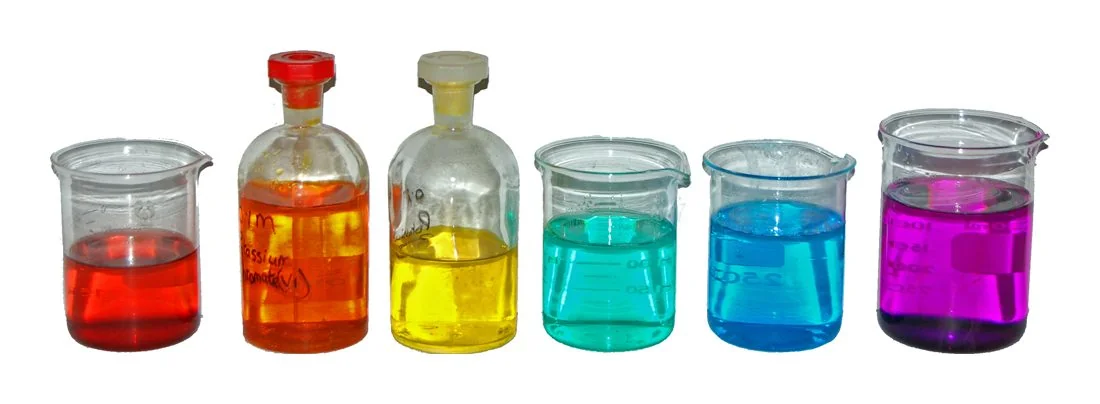
Six transition-metal solutions, each a different colour: cobalt(II) (red), dichromate (orange), chromate (yellow), nickel(II) (green), copper(II) (blue) and permanganate (violet)
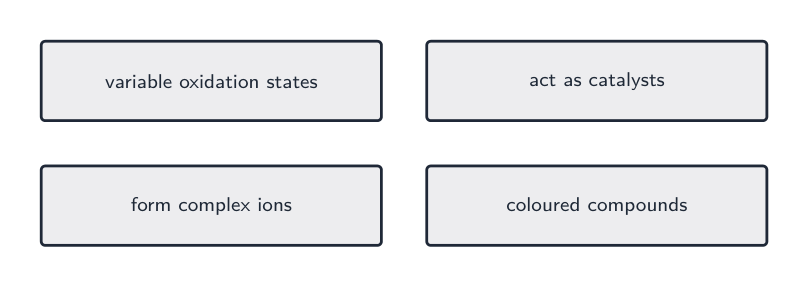
The four key properties of the transition elements
Transition metals show variable oxidation states because:
Dificuldade 1/5 · Moedas 100 + pequeno bônus na primeira conclusão hoje
Similar energies mean similar small amounts of energy can remove different numbers of electrons.
Transition metal compounds are coloured because:
Dificuldade 1/5 · Moedas 100 + pequeno bônus na primeira conclusão hoje
Ligands split the d orbitals; absorbing light of the gap energy gives the colour we see.
Match each transition-element fact.
Dificuldade 2/5 · Moedas 140 + pequeno bônus na primeira conclusão hoje
Each item links the term to its correct meaning.
Worked example: which ions are coloured?
Write the configurations of $\text{Fe}$, $\text{Fe}^{3+}$, $\text{Cu}^{2+}$ and $\text{Cu}^{+}$, and say which ions are coloured.
- Ions lose 4s electrons first: Fe $[\text{Ar}]\,3\text{d}^6 4\text{s}^2$ → $\text{Fe}^{3+}$ $[\text{Ar}]\,3\text{d}^5$; Cu $[\text{Ar}]\,3\text{d}^{10} 4\text{s}^1$ → $\text{Cu}^{2+}$ $[\text{Ar}]\,3\text{d}^9$ and $\text{Cu}^{+}$ $[\text{Ar}]\,3\text{d}^{10}$.
- $\text{Fe}^{3+}$ and $\text{Cu}^{2+}$ have partly filled d subshells, so electrons can jump between split d orbitals: coloured. $\text{Cu}^{+}$ ($3\text{d}^{10}$) has a full d subshell, so its compounds are white or colourless.
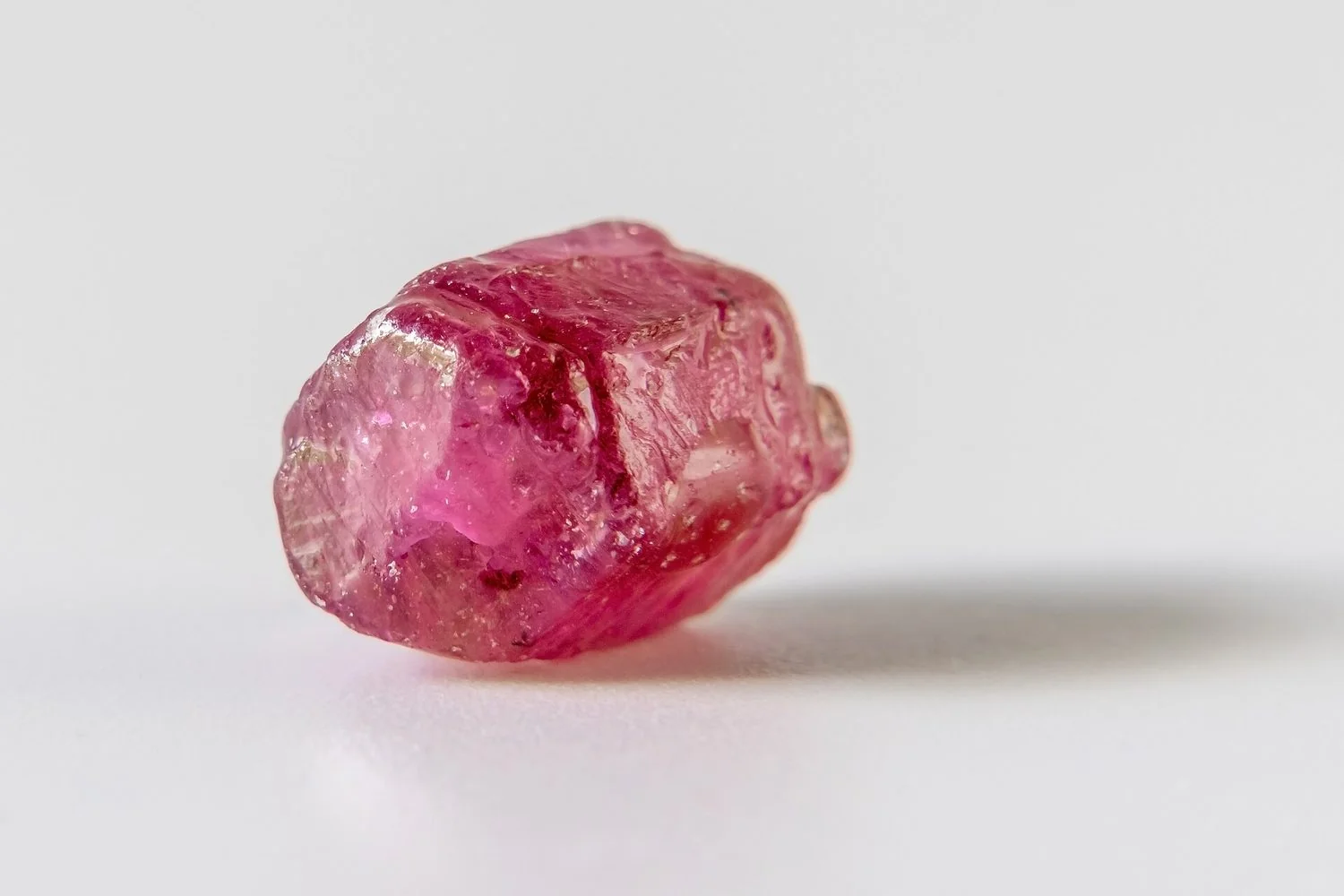
A ruby is red because of transition-metal (chromium) ions held in its lattice.
How many unpaired electrons does an $\text{Fe}^{3+}$ ion ($3\text{d}^5$) have?
Dificuldade 2/5 · Moedas 140 + pequeno bônus na primeira conclusão hoje
Five d electrons spread one into each of the five d orbitals before any pair up.
Zinc sulfate solution is colourless because $\text{Zn}^{2+}$ has a full $3\text{d}^{10}$ subshell.
Dificuldade 1/5 · Moedas 100 + pequeno bônus na primeira conclusão hoje
With every d orbital full, no d–d electron jump can absorb visible light.
Scandium and zinc are exceptions
- Scandium and zinc are d-block but not classed as transition metals.
- Their ions do not have a partly filled d subshell, so they lack the typical properties.
You've got it
- a transition element forms stable ions with incomplete d orbitals (not Sc or Zn)
- four properties: variable oxidation state (3d/4s close), catalysis, complex ions (accept lone pairs), colour (split d orbitals)