Mass spectrometry · Espectrometria de massas
| English | Português |
|---|---|
| mass spectrometry/mæs spekˈtrɒmətri/ | espectrometria de massas |
| mass-to-charge ratio/mæs tə tʃɑːdʒ ˈreɪʃɪəʊ/ | razão massa-carga |
| abundance/əˈbʌndəns/ | abundância |
| molecular ion/məˈlekjʊlə ˈaɪɒn/ | íon molecular |
| fragmentation/ˌfræɡmənˈteɪʃn/ | fragmentação |
Weighing a single molecule
- In mass spectrometry 质谱, a molecule is ionised and sorted by mass-to-charge ratio 质荷比 ($m/e$).
- The spectrum is a set of peaks.
- From it we get relative masses and structural clues.
Pesando uma única molécula
- Na espectrometria de massas 质谱, uma molécula é ionizada e separada por razão massa-carga 质荷比 ($m/e$).
- O espectro é um conjunto de picos.
- Dela obtemos massas relativas e pistas estruturais.
Mass spectrometry route · Rota de espectrometria de massas
Follow a molecule through ionisation, separation and detection. · Siga uma molécula através da ionização, separação e detecção.
In mass spectrometry, the peak at the highest m/z (the molecular ion) gives the relative molecular ______. · Na espectrometria de massas, o pico no maior m/z (o íon molecular) fornece a massa molecular relativa ______.
The M⁺ peak equals the Mr. · O pico M⁺ equivale ao Mr.
Relative atomic mass from isotopes
- An element's isotopes give several peaks. From their abundances 丰度, the relative atomic mass is a weighted average:
- Chlorine (75% $^{35}\text{Cl}$, 25% $^{37}\text{Cl}$): $A_r = \dfrac{35 \times 75 + 37 \times 25}{100} = 35.5$.
A mass spectrum: the molecular ion 分子离子 gives the Mr, fragments show what was lost
Massa atômica relativa a partir de isótopos
- Os isótopos de um elemento dão vários picos. A partir de suas abundâncias 丰度, a massa atômica relativa é uma média ponderada:
- Cloro (75% $^{35}\text{Cl}$, 25% $^{37}\text{Cl}$): $A_r = \dfrac{35 \times 75 + 37 \times 25}{100} = 35.5$.
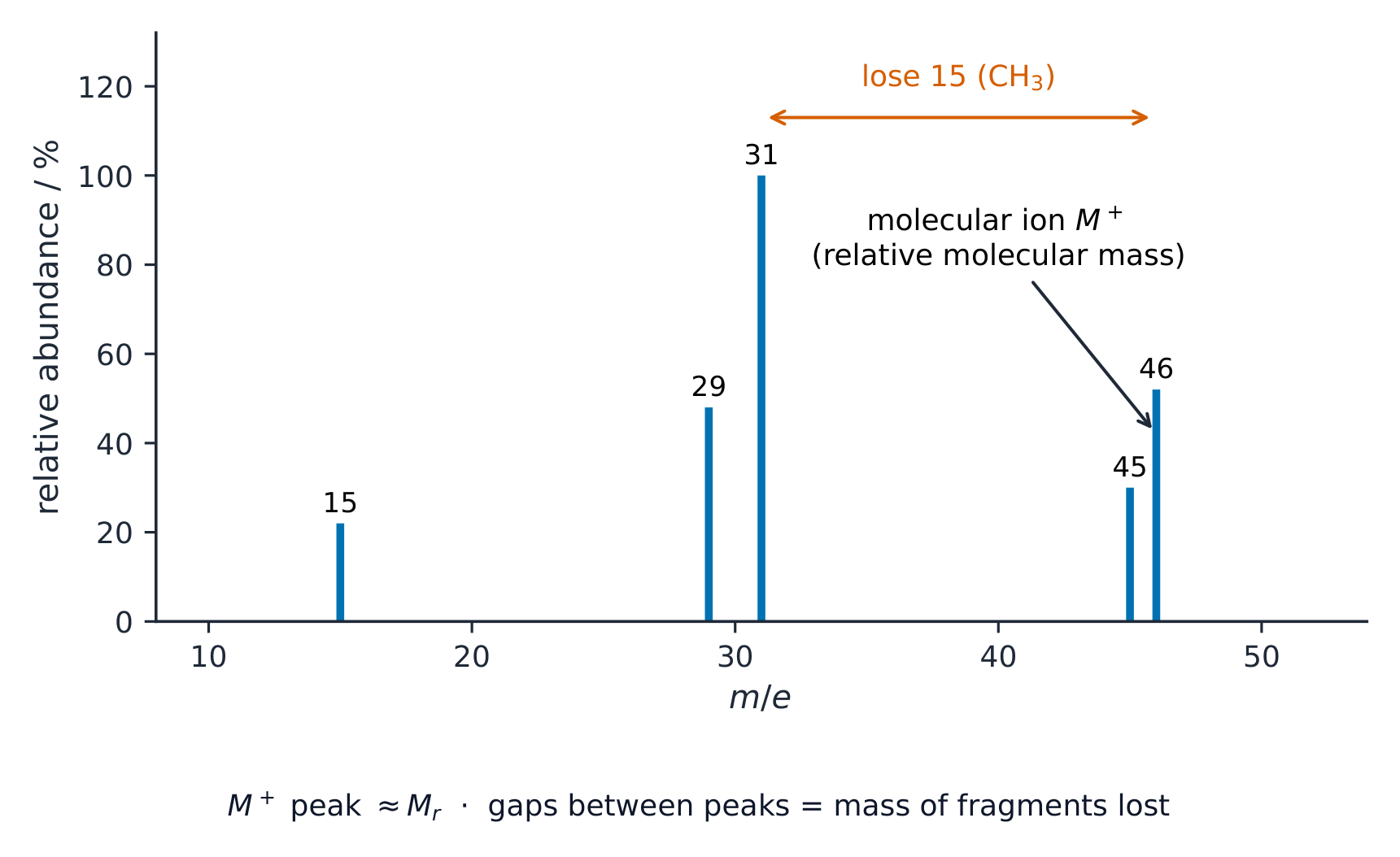
Um espectro de massas: o íon molecular 分子离子 dá o Mr, fragmentos mostram o que foi perdido
Chlorine is 75% ³⁵Cl and 25% ³⁷Cl. What is its relative atomic mass? (use (35×75 + 37×25)/100) · O cloro é 75% ³⁵Cl e 25% ³⁷Cl. Qual é a sua massa atómica relativa? (use (35×75 + 37×25)/100)
Ar = (35×75 + 37×25)/100 = (2625 + 925)/100 = 35.5.
Molecular ion and fragmentation 碎裂
- The highest $m/e$ peak is the molecular ion ($M^{+}$) — it gives the relative molecular mass.
- The molecule also breaks into pieces (fragmentation). The gap between peaks = the mass lost: a loss of 15 = a $\text{CH}_3$ group; a loss of 29 = $\text{CHO}$ or $\text{C}_2\text{H}_5$.
A modern mass spectrometer in a laboratory; the sample is loaded at the front and the machine sorts its ions by mass-to-charge ratio
Íon molecular e fragmentação 碎裂
- O pico mais alto $m/e$ é o íon molecular ($M^{+}$) — ele fornece a massa molecular relativa.
- A molécula também se divide em pedaços (fragmentação). A lacuna entre picos = a massa perdida: perda de 15 = um grupo $\text{CH}_3$; perda de 29 = $\text{CHO}$ ou $\text{C}_2\text{H}_5$.

Um espectrômetro de massas moderno em laboratório; a amostra é carregada na frente e a máquina separa seus íons por razão massa-carga
The molecular ion peak (the highest m/e) gives the: · O pico do íon molecular (o maior m/e) fornece:
The highest-m/e peak (M⁺) is the whole molecule, so it gives the Mr. · O pico de maior m/e (M⁺) corresponde à molécula inteira, portanto fornece o Mr.
A gap of 15 between two peaks means the molecule has lost: · Uma lacuna de 15 entre dois picos significa que a molécula perdeu:
A loss of 15 mass units corresponds to a CH₃ fragment; a loss of 29 is CHO or C₂H₅. · Uma perda de 15 unidades de massa corresponde ao fragmento CH₃; uma perda de 29 corresponde a CHO ou C₂H₅.
The [M+1] and [M+2] peaks
- a small [M+1] peak (from $^{13}\text{C}$) tells you the number of carbons.
- an [M+2] peak (two units up) shows a halogen: chlorine gives a 3:1 ratio, bromine a 1:1 ratio.
Os picos [M+1] e [M+2]
- um pequeno pico [M+1] (de $^{13}\text{C}$) informa o número de carbonos.
- um pico [M+2] (duas unidades acima) mostra um halogênio: cloro dá uma razão 3:1, bromo uma razão 1:1.
An [M+2] peak about the same height as M⁺ (a 1:1 ratio) shows the molecule contains: · Um pico [M+2] com altura aproximadamente igual à M⁺ (uma proporção 1:1) indica que a molécula contém:
One bromine gives a 1:1 [M+2]:M⁺ ratio; one chlorine gives about 3:1. · Um bromo fornece uma razão 1:1 [M+2]:M⁺; um cloro fornece cerca de 3:1.
You've got it
- mass spec sorts ions by $m/e$; $A_r = \dfrac{\sum(\text{mass} \times \text{abundance})}{\sum \text{abundance}}$ (Cl = 35.5)
- the molecular ion ($M^{+}$, highest $m/e$) = the $M_r$; fragmentation gaps give lost pieces (loss 15 = $\text{CH}_3$)
- [M+1] ($^{13}\text{C}$) → number of carbons; [M+2] → halogen (Cl 3:1, Br 1:1)
Entendeu?
- a espectrometria de massas separa íons com base no $m/e$; $A_r = \dfrac{\sum(\text{mass} \times \text{abundance})}{\sum \text{abundance}}$ (Cl = 35.5)
- o íon molecular ($M^{+}$, pico mais alto $m/e$) = a $M_r$; lacunas de fragmentação indicam peças perdidas (perda 15 = $\text{CH}_3$)
- [M+1] ($^{13}\text{C}$) → número de carbonos; [M+2] → halogênio (Cl 3:1, Br 1:1)