Planning a synthetic route · Planejamento de rota sintética
| English | Português |
|---|---|
| target molecule/ˈtɑːɡɪt ˈmɒlɪkjuːl/ | molécula-alvo |
| starting material/ˈstɑːtɪŋ məˈtɪərɪəl/ | material de partida |
| reagent/rɪˈeɪdʒənt/ | reactivo |
| by-product/baɪ ˈprɒdʌkt/ | subproduto |
| yield/jiːld/ | rendimento |
From start to target
- A target molecule 目标分子 is built in several steps.
- The trick is to work backwards from the target.
- You also analyse a given route step by step.
Do início ao alvo
- Uma molécula-alvo 目标分子 é construída em várias etapas.
- O truque é trabalhar para trás a partir do alvo.
- Você também analisa uma rota dada passo a passo.
Synthetic route planning lab · Laboratório de planejamento de rota sintética
Follow how a target molecule is planned backwards then made forwards. · Siga como uma molécula-alvo é planejada para trás e depois feita para frente.
A good synthetic route uses few steps and gives a high overall yield. · Uma boa rota sintética usa poucas etapas e dá alto rendimento global.
Fewer steps means less loss of product. · Menos etapas significam menos perda de produto.
Planning a route
- compare the target with the starting material 起始材料 — what changed (the group, the number of carbons)?
- work backwards: which single reaction could make the target, and from what?
- repeat until you reach the starting material.
- write each step with its reagent 试剂 and conditions.
- To add a carbon, the KCN step is the key (the only chain-lengthening AS reaction).
Plan a synthesis backwards — from the target, step by step, to the starting material
Medicines are built up by multi-step organic synthesis.
Planejando uma rota
- compare o alvo com o material inicial 起始材料 — o que mudou (o grupo, o número de carbonos)?
- trabalhe para trás: qual reação única poderia produzir o alvo, e a partir de quê?
- repita até chegar ao material inicial.
- escreva cada etapa com seu reagente 试剂 e condições.
- Para adicionar um carbono, a etapa de KCN é a chave (a única reação de alongamento de cadeia AS).
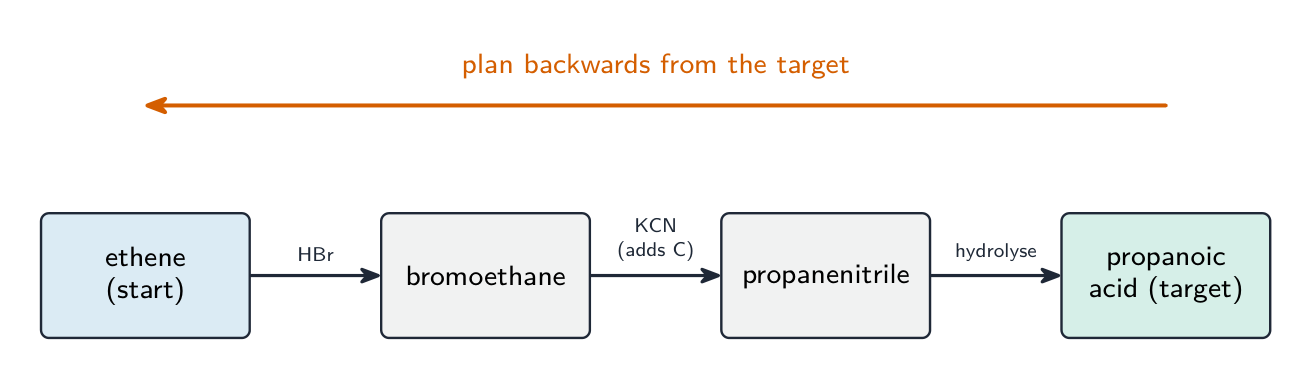
Planeje uma síntese para trás — do alvo, passo a passo, até o material inicial

Medicamentos são construídos por síntese orgânica multietapa.
The best way to plan a multi-step synthesis is to: · A melhor maneira de planejar uma síntese multietapa é:
Working backwards from the target finds which reaction makes it, and from what, step by step. · Trabalhar para trás a partir do alvo encontra qual reação o produz e de onde, passo a passo.
If your route needs to add a carbon atom, the key step is: · Se sua rota precisar adicionar um átomo de carbono, a etapa chave é:
KCN is the only AS reaction that lengthens the carbon chain. · KCN é a única reação AS que alonga a cadeia de carbonos.
Match each synthesis idea. · Combine cada ideia de síntese.
Each item links the term to its correct meaning. · Cada item associa o termo ao seu significado correto.
Analysing a route
- For each step, state the type of reaction (oxidation, reduction, substitution, addition, elimination) and the reagent.
- Think about by-products 副产物 — e.g. making an amine from a halogenoalkane also gives further-substituted amines, so the yield 产率 of the simple amine is low.
Analisando uma rota
- Para cada etapa, indique o tipo de reação (oxidação, redução, substituição, adição, eliminação) e o reagente.
- Pense nos subprodutos 副产物 — ex.: ao fazer uma amina a partir de um haloalcano também se formam aminas mais substituídas, então o rendimento 产率 da amina simples é baixo.
When analysing each step of a given route, you should state: · Ao analisar cada etapa de uma rota dada, você deve afirmar:
Identify the reaction type (oxidation, substitution, etc.) and the reagent/conditions for each step. · Identifique o tipo de reação (oxidação, substituição, etc.) e o reagente/condições para cada etapa.
Why is the yield of a simple amine from a halogenoalkane low? · Por que o rendimento de uma amina simples a partir de um haloalcano é baixo?
The amine is itself a nucleophile, so it reacts again — a by-product mixture lowers the yield. · A amina é ela mesma um nucleófilo, então reage novamente — uma mistura de subprodutos reduz o rendimento.
Judging a route
- Prefer routes with few steps and high yield, using safe, cheap reagents.
- Each extra step loses product, so the overall yield falls quickly.
Avaliando uma rota
- Prefira rotas com menos etapas e alto rendimento, usando reagentes seguros e baratos.
- Cada etapa extra perde produto, então o rendimento total cai rapidamente.
You've got it
- plan by working backwards from the target (compare groups and carbon count)
- write each step's reagent + conditions; use KCN to add a carbon
- to analyse a route, give each step's reaction type and reagent, and watch for by-products
Entendeu?
- planeie para trás a partir do alvo (compare grupos e contagem de carbono)
- escreva o reagente + condições de cada etapa; use KCN para adicionar um carbono
- para analisar uma rota, dê o tipo de reação e o reagente de cada etapa, e observe os subprodutos