Reactions of chlorine
Introduzido| English | Significado |
|---|---|
| chlorate/ˈklɔːreɪt/ | clorato |
| disproportionation/ˌdɪsprəˈpɔːʃəneɪʃn/ | disproporcionamento |
| water purification/ˈwɔːtə ˌpjʊərɪfɪˈkeɪʃn/ | purificação de água |
| bacteria/bækˈtɪərɪə/ | bactérias |
The chemistry that cleans water
- Chlorine reacts with sodium hydroxide in two ways.
- In both, chlorine is disproportionated.
- A little chlorine also makes water safe to drink.
Chlorine reaction route
Follow chlorine from water treatment to redox reactions.
Chlorine reacts with water to form a mixture used to disinfect water supplies.
Dificuldade 1/5 · Moedas 100 + pequeno bônus na primeira conclusão hoje
It forms chloric(I) acid, which kills microbes.
With sodium hydroxide
- Cold, dilute NaOH → chloride + chlorate 氯酸盐(I):
$$\text{Cl}_2 + 2\text{NaOH} \rightarrow \text{NaCl} + \text{NaClO} + \text{H}_2\text{O}$$
- Hot, concentrated NaOH → chloride + chlorate(V):
$$3\text{Cl}_2 + 6\text{NaOH} \rightarrow 5\text{NaCl} + \text{NaClO}_3 + 3\text{H}_2\text{O}$$
- In both, chlorine's oxidation number goes both up and down from 0 — disproportionation 歧化.
Chlorine with cold, dilute sodium hydroxide forms:
Dificuldade 1/5 · Moedas 100 + pequeno bônus na primeira conclusão hoje
Cl₂ + 2NaOH → NaCl + NaClO + H₂O (chlorate(I)); hot concentrated NaOH gives chlorate(V) instead.
These reactions of chlorine with NaOH are disproportionation because chlorine:
Dificuldade 1/5 · Moedas 100 + pequeno bônus na primeira conclusão hoje
Some chlorine goes to −1 (chloride) and some to +1 or +5 (chlorate) — the same element both up and down.
In the reaction of chlorine with sodium hydroxide, chlorine is only reduced.
Dificuldade 1/5 · Moedas 100 + pequeno bônus na primeira conclusão hoje
False. Chlorine is both oxidised (to ClO⁻ or ClO₃⁻) and reduced (to Cl⁻), which makes it a disproportionation reaction.
Match each chlorine reaction to its product/role.
Dificuldade 2/5 · Moedas 140 + pequeno bônus na primeira conclusão hoje
Each item links the term to its correct meaning.
Water purification 水净化
- A little chlorine is added to water:
$$\text{Cl}_2 + \text{H}_2\text{O} \rightleftharpoons \text{HOCl} + \text{HCl}$$
- The active species HOCl and ClO⁻ kill bacteria 细菌, making the water safe to drink.
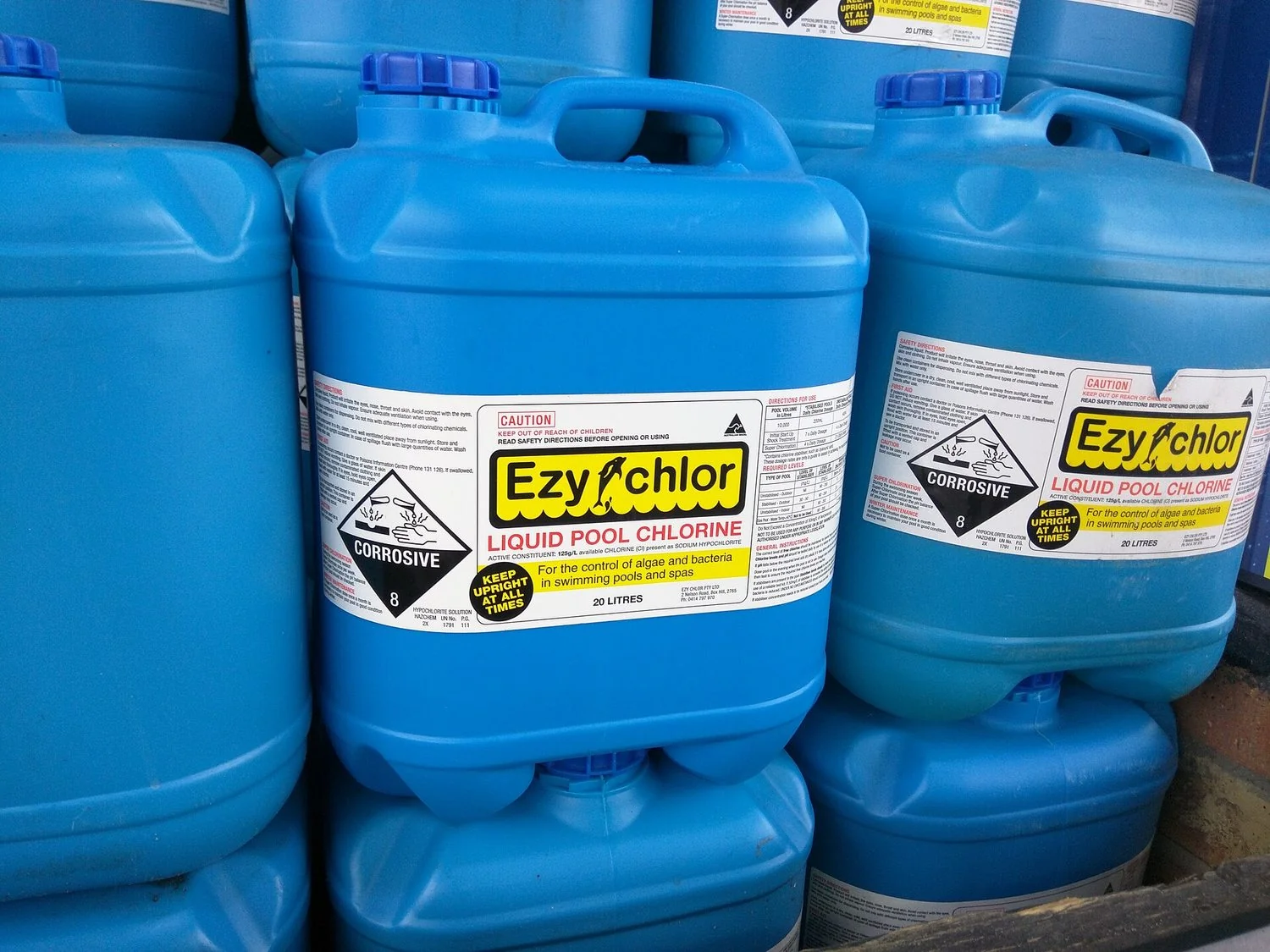
Chlorine is added to pool water to kill microbes
Chlorine makes water safe to drink because:
Dificuldade 1/5 · Moedas 100 + pequeno bônus na primeira conclusão hoje
Cl₂ + H₂O ⇌ HOCl + HCl; the HOCl and ClO⁻ kill bacteria.
Worked example: why 5 NaCl for every NaClO₃?
Use oxidation numbers to explain the ratio in $3\text{Cl}_2 + 6\text{NaOH} \rightarrow 5\text{NaCl} + \text{NaClO}_3 + 3\text{H}_2\text{O}$.
- Cl starts at 0. In $\text{NaCl}$ it is $-1$ (a fall of 1); in $\text{NaClO}_3$ it is $+5$, since $+1 + x + 3(-2) = 0$ (a rise of 5).
- Electrons lost must equal electrons gained, so five Cl atoms fall by 1 for every one that rises by 5: 5 NaCl to 1 $\text{NaClO}_3$, using 6 Cl atoms, which is $3\text{Cl}_2$. In water treatment, $\text{Cl}_2 + \text{H}_2\text{O} \rightarrow \text{HCl} + \text{HOCl}$ is also a disproportionation: Cl goes to $-1$ and $+1$.
What is the oxidation number of chlorine in chloric(I) acid, HOCl?
Dificuldade 2/5 · Moedas 140 + pequeno bônus na primeira conclusão hoje
H is $+1$ and O is $-2$, so $+1 - 2 + x = 0$ e $x = +1$, as the name chloric(I) says.
Which chlorine-containing products form when chlorine reacts with hot, concentrated sodium hydroxide?
Dificuldade 1/5 · Moedas 100 + pequeno bônus na primeira conclusão hoje
Hot alkali gives chlorate(V). Five Cl atoms fall by 1 for each one that rises by 5. Cold dilute alkali gives NaCl and NaClO 1 : 1.
You've got it
- chlorine + cold dilute NaOH → NaCl + NaClO (chlorate I); + hot conc NaOH → NaCl + NaClO₃ (chlorate V)
- both are disproportionation (Cl goes up and down from 0)
- chlorine purifies water: $\text{Cl}_2 + \text{H}_2\text{O} \rightleftharpoons \text{HOCl} + \text{HCl}$; HOCl kills bacteria