Halogens and hydrogen halides
Introduzido| English | Significado |
|---|---|
| oxidising agent/ˈɒksɪdaɪzɪŋ ˈeɪdʒənt/ | agente oxidante |
| hydrogen halide/ˈhaɪdrədʒn ˈhælaɪd/ | haleto de hidrogênio |
| displace/dɪˈspleɪs/ | deslocar |
| vigorous/ˈvɪɡərəs/ | vigoroso |
| thermal stability/ˈθɜːml stəˈbɪlɪti/ | estabilidade térmica |
Reactive non-metals
- Each halogen gains an electron to form a $1-$ ion — so it is an oxidising agent 氧化剂.
- Its oxidising power decreases down the group.
- The hydrogen halides 卤化氢 get less stable down the group.
Halogen and hydrogen halide lab
Classify halogen chemistry by oxidising and reducing strength.
A halogen acts as an oxidising agent because it:
Dificuldade 1/5 · Moedas 100 + pequeno bônus na primeira conclusão hoje
Halogens gain an electron (so they oxidise other species); this power falls down the group.
A more reactive halogen will ______ a less reactive one from solution.
Dificuldade 1/5 · Moedas 100 + pequeno bônus na primeira conclusão hoje
e.g. chlorine displaces bromine.
Oxidising power and displacement
- A halogen acts as an oxidising agent (it gains one electron). This power falls down the group (larger atoms attract the extra electron less).
- A more reactive halogen displaces 置换 a less reactive one from its salt:
$$\text{Cl}_2 + 2\text{KBr} \rightarrow 2\text{KCl} + \text{Br}_2$$
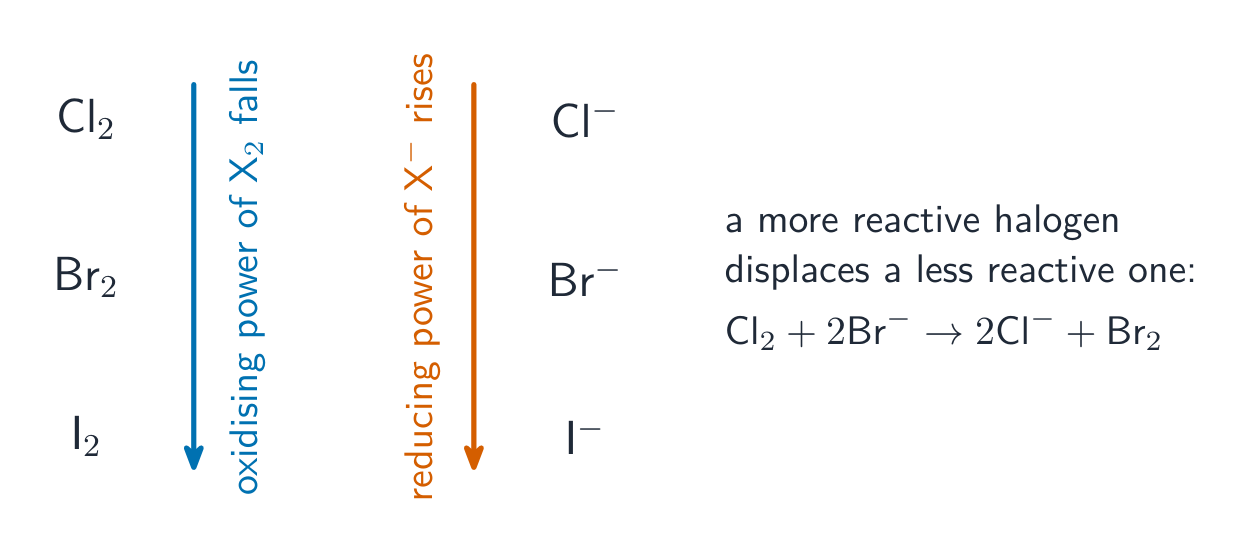
Halogen oxidising power falls and halide reducing power rises down the group
Chlorine displaces bromine from potassium bromide because chlorine is:
Dificuldade 1/5 · Moedas 100 + pequeno bônus na primeira conclusão hoje
A more reactive halogen pushes out a less reactive one: Cl₂ + 2KBr → 2KCl + Br₂.
Match each halogen-reaction fact.
Dificuldade 2/5 · Moedas 140 + pequeno bônus na primeira conclusão hoje
Each item links the term to its correct meaning.
Reactions with hydrogen
- Each halogen forms a hydrogen halide: $\text{H}_2 + \text{Cl}_2 \rightarrow 2\text{HCl}$.
- The reaction gets less vigorous 剧烈 down the group (chlorine explosive in light; iodine slow and partial).
The reaction of the halogens with hydrogen:
Dificuldade 1/5 · Moedas 100 + pequeno bônus na primeira conclusão hoje
Chlorine reacts explosively in light, bromine needs heat, and iodine reacts slowly and partly.
Thermal stability 热稳定性 of HX
- The thermal stability of the hydrogen halides decreases down the group.
- The H–X bond gets weaker as the halogen gets larger, so HI breaks apart on gentle heating while HCl is very stable.
The thermal stability of the hydrogen halides:
Dificuldade 1/5 · Moedas 100 + pequeno bônus na primeira conclusão hoje
The H–X bond weakens as X gets larger, so HI decomposes easily while HCl is very stable.
Worked example: predict a displacement
Predict what happens when chlorine water is added to potassium iodide solution, and when iodine solution is added to potassium chloride solution.
- Chlorine is the stronger oxidising agent, so it takes electrons from iodide: $\text{Cl}_2 + 2\text{I}^- \rightarrow 2\text{Cl}^- + \text{I}_2$. The colourless solution turns brown as iodine forms.
- Iodine is a weaker oxidising agent than chlorine, so it cannot oxidise $\text{Cl}^-$: no reaction. A halogen displaces only the halides below it in the group.
Bromine water is added to separate solutions of KCl and KI. What is observed?
Dificuldade 1/5 · Moedas 100 + pequeno bônus na primeira conclusão hoje
Bromine oxidises iodide, which is below it, to iodine: $\text{Br}_2 + 2\text{I}^- \rightarrow 2\text{Br}^- + \text{I}_2$. It cannot oxidise chloride, which is above it.
You've got it
- halogens are oxidising agents (gain 1 electron); power decreases down the group
- a more reactive halogen displaces a less reactive one ($\text{Cl}_2 + 2\text{KBr} \rightarrow 2\text{KCl} + \text{Br}_2$)
- reactions with hydrogen get less vigorous down; HX thermal stability decreases down (HI least stable)