Catalysts · Catalisadores
| English | Português |
|---|---|
| catalyst/ˈkætəlɪst/ | catalisador |
| reaction mechanism/rɪˈækʃn ˈmekənɪzəm/ | mecanismo de reação |
| homogeneous catalyst/həˈməʊdʒnɪəs ˈkætəlɪst/ | catalisador homogêneo |
| heterogeneous catalyst/ˌhetrəˈdʒiːnɪəs ˈkætəlɪst/ | catalisador heterogêneo |
A shortcut for reactions
- A catalyst 催化剂 speeds up a reaction but is not used up.
- It works by giving a new route with a lower activation energy.
- It does not change the enthalpy of the reaction.
Um atalho para reações
- Um catalisador 催化剂 acelera uma reação mas não é consumido.
- Ele funciona oferecendo uma nova rota com energia de ativação menor.
- Ele não altera a entalpia da reação.
A catalyst speeds up a reaction by: · Um catalisador acelera uma reação:
A catalyst offers a new mechanism with a lower Eₐ, so more molecules can react; it is not used up. · Um catalisador oferece um novo mecanismo com Eₐ mais baixa, permitindo que mais moléculas reajam; ele não é consumido.
A catalyst speeds up a reaction by providing a route with a lower activation energy. · Um catalisador acelera uma reação fornecendo uma rota com energia de ativação mais baixa.
It is not used up. · Ele não é consumido.
How a catalyst works
- A catalyst provides a different reaction mechanism 反应机理 with a lower $E_A$.
- On the Boltzmann distribution, lowering $E_A$ moves the line left, so more molecules can react → more effective collisions → faster rate.
- The enthalpy change $\Delta H$ is unchanged — only the activation energy is lowered.
A catalyst gives a route with lower activation energy; the enthalpy change is unchanged
Como um catalisador funciona
- Um catalisador fornece um mecanismo de reação 反应机理 diferente com uma menor $E_A$.
- Na distribuição de Boltzmann, reduzir $E_A$ move a linha para a esquerda, permitindo que mais moléculas reajam → mais colisões efetivas → velocidade maior.
- A variação de entalpia $\Delta H$ permanece inalterada — apenas a energia de ativação é reduzida.

Um catalisador oferece uma rota com energia de ativação menor; a variação de entalpia permanece inalterada
Catalysts · Catalisadores
a catalyst lowers Ea · um catalisador reduz Ea
A catalyst lowers Ea, so a bigger fraction of molecules can react — without heating. · Um catalisador reduz Ea, permitindo que uma fração maior de moléculas reaja — sem aquecimento.
A catalyst does NOT change the: · Um catalisador NÃO altera o:
A catalyst lowers Eₐ and speeds the rate, but the overall ΔH (reactants to products) is unchanged. · Um catalisador reduz Eₐ e acelera a taxa, mas a ΔH total (reagentes para produtos) permanece inalterada.
Match each catalyst idea to its meaning. · Combine cada ideia de catalisador com seu significado.
Each item links the term to its correct meaning. · Cada item associa o termo ao seu significado correto.
Two types
- a homogeneous catalyst 均相催化剂 is in the same physical state as the reactants (e.g. an acid dissolved among liquids).
- a heterogeneous catalyst 多相催化剂 is in a different state (e.g. solid iron speeding up the gases in the Haber process; a car's catalytic converter).
A homogeneous catalyst mixes in with the reactants; a heterogeneous one is a separate surface
Dois tipos
- um catalisador homogêneo 均相催化剂 está no mesmo estado físico dos reagentes (ex.: um ácido dissolvido entre líquidos).
- um catalisador heterogêneo 多相催化剂 está em um estado diferente (ex.: ferro sólido acelerando gases no processo Haber; conversor catalítico de carro).
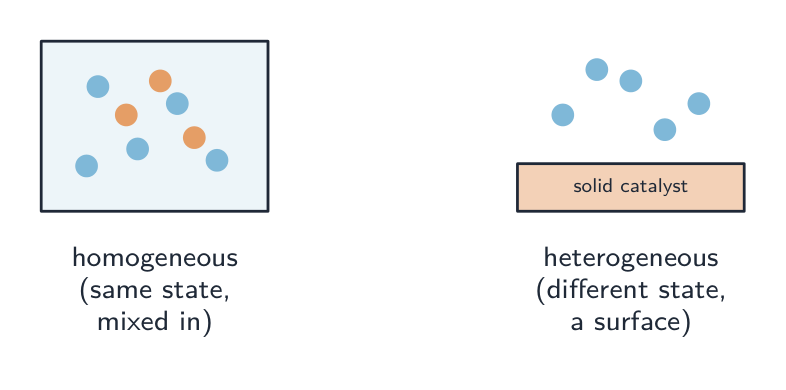
Um catalisador homogêneo mistura-se aos reagentes; um heterogêneo é uma superfície separada
A heterogeneous catalyst is one that is: · Um catalisador heterogêneo é aquele que está:
Heterogeneous = different state (e.g. solid catalyst, gas reactants); homogeneous = same state. · Heterogêneo = estado diferente (ex. catalisador sólido, reagentes gasosos); homogêneo = mesmo estado.
Solid iron speeding up the gas reaction in the Haber process is an example of a: · O ferro sólido acelerando a reação gasosa no processo Haber é um exemplo de:
The solid iron is in a different state from the gaseous reactants, so it is a heterogeneous catalyst. · O ferro sólido está em estado diferente dos reagentes gasosos, sendo um catalisador heterogêneo.
How a catalyst changes the picture
- A catalyst gives an alternative pathway with a lower activation energy.
- More molecules now have enough energy to react, so the rate rises — without being used up.
Como um catalisador muda o quadro
- Um catalisador oferece um caminho alternativo com energia de ativação menor.
- Mais moléculas agora têm energia suficiente para reagir, aumentando a velocidade — sem serem consumidas.
You've got it
- a catalyst speeds up a reaction, is not used up, and gives a route with lower $E_A$
- lower $E_A$ → more molecules can react → faster rate; $\Delta H$ is unchanged
- homogeneous = same state as reactants; heterogeneous = different state (e.g. solid iron, catalytic converter)
Entendeu?
- um catalisador acelera uma reação, não é consumido e oferece uma rota com menor $E_A$
- menor $E_A$ → mais moléculas podem reagir → velocidade maior; $\Delta H$ permanece inalterado
- homogêneo = mesmo estado que os reagentes; heterogêneo = estado diferente (ex.: ferro sólido, conversor catalítico)