Rate of reaction · Taxa de reação
| English | Português |
|---|---|
| rate of reaction/reɪt ɒv rɪˈækʃn/ | taxa de reação |
| effective collision/ɪˈfektɪv kəˈlɪʒn/ | colisão eficaz |
| concentration/ˌkɒnsənˈtreɪʃn/ | concentração |
| orientation/ˌɔːrɪənˈteɪʃn/ | orientação |
How fast, and why
- The rate of reaction 反应速率 is how fast reactants turn into products.
- For particles to react, they must collide.
- But not every collision works.
Quão rápido, e por quê
- A velocidade de reação 反应速率 é quão rápido os reagentes viram produtos.
- Para partículas reagirem, elas devem colidir.
- Mas nem toda colisão funciona.
Rate of reaction is measured as the: · A taxa de reação é medida como a:
Rate is how much the concentration (or amount) changes in each unit of time. · A taxa é quanto a concentração (ou quantidade) muda em cada unidade de tempo.
The rate of reaction can be found from the ______ of a concentration-time graph. · A taxa de reação pode ser encontrada pela ______ de um gráfico de concentração versus tempo.
A steeper gradient means a faster rate. · Um gradiente mais íngreme significa uma taxa mais rápida.
Effective collisions 有效碰撞
- An effective collision has enough energy and the correct direction — so a reaction happens.
- A non-effective collision lacks energy or hits at the wrong angle — nothing happens.
- The rate depends on the frequency of effective collisions per second.
At higher temperature the curve spreads to the right, so a larger fraction of molecules can react
Colisões efetivas 有效碰撞
- Uma colisão efetiva tem energia suficiente e a direção correta — para que uma reação ocorra.
- Uma colisão inefetiva carece de energia ou bate num ângulo errado — nada acontece.
- A velocidade depende da frequência de colisões efetivas por segundo.
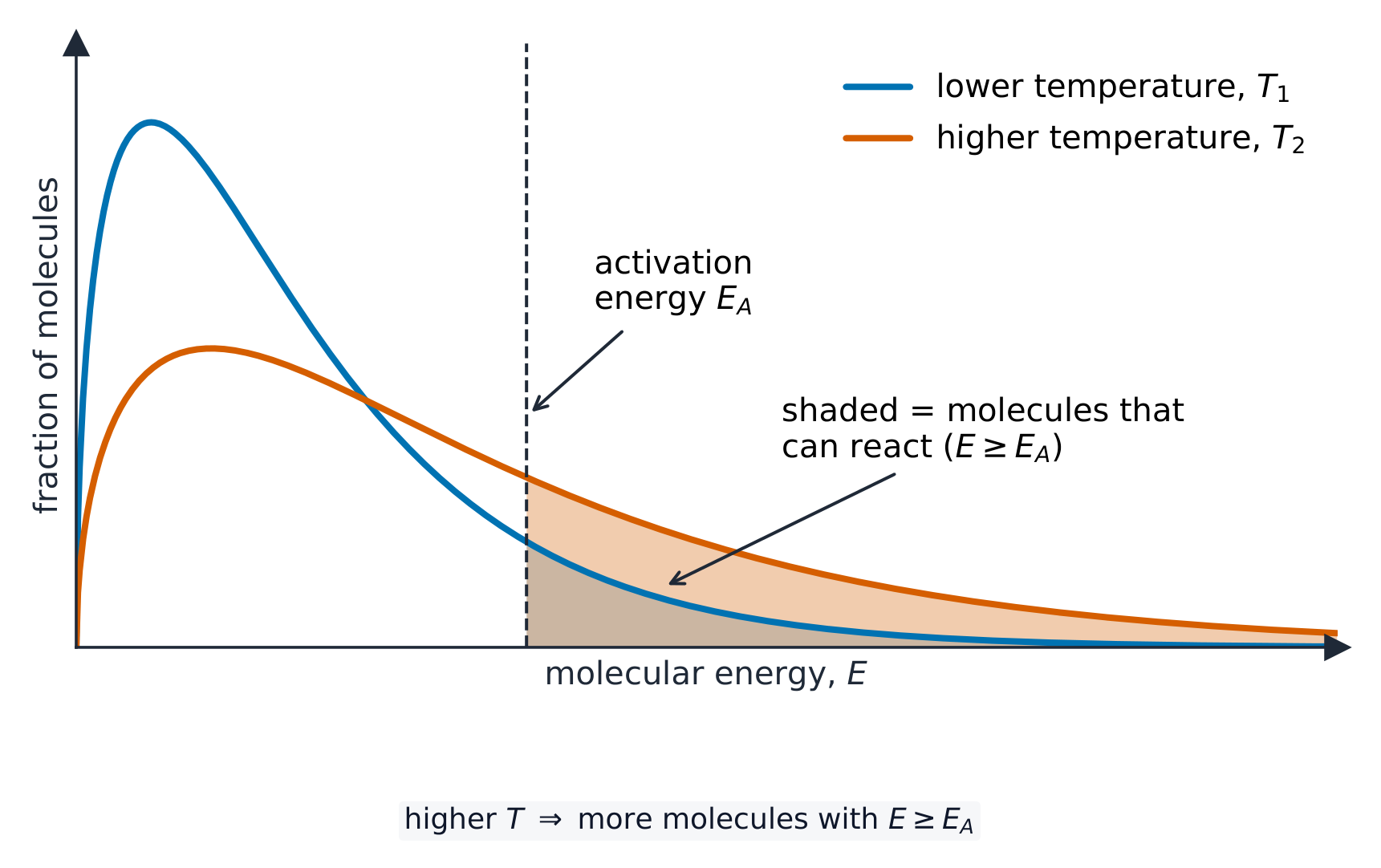
Em temperatura mais alta a curva se espalha para a direita, permitindo que uma fração maior de moléculas reaja
Rate of reaction · Taxa de reação
[A] = [A]₀·bᵗ
Reactant concentration falls over time as it's used up. · A concentração do reagente diminui com o tempo à medida que é consumida.
An effective collision is one that: · Uma colisão eficaz é aquela que:
A collision only reacts with sufficient energy and the right orientation. · Uma colisão só reage com energia suficiente e orientação correta.
The rate of reaction depends on the: · A taxa de reação depende da:
More effective collisions per second means a faster rate. · Mais colisões eficazes por segundo significam uma taxa mais rápida.
Match each rate idea to its meaning. · Combine cada ideia de taxa com seu significado.
Each item links the term to its correct meaning. · Cada item associa o termo ao seu significado correto.
Concentration 浓度 and pressure
- Increasing concentration (or gas pressure) packs particles closer together.
- They collide more often, so there are more effective collisions per second — the rate rises.
A catalytic converter speeds up reactions that clean a car's exhaust gases
Concentração 浓度 e pressão
- Aumentar a concentração (ou pressão de gás) aproxima as partículas.
- Elas colidem com mais frequência, então há mais colisões efetivas por segundo — a velocidade aumenta.

Um conversor catalítico acelera reações que limpam os gases de escape de um carro
Increasing the concentration of a reactant speeds up the reaction because: · Aumentar a concentração de um reagente acelera a reação porque:
More particles in the same volume collide more frequently, raising the rate. · Mais partículas no mesmo volume colidem com mais frequência, aumentando a taxa.
Measuring rate in the lab
- Follow a reaction by gas volume, mass loss, or a colour/conductivity change over time.
- The initial rate is the gradient of the tangent at the start.
More particles in the same volume collide more often, so the rate rises
Medindo a velocidade no laboratório
- Acompanhe uma reação pelo volume de gás, perda de massa ou mudança de cor/condutividade ao longo do tempo.
- A velocidade inicial é a inclinação da tangente no início.

Mais partículas no mesmo volume colidem com mais frequência, então a velocidade aumenta
You've got it
- rate = change in concentration (or amount) per unit time
- an effective collision needs enough energy + correct orientation 取向
- rate depends on the frequency of effective collisions
- higher concentration/pressure → more frequent collisions → faster rate
Entendeu?
- rate = variação na concentração (ou quantidade) por unidade de tempo
- uma colisão efetiva precisa de energia suficiente + orientação correta 取向
- a velocidade depende da frequência de colisões efetivas
- maior concentração/pressão → colisões mais frequentes → velocidade maior