Ionic bonding
Introduzido| English | Significado |
|---|---|
| ionic bonding/aɪˈɒnɪk ˈbɒndɪŋ/ | ligação iônica |
| electrostatic attraction/ɪˌlektrəʊˈstætɪk əˈtrækʃn/ | atração eletrostática |
| cation/ˈkætaɪən/ | cátion |
| anion/ˈænaɪən/ | ânion |
| lattice/ˈlætɪs/ | rede cristalina |
| molten/ˈməʊltn/ | fundido |
Giving electrons away
- Ionic bonding 离子键 is the electrostatic attraction 静电引力 between oppositely charged ions.
- Positive cations 阳离子 attract negative anions 阴离子.
- The ions pack into a giant lattice 晶格.
Ionic bonding is the electrostatic attraction between oppositely charged ions.
Dificuldade 1/5 · Moedas 100 + pequeno bônus na primeira conclusão hoje
It forms by transferring electrons from a metal to a non-metal.
Ionic bonding is:
Dificuldade 1/5 · Moedas 100 + pequeno bônus na primeira conclusão hoje
Ionic bonding is the attraction between positive cations and negative anions.
How it forms
- A metal gives electrons to a non-metal — e.g. $\text{NaCl}$, $\text{MgO}$, $\text{CaF}_2$.
- The ions form a regular giant lattice, held by attraction in every direction.
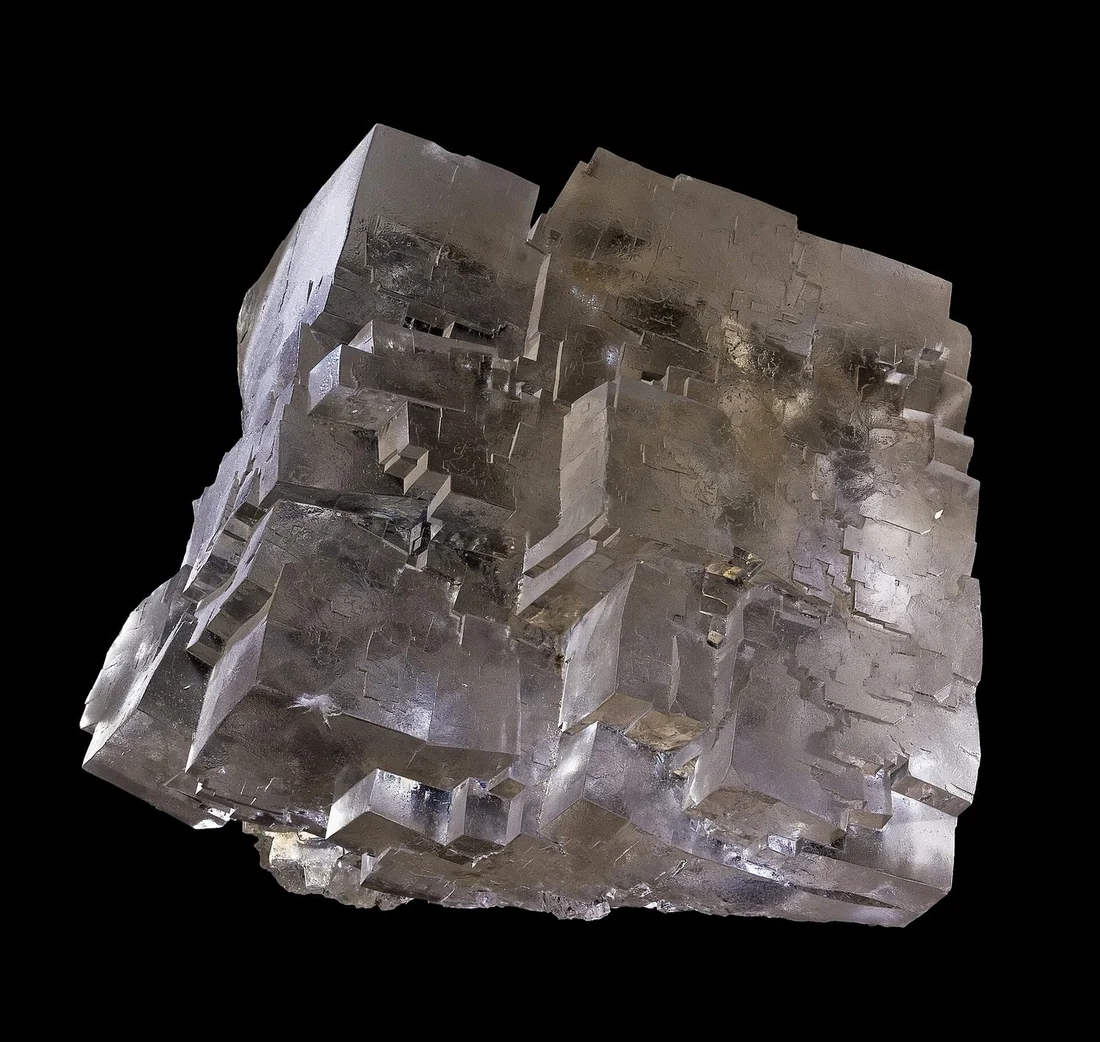
A salt crystal's cubic shape comes straight from the giant ionic lattice inside.
Formando uma ligação iônica (NaCl)
Step through it. A metal hands its outer electron to a non-metal; the oppositely charged ions then attract in a giant lattice.
Ionic bonding forms when:
Dificuldade 1/5 · Moedas 100 + pequeno bônus na primeira conclusão hoje
A metal transfers electrons to a non-metal, making oppositely charged ions (e.g. NaCl).
In an ionic solid the ions are packed into a regular giant ______, held by attraction in every direction.
Dificuldade 1/5 · Moedas 100 + pequeno bônus na primeira conclusão hoje
Each ion is surrounded by oppositely charged neighbours, so the structure is very strong.
In an ionic solid, the ions are arranged in:
Dificuldade 1/5 · Moedas 100 + pequeno bônus na primeira conclusão hoje
Ions pack into a giant lattice, with each ion attracted to oppositely charged neighbours all around.
Dot-and-cross
- In $\text{NaCl}$, sodium transfers its single outer electron to chlorine.
- This gives $\text{Na}^{+}$ and a full-octet $\text{Cl}^{-}$, drawn with dots and crosses.
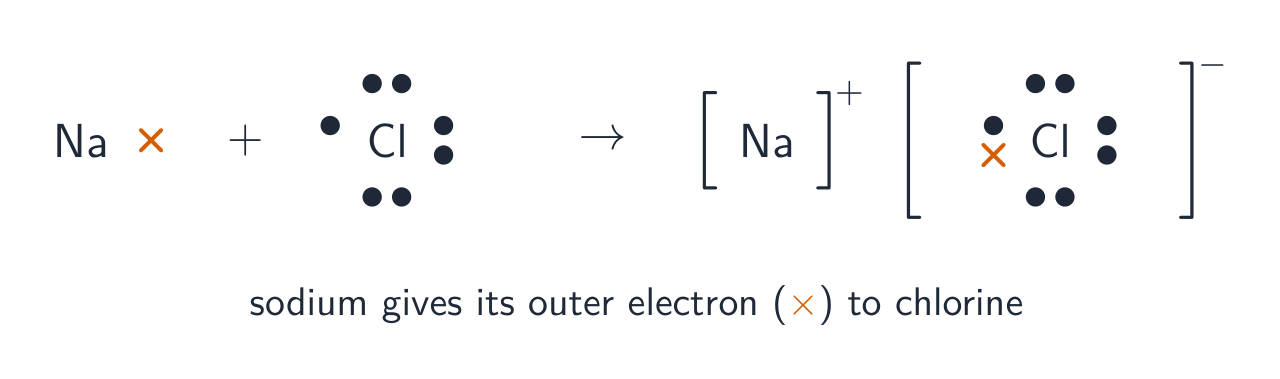
Sodium gives its single outer electron to chlorine, forming Na⁺ and a full-octet Cl⁻.
In the NaCl dot-and-cross diagram:
Dificuldade 1/5 · Moedas 100 + pequeno bônus na primeira conclusão hoje
Sodium loses one electron to chlorine, forming Na⁺ and a full-octet Cl⁻.
Put the formation of an ionic bond in order.
Dificuldade 3/5 · Moedas 200 + pequeno bônus na primeira conclusão hoje
Transfer the electron → make ions → they attract → giant lattice.
Worked example: magnesium oxide against sodium chloride
Describe the bonding in MgO, and explain why it melts at about 2850 °C while NaCl melts at 801 °C.
- Mg ($2,8,2$) gives two electrons to O ($2,6$): $\text{Mg}^{2+}$ and $\text{O}^{2-}$, both with the neon arrangement $2,8$. In the dot-and-cross diagram, $\text{O}^{2-}$ shows 6 dots and 2 crosses, in square brackets with the charge outside.
- Both are giant ionic lattices, but $\text{Mg}^{2+}$ and $\text{O}^{2-}$ carry double the charges of $\text{Na}^{+}$ and $\text{Cl}^{-}$ and are smaller, so the attraction between ions is much stronger and more energy is needed to separate them. Both conduct only when molten or dissolved.
Calcium ($2,8,8,2$) reacts with fluorine. What is the formula of the compound, and why?
Dificuldade 1/5 · Moedas 100 + pequeno bônus na primeira conclusão hoje
Ca loses 2 electrons to form $\text{Ca}^{2+}$; each F gains only 1 to form $\text{F}^-$, so two F are needed.
Solid magnesium oxide conducts electricity, because it contains charged ions.
Dificuldade 1/5 · Moedas 100 + pequeno bônus na primeira conclusão hoje
The ions are fixed in the lattice; it conducts only when molten, when the ions can move.
You've got it
- ionic bonding = electrostatic attraction between cations and anions
- forms when a metal transfers electrons to a non-metal ($\text{NaCl}$, $\text{MgO}$, $\text{CaF}_2$)
- the ions form a giant lattice held in every direction