Ionisation energy · Energia de ionização
| English | Português |
|---|---|
| ionisation energy/ˌaɪənaɪˈzeɪʃn ˈenədʒi/ | energia de ionização |
| gaseous/ˈɡeɪsɪəs/ | gasoso |
| nuclear charge/ˈnjuːklɪə tʃɑːdʒ/ | carga nuclear |
| atomic radius/əˈtɒmɪk ˈreɪdɪəs/ | raio atômico |
| shielding/ˈʃiːldɪŋ/ | blindagem |
| spin-pair repulsion/spɪn peə rɪˈpʌlʃn/ | repulsão por par de spins |
How tightly are electrons held?
- Ionisation energy 电离能 is the energy to pull electrons off gaseous 气态 atoms.
- Its trends and dips are powerful evidence for shells and sub-shells.
- It is a favourite exam topic.
Quão fortemente os elétrons são segurados
- A energia de ionização 电离能 é a energia para arrancar elétrons de átomos gasosos 气态.
- Suas tendências e quedas são evidências poderosas para camadas e subcamadas.
- É um tema favorito em exames.
First and successive ionisation energies
- The first ionisation energy removes one electron from each atom in a mole of gaseous atoms (unit $\text{kJ}/\text{mol}$):
$$\text{X}(\text{g}) \rightarrow \text{X}^{+}(\text{g}) + \text{e}^{-}$$
- Successive ionisation energies remove the next electron each time, e.g. $\text{X}^{+}(\text{g}) \rightarrow \text{X}^{2+}(\text{g}) + \text{e}^{-}$.
- Each successive value is larger — the electron leaves a more positive ion.
Primeiras e sucessivas energias de ionização
- A primeira energia de ionização remove um elétron de cada átomo em um mol de átomos gasosos (unidade $\text{kJ}/\text{mol}$):
$$\text{X}(\text{g}) \rightarrow \text{X}^{+}(\text{g}) + \text{e}^{-}$$
- As energias de ionização sucessivas removem o próximo elétron cada vez, ex. $\text{X}^{+}(\text{g}) \rightarrow \text{X}^{2+}(\text{g}) + \text{e}^{-}$.
- Cada valor subsequente é maior — o elétron sai de um íon mais positivo.
Why are gaseous atoms specified in the definition of ionisation energy? · Por que átomos gasosos são especificados na definição de energia de ionização?
Using gaseous atoms means there are no interactions between particles, so the value measures only the atom's own attraction. · Usar átomos gasosos significa que não há interações entre partículas, então o valor mede apenas a atração própria do átomo.
The energy to remove one mole of electrons from one mole of gaseous atoms is the first ______ energy. · A energia para remover um mol de elétrons de um mol de átomos gasosos é a primeira energia de ______.
It measures how tightly the outer electron is held. · Ela mede quão firmemente o elétron externo é mantido.
Each successive ionisation energy is larger than the last because: · Cada energia de ionização subsequente é maior que a anterior porque:
After each removal the ion is more positive, so the next electron is held more tightly. · Após cada remoção, o íon fica mais positivo, então o próximo elétron é segurado com mais força.
What it depends on
- nuclear charge 核电荷 — more protons → stronger pull → higher IE.
- atomic radius 原子半径 — outer electron further out → weaker pull → lower IE.
- shielding 屏蔽 — more inner shells → more shielding → lower IE.
Successive ionisation energies of sodium: big jumps reveal the 2,8,1 shells
No que depende
- carga nuclear 核电荷 — mais prótons → atração mais forte → IE mais alta.
- raio atômico 原子半径 — elétron externo mais longe → atração mais fraca → IE mais baixa.
- blindagem 屏蔽 — mais camadas internas → mais blindagem → IE mais baixa.
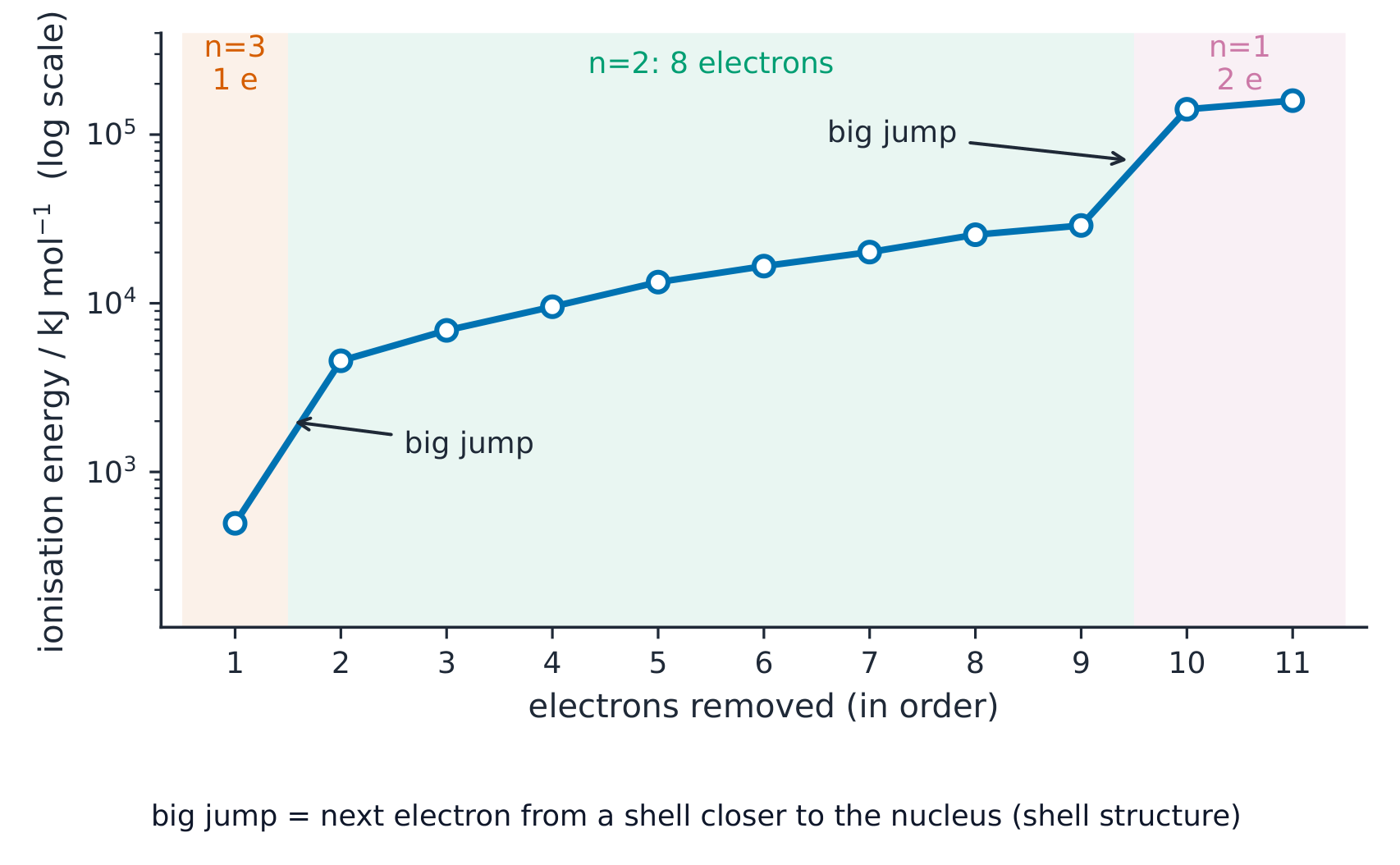
Energias de ionização sucessivas do sódio: saltos grandes revelam as camadas 2,8,1
Which change would LOWER the first ionisation energy? · Qual mudança DIMINUIRIA a primeira energia de ionização?
More shielding weakens the pull on the outer electron, lowering the ionisation energy. · Mais blindagem enfraquece a atração sobre o elétron externo, diminuindo a energia de ionização.
Match each change to its effect on first ionisation energy. · Combine cada mudança com seu efeito na primeira energia de ionização.
IE rises with nuclear pull and falls with distance/shielding; successive ionisations always rise. · EI aumenta com a atração nuclear e diminui com distância/blindagem; ionizações sucessivas sempre aumentam.
Trends and the tell-tale dips
- Across a period IE generally rises; down a group it falls.
- But two dips appear in Period 3 — evidence for sub-shells:
- Al dip: its electron comes from a higher-energy 3p sub-shell.
- S dip: a paired 3p electron is easier to remove (spin-pair repulsion 自旋成对排斥).
Tendências e as quedas reveladoras
- Ao longo de um período a IE geralmente sobe; descendo um grupo ela cai.
- Mas duas quedas aparecem no Período 3 — evidência para subcamadas:
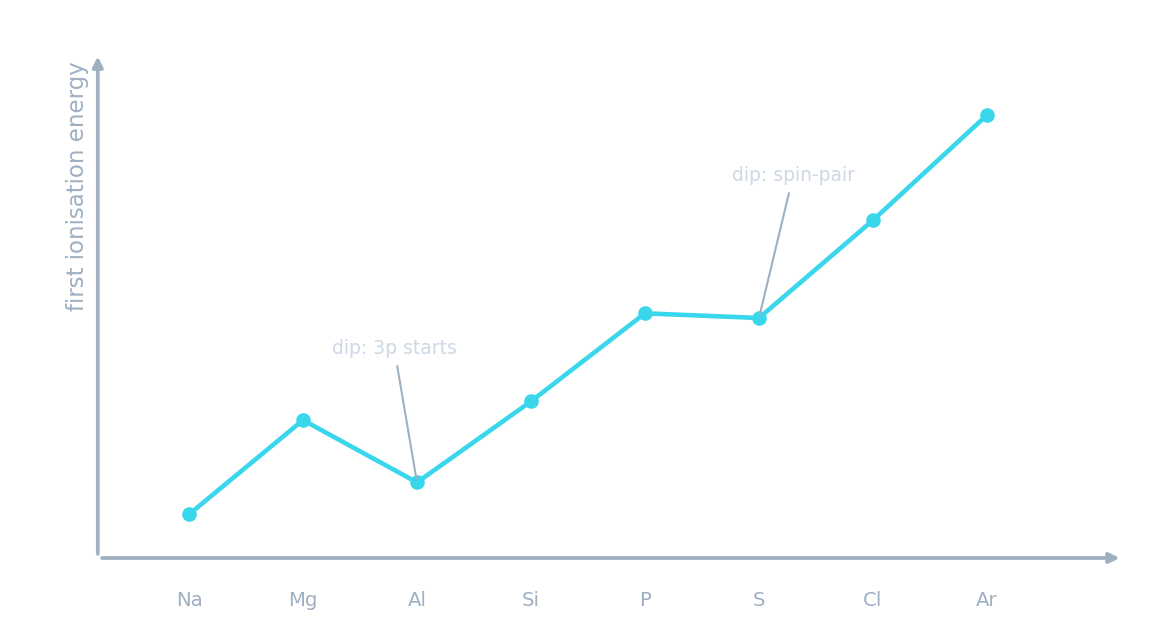
- Queda em Al: seu elétron vem de uma subcamada 3p de maior energia.
- Queda em S: um elétron 3p emparelhado é mais fácil de remover (repulsão por par de spin 自旋成对排斥).
The ionisation-energy trend — and its dips · A tendência da energia de ionização — e seus declínios
First ionisation energy generally rises across a period, but DIPS where a new p sub-shell starts and where a p-orbital pair first forms. Step across to find the two tell-tale dips. · A primeira energia de ionização geralmente aumenta ao longo de um período, mas HÁ DECADÊNCIAS quando uma nova subcamada p começa e quando um par de elétrons p se forma pela primeira vez. Avance para encontrar as duas quedas características.
The dip in first ionisation energy at aluminium (vs magnesium) is because: · O declínio na primeira energia de ionização no alumínio (em relação ao magnésio) ocorre porque:
Al's outer electron is in 3p (higher energy than Mg's full 3s), so it is easier to remove — a dip. · O elétron externo do Al está em 3p (maior energia que o 3s cheio do Mg), então é mais fácil removê-lo — um declínio.
Successive IE → shells
- Big jumps appear when the next electron must come from a shell closer in.
- Counting the electrons removed before the first big jump gives the element's group.
IE sucessiva → camadas
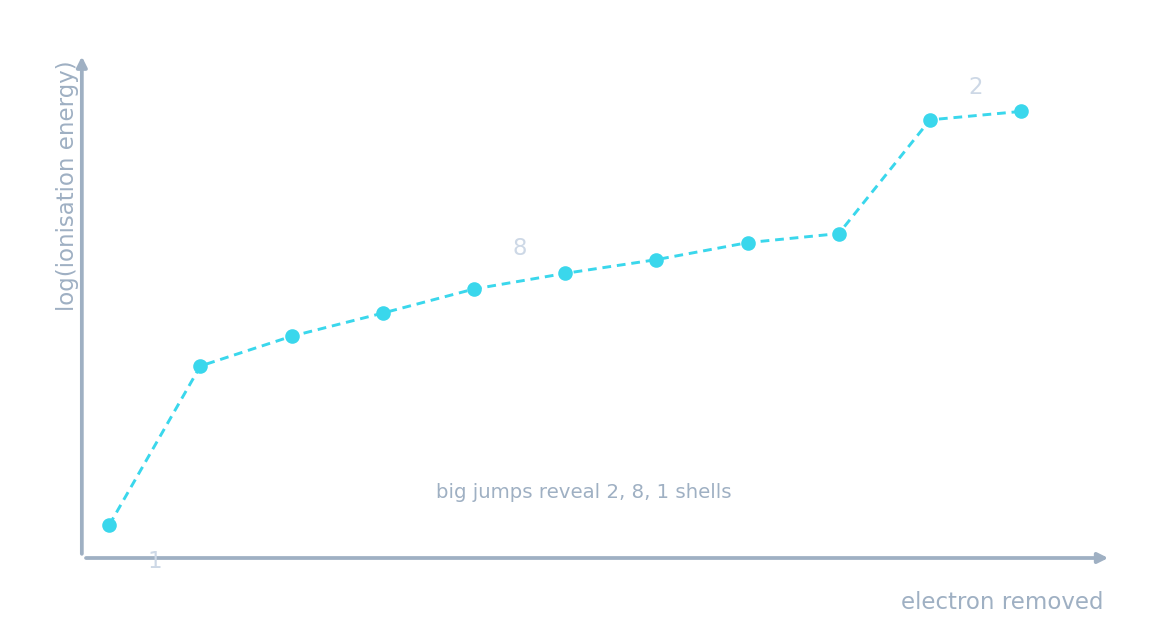
- Saltos grandes aparecem quando o próximo elétron deve vir de uma camada mais interna.
- Contar os elétrons removidos antes do primeiro salto grande dá o grupo do elemento.
A big jump in successive ionisation energies happens when: · Um grande salto nas energias de ionização sucessivas acontece quando:
The big jump marks moving to an inner shell; counting electrons before the first jump gives the outer-shell number (the group). · O grande salto marca a passagem para uma camada interna; contar elétrons antes do primeiro salto dá o número da camada externa (o grupo).
A big jump in successive ionisation energies marks the move to a new, inner shell. · Um grande salto nas energias de ionização sucessivas marca a passagem para uma nova camada interna.
The jumps reveal the shell structure — e.g. sodium's successive IEs split into 1, then 8, then 2. · Os saltos revelam a estrutura das camadas — ex.: as IEs sucessivas do sódio dividem-se em 1, depois 8, depois 2.
You've got it
- 1st IE: $\text{X}(\text{g}) \rightarrow \text{X}^{+}(\text{g}) + \text{e}^{-}$ (gaseous, $\text{kJ}/\text{mol}$); successive values keep rising
- IE depends on nuclear charge, radius, shielding
- across a period IE rises (dips at Al = 3p starts, S = spin-pair); down a group it falls
- big jumps in successive IE reveal the shell structure (and the group)
Entendeu?
- 1ª IE: $\text{X}(\text{g}) \rightarrow \text{X}^{+}(\text{g}) + \text{e}^{-}$ (gasoso, $\text{kJ}/\text{mol}$); valores subsequentes continuam subindo
- IE depende de carga nuclear, raio, blindagem
- ao longo de um período a IE sobe (quedas em Al = início do 3p, S = par de spin); descendo um grupo ela cai
- saltos grandes nas IEs sucessivas revelam a estrutura das camadas (e o grupo)