Orbitals and electrons in boxes
Introduzido| English | Significado |
|---|---|
| spin/spɪn/ | spin |
| orbital/ˈɔːbɪtl/ | orbital |
| repulsion/rɪˈpʌlʃn/ | repulsão |
| unpaired electron/ʌnˈpeəd ɪˈlektrɒn/ | eletrão desemparelhado |
| free radical/friː ˈrædɪkl/ | radical livre |
A silver beam split in two, 1922
- In February 1922 Otto Stern and Walther Gerlach in Frankfurt fired a beam of silver atoms through an uneven magnetic field onto a glass plate. Classical physics predicted a smear. Instead the beam split into exactly two spots. Each silver atom has one unpaired outer electron, and that electron behaves as if it has one of two spin 自旋 states.
- Electrons occupy orbitals 轨道: regions where there is a high probability of finding an electron. Each holds at most two, with opposite spins.
Into how many spots did the Stern–Gerlach silver beam split?
Dificuldade 2/5 · Moedas 140 + pequeno bônus na primeira conclusão hoje
Two spin states.
Shapes of s and p orbitals
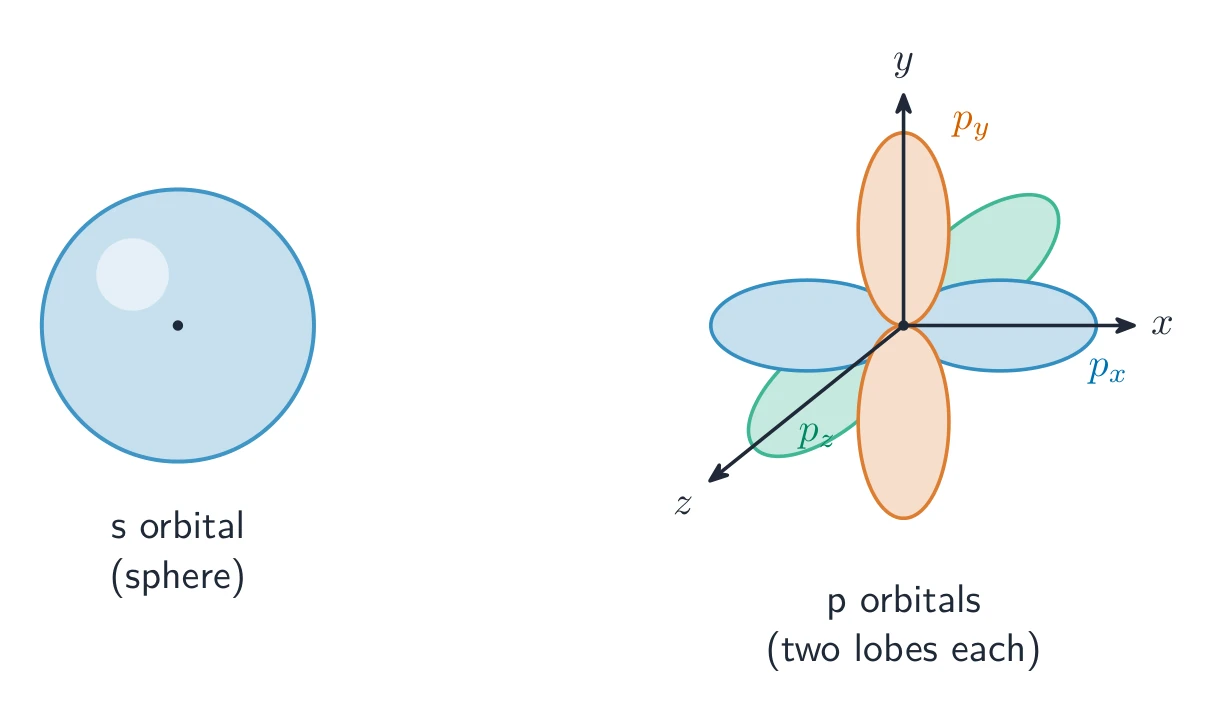
- An s orbital is spherical around the nucleus. A p orbital has two lobes with the nucleus between them; both lobes belong to one orbital.
- Each p sub-shell has three p orbitals at right angles ($p_x$, $p_y$, $p_z$); each d sub-shell has five d orbitals.
Filling the orbitals
Drag the proton number up and watch electrons fill the shells and sub-shells in order — 1s, 2s, 2p … — each box holding a spin-paired pair.
Match each sub-shell to its number of orbitals.
Dificuldade 2/5 · Moedas 140 + pequeno bônus na primeira conclusão hoje
Each orbital holds two electrons.
Filling rules
- Fill in order of energy: 1s, 2s, 2p, 3s, 3p, 4s, 3d. Two electrons in one orbital must have opposite spins.
- Within a sub-shell, electrons occupy separate orbitals with parallel spins before pairing, which reduces repulsion 排斥. Nitrogen's 2p³ has three singly occupied orbitals.
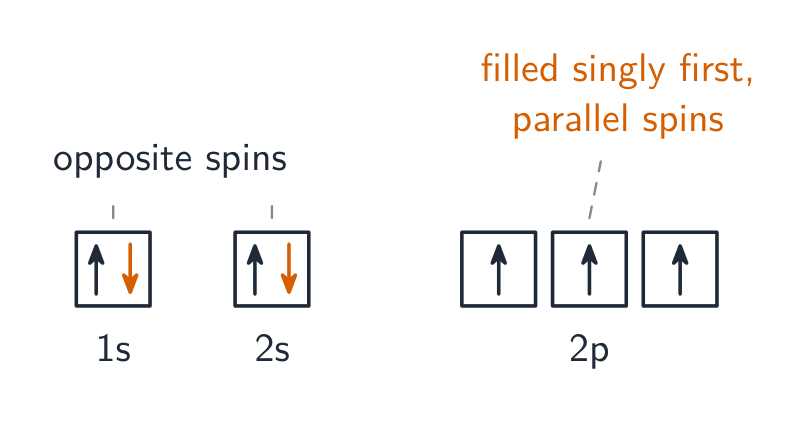
In nitrogen, the three 2p electrons occupy separate orbitals with parallel spins.
Dificuldade 1/5 · Moedas 100 + pequeno bônus na primeira conclusão hoje
Singly before pairing.
Order these sub-shells by filling.
Dificuldade 3/5 · Moedas 200 + pequeno bônus na primeira conclusão hoje
4s before 3d.
Electrons in boxes
- Draw each orbital as a box and each electron as a half-arrow. Oxygen, 1s² 2s² 2p⁴: one 2p box has a pair, two have one electron each.
- An unpaired electron 未成对电子 sits alone in a box. Count pairs only in the shell or sub-shell asked for.

How many unpaired electrons does an oxygen atom have?
Dificuldade 2/5 · Moedas 140 + pequeno bônus na primeira conclusão hoje
2p⁴ has one pair and two single electrons.
Worked example: why oxygen's first ionisation energy dips
First ionisation energy rises across Period 2, but O (1314 kJ/mol) is lower than N (1402 kJ/mol).
- Nitrogen: 2p³, three unpaired electrons in separate orbitals.
- Oxygen: 2p⁴, one orbital now holds a pair; the two electrons repel each other.
- Result: less energy is needed to remove one electron of that pair, so oxygen's ionisation energy is lower.
Why is oxygen's first ionisation energy lower than nitrogen's?
Dificuldade 1/5 · Moedas 100 + pequeno bônus na primeira conclusão hoje
Pairing adds repulsion.
Radicals, ions and transition metals
- A free radical 自由基 has at least one unpaired electron: a Cl atom (3p⁵) is a radical; Cl⁻ (3p⁶) is not, despite its charge.
- 4s fills before 3d but also empties first: Fe is [Ar] 3d⁶ 4s², Fe²⁺ is [Ar] 3d⁶. Cr is [Ar] 3d⁵ 4s¹ and Cu is [Ar] 3d¹⁰ 4s¹.
What is the electron configuration of Fe²⁺?
Dificuldade 1/5 · Moedas 100 + pequeno bônus na primeira conclusão hoje
4s electrons are lost first.
An orbital is not an orbit. Electrons do not travel round fixed circular paths; the drawn shape marks where an electron is most likely to be found.
Orbitals hold up to two electrons of opposite spin; s is spherical, p has two lobes. Fill by energy, singly before pairing. Paired electrons repel (oxygen's ionisation-energy dip); a radical has an unpaired electron; 4s empties before 3d.
Draw (in words) the electrons-in-boxes diagram for sulfur's third shell, and say whether a sulfur atom is a radical.
Boxes and radicals.