Evolution and speciation
Introduzido| English | Significado |
|---|---|
| species/ˈspiːsiːz/ | espécie |
| evolution/ɪvəˈluːʃn/ | evolução |
| gene pool/dʒiːn puːl/ | pool gênico |
| common ancestor/ˈkɒmən ˈænsestə/ | ancestral comum |
| speciation/ˌspiːʃɪˈeɪʃn/ | especiação |
| allopatric speciation/ˌæləˈpætrɪk ˌspiːʃɪˈeɪʃn/ | especiação alopátrica |
| sympatric speciation/ˈsɪmpətrɪk ˌspiːʃɪˈeɪʃn/ | especiação simpátrica |
How new species 物种 arise
- Evolution 进化 is the slow formation of new species from earlier ones.
- It happens as the gene pool 基因库 (all the alleles in a population) changes over generations.
- New species form when populations become genetically isolated.
Evolution is best described as:
Dificuldade 1/5 · Moedas 100 + pequeno bônus na primeira conclusão hoje
Evolution is the change in a population's gene pool over time, which can lead to new species.
Speciation is the formation of a new species, when two populations can no longer interbreed.
Dificuldade 1/5 · Moedas 100 + pequeno bônus na primeira conclusão hoje
It can be allopatric (geographical barrier) or sympatric (same area).
Evidence from DNA
- DNA sequence data shows how closely two species are related.
- The more similar their DNA, the more recently they shared a common ancestor 共同祖先.
Two species with very similar DNA sequences:
Dificuldade 1/5 · Moedas 100 + pequeno bônus na primeira conclusão hoje
The more similar the DNA, the more recently the species shared a common ancestor.
Speciation 物种形成
- Speciation happens when two populations become genetically separated, so they can no longer breed together. Two ways:
- allopatric speciation 异域物种形成 — populations kept apart by a geographical barrier (a sea, a mountain range).
- sympatric speciation 同域物种形成 — populations in the same area, separated by differences in behaviour or way of life.
Allopatric speciation
Step through it. A barrier splits one population; the two halves diverge until they can no longer interbreed.
Allopatric speciation requires:
Dificuldade 1/5 · Moedas 100 + pequeno bônus na primeira conclusão hoje
Allopatric speciation needs a physical barrier (sea, mountains); sympatric happens in the same area via behaviour.
Speciation is the formation of a new ______.
Dificuldade 1/5 · Moedas 100 + pequeno bônus na primeira conclusão hoje
It happens when two populations become so genetically different they can no longer interbreed.
Put allopatric speciation in order.
Dificuldade 3/5 · Moedas 200 + pequeno bônus na primeira conclusão hoje
Isolate → diverge → reproductive isolation. The barrier is geographical in allopatric speciation.
Match each term to its meaning.
Dificuldade 2/5 · Moedas 140 + pequeno bônus na primeira conclusão hoje
Allopatric = geographically separated; sympatric = isolated while together; both end in reproductive isolation.
Types of speciation
- Allopatric speciation: a population is split by a geographic barrier and the groups diverge.
- Sympatric speciation: new species arise without physical separation, in the same area.
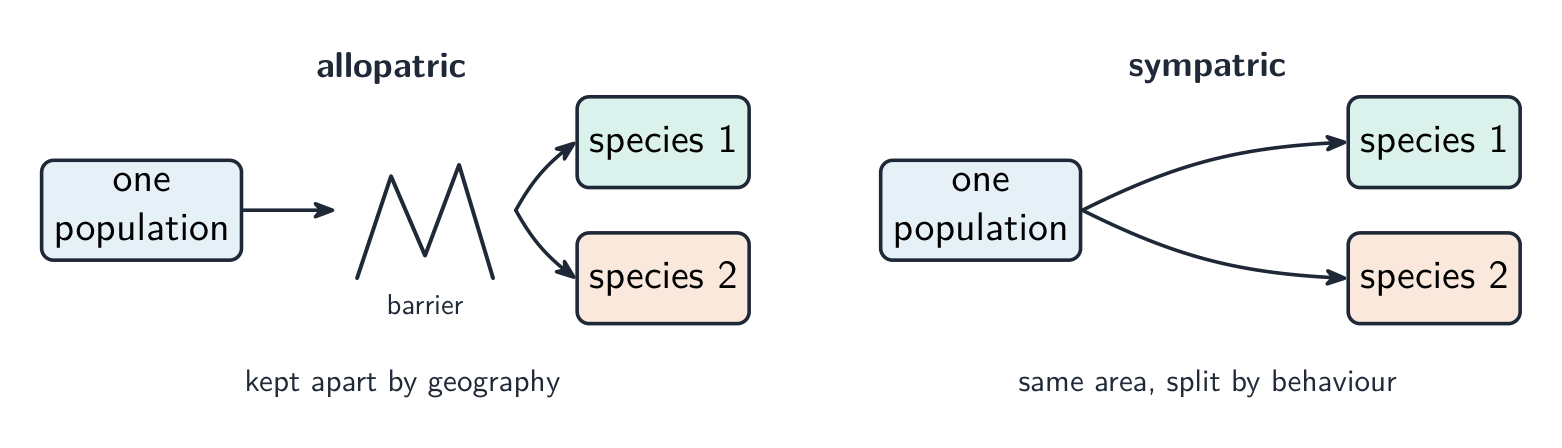
Allopatric (a geographical barrier) and sympatric (same area) speciation
Worked example: squirrels on two sides of a canyon
A canyon splits a squirrel population into north and south groups. After many thousands of years, the two groups cannot interbreed. Explain how this happened.
- The canyon is a geographic barrier, so the two gene pools are isolated: no alleles flow between them. Different mutations arise on each side, and the two sides have different conditions, so natural selection favours different alleles. Genetic drift also changes allele frequencies by chance.
- Over many generations the gene pools become so different (in breeding season, behaviour or chromosomes) that the groups could no longer produce fertile offspring even if they met: allopatric speciation.
Two populations of fish in separate lakes become different species. This is:
Dificuldade 1/5 · Moedas 100 + pequeno bônus na primeira conclusão hoje
A geographic barrier separates the populations.
Two species whose DNA sequences differ only slightly probably shared a common ancestor recently.
Dificuldade 1/5 · Moedas 100 + pequeno bônus na primeira conclusão hoje
Fewer differences mean less time to build up mutations.
You've got it
- evolution = the gene pool changing over generations → new species
- DNA similarity shows relatedness (more similar → more recent common ancestor)
- speciation = genetic isolation so they can't interbreed
- allopatric (geographical barrier) vs sympatric (same area, behaviour)
Write from this case
- A mountain range splits one population into two.
- The two sides no longer interbreed, and later they cannot produce fertile offspring.
What kind of speciation is this?
A geographic barrier divides the populations.
What speciation starts with the mountain range?
Dificuldade 1/5 · Moedas 100 + pequeno bônus na primeira conclusão hoje
Separation by a barrier is allopatric.