The light-dependent stage
Introduzido| English | Significado |
|---|---|
| photophosphorylation/ˌfəʊtəʊˌfɒsfɔːrɪˈleɪʃn/ | fotofosforilação |
| cyclic/ˈsaɪklɪk/ | cíclico |
| non-cyclic/nɒn ˈsaɪklɪk/ | não cíclico |
| photosystem/ˌfəʊtəʊˈsɪstəm/ | fossistema |
| photolysis/fəʊˈtɒləsɪs/ | fotólise |
| ATP synthase/ˌeɪ tiː ˈpiː ˈsɪnθeɪs/ | ATP sintase |
Capturing the Sun
- In the thylakoids, light energy is used to make ATP.
- This is photophosphorylation 光合磷酸化, and it comes in two forms.
- One form also splits water and releases the oxygen we breathe.
Water is split in the light-dependent stage by ______.
Dificuldade 1/5 · Moedas 100 + pequeno bônus na primeira conclusão hoje
Photolysis releases electrons, H⁺ and oxygen — the oxygen we breathe is a by-product.
Cyclic 循环 vs non-cyclic 非循环
- Cyclic photophosphorylation: uses photosystem 光系统 I only; chlorophyll is photoactivated; makes only ATP.
- Non-cyclic photophosphorylation: uses photosystems I and II; the oxygen-evolving complex carries out photolysis 光解 of water (releasing oxygen); makes ATP and reduced NADP.
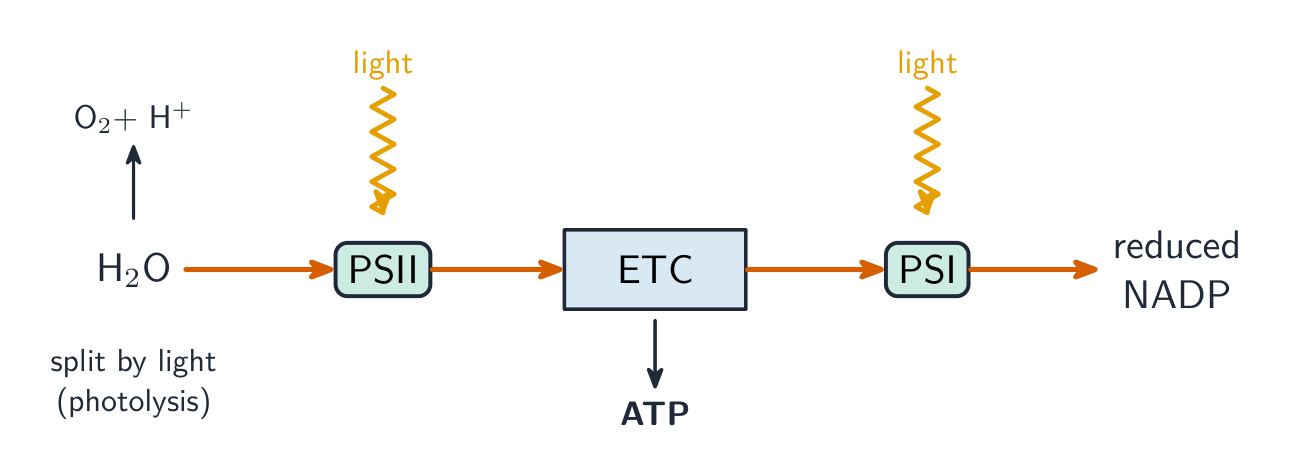
Non-cyclic photophosphorylation in the light-dependent stage
A fase dependente da luz
Step through it. Light excites electrons and splits water; the result is ATP, reduced NADP and oxygen.
Cyclic photophosphorylation:
Dificuldade 1/5 · Moedas 100 + pequeno bônus na primeira conclusão hoje
Cyclic photophosphorylation uses PSI alone and produces ATP only (no NADP reduced, no water split).
Non-cyclic photophosphorylation produces:
Dificuldade 1/5 · Moedas 100 + pequeno bônus na primeira conclusão hoje
Using PSI and PSII, it makes ATP and reduced NADP, and photolysis of water releases oxygen.
How the ATP is made
- In both forms:
- energetic electrons pass along an electron transport chain, releasing energy.
- that energy pumps protons across the thylakoid membrane.
- protons flow back into the stroma through ATP synthase ATP合酶, making ATP (chemiosmosis).
Photolysis splits carbon dioxide, releasing oxygen as a by-product.
Dificuldade 1/5 · Moedas 100 + pequeno bônus na primeira conclusão hoje
False. Photolysis splits water using light energy; the oxygen released comes from water, not from carbon dioxide.
In the thylakoid, ATP is made as protons flow back through:
Dificuldade 1/5 · Moedas 100 + pequeno bônus na primeira conclusão hoje
Protons pumped into the thylakoid space flow back through ATP synthase, driving ATP synthesis.
Match each part of the light-dependent stage to what it does.
Dificuldade 2/5 · Moedas 140 + pequeno bônus na primeira conclusão hoje
Light excites electrons and splits water; the chain makes ATP; reduced NADP carries hydrogen onward.
Photolysis of water
- Light energy splits water in photolysis: water → hydrogen ions + electrons + oxygen.
- The electrons replace those lost by chlorophyll, and the oxygen is released as a waste product.
Worked example: the Hill reaction with DCPIP
Isolated chloroplasts are mixed with blue DCPIP. In light the blue colour fades in 5 minutes; in the dark it stays blue; with chloroplasts boiled first it stays blue. Explain the results.
- In light, photolysis splits water and electrons pass along the chain. DCPIP acts as an electron acceptor in place of NADP, so it is reduced and turns colourless.
- In the dark there is no photoactivation of chlorophyll, so no electrons flow. Boiling denatures the proteins of the photosystems and the electron carriers, so even in light nothing happens. Both are controls, showing the colour change needs light and working chloroplasts.
The oxygen released in photosynthesis comes from:
Dificuldade 1/5 · Moedas 100 + pequeno bônus na primeira conclusão hoje
Photolysis of water releases oxygen.
Cyclic photophosphorylation produces reduced NADP.
Dificuldade 1/5 · Moedas 100 + pequeno bônus na primeira conclusão hoje
It makes ATP only; electrons return to photosystem I.
You've got it
- the light-dependent stage = photophosphorylation in the thylakoids
- cyclic: PSI only → ATP only
- non-cyclic: PSI + PSII → photolysis of water (releases O₂) → ATP + reduced NADP
- electrons pump protons → flow back through ATP synthase → ATP (chemiosmosis)
Write from this case
- Light strikes chlorophyll in a thylakoid.
- Water is split.
Where does the oxygen gas come from?
Splitting water releases the oxygen.
What is the source of the oxygen gas?
Dificuldade 1/5 · Moedas 100 + pequeno bônus na primeira conclusão hoje
Photolysis of water frees oxygen.