Transport of oxygen · Transporte de oxigênio
| English | Português |
|---|---|
| haemoglobin/ˌhiːməˈɡləʊbɪn/ | hemoglobina |
| oxygen dissociation curve/ˈɒksɪdʒn dɪˌsəʊsɪˈeɪʃn kɜːv/ | curva de dissociação da oxigênio |
| saturation/ˌsætʃəˈreɪʃn/ | saturação |
| partial pressure/ˈpɑːʃl ˈpreʃə/ | pressão parcial |
| Bohr shift/ˈbəʊə ʃɪft/ | deslocamento de Bohr |
| fetal haemoglobin/ˈfiːtl ˌhiːməˈɡləʊbɪn/ | hemoglobina fetal |
| affinity/əˈfɪnɪti/ | afinidade |
Carrying oxygen
- Oxygen is carried by haemoglobin 血红蛋白 in red blood cells.
- How tightly haemoglobin holds oxygen depends on how much oxygen is around.
- The oxygen dissociation curve 氧解离曲线 captures this in one S-shaped graph.
Transportando oxigênio
- O oxigênio é transportado pela hemoglobina 血红蛋白 nos glóbulos vermelhos.
- Quão firmemente a hemoglobina segura o oxigênio depende de quanto oxigênio há ao redor.
- A curva de dissociação do oxigênio 氧解离曲线 captura isso em um único gráfico em forma de S.
Loading and unloading
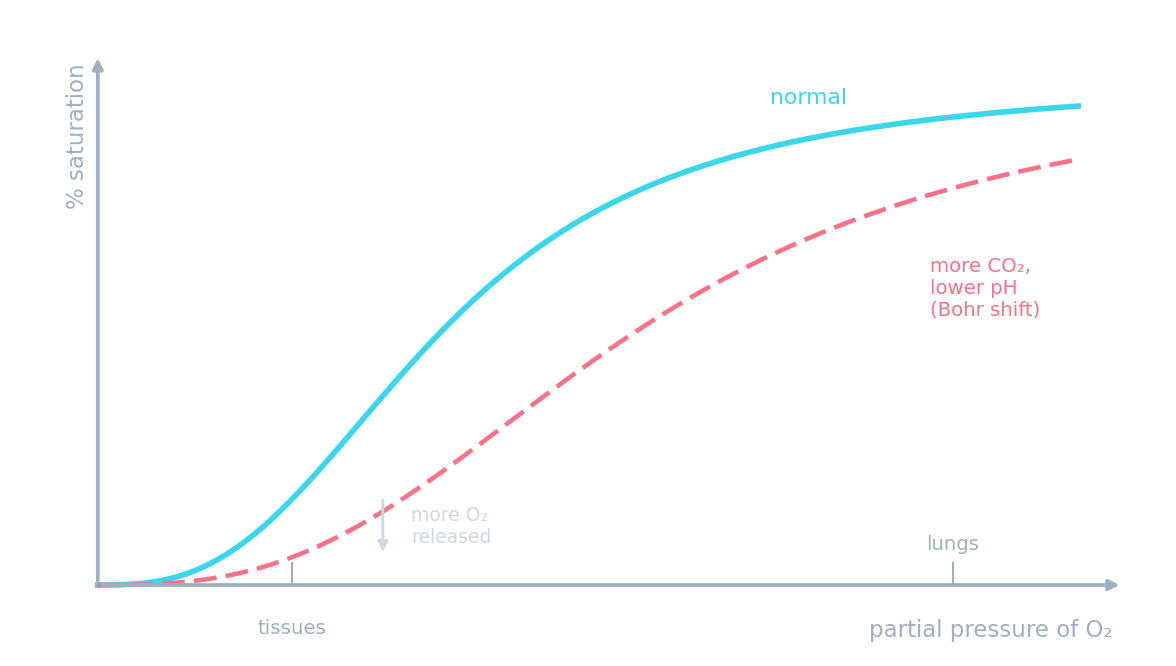
- The curve plots % saturation 饱和度 (how full of oxygen) against the partial pressure 分压 of oxygen.
- Where oxygen is high (the lungs), haemoglobin loads up and becomes almost fully saturated.
- Where oxygen is low (respiring tissues), haemoglobin unloads its oxygen for the cells.
Carregamento e descarregamento
- A curva plota a % de saturação 饱和度 (quão cheia de oxigênio está) contra a pressão parcial 分压 do oxigênio.
- Onde o oxigênio é alto (nos pulmões), a hemoglobina carrega oxigênio e torna-se quase totalmente saturada.
- Onde o oxigênio é baixo (nos tecidos respirando), a hemoglobina libera seu oxigênio para as células.
How blood carries oxygen · Como o sangue transporta oxigênio
Haemoglobin picks up oxygen where there is lots of it (the lungs) and releases it where there is little (the tissues). · A hemoglobina capta oxigênio onde há muito dele (nos pulmões) e o libera onde há pouco (nos tecidos).
Where the partial pressure of oxygen is high (the lungs), haemoglobin: · Onde a pressão parcial de oxigênio é alta (nos pulmões), a hemoglobina:
At high oxygen partial pressure (lungs), haemoglobin loads up and becomes nearly fully saturated. · Em alta pressão parcial de oxigênio (pulmões), a hemoglobina carrega oxigênio e torna-se quase totalmente saturada.
In respiring tissues, where oxygen is low, haemoglobin: · Em tecidos respiratórios, onde o oxigênio é baixo, a hemoglobina:
At low oxygen partial pressure (tissues), haemoglobin releases oxygen to the cells. · Em baixa pressão parcial de oxigênio (tecidos), a hemoglobina libera oxigênio às células.
The oxygen dissociation curve is S-shaped (sigmoid). · A curva de dissociação do oxigênio tem formato de S (sigmoide).
It is S-shaped: binding one oxygen makes the next bind more easily, giving the characteristic sigmoid curve. · É em forma de S: a ligação de um oxigênio facilita a ligação do próximo, resultando na curva sigmoide característica.
The Bohr shift 波尔位移
- Active tissues release more carbon dioxide, which lowers the pH.
- This makes haemoglobin release oxygen more easily — the curve shifts to the right.
- So oxygen is given up exactly where it is needed most. This is the Bohr shift — the right-shifted curve above.
Efeito Bohr 波尔位移
- Tecidos ativos liberam mais dióxido de carbono, o que diminui o pH.
- Isso faz com que a hemoglobina libere oxigênio mais facilmente — a curva desloca-se para a direita.
- Assim, o oxigênio é entregue exatamente onde é mais necessário. Este é o efeito Bohr — a curva deslocada para a direita acima.
Match each situation to what haemoglobin does. · Associe cada situação ao que a hemoglobina faz.
Hb loads in the lungs, unloads in tissues; high CO₂ shifts the curve right; fetal Hb grabs oxygen from the mother. · Hb carrega nos pulmões, desalpha nos tecidos; alto CO₂ desloca a curva para a direita; Hb fetal captura oxigênio da mãe.
The Bohr shift describes how: · O efeito Bohr descreve como:
More CO₂ lowers pH, shifting the curve right so haemoglobin releases more oxygen where tissues need it. · Mais CO₂ reduz o pH, deslocando a curva para a direita para que a hemoglobina libere mais oxigênio onde os tecidos precisam.
The rightward shift of the curve when CO₂ rises, releasing more oxygen to active tissues, is the ______ shift. · O deslocamento da curva para a direita quando o CO₂ aumenta, liberando mais oxigênio aos tecidos ativos, é o ______ shift.
The Bohr shift means active tissues (high CO₂, low pH) get more oxygen unloaded to them. · O efeito Bohr significa que tecidos ativos (alto CO₂, baixo pH) recebem mais oxigênio desalpha.
Fetal haemoglobin 胎儿血红蛋白
- A fetus must take oxygen from its mother's blood, so its fetal haemoglobin has a higher affinity 亲和力 for oxygen.
- Its dissociation curve lies to the left of the adult curve — it loads oxygen where adult haemoglobin would unload it.
Hemoglobina fetal 胎儿血红蛋白
- Um feto precisa retirar oxigênio do sangue da mãe, então sua hemoglobina fetal tem maior afinidade 亲和力 por oxigênio.
- Sua curva de dissociação fica à esquerda da curva adulta — ela carrega oxigênio onde a hemoglobina adulta o liberaria.
You've got it
- haemoglobin carries oxygen; the dissociation curve is S-shaped
- high oxygen (lungs) → loads / saturated; low oxygen (tissues) → unloads
- Bohr shift: more CO₂ → lower pH → curve moves right → more oxygen released
- the Bohr shift delivers oxygen where active tissues need it most
Entendeu?
- hemoglobina transporta oxigênio; a curva de dissociação é em forma de S
- alto oxigênio (pulmões) → carrega / saturado; baixo oxigênio (tecidos) → libera
- Efeito Bohr: mais CO₂ → pH mais baixo → curva move-se para a direita → mais oxigênio liberado
- O efeito Bohr entrega oxigênio onde os tecidos ativos mais precisam dele