Pular para o conteúdo
Matérias

OxfordAQA · International GCSE · Physics

  • 1

    3.1 · Forces and their effects

    Programa de aprendizado em breve

    Material de apoio

    English

    Forces and their effects

    Every push, pull and hold in the world is a force — and OxfordAQA's first topic organises them: contact and non-contact interactions, scalars against vectors, Newton's three laws, vehicle safety, and the P-extension ideas of momentum, terminal velocity, centre of mass and moments.

    OxfordAQA International GCSE Physics 9203, topic 3.1 (Version 5.1, exams 2018 onwards). Statements marked (P) are Paper-2-only; paper details are in the specification's scheme of assessment. The specimen components on file are 9203-92031 and 9203-92032 — specimen practice in this package is always labelled as such.

    Forces and their interactions

    Objects interact by non-contact field forces (gravity, electrostatics, magnetism) and contact forces (friction, air resistance, tension, normal contact force). Friction 摩擦 acts between two surfaces, impedes motion and may heat them; air resistance is friction with a fluid.
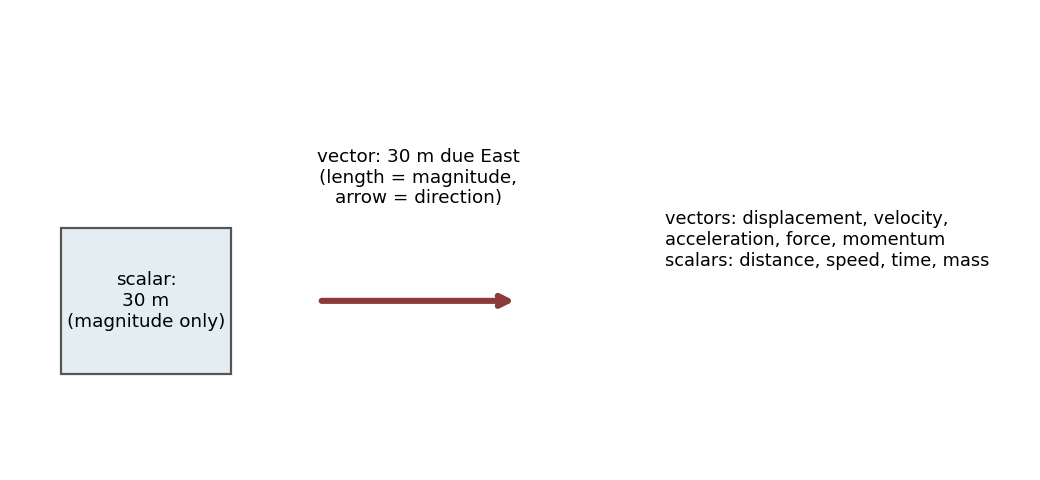
    A scalar has only a size; a vector is an arrow whose length is the magnitude and whose direction is the arrow.

    Scalars 标量 have magnitude only (distance, speed, time); vectors 矢量 add direction (displacement, velocity, acceleration, force, momentum) and can be drawn as arrows. Weight is the force of gravity: $W = m \times g$.

    Forces can change shape — stretching, bending, compressing. Elastic distortions recover; inelastic ones do not (P). A stretched spring stores elastic potential energy, and below the limit of proportionality:

    $$F = k \times e$$

    Required practical: investigate force against extension for a spring (hang masses, plot the line, gradient = k).

    Motion and Newton's laws

    Speed is the gradient of a distance–time graph; velocity adds direction: $v = s/t$ (usable for average speeds too). Acceleration is the rate of change of velocity: $a = \Delta v/t$ — from the gradient of a velocity–time graph, whose area gives distance travelled. Changing direction at constant speed is still acceleration.

    Two skaters push: the forces on each are equal and opposite — Newton's Third Law.
    • Newton's First Law: zero resultant force → rest stays rest, motion keeps its velocity.
    • Newton's Second Law: $F = m \times a$ in the direction of the resultant.
    • Newton's Third Law: interacting objects exert equal, opposite forces on each other.

    Resultants: opposite or parallel forces add along a line; two coplanar forces combine by scale drawing (drawn to scale, head to tail).

    (P) Momentum, safety and terminal velocity

    $$p = m \times v \qquad F = \frac{\Delta p}{t}$$

    Momentum 动量 is conserved in a closed system — collisions and explosions share a fixed total. Car safety: airbags, seat belts, side-impact bars, crumple zones, crash mats, cushioned playground surfaces and cycle helmets all lengthen the time of impact, so for the same momentum change the force is smaller.

    At a steady speed the driving force balances resistive forces. Stopping distance = thinking + braking distance; reaction time grows with tiredness, distraction, drugs and alcohol; braking force must grow with speed, and large decelerations overheat brakes. Braking converts the vehicle's kinetic energy into heating the brakes (friction work); braking distance lengthens on wet or icy roads and with worn brakes or tyres.

    An object falling through a fluid accelerates until drag equals weight — terminal velocity 终末速度; parachutes raise drag to cut the terminal velocity, and streamlining (a shark's shape, a car's design) reduces drag to raise the maximum speed.
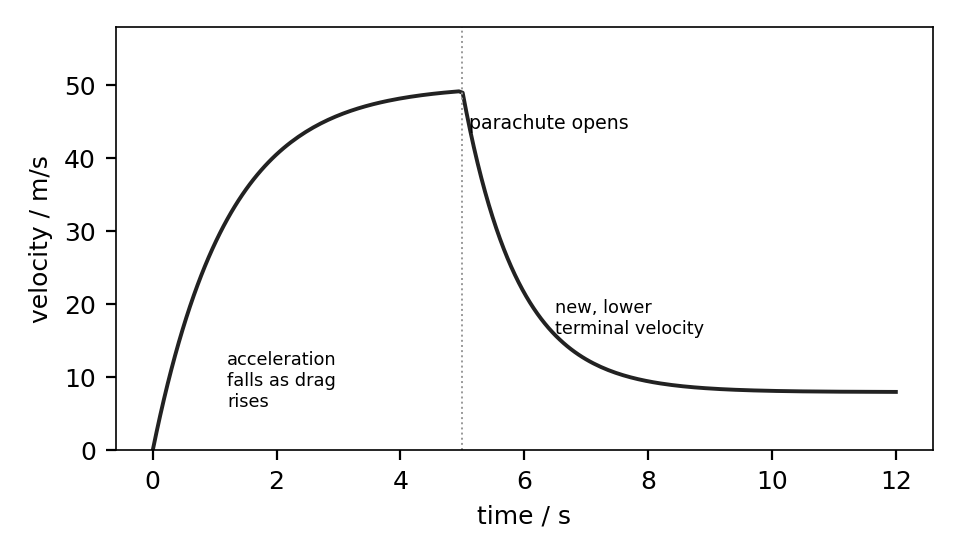
    Velocity against time for a parachutist: a first terminal velocity, then a lower one after opening.

    (P) Centre of mass and moments

    The centre of mass 质心 is where an object's mass may be thought concentrated; a freely suspended object rests with it below the suspension point, and a symmetrical object's centre of mass lies on the axis of symmetry. Find it for an irregular lamina by suspending it from two points and drawing plumb lines.

    $$M = F \times d$$

    A balanced object has equal total clockwise and anticlockwise moments 力矩; levers are force multipliers. If the weight's line of action falls outside the base, the resultant moment topples the object (vehicles, balancing toys).
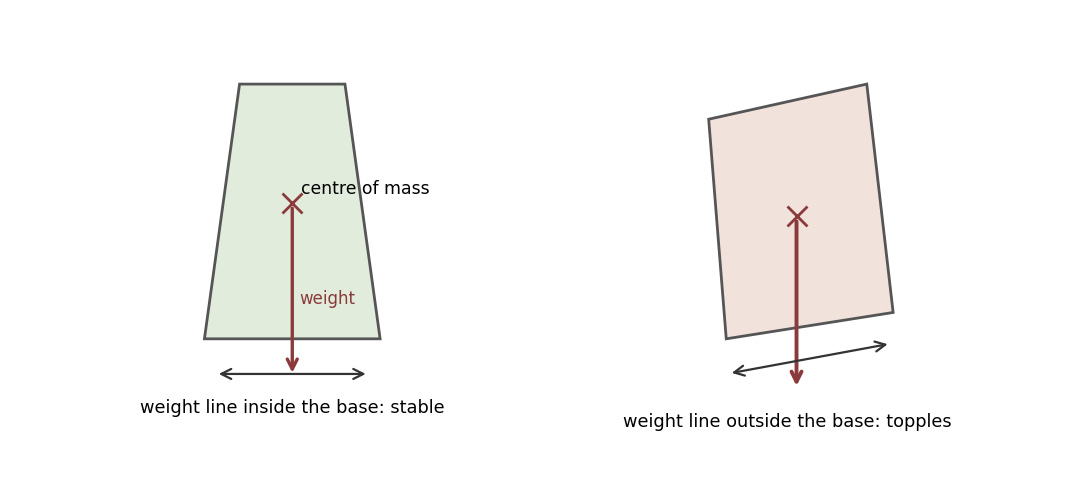
    A stable block has its weight line inside the base; a tilted block with the line outside topples.

    Check yourself

    1. Give one example each of a contact and a non-contact force.
    2. Which of these are vectors: speed, displacement, time, force?
    3. State the spring equation and the name of its constant.
    4. State Newton's three laws in one sentence each.
    5. A 900 kg car accelerates at 2 m/s². Calculate the resultant force.
    6. Name two factors that lengthen thinking distance and two that lengthen braking distance.
    7. (P) Explain how a crumple zone protects passengers, using F = Δp/t.
    8. (P) Why does a parachutist reach a lower terminal velocity after opening the parachute?
    9. (P) Where is the centre of mass of a symmetrical object?
    10. (P) A 250 N force acts 0.4 m from a pivot. Calculate its moment.

    Answers: 1 contact — friction/tension/air resistance/normal; non-contact — gravity/electrostatic/magnetic; 2 displacement and force; 3 $F = ke$, the spring constant (N/m); 4 first — no resultant force means no change in velocity; second — $F = ma$ in the resultant's direction; third — interactions give equal and opposite forces; 5 $F = 900 \times 2 = 1800$ N; 6 thinking — tiredness, distractions, drugs/alcohol (any two); braking — wet or icy roads, worn brakes or tyres (any two); 7 (P) the crumple zone lengthens the collision time; for the same momentum change, $F = \Delta p/t$ is smaller, so less force reaches the passengers; 8 (P) the parachute greatly increases drag, so drag balances weight at a much lower speed; 9 (P) on its axis of symmetry; 10 (P) $M = 250 \times 0.4 = 100$ N m.
    Vocabulário
    English Português
    friction/ˈfrɪkʃn/ atrito
    scalar/ˈskeɪlə/ escalar
    vector/ˈvektə/ vetor
    momentum/məʊˈmentəm/ quantidade de movimento
    terminal velocity/ˈtɜːmɪnl vəˈlɒsɪti/ velocidade terminal
    centre of mass/ˈsentə ɒv mæs/ centro de massa
    moment/ˈməʊmənt/ momento (força)
  • 2

    3.2 · Energy

    Programa de aprendizado em breve

    Material de apoio

    Energia: o contador da física

    Nada destrói energia — ela apenas se move entre estoques e parte é dissipada em formas menos úteis. O segundo tópico da OxfordAQA constrói essa contabilidade: trabalho e potência, as três equações de estoque de energia, conservação com diagramas de Sankey e as escolhas por trás dos recursos energéticos nacionais.

    OxfordAQA International GCSE Física 9203, tópico 3.2 (Versão 5.1). As afirmações marcadas (P) são apenas para Prova-2.

    Forças e energia

    $$W = F \times d \qquad E_e = \tfrac{1}{2}ke^2 \qquad E_p = mgh \qquad E_k = \tfrac{1}{2}mv^2 \qquad P = \frac{E}{t}$$

    Trabalho é realizado quando uma força desloca seu ponto de aplicação por uma distância; o trabalho contra o atrito transfere energia por aquecimento (reentrada de nave, meteoritos, freios). Uma mola esticada armazena energia potencial elástica $\frac{1}{2}ke^2$; uma massa elevada armazena energia potencial gravitacional mgh; uma massa em movimento possui energia cinética ½mv² — dobrar a massa dobra-a, dobrar a velocidade a quadruplica (ligação à segurança no trânsito). Potência é a taxa de transferência de energia.

    Exemplo resolvido. Um carro de 1500 kg a 20 m/s freia até parar: KE removido $= \frac{1}{2} \times 1500 \times 400 = 300\,000$ J — tudo transferido para aquecer os freios. Levantá-lo 2 m com g = 10 N/kg armazena $1500 \times 10 \times 2 = 30\,000$ J.

    Transferências e dissipação de energia

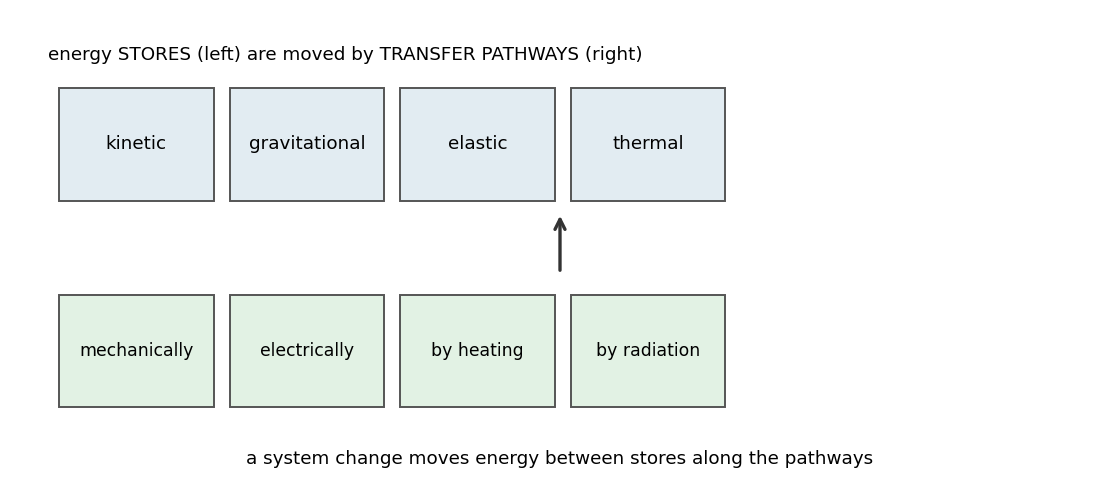
    Armazéns de energia no topo, caminhos de transferência abaixo; uma mudança no sistema move energia entre armazéns.

    Quando um sistema muda, a energia é transferida — utilmente, armazenada ou dissipada (

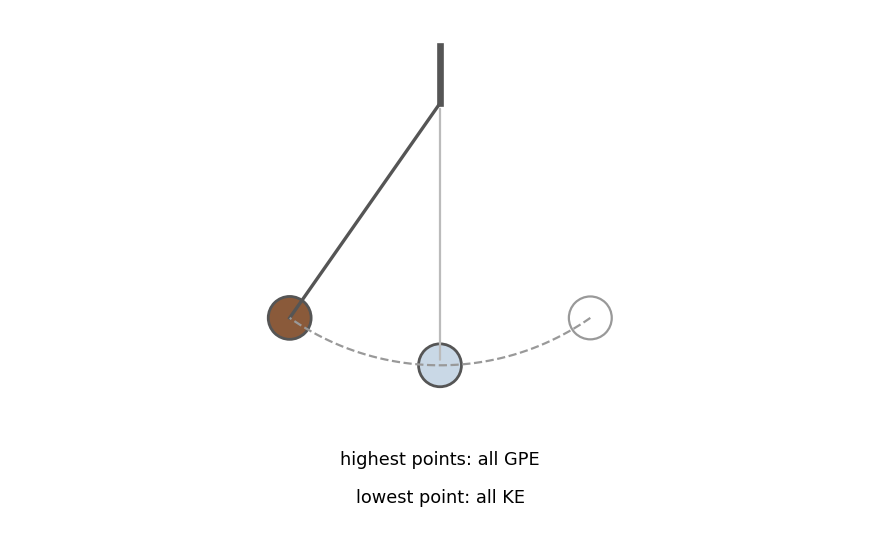
    Um pêndulo: toda GPE no topo de cada oscilação, toda KE na parte inferior.
    $$\text{efficiency} = \frac{\text{useful energy out}}{\text{total energy in}} \times 100\% \ (=\frac{\text{useful power out}}{\text{total power in}})$$

    Diagramas de Sankey mostram a redistribuição: as setas se dividem proporcionalmente aos fluxos de energia (desenhá-los em escala — largura ∝ energia).

    Exemplo resolvido. Uma lâmpada de 60 W emite 6 W de luz: eficiência $= 6/60 \times 100 = 10\%$.

    Recursos energéticos

    Combustíveis são escolhidos pela facilidade de armazenamento, conteúdo energético e segurança; alguns transferem mais de sua energia utilmente que outros. A geração nacional negocia renovabilidade contra custo, confiabilidade e custo ambiental de extração, uso e descarte.

    Quatro tecnologias renováveis com uma vantagem e uma desvantagem cada.

    Verifique você mesmo

    1. Calcule o trabalho realizado por uma força de 50 N movendo-se 4 m.
    2. Calcule a energia elástica em uma mola (k = 200 N/m) esticada 0.15 m.
    3. Um livro de 2 kg é levantado 3 m com g = 10 N/kg. Calcule a GPE ganho.
    4. O que acontece com a energia cinética de um carro quando ele freia?
    5. Um motor transfere 800 J em 20 s. Calcule sua potência.
    6. Enuncie a equação de eficiência nas formas de energia e potência.
    7. Uma lâmpada emite 12 J de luz para cada 100 J inserido. Calcule a eficiência.
    8. O que a largura da seta em um diagrama de Sankey indica?
    9. Cite uma vantagem e uma desvantagem da energia eólica.
    10. O que significa "dissipado"?

    Respostas: 1 $W = 50 \times 4 = 200$ J; 2 $E_e = \frac{1}{2} \times 200 \times 0.0225 = 2.25$ J; 3 $E_p = 2 \times 10 \times 3 = 60$ J; 4 é transferido para a energia térmica dos freios e do ambiente pela força de atrito (os freios aquecem); 5 $P = 800/20 = 40$ W; 6 energia útil de saída ÷ energia total de entrada (×100 %); potência útil de saída ÷ potência total de entrada; 7 $12/100 \times 100 = 12\%$; 8 a energia fluindo nessa direção — a largura é proporcional à energia; 9 renovável, sem combustível ou emissões; saída intermitente com impacto visual; 10 transferida para estoques menos úteis (geralmente calor residual), não podendo realizar facilmente o trabalho desejado.

    Vocabulário
    English Português
    work/wɜːk/ trabalho
    power/ˈpaʊə/ potência
    dissipation/ˌdɪsɪˈpeɪʃn/ dissipação
    efficiency/ɪˈfɪʃənsi/ eficiência
  • 3

    3.3 · Waves

    Programa de aprendizado em breve

    Material de apoio

    English

    Waves: carrying energy and information

    Waves move energy from a source to a receiver without moving matter — light to an eye, sound to an ear, radio to a phone. This topic builds the wave model (frequency, wavelength, speed), then applies it across the electromagnetic spectrum, to sound and (P) ultrasound, reflection, refraction with total internal reflection, and (P) lenses and the eye.

    OxfordAQA International GCSE Physics 9203, topic 3.3 (Version 5.1). Statements marked (P) are Paper-2-only.

    General properties of waves

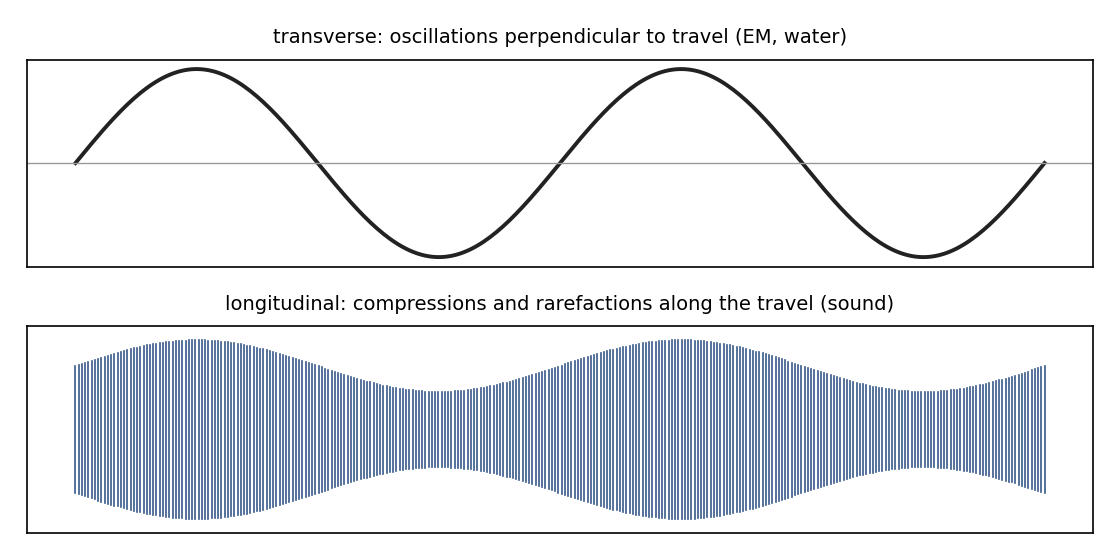
    Transverse waves oscillate across their travel; longitudinal waves compress along it.

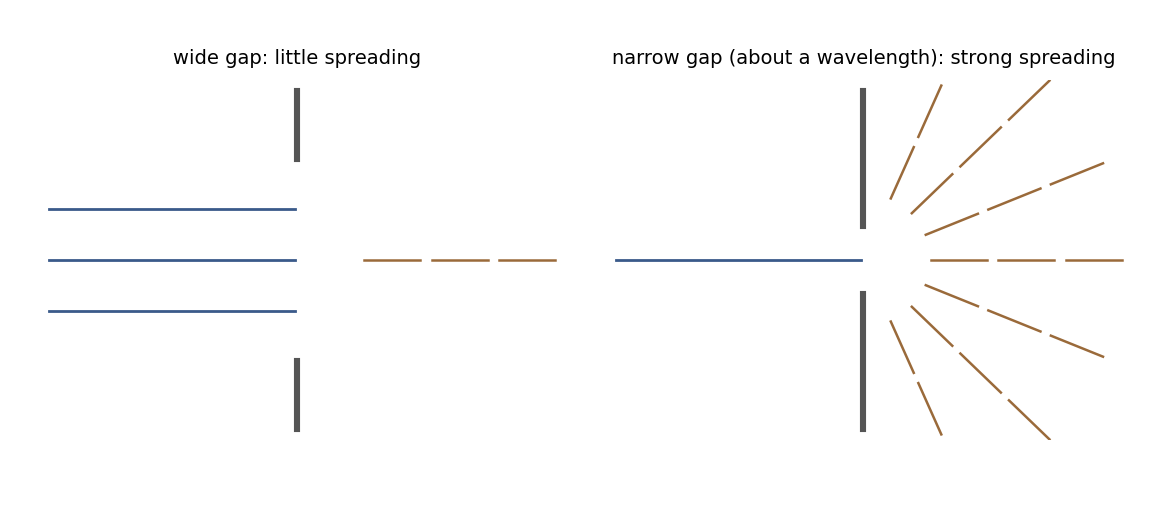
    Transverse 横波: oscillations perpendicular to travel — electromagnetic and water waves. Longitudinal 纵波: oscillations parallel, as compressions and rarefactions — sound; mechanical waves may be either. At a boundary, waves are reflected, transmitted or absorbed; refraction 折射 comes from a change of velocity between media, and diffraction 衍射 spreads waves through a gap — strongly when the gap is comparable to the wavelength.

    A wide gap gives little spreading; a gap near the wavelength spreads strongly.

    Amplitude, wavelength, frequency, period and wavefront define any wave, and:

    $$v = f \times \lambda$$

    Worked check. A water wave of frequency 2 Hz and wavelength 1.5 m travels at $2 \times 1.5 = 3$ m/s.

    The electromagnetic spectrum

    One continuous family, all transverse, all at the same speed in vacuum, ordered from radio (10⁴ m and beyond) down to gamma (10⁻¹⁵ m). Visible light is the narrow band our eyes detect — different wavelengths are different colours. Every object emits and absorbs infrared; (P) hotter objects radiate more and at higher frequencies (black-body radiation), dark matt surfaces absorb and emit best, light shiny ones reflect.

    Uses: radio — TV and radio including Bluetooth; microwaves — phones, satellite TV; infrared — remotes, night vision, heating; visible — photography, fibre optics; UV — security marking; X-rays — medical imaging; gamma — sterilising instruments and food. Hazards: microwaves heat tissue; infrared burns; UV causes skin cancer and blindness; X-rays kill cells in high doses; gamma causes mutations — limit exposure time and distance, and shield.

    X-rays: very short wavelength, high energy, ionising; they affect photographic film, are absorbed by metal and bone, and are transmitted by soft tissue — the basis of CT, fracture and dental imaging, and of cancer treatment (with careful monitoring of workers' doses).

    Sound and ultrasound

    Sound is longitudinal, vibrating a medium, heard between 20 Hz and 20 000 Hz; pitch follows frequency, loudness follows amplitude. Sound reflects (echoes) and diffracts. (P) Ultrasound 超声波 lies above 20 kHz: at a boundary between media it partially reflects, and the echo time locates the boundary:

    $$s = v \times t$$

    Worked check. An ultrasound pulse returns from a fetus boundary after $6.0 \times 10^{-5}$ s (speed 1500 m/s in tissue): boundary depth $= 1500 \times 6.0\times10^{-5}/2 = 4.5$ cm — divide by two for the round trip. Uses: prenatal scanning, breaking kidney stones.

    Reflection and refraction

    Law of reflection: angle of incidence = angle of reflection, measured from the normal. A plane mirror gives a virtual, upright, laterally inverted image; construct ray diagrams with the normal drawn in. (P) Light entering a denser medium slows and bends towards the normal; into a less dense one, away; a prism disperses white light into a spectrum. Refractive index compares speeds:

    $$n = \frac{\text{speed of light in vacuum}}{\text{speed in the medium}} = \frac{\sin i}{\sin r} \qquad \sin c = \frac{1}{n}$$

    Beyond the critical angle in the denser medium, light is totally internally reflected — how optical fibres carry visible light and infrared for medicine (endoscopes) and communications. Required practical: refraction of light by different substances.

    Lenses and the eye (P)

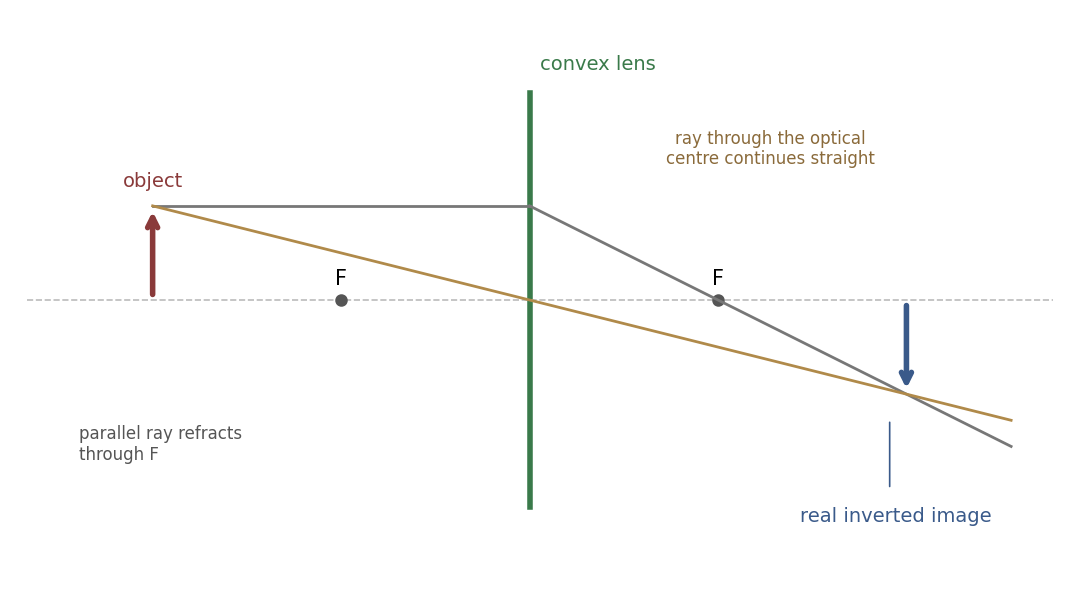
    A convex (converging) lens brings parallel rays to the principal focus (focal length from the lens); a concave (diverging) lens spreads them as if from the focus. Images are described as larger/smaller, upright/inverted, real/virtual — ray diagrams on graph paper show them, and magnification = image height ÷ object height. A converging lens held close acts as a magnifying glass (virtual, upright, enlarged).

    A convex lens forms a real, inverted image of an object beyond the focus.

    The eye: retina (detector), cornea (main refraction), variable-focus lens, pupil/iris (aperture), ciliary muscle and suspensory ligaments (change lens shape). Near point ≈ 25 cm; far point at infinity. Long sight (eyeball too short) is corrected with a convex lens; short sight (too long) with a concave lens; lasers can reshape the cornea in surgery. Against a camera: the eye focuses by changing lens shape, the camera by changing the lens–film distance; the retina plays the CCD's role.

    Check yourself

    1. Give the oscillation directions of transverse and longitudinal waves, with one example of each.
    2. State v = fλ and calculate the speed of a 500 Hz wave of wavelength 0.68 m.
    3. When is diffraction strongest through a gap?
    4. Order the EM spectrum by increasing frequency.
    5. Which surfaces best absorb infrared?
    6. State the frequency range of human hearing.
    7. (P) An ultrasound echo returns in 0.0001 s from 15 cm deep. What is the speed?
    8. State the law of reflection and the nature of a plane-mirror image.
    9. (P) Glass has n = 1.5. Calculate the critical angle.
    10. (P) Which lens corrects short sight, and why?

    Answers: 1 perpendicular — light; parallel, compressions — sound; 2 $v = 500 \times 0.68 = 340$ m/s; 3 gap ≈ one wavelength; 4 radio → microwave → IR → visible → UV → X-ray → gamma; 5 dark, matt; 6 20 Hz–20 kHz; 7 (P) $v = 0.3/10^{-4} = 3000$ m/s (round trip).

    Answers continued: 8 i = r; virtual, upright, laterally inverted; 9 (P) $\sin c = 1/1.5$, $c \approx 41.8°$; 10 (P) a concave lens — it spreads light so the too-long eye focuses it on the retina.

    Vocabulário
    English Português
    transverse wave/trænsˈvɜːs weɪv/ onda transversal
    longitudinal wave/ˌlɒŋɡɪˈtjuːdɪnl weɪv/ onda longitudinal
    refraction/rɪˈfrækʃn/ refração
    diffraction/dɪˈfrækʃn/ difração
    ultrasound/ˌʊltrəˈsaʊnd/ ultrassom
  • 4

    3.4 · Particle model of matter

    Programa de aprendizado em breve

    Material de apoio

    English

    The particle model of matter

    Everything is particles. Their energy, separation and motion explain the states of matter, heating and cooling, and why bridges need gaps. OxfordAQA's fourth topic builds the model and quantifies it: specific heat capacity, the (P) latent heats, evaporation, energy-transfer design and thermal expansion.

    OxfordAQA International GCSE Physics 9203, topic 3.4 (Version 5.1). Statements marked (P) are Paper-2-only.

    Kinetic theory

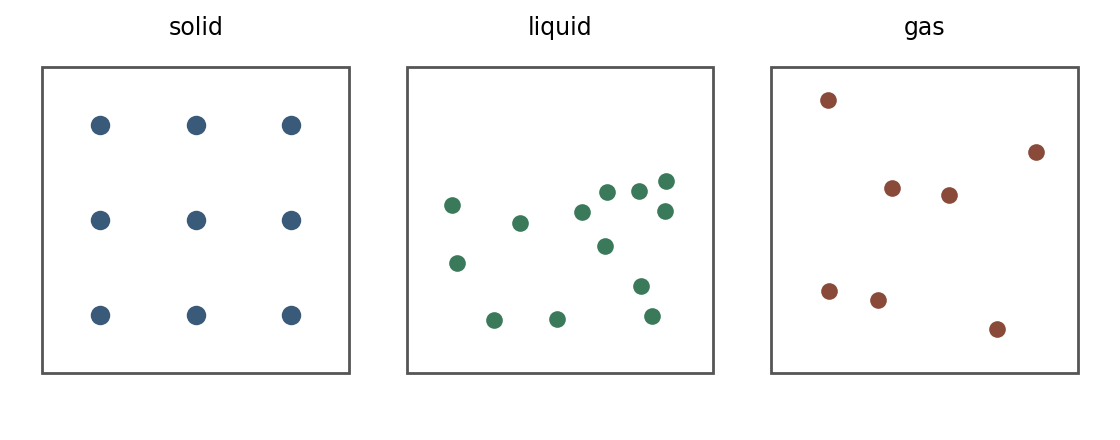
    Solids: fixed, touching particles; liquids: touching but disordered; gases: far apart and fast.

    Specific heat capacity 比热容 c is the energy to raise 1 kg of a substance by 1 °C:

    $$E = m \times c \times \Delta\theta$$

    Worked check. Heating 1.5 kg of water ($c = 4200$) by 40 °C: $E = 1.5 \times 4200 \times 40 = 252\,000$ J.

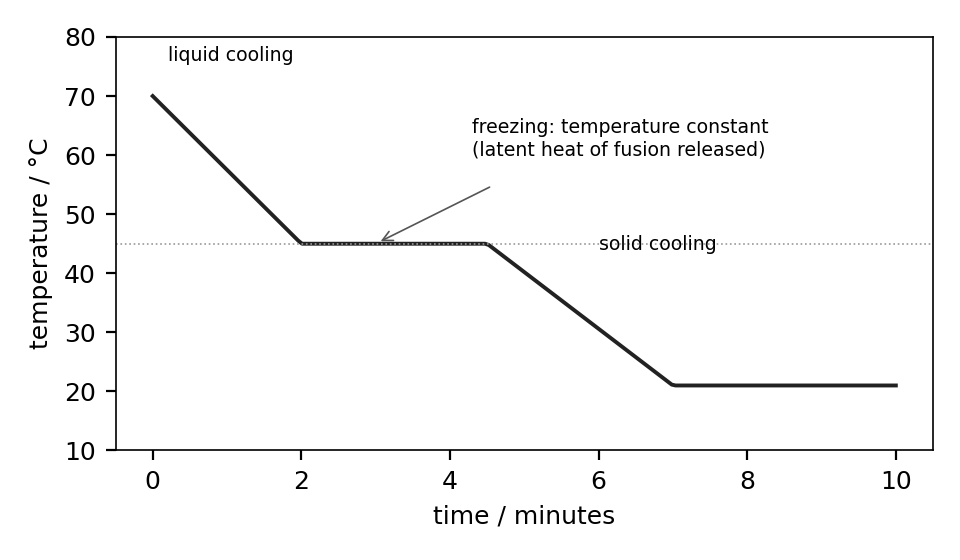
    (P) Changing state needs energy with no temperature change: latent heat of vaporisation 汽化热 $E = m \times L_V$ (liquid → vapour) and latent heat of fusion 熔化热 $E = m \times L_F$ (solid → liquid). Impurities change melting and boiling points. Required practical (P): a cooling curve for stearic acid.

    A cooling curve: the plateau while freezing releases latent heat at constant temperature.

    Energy transfers and particle motion

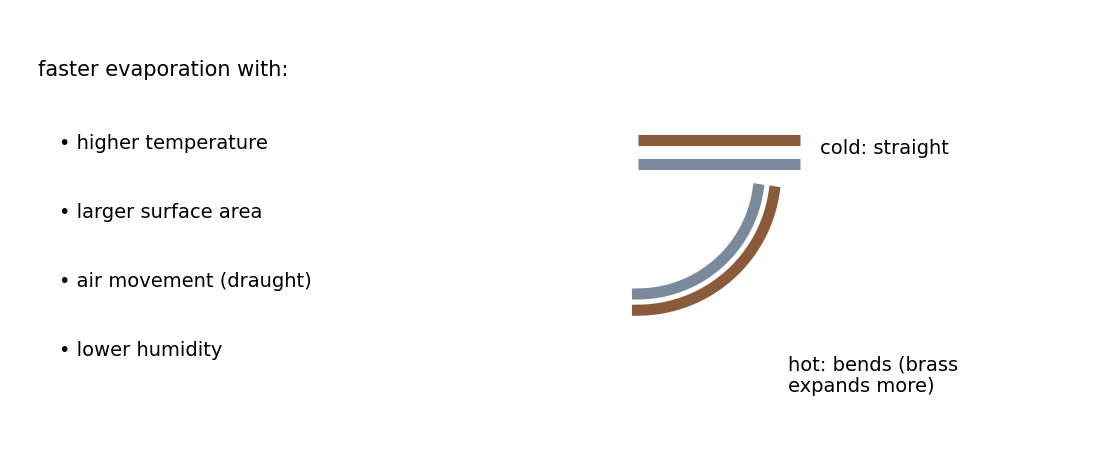
    Conduction 传导 passes energy along a solid by particle vibration, helped by free electrons in metals; insulators lack both. Convection 对流 circulates fluid: particles gain energy, move apart, the fluid becomes less dense and rises, cooler fluid sinks. Evaporation 蒸发 turns fast surface molecules to vapour, cooling what remains — faster with higher temperature, larger surface area, draughts and lower humidity; condensation reverses it.

    Evaporation factors and the bimetallic strip that bends on heating.

    The rate of energy transfer by heating grows with surface area and volume, the material, the surface in contact, and the temperature difference. Design follows: cooling fins maximise area; animals' relative ear size matches climate. Most substances expand when heated — a hazard for roofs and bridges (gaps and rollers), useful in the bimetallic-strip thermostat that bends as one metal expands more and breaks a circuit.

    Check yourself

    1. Describe the particle arrangement in a liquid.
    2. Define specific heat capacity.
    3. Calculate the energy to heat 2 kg of aluminium (c = 900) by 30 °C.
    4. (P) Why does the temperature stay constant while a substance freezes?
    5. (P) 0.5 kg of a substance has L_F = 330 000 J/kg. Calculate the energy to melt it.
    6. Explain conduction in metals, naming the extra carriers.
    7. Explain why warm water rises.
    8. Give three factors that speed evaporation.
    9. Give one hazard and one use of thermal expansion.
    10. Why do cooling fins have large surface area?

    Answers: 1 particles touch but arranged randomly, moving past each other; 2 the energy needed to change the temperature of 1 kg of the substance by 1 °C; 3 $E = 2 \times 900 \times 30 = 54\,000$ J; 4 (P) the energy released as bonds form (latent heat of fusion) leaves at the same rate energy is removed, so the particles' kinetic energy is unchanged; 5 (P) $E = 0.5 \times 330\,000 = 165\,000$ J; 6 vibrating particles pass energy to neighbours, and free electrons carry energy quickly through the metal; 7 the warmer particles move apart, making that water less dense than its surroundings, so it rises; 8 higher temperature, larger surface area, air movement over the surface (also lower humidity); 9 hazard — expansion of bridges/roofs needs gaps; use — the bending bimetallic strip in a thermostat; 10 larger area transfers energy to the surroundings faster by heating.

    Vocabulário
    English Português
    specific heat capacity/spəˈsɪfɪk hiːt kəˈpæsɪti/ calor específico
    latent heat of vaporisation/ˈleɪtənt hiːt ɒv ˌveɪpəraɪˈzeɪʃn/ calor latente de vaporização
    latent heat of fusion calor latente de fusão
    conduction/kənˈdʌkʃn/ condução
    convection/kənˈvekʃn/ convecção
    evaporation/ɪˌvæpəˈreɪʃn/ evaporação
  • 5

    3.5 · Electricity and magnetism

    Programa de aprendizado em breve

    Material de apoio

    English

    Electricity and magnetism

    Electricity is charge on the move, guided by potential difference, resisted by every component — and every current makes a magnetic field. OxfordAQA's largest topic builds the circuit toolkit, the component behaviours, and the electromagnets that follow.

    OxfordAQA International GCSE Physics 9203, topic 3.5 (Version 5.1). Statements marked (P) are Paper-2-only.

    Electrical circuits

    Metals conduct because they have free electrons; (P) an isolated charge imbalance is static electricity, discharged when a conducting route appears (lightning). Current is the rate of flow of charge:

    $$I = \frac{Q}{t} \qquad V = \frac{E}{Q} \qquad V = I \times R$$

    Voltage drives charge round a circuit; potential difference across a component measures the energy transferred per unit charge (volts = joules per coulomb). Learn the standard symbols — switch, lamp, fuse, cell, battery, diode, resistor, variable resistor, thermistor, LDR, LED, ammeter and voltmeter.

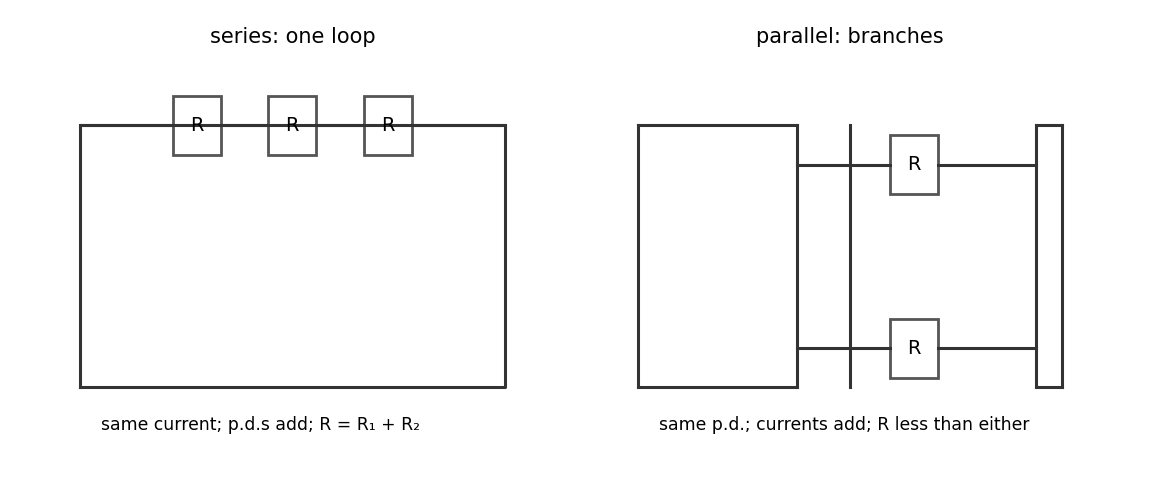
    Series: one loop, same current, resistances add. Parallel: branches share the p.d., currents add.

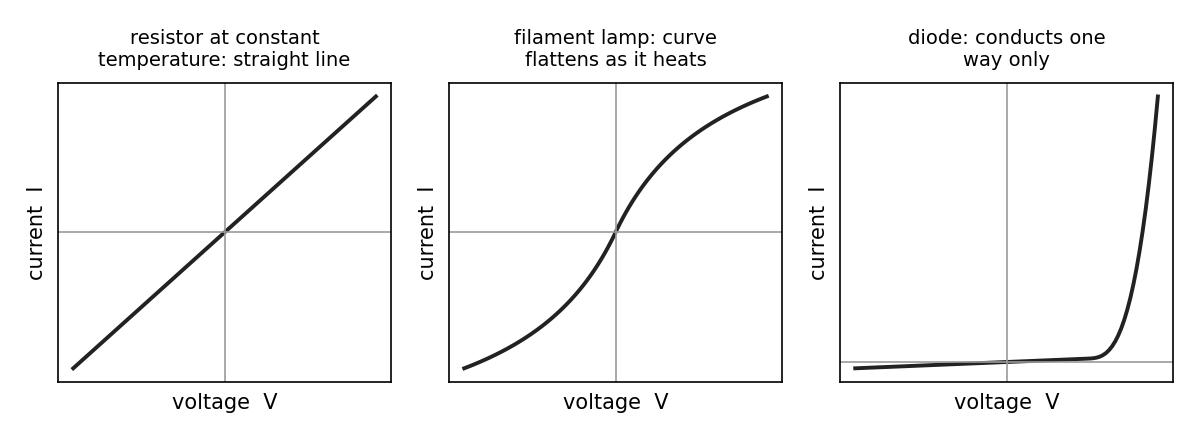
    At constant temperature a resistor's V–I graph is a straight line (ohmic); a filament lamp curves as its ions vibrate more with temperature; a diode conducts forward only; (P) a thermistor's resistance falls as temperature rises (thermostats); an LDR's falls as light rises (automatic lighting); an LED emits light forward and saves energy versus filament and CFL lamps.

    The three required V-I characteristics.

    Series: same current, p.d.s shared, resistances add. Parallel: same p.d., currents split, combined resistance less than either. Charge colliding with the lattice heats every resistor.

    Worked check. A 230 V lamp draws 0.25 A: $R = 230/0.25 = 920\ \Omega$. Two 4 Ω resistors in series across 12 V carry $I = 12/8 = 1.5$ A; in parallel, $R = 2\ \Omega$ and the supply gives $I = 12/2 = 6$ A.

    Magnetism and electromagnetism

    Poles: like repel, unlike attract — non-contact forces. Field lines run N to S outside a magnet; opposite poles facing give a uniform field between them. An induced magnet attracts while in the field and loses magnetism on removal; the Earth's field lets a plotting compass navigate.

    A current-carrying wire has circular field lines around it (stronger current → stronger field; reverse current → reverse direction). A solenoid 螺线管 concentrates the field; with a soft-iron core it is an electromagnet 电磁铁 — switchable, adjustable, used in scrapyard cranes, relays and door locks. Required practical: the factors determining an electromagnet's strength.

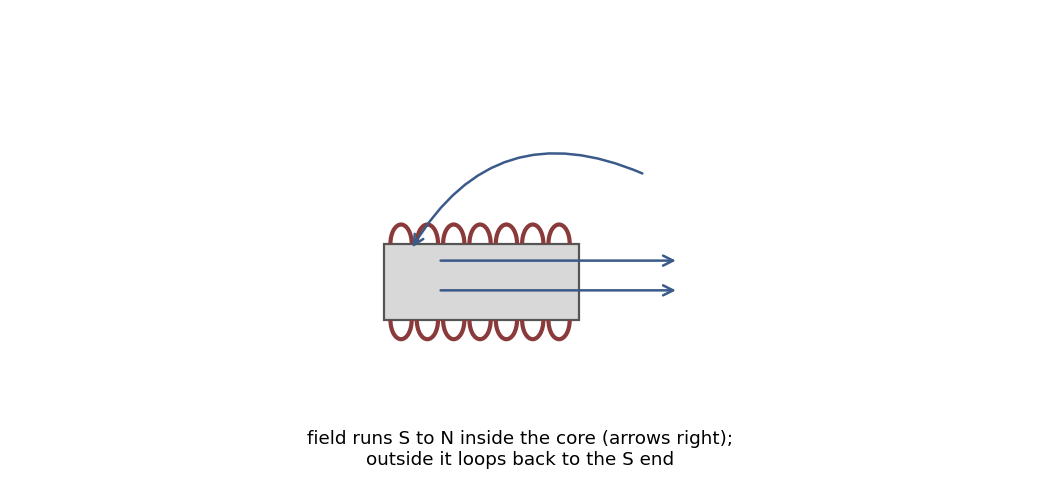
    A solenoid on a soft-iron core: the electromagnet's field is that of a bar magnet, but switchable.

    Check yourself

    1. Why do metals conduct?
    2. State the relationship between current, charge and time with units.
    3. Calculate the charge flowing when 2 A passes for 30 s.
    4. State the V-I shape for a resistor at constant temperature and for a filament lamp.
    5. (P) What happens to a thermistor's resistance as temperature rises?
    6. State the current and p.d. rules for series and for parallel connections.
    7. Calculate R for a 12 V supply pushing 0.5 A.
    8. State the pole rule and the direction of field lines outside a magnet.
    9. What is an induced magnet?
    10. Name two ways to strengthen an electromagnet.

    Answers: 1 they contain free electrons that drift when a p.d. is applied; 2 Q = It, charge in coulombs = current in amperes × time in seconds; 3 Q = 2 × 30 = 60 C; 4 straight line through the origin; S-curve flattening as current (and so temperature) rises; 5 (P) it falls — used in thermostats; 6 series — same current everywhere, p.d.s add; parallel — same p.d. across branches, currents add; 7 R = 12/0.5 = 24 Ω; 8 like poles repel, unlike attract; N to S outside the magnet; 9 a magnetic material that becomes a magnet only while placed in a field — attraction only, losing most magnetism on removal; 10 more turns on the coil; larger current (also a soft-iron core).

    Vocabulário
    English Português
    solenoid/ˈsəʊlənɔɪd/ solenoide
    electromagnet/ɪˌlektrəʊˈmæɡnɪt/ eletroímã
  • 6

    3.6 · Generating and distributing electricity and household use

    Programa de aprendizado em breve

    Material de apoio

    English

    Generating and distributing electricity

    Move a magnet, move a current — a p.d. appears. OxfordAQA's sixth topic runs the full chain from the generator effect through the national grid's transformers to the appliances and safety systems of the home. All statements in this topic are Paper-2 (P).

    OxfordAQA International GCSE Physics 9203, topic 3.6 (Version 5.1) — entirely (P) content.

    Generating electricity (P)

    The generator effect 发电机效应 induces a p.d. across a conductor that moves through a magnetic field, or sits in a changing field. Reverse the motion or the polarity and the induced p.d. reverses; the induced current's own field opposes the change. The p.d. grows with faster movement, stronger field, more turns and larger coil area.

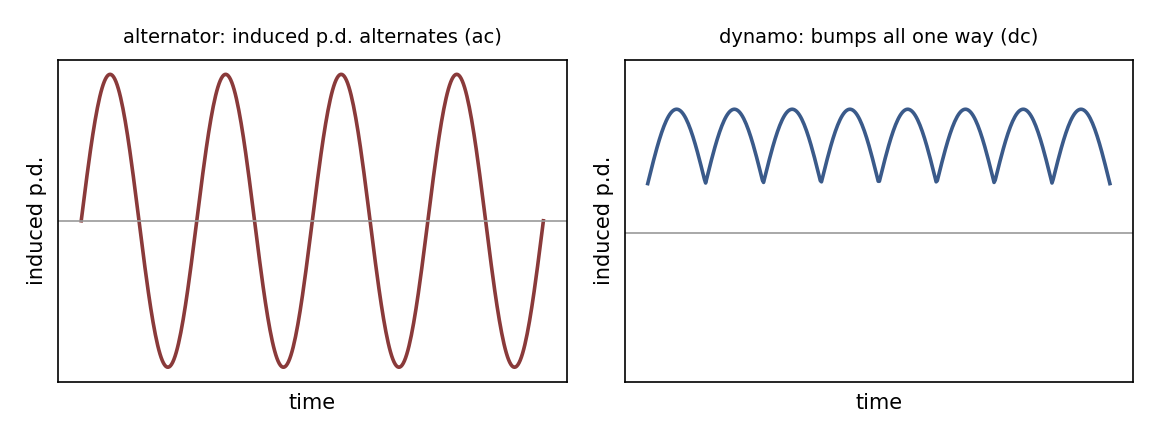
    An alternator spins a coil in a field to make a.c.; a dynamo gives d.c. — know the p.d.–time graphs. Power stations spin turbines to turn coils between magnets.

    An alternator's induced p.d. alternates; a dynamo's bumps point one way.

    Transmission, transformers and the home (P)

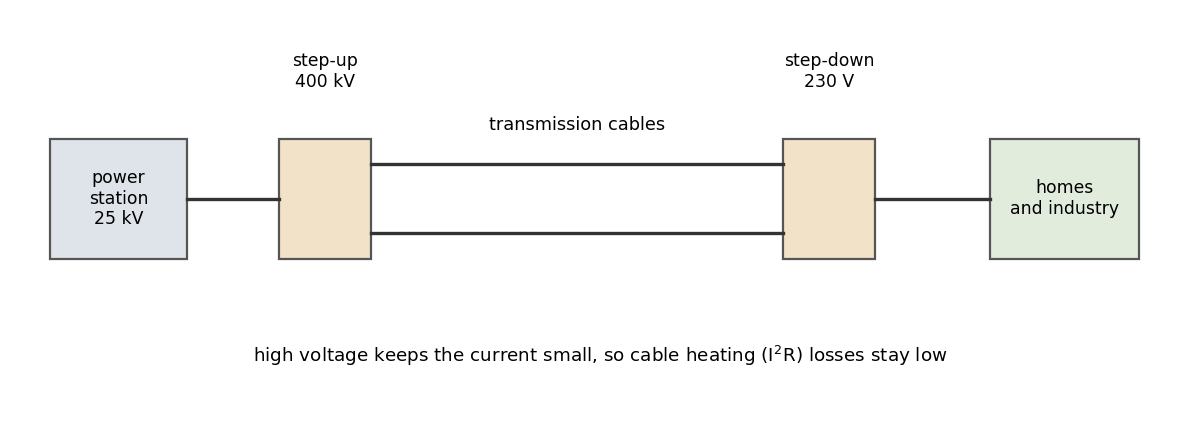
    From the station to the socket, every watt travels the same chain of coils and cables.

    Power station, step-up transformer, high-voltage cables, step-down transformer, consumers.

    For a given power, high transmission voltage means low current and so little cable heating. A transformer 变压器 is two coils on a soft-iron core: alternating current in the primary makes a changing field that induces a p.d. in the secondary.

    $$\frac{V_p}{V_s} = \frac{n_p}{n_s} \qquad V_p I_p = V_s I_s \ (100\%)$$

    Step-up before the lines, step-down after; switch-mode transformers (50–200 kHz) are small and light — phone chargers.

    Worked check. A transformer steps 25 kV up to 400 kV with 1000 primary turns: $n_s = 1000 \times 400/25 = 16\,000$ turns. At 100 MW the line current is $I = P/V = 10^8/(4 \times 10^5) = 250$ A.

    Cells give d.c.; mains is a.c. with fixed frequency and voltage — read period and frequency from oscilloscope-style traces. Safety: earthing 接地 drains fault current from metal casings; a fuse 保险丝 melts or a circuit breaker trips on excess current — the breaker is faster and resettable; double-insulated appliances need no earth.

    The motor effect (P)

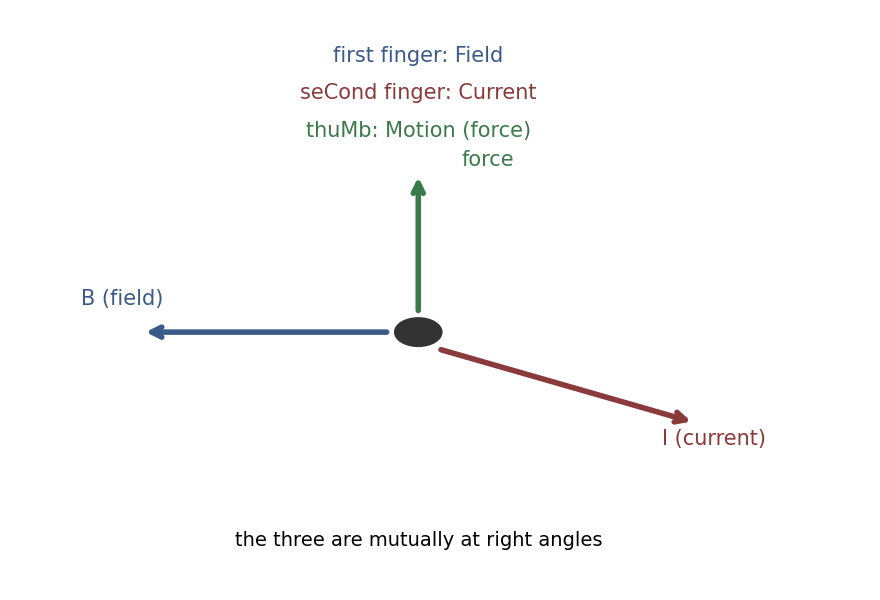
    A current-carrying wire across a magnetic field feels a force (zero if parallel to it). Force grows with stronger field, bigger current and more wire in the field; reverse either to reverse the force — Fleming's left-hand rule 左手定则 predicts the direction.

    Fleming's left-hand rule: field, current and force mutually at right angles.

    A current-carrying coil in a field rotates — the electric motor.

    Transferring electrical energy (P)

    $$P = \frac{E}{t} \qquad P = I \times V \qquad E = V \times Q \qquad E\,(\mathrm{kWh}) = P\,(\mathrm{kW}) \times t\,(\mathrm{h})$$

    Appliance labels give power; compute the current to choose a fuse, and the energy in kilowatt-hours for billing (E = Pt; cost = kWh × price per unit, read from meter readings).

    Worked check. A 2.0 kW heater for 3 h uses 6.0 kWh; at 0.9 per kWh that costs 5.4. A 230 V, 1.1 kW kettle draws I = 1100/230 ≈ 4.8 A — fit a 5 A or 13 A fuse (next rating above).

    Check yourself

    1. State two ways to induce a p.d. in a conductor.
    2. Give three factors that increase the size of an induced p.d.
    3. Sketch the p.d.–time graphs of an alternator and a dynamo.
    4. Why does the grid transmit at high voltage?
    5. A transformer has 200 primary and 3000 secondary turns on 12 V a.c. Calculate the secondary p.d.
    6. State the turns-ratio and power equations for a 100 % efficient transformer.
    7. Explain how earthing and a fuse protect a user together.
    8. State Fleming's left-hand rule.
    9. Calculate the current of a 230 V, 2.3 kW heater, and a sensible fuse.
    10. Calculate the energy in kWh used by a 1.5 kW kettle in 20 minutes.

    Answers: 1 move the conductor through a field; place it in a changing magnetic field; 2 faster motion; stronger field; more turns (also larger coil area); 3 alternator — a sine wave about zero; dynamo — humps all above (or all below) the axis; 4 for the same power the current is smaller, so I²R heating losses in the cables are far lower; 5 $V_s = 12 \times 3000/200 = 180$ V; 6 $V_p/V_s = n_p/n_s$ and $V_p I_p = V_s I_s$; 7 the earth wire gives the fault current a path to earth, and the surge blows the fuse, disconnecting the live wire; 8 first finger Field, second finger Current, thumb Motion — mutually at right angles; 9 I = 2300/230 = 10 A — use a 13 A fuse; 10 t = 1/3 h, so E = 1.5 × 1/3 = 0.5 kWh.

    Vocabulário
    English Português
    generator effect efeito gerador
    transformer/trænsˈfɔːmə/ transformador
    earthing aterramento
    fuse/fjuːz/ fusível
    left-hand rule/left hænd ruːl/ regra da mão esquerda
  • 7

    3.7 · Nuclear physics

    Programa de aprendizado em breve

    Material de apoio

    Física nuclear

    O núcleo ocupa um milionésimo do átomo, mas detém quase toda a sua massa — e núcleos instáveis emitem energia como radiação, fragmentos de fissão ou fusão que ilumina as estrelas. O sétimo tópico da OxfordAQA cobre o modelo nuclear, as três radiações, meia-vida, contaminação versus irradiação, reatores e (P) fusão.

    Física OxfordAQA International GCSE 9203, tópico 3.7 (Versão 5.1). As afirmações marcadas (P) aplicam-se apenas ao Paper-2-.

    Estrutura atômica

    Um átomo tem cerca de 10⁻¹⁰ m de diâmetro: um pequeno núcleo positivo (prótons e nêutrons, quase toda a massa) com elétrons ao redor — evidência de Rutherford de espalhamento alfa para um núcleo concentrado. Massa do próton 1 carga +1; massa do nêutron 1 carga 0; carga do elétron −1, massa desprezível. Um átomo neutro tem igual número de prótons e elétrons; átomos perdem ou ganham elétrons para se tornarem íons.

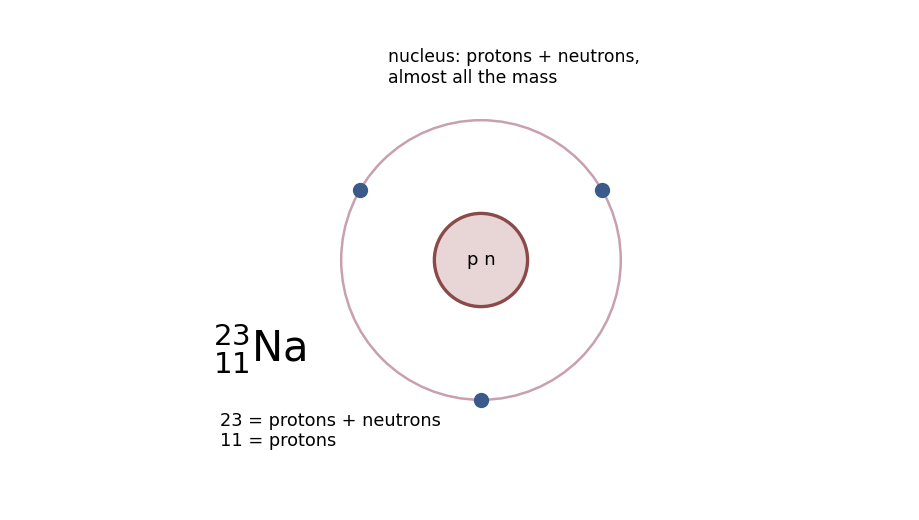
    Notação nuclear: número de massa e número atômico.

    ${}^{A}_{Z}X$: A = número de massa (prótons + nêutrons), Z = número atômico; isótopos compartilham Z e diferem no número de nêutrons.

    Radiação ionizante do núcleo

    Núcleos instáveis decaem aleatoriamente, sem serem afetados por química ou física, emitindo:

    Radiação Natureza Ionizante Alcance no ar
    alfa 2p + 2n (núcleo de hélio) mais forte alguns cm
    beta-menos elétron rápido (nêutron → próton) médio dezenas de cm
    gama onda eletromagnética mais fraco metros
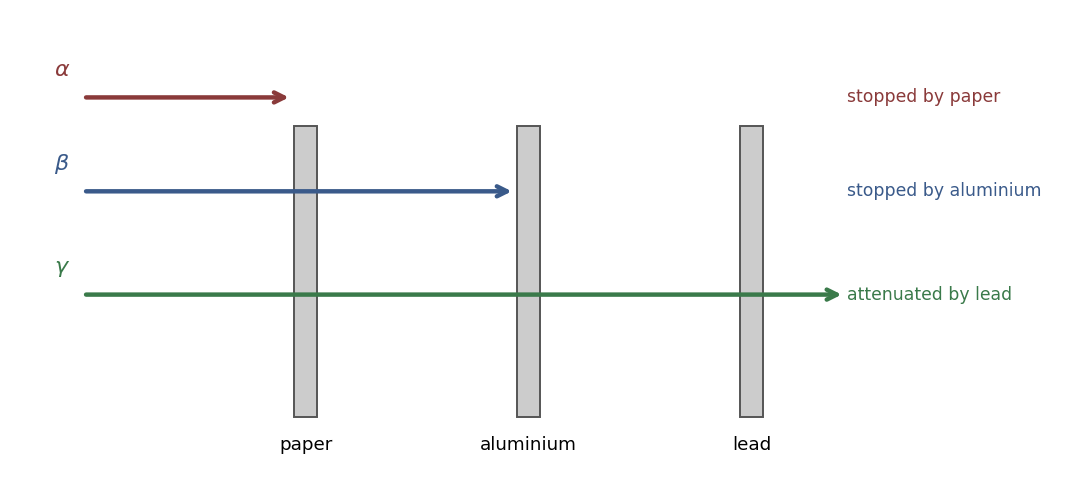
    Penetração: alfa parado por papel, beta por alumínio, gama atenuado por chumbo.

    Equações nucleares conservam número de massa e carga: ${}^{238}_{92}U \rightarrow\, {}^{234}_{90}Th +\, {}^{4}_{2}He$ (alfa); ${}^{14}_{6}C \rightarrow\, {}^{14}_{7}N +\, {}^{0}_{-1}e$ (beta). Radiação de fundo vem de rochas, espaço, alimentos e dispositivos médicos. (P) A meia-vida é o tempo para metade dos núcleos (ou taxa de contagem) decair — a maioria dos núcleos instáveis tem meias-vidas curtas; os menos instáveis duram milênios. Contaminação (átomos radioativos sobre você) é um risco persistente; irradiação expõe sem tornar você radioativo. Perigos: mutações, danos celulares e teciduais.

    Fissão nuclear e (P) fusão

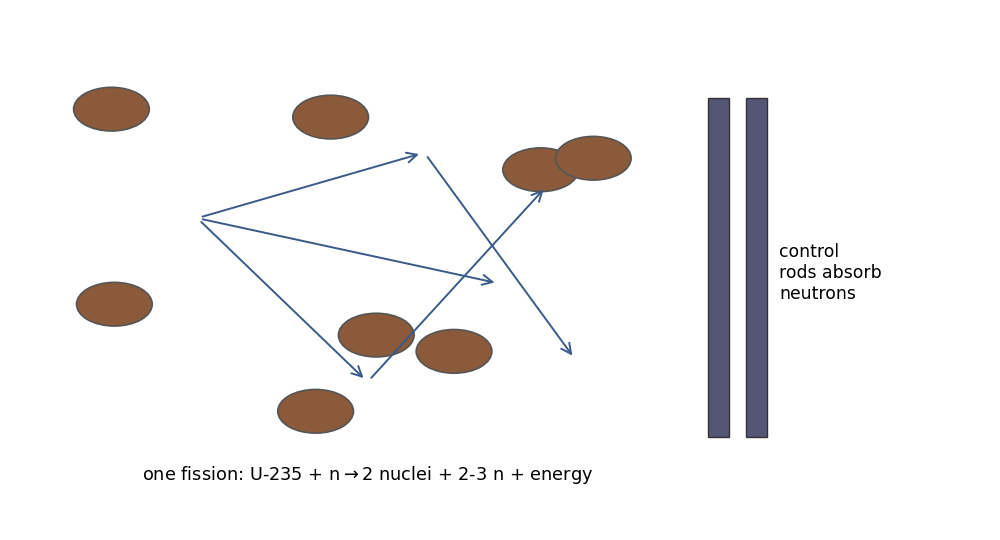
    Fissão divide um grande núcleo instável: U-235 ou Pu-239 absorve um nêutron, divide-se em dois núcleos menores com 2–3 nêutrons e muito mais energia que qualquer reação química. Nêutrons atingindo outros núcleos geram uma reação em cadeia; num reator, barras de controle absorvem nêutrons para manter uma fissão por nêutron.

    Reação em cadeia com barras de controle absorvendo nêutrons.

    Resíduos radioativos permanecem perigosos por tempos definidos pela sua meia-vida — custo de disposição gerenciada da energia nuclear. (P) Fusão une dois núcleos leves em um mais pesado, convertendo massa em energia: alimenta as estrelas, mas núcleos positivos se repelem, exigindo temperatura e pressão extremas.

    Verifique você mesmo

    1. Dê as massas relativas e cargas do próton, nêutron e elétron.
    2. Em ${}^{19}_{9}F$, quantos prótons e nêutrons?
    3. O que o espalhamento alfa revelou sobre o átomo?
    4. Nomeie as três radiações e suas naturezas.
    5. Qual radiação é interrompida pelo papel e qual penetra no alumínio?
    6. Equilibre o decaimento alfa de ${}^{226}_{88}Ra$.
    7. (P) Defina vida média.
    8. (P) Explique a diferença entre contaminação e irradiação.
    9. O que as barras de controle fazem em um reator?
    10. (P) Por que a fusão exige temperaturas extremas?

    Respostas: 1 próton 1/+1; nêutron 1/0; elétron desprezível/−1; 2 9 prótons, 10 nêutrons; 3 massa e carga positiva concentram-se em um núcleo minúsculo — maioria dos alfas passa, alguns rebatem; 4 alfa — núcleo de hélio; beta — elétron rápido; gama — onda EM; 5 alfa; gama (precisa de chumbo espesso); 6 ${}^{226}_{88}Ra \rightarrow\, {}^{222}_{86}Rn +\, {}^{4}_{2}He$; 7 (P) tempo para metade dos núcleos (ou taxa de contagem) reduzir à metade; 8 (P) contaminação — material radioativo sobre você, perigo até ser removido; irradiação — exposição à radiação, termina quando a fonte se afasta; 9 absorvem nêutrons, mantendo a cadeia com uma fissão por nêutron — estável; 10 (P) núcleos positivos se repelem; devem colidir em velocidade enorme para fundir.

    Vocabulário
    English Português
    half-life/hɑːf laɪf/ meia-vida
    contamination/kənˌtæmɪˈneɪʃn/ contaminação
    irradiation/ˌɪreɪdɪˈeɪʃn/ irradiação
    fission/ˈfɪʃn/ fissão
    fusion/ˈfjuːʒn/ fusão
  • 8

    3.8 · Space physics

    Programa de aprendizado em breve

    Material de apoio

    Física espacial

    A gravidade congrega poeira em estrelas, as estrelas fundem os elementos e o desvio para o vermelho de galáxias distantes indica que todo o universo está se expandindo desde um início 14 mil milhões de anos atrás. O tópico final do OxfordAQA encerra o curso com ciclos de vida estelares, órbitas e evidências do Big Bang.

    OxfordAQA International GCSE Physics 9203, topic 3.8 (Versão 5.1). Declarações marcadas (P) são apenas Paper-2-only.

    Ciclo de vida de uma estrela

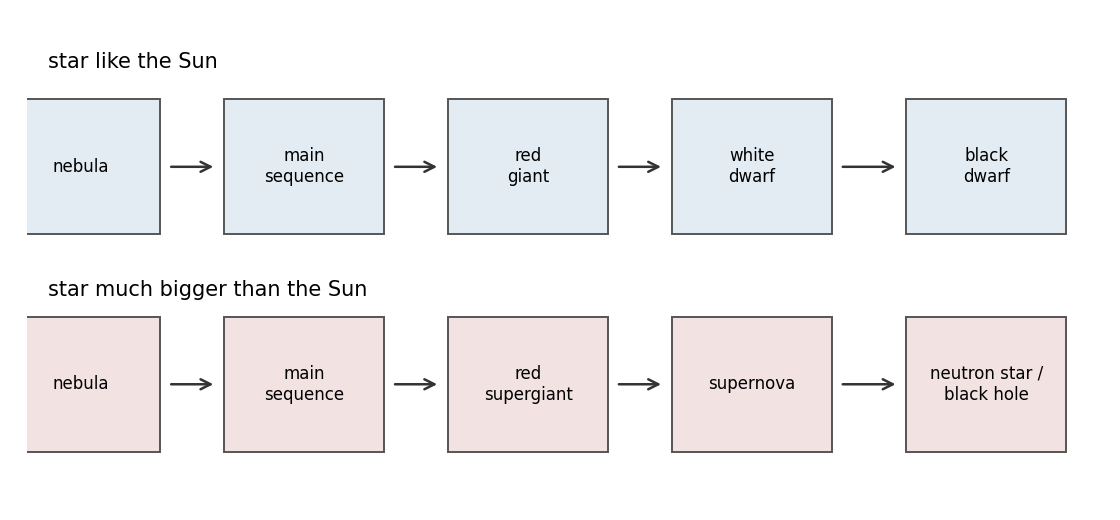
    Dois rastros: estrelas semelhantes ao Sol terminam como anãs negras; estrelas massivas terminam em supernovas e estrelas de nêutrons ou buracos negros.

    Estrelas formam-se quando a gravidade atrai poeira e gás (principalmente hidrogênio e hélio) juntos — aglomerados menores tornam-se planetas. Na longa sequência principal, o hidrogênio funde-se em hélio no núcleo e a gravidade equilibra as forças externas. Quanto mais massiva uma estrela, mais quente seu núcleo e mais pesados os núcleos que pode construir por fusão.

    Quando o hidrogênio acaba, a massa decide o fim. Uma estrela semelhante ao Sol incha para uma gigante vermelha, perde suas camadas e o núcleo exposto esfria de anã branca para anã negra. Uma estrela massiva incha para uma supergigante vermelha, funde elementos cada vez mais pesados (carbono, nitrogênio, oxigênio), depois explode como uma supernova — espalhando os elementos (aqueles mais pesados que ferro são criados na própria explosão) — deixando uma estrela de nêutrons ou buraco negro. Fusão em estrelas e supernovas criou todos os elementos naturalmente existentes: o universo inicial continha apenas hidrogênio.

    Sistema solar e movimento orbital

    O sistema solar: oito planetas orbitando o Sol, além de luas, asteroides, planetas anões e cometas. A Via Láctea é uma de milhares de milhões de galáxias, cada uma com milhares de milhões de estrelas. Satélites artificiais orbitam a Terra em órbitas geostacionárias ou polares baixas.

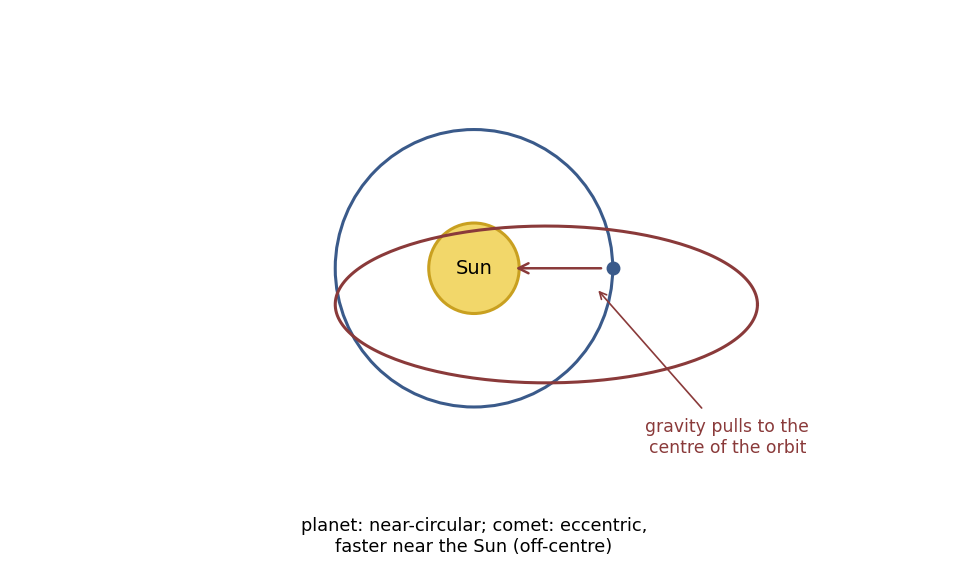
    Órbita quase circular de um planeta e órbita excêntrica de um cometa, com a gravidade fornecendo a tração centrípeta.

    A gravidade fornece a força centrípeta: atua em direção ao centro, alterando a direção do movimento (velocidade) sem alterar a rapidez. Maior separação significa gravidade mais fraca, logo menor velocidade orbital: para permanecer em um raio específico, um satélite deve mover-se à velocidade correspondente — alterar a velocidade muda o raio da órbita.

    Desvio para o vermelho e universo em expansão (P)

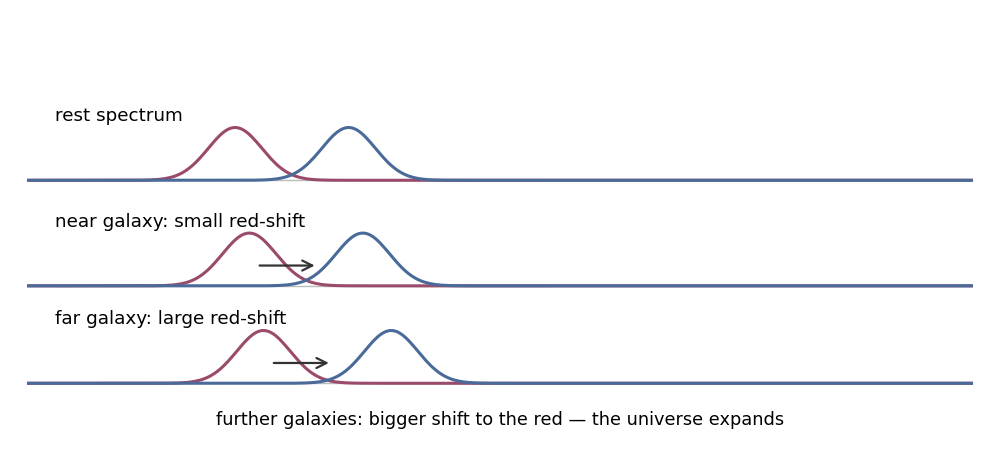
    Três espectros: quanto maior a distância da galáxia, maior o desvio para o vermelho.

    A fonte de onda em movimento altera o comprimento de onda observado (o efeito Doppler): fontes que se afastam esticam as ondas — maior comprimento de onda, menor frequência. Quanto mais distante uma galáxia, mais rápido ela se afasta e maior é o desvio para o vermelho — o próprio espaço está se expandindo, apontando para um início muito pequeno: o Big Bang. A radiação cósmica de fundo — radiação que preenche o universo logo após esse início — é a segunda coluna; a teoria do Big Bang é atualmente a única que a explica.

    Verifique você mesmo

    1. O que puxa poeira e gás para dentro das estrelas?
    2. O que acontece no núcleo de uma estrela da sequência principal?
    3. Liste as três etapas por que passa uma estrela semelhante ao Sol após a sequência principal.
    4. Quais estrelas se tornam supernovas?
    5. Onde são criados elementos mais pesados que o ferro?
    6. Nomeie os dois tipos de órbita artificial de satélite.
    7. Por que um satélite em órbita mais alta move-se mais lentamente?
    8. (P) O que acontece com o comprimento de onda de uma onda quando sua fonte se afasta?
    9. (P) Cite as duas evidências do Big Bang.
    10. (P) O que é a CMBR?

    Respostas: 1 atração gravitacional; 2 núcleos de hidrogênio fundem-se em hélio, liberando energia, com a gravidade equilibrada; 3 gigante vermelha, anã branca, anã negra (três etapas após a sequência principal); 4 estrelas muito mais massivas que o Sol; 5 em explosões de supernova; 6 geostacionária e polar baixa; 7 a gravidade enfraquece com a distância, então a força centrípeta — e a velocidade que ela exige — é menor; 8 (P) aumenta (desvio para o vermelho), e a frequência observada cai; 9 (P) desvio para o vermelho das galáxias aumentando com a distância, e a radiação cósmica de fundo; 10 (P) radiação eletromagnética que preenche o universo, remanescente de pouco tempo depois do Big Bang.

    Vocabulário
    English Português
    red-shift/red ʃɪft/ desvio para o vermelho
    Big Bang/bɪɡ bæŋ/ Big Bang
    cosmic microwave background/ˈkɒzmɪk ˈmaɪkrəʊweɪv ˈbækɡraʊnd/ radiação cósmica de fundo

Entrar ou criar conta

IGCSE, A-Level & AP