Adjetivos que indicam intensidade e modo. (degree marker)得extremely / terrible不得了 e (degree marker)得degree / adjective linker很 vêm depois de um adjetivo e intensificam seu sentido; adjetivo + (completed / change)了 + (one / a一)a little点儿 indica que algo passa um pouco do ponto (big大(completed / change)了a little一点儿, grande demais); have plenty of有的是 + substantivo indica que há algo em abundância. specific; concrete具体 pede detalhes específicos (具体来说), individual; a few个别 destaca alguns casos, e quickly; rapid迅速 descreve uma ação rápida na escrita.
Adjetivos
 4:25
HSK 5 Gramática 1: Adjetivos — Extremo e Muito
Uma estação movimentada oferece quatro reações. Você perde um assento, o vagão está lotado, o lanche custa mais do que esperava, e o chá é mais doce do que gosta.…
Explicações em inglês + exemplos em mandarim · legendas seguem o texto falado
1.1
Visão geral
- 1. Adj. + (degree marker)得extremely / terrible不得了 – extremamente: team member队员(plural)们emotional; worked up激动(degree marker)得extremely / terrible不得了。
- 2. Adj. + (degree marker)得degree / adjective linker很 – muito: here这里(modifier / structural particle)的air空气fresh新鲜(degree marker)得degree / adjective linker很。
- 3. Adj. + (completed / change)了 + (one / a一)a little点儿 – um pouco demais: 这汤salty咸(completed / change)了a little点儿。
- 4. have plenty of有的是 + substantivo – ter em abundância: 书架上have plenty of有的是novel小说,you你as you like; casual随便to borrow借。
- 5. specific; concrete具体 vs. detailed详细 – específico, em detalhes: please; to invite请you你specific; concrete具体to speak说to speak说you你(modifier / structural particle)的plan计划。
- 6. individual; a few个别 vs. small number少数 e some一些 – alguns casos individuais: besides除了individual; a few个别classmate同学,everyone大家all / both都on time按时to / arrive / (result: get)到(completed / change)了。
- 7. quickly; rapid迅速 vs. fast快速 e at once立刻 – rapidamente: firefighter消防员quickly; rapid迅速to hurry (to some place)赶到(completed / change)了the scene; on the spot现场。
1.2
1. Adj. + 得不得了 (extremamente)
Forma: adjetivo / verbo de sentimento + (degree marker)得extremely / terrible不得了
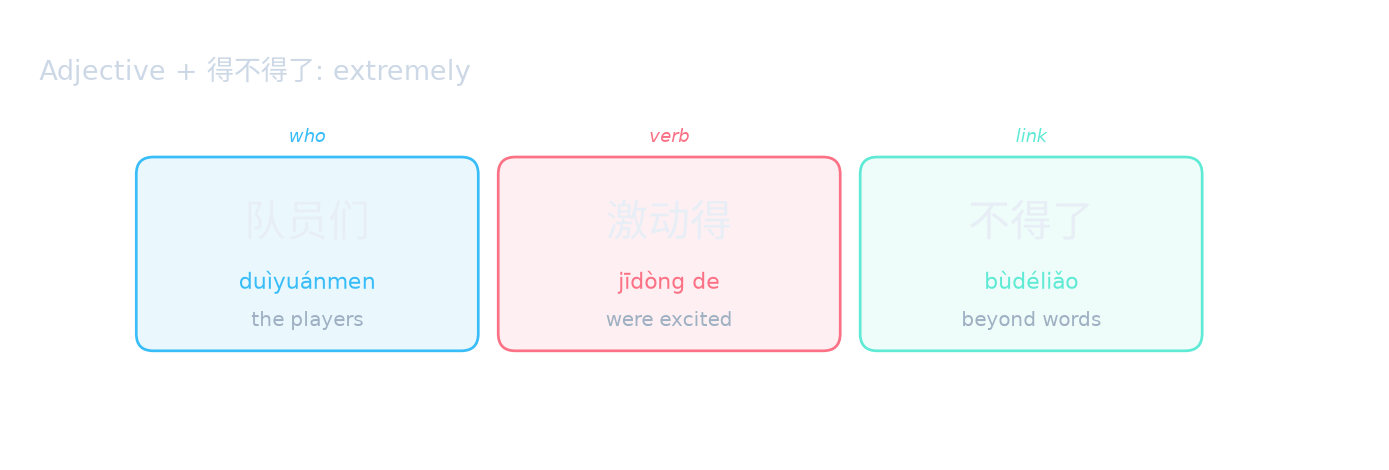
- team member队员(plural)们emotional; worked up激动(degree marker)得extremely / terrible不得了。 Duìyuánmen jīdòng de bùdéliǎo. – Os jogadores estavam extremamente empolgados.
- today今天热得extremely / terrible不得了,I / me我a little一点儿also也not want to不想to go out出门。 – Hoje está insuportavelmente quente; não quero sair de jeito nenhum.
- to hear (sth said)听说you你want / will / need要to come来,child孩子(plural)们happy; glad高兴(degree marker)得extremely / terrible不得了。 – Quando souberam que você viria, as crianças ficaram radiantes.
Como funciona. (degree marker)得 liga o adjetivo a extremely / terrible不得了 bùdéliǎo ("além do que se pode suportar"), que encerra a oração e leva o sentimento a um extremo, bom ou ruim.
| Expressão | Significado |
|---|---|
| tired累(degree marker)得extremely / terrible不得了 | exausto |
| extremely / terrible不得了(completed / change)了! | Ah, não, isso é grave! |
| terrific了不得 | notável: he / him他really真terrific了不得 |
Cuidado
- Use apenas uma palavra de grau: incorreto: degree / adjective linker很busy忙(degree marker)得extremely / terrible不得了 → busy忙(degree marker)得extremely / terrible不得了.
- Mantenha (degree marker)得: incorreto: tired累extremely / terrible不得了 → tired累(degree marker)得extremely / terrible不得了.
Vocabulário
Treinar
| 汉字 | Pinyin | English |
|---|---|---|
| 不得了 | bù dé liǎo | extremely; terrible |
1.3
2. Adj. + 得很 (muito)
Forma: adjetivo / verbo de sentimento + (degree marker)得degree / adjective linker很
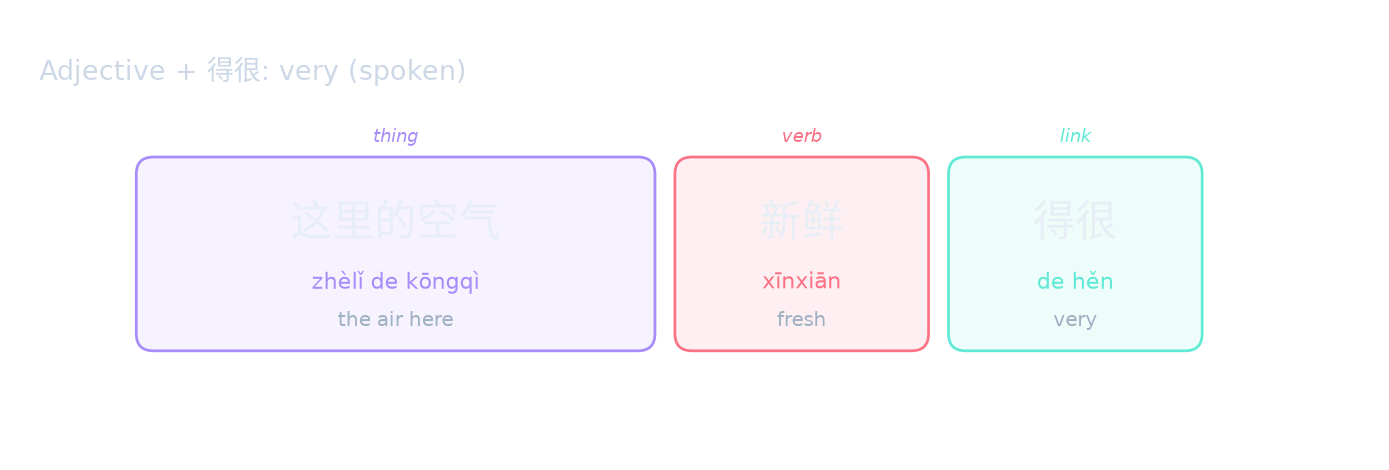
- here这里(modifier / structural particle)的air空气fresh新鲜(degree marker)得degree / adjective linker很。 Zhèlǐ de kōngqì xīnxiān de hěn. – O ar aqui é muito puro.
- he / him他(modifier / structural particle)的Chinese language中文good好(degree marker)得degree / adjective linker很,you你need not不用anxious担心。 – O chinês dele é muito bom; não se preocupe.
- 这家hotel酒店cheap便宜(degree marker)得degree / adjective linker很。 – Este hotel é muito barato.
- good好(degree marker)得degree / adjective linker很,again又to arrive late迟到(completed / change)了! – Ótimo, chegou atrasado de novo! (irônico)
Como funciona. (degree marker)得degree / adjective linker很 depois de um adjetivo significa "muito, realmente" e é mais expressivo e enfático do que degree / adjective linker很 antes dele. Encerra a oração e também vem depois de verbos de sentimento: he / him他to like喜欢(degree marker)得degree / adjective linker很. Dito sem entonação, pode ser irônico.
| degree / adjective linker很fresh新鲜 | fresh新鲜(degree marker)得degree / adjective linker很 | fresh新鲜(degree marker)得extremely / terrible不得了 |
|---|---|---|
| neutro | enfático | mais forte |
Cuidado
- incorreto: degree / adjective linker很fresh新鲜(degree marker)得degree / adjective linker很 → fresh新鲜(degree marker)得degree / adjective linker很; incorreto: good好degree / adjective linker很 → good好(degree marker)得degree / adjective linker很.
1.4
3. Adj. + 了 + (一)点儿 (um pouco demais)
Forma: adjetivo + (completed / change)了 + (one / a一)a little点儿 (um pouco demais …)
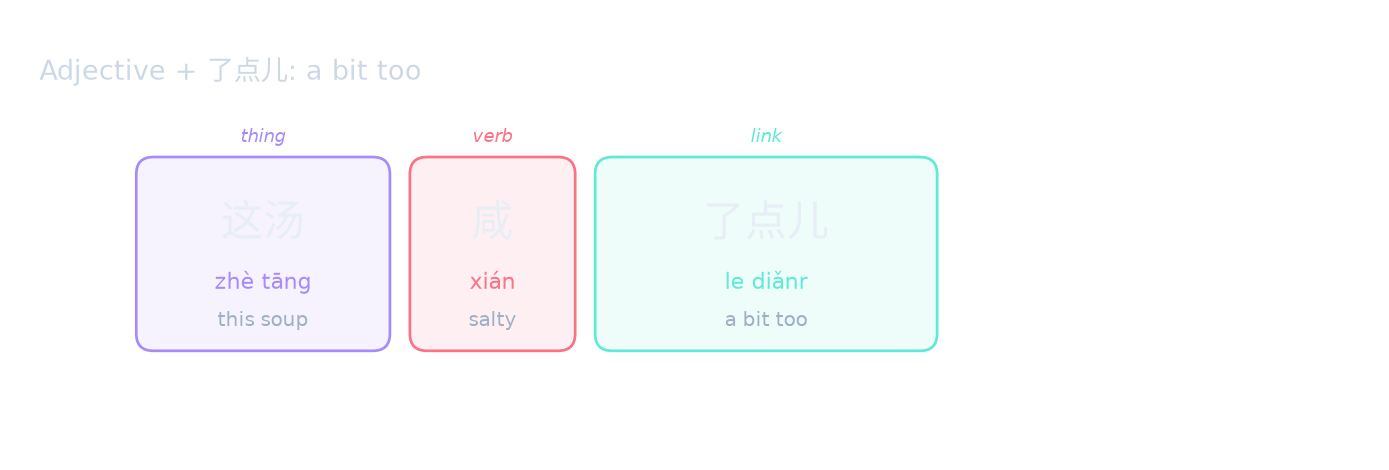
- 这汤salty咸(completed / change)了a little点儿。 Zhè tāng xiánle diǎnr. – Esta sopa está um pouco salgada demais.
- this这measure word for long thin things条trousers裤子long长(completed / change)了a little点儿。 – Esta calça está um pouco comprida demais.
- 八点to hold a meeting开会,to / towards / correct对I / me我来说early早(completed / change)了a little一点儿。 – Uma reunião às oito é um pouco cedo para mim.
- price价格expensive贵(completed / change)了a little点儿,can / be able to能cheap便宜a little一点儿(yes/no ?)吗? – Está um pouco caro; poderia fazer um preço um pouco menor?
Como funciona. Adjetivo + (completed / change)了 + a little点儿 compara algo com a medida adequada: passa um pouco dela. É uma reclamação leve e educada.
| big大(completed / change)了a little点儿 | big大a little一点儿 | slightly有点儿big大 | too太big大(completed / change)了! |
|---|---|---|---|
| um pouco grande demais | um pouco maior (pedido) | um pouco grande (a impressão) | grande demais |
Cuidado
- Para pedir um tamanho maior, diga big大a little一点儿(modifier / structural particle)的; big大(completed / change)了a little点儿 indica que este está grande demais.
1.5
4. 有的是 + substantivo (ter em abundância)
Forma: (tópico,) sujeito + have plenty of有的是 + substantivo
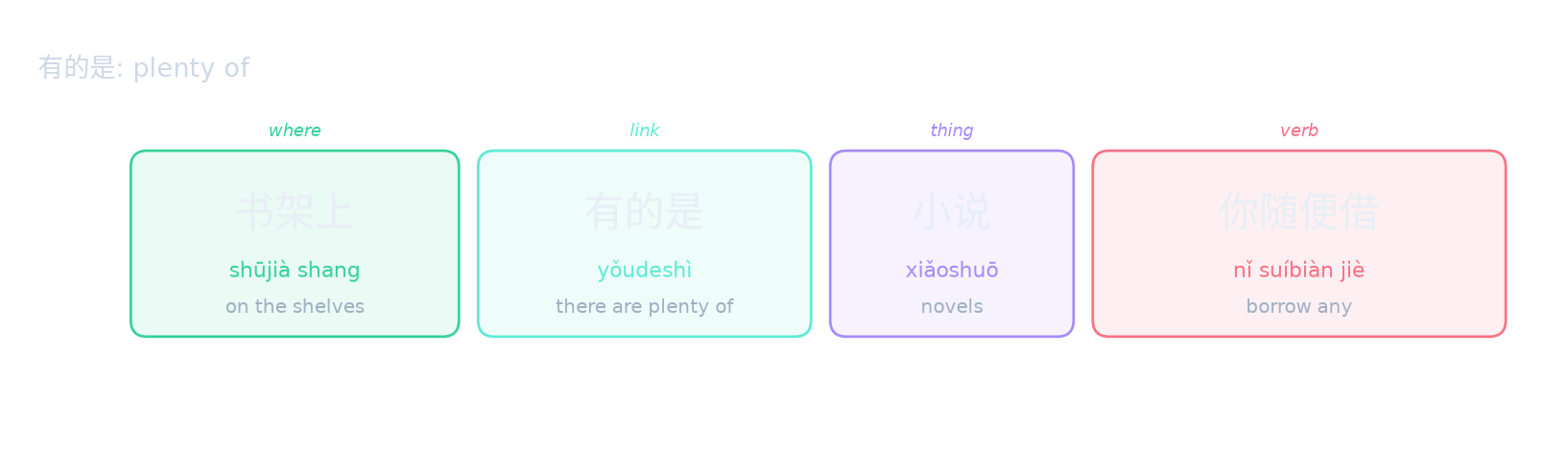
- 书架上have plenty of有的是novel小说,you你as you like; casual随便to borrow借。 Shūjià shang yǒudeshì xiǎoshuō, nǐ suíbiàn jiè. – Há muitos romances na estante; pegue emprestado o que quiser.
- don't别anxious担心,ticket票have plenty of有的是。 – Não se preocupe, há ingressos de sobra.
- this kind of这种thing; stuff东西,supermarket超市inside; in里have plenty of有的是。 – O supermercado tem muitas coisas desse tipo.
- he / him他have plenty of有的是means办法。 – Ele tem muitas maneiras de lidar com isso.
Como funciona. have plenty of有的是 yǒudeshì significa "não falta". Transmite tranquilidade e acrescenta a ideia de "então não se preocupe": to have / there is有很多time时间 é neutro; have plenty of有的是time时间 indica que não há necessidade de pressa. O tópico pode vir primeiro e have plenty of有的是 por último.
| have plenty of有的是 + substantivo | to have / there is有(modifier / structural particle)的 + substantivo |
|---|---|
| em abundância | alguns |
| have plenty of有的是time时间 | to have / there is有(modifier / structural particle)的person人not不to like喜欢to eat吃spicy辣 |
Cuidado
- Não inclua 很多: incorreto: have plenty of有的是很多money钱 → have plenty of有的是money钱.
1.6
5. 具体 vs. 详细 (específico, em detalhes)
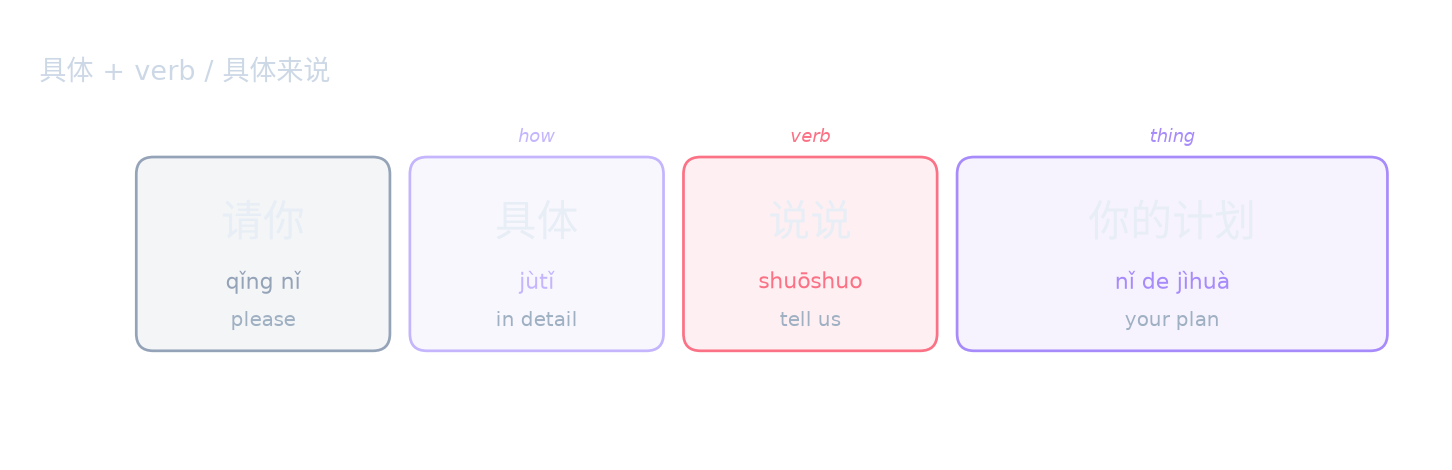
Forma: specific; concrete具体 + verbo · specific; concrete具体(modifier / structural particle)的 + substantivo · 具体来说,…
- please; to invite请you你specific; concrete具体to speak说to speak说you你(modifier / structural particle)的plan计划。 Qǐng nǐ jùtǐ shuōshuo nǐ de jìhuà. – Conte-nos sobre seu plano em detalhes, por favor.
- meeting会议(modifier / structural particle)的specific; concrete具体time时间still / also / even还没定。 – O horário exato da reunião ainda não foi definido.
- 具体来说,to participate参加(modifier / structural particle)的person人than / compared to比last year去年many; much多(completed / change)了一倍。 – Para ser específico, o dobro de pessoas participou em relação ao ano passado.
Como funciona. specific; concrete具体 = específico, concreto, não vago. 具体来说 introduz detalhes depois de uma ideia geral. detailed详细 = cheio de detalhes; distinct清楚 = claro. Oposto: abstract抽象.
| specific; concrete具体time时间 | detailed详细to explain / to show说明 | 具体来说 |
|---|---|---|
| horário exato | instruções completas | para ser específico |
Cuidado
- specific; concrete具体 = exato, não vago; detailed详细 = com muitos detalhes.
Vocabulário
Treinar
| 汉字 | Pinyin | English |
|---|---|---|
| 具体 | jù tǐ | specific; concrete |
| 抽象 | chōu xiàng | abstract |
1.7
6. 个别 vs. 少数 e 一些 (alguns casos individuais)
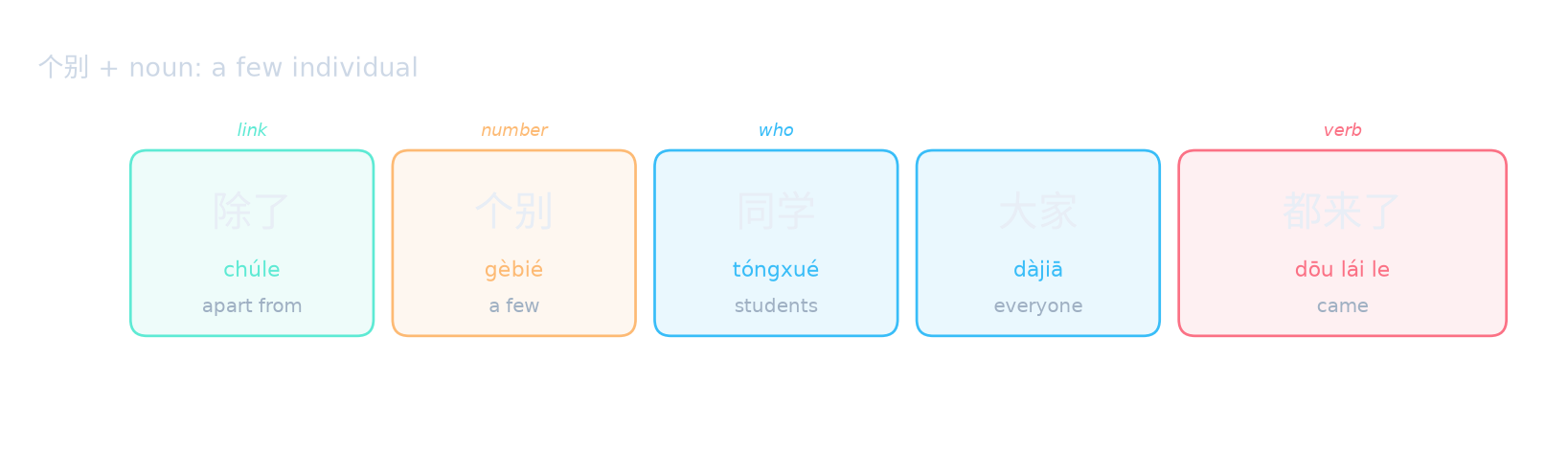
Forma: individual; a few个别 + substantivo · individual; a few个别 + verbo (individualmente)
- besides除了individual; a few个别classmate同学,everyone大家all / both都on time按时to / arrive / (result: get)到(completed / change)了。 Chúle gèbié tóngxué, dàjiā dōu ànshí dào le. – Com exceção de alguns alunos, todos chegaram na hora.
- this这merely只是个别现象。 – Este é apenas um caso isolado.
- teacher老师can / will会个别辅导achievement成绩no good不好(modifier / structural particle)的student学生。 – O professor dará ajuda individual aos alunos com notas baixas.
Como funciona. individual; a few个别 = pouquíssimos casos individuais e isolados, destacados dos demais; antes de um verbo, individualmente. small number少数 = uma minoria; some一些 = alguns. Oposto: common; widespread普遍.
| individual; a few个别classmate同学 | small number少数person人 | common; widespread普遍 |
|---|---|---|
| alguns alunos | uma minoria | generalizado |
Cuidado
- individual; a few个别 destaca casos isolados; small number少数, uma minoria.
Vocabulário
Treinar
| 汉字 | Pinyin | English |
|---|---|---|
| 个别 | gè bié | individual; a few |
1.8
7. 迅速 vs. 快速 e 立刻 (rapidamente)
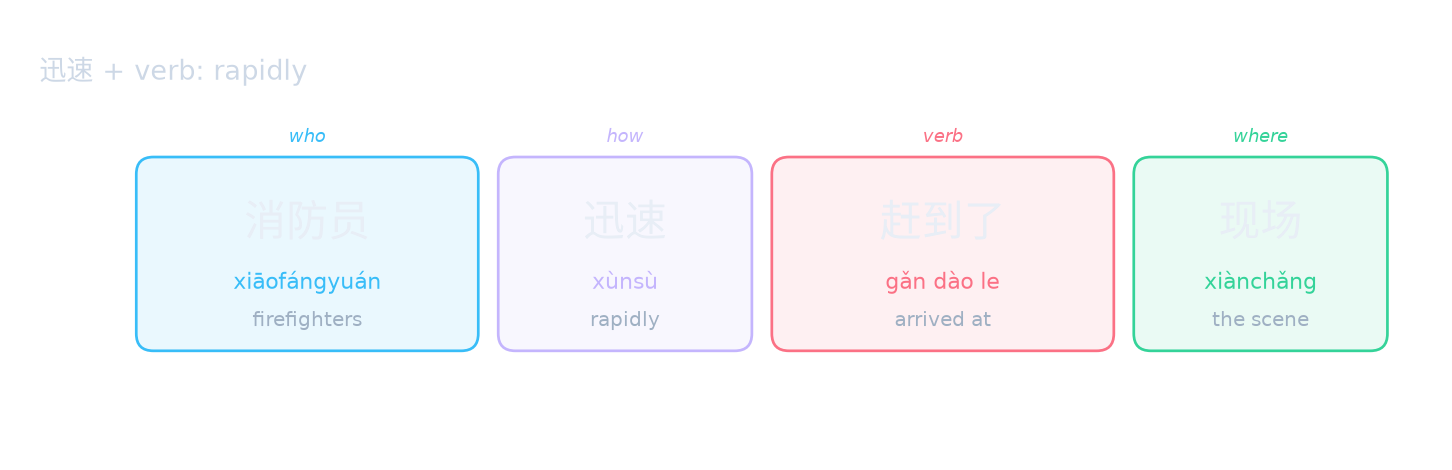
Forma: quickly; rapid迅速 + verbo · verbo + (degree marker)得 + degree / adjective linker很quickly; rapid迅速
- firefighter消防员quickly; rapid迅速to hurry (to some place)赶到(completed / change)了the scene; on the spot现场。 Xiāofángyuán xùnsù gǎn dào le xiànchǎng. – Os bombeiros correram para o local.
- 这座city城市to develop; development发展(degree marker)得very非常quickly; rapid迅速。 – Esta cidade se desenvolveu muito rapidamente.
- please; to invite请at once立刻to pull up (stop one's…停车! – Pare o carro imediatamente!
Como funciona. quickly; rapid迅速 = rapidamente, uma palavra usada na escrita para uma ação ou mudança rápida. fast快速 tem sentido próximo (e costuma vir antes de substantivos). at once立刻 / right away马上 = imediatamente. Na fala: 很快.
| quickly; rapid迅速to hurry (to some place)赶到 | to develop; development发展quickly; rapid迅速 | at once立刻to pull up (stop one's…停车 |
|---|---|---|
| correr até lá | desenvolver-se rapidamente | parar imediatamente |
Cuidado
- Na fala, 很快 soa mais natural que quickly; rapid迅速.
Vocabulário
Treinar
| 汉字 | Pinyin | English |
|---|---|---|
| 迅速 | xùn sù | quickly; rapid |
| 立刻 | lì kè | at once |
1.9
Prática
Cubra as páginas de conteúdo antes de responder. As respostas estão no final.
1. Adj. + (degree marker)得extremely / terrible不得了 (extremamente)
1. Complete: “Estou ocupadíssimo esta semana.” this这个week星期我忙…………extremely / terrible不得了。
2. Qual frase está correta?
- A. he / him他happy; glad高兴(degree marker)得extremely / terrible不得了。
- B. he / him他extremely / terrible不得了happy; glad高兴。
- C. he / him他happy; glad高兴extremely / terrible不得了(degree marker)得。
- D. he / him他degree / adjective linker很happy; glad高兴(degree marker)得extremely / terrible不得了。
3. Associe cada expressão ao seu significado.
-
(1) tired累(degree marker)得extremely / terrible不得了
-
(2) extremely / terrible不得了(completed / change)了!
-
(3) terrific了不得
-
A. notável
-
B. exausto
-
C. oh não, isso é sério!
4. Forme a frase: “Quando souberam que você viria, as crianças ficaram radiantes.”
Coloque em ordem: to hear (sth said)听说you你want / will / need要to come来 / extremely / terrible不得了。 / ,child孩子(plural)们 / happy; glad高兴(degree marker)得
5. O time da sua escola acabou de vencer o campeonato da cidade após uma disputa de pênaltis. Use adj. + (degree marker)得extremely / terrible不得了. Escreva sua resposta em chinês e depois diga-a em voz alta.
2. Adj. + (degree marker)得degree / adjective linker很 (muito)
6. Complete: “Este hotel é muito barato.” 这家hotel酒店cheap便宜…………。
7. Qual frase está correta?
- A. air空气fresh新鲜(degree marker)得degree / adjective linker很。
- B. air空气degree / adjective linker很fresh新鲜(degree marker)得degree / adjective linker很。
- C. air空气fresh新鲜degree / adjective linker很。
- D. air空气(degree marker)得degree / adjective linker很fresh新鲜。
8. Forme a frase: “O chinês dele é muito bom.”
Coloque em ordem: (degree marker)得degree / adjective linker很。 / good好 / he / him他(modifier / structural particle)的Chinese language中文
9. Verdadeiro ou falso? (degree marker)得extremely / terrible不得了 geralmente é mais forte que (degree marker)得degree / adjective linker很. Se for falso, corrija.
10. Após uma semana em uma cidade cheia de poluição, você caminha em um parque nas montanhas. Use adj. + (degree marker)得degree / adjective linker很. Escreva sua resposta em chinês e depois diga-a em voz alta.
3. Adj. + (completed / change)了 + (one / a一)a little点儿 (um pouco demais)
11. Complete: “Esta calça está um pouco comprida demais.” this这measure word for long thin things条trousers裤子long长…………a little点儿。
12. Você quer um tamanho um pouco maior. O que você pede?
- A. too太big大(completed / change)了(modifier / structural particle)的
- B. big大(completed / change)了a little点儿(modifier / structural particle)的
- C. slightly有点儿big大(modifier / structural particle)的
- D. big大a little一点儿(modifier / structural particle)的
13. Forme a frase: “Uma reunião às oito é um pouco cedo para mim.”
Coloque em ordem: ,to / towards / correct对I / me我来说 / early早(completed / change)了 / a little一点儿。 / 八点to hold a meeting开会
14. Verdadeiro ou falso? 太咸(completed / change)了 é uma reclamação mais forte que 咸了a little点儿. Se for falso, corrija.
15. Você prova a sopa que seu colega de quarto fez. Está boa, mas tem um pouco de sal demais. Use adj. + (completed / change)了 +. Escreva sua resposta em chinês e depois diga-a em voz alta.
4. have plenty of有的是 + substantivo (ter em abundância)
16. Tranquilize: “Não se preocupe, há ingressos de sobra.” don't别anxious担心,ticket票…………。
17. O que significa to have / there is有(modifier / structural particle)的person人not不to like喜欢to eat吃spicy辣?
- A. Algumas pessoas não gostam de comida picante.
- B. Muitas pessoas não gostam de comida picante.
- C. Todos gostam de comida picante.
- D. Ninguém gosta de comida picante.
18. Forme: “Ele tem muitas maneiras (de resolver isso).”
Coloque em ordem: means办法。 / he / him他 / have plenty of有的是
19. Verdadeiro ou falso? have plenty of有的是time时间 sugere que não há necessidade de ter pressa. Se for falso, corrija.
20. Uma amiga está preocupada por achar que não encontrará um romance para ler nas férias. Use have plenty of有的是 + substantivo. Escreva sua resposta em chinês e depois diga-a em voz alta.
5. specific; concrete具体 vs detailed详细 (específico, em detalhes)
21. Complete: “Por favor, conte-nos sobre seu plano em detalhes.” please; to invite请you你…………to speak说to speak说you你(modifier / structural particle)的plan计划。
22. Qual expressão introduz detalhes após uma afirmação geral?
- A. general笼统来说,……
- B. 具体来说,……
23. “O horário exato da reunião ainda não foi definido.” Qual opção se encaixa melhor?
- A. meeting会议(modifier / structural particle)的detailed详细time时间still / also / even还没定。
- B. meeting会议(modifier / structural particle)的specific; concrete具体time时间still / also / even还没定。
24. Forme: “Mais especificamente, o dobro de pessoas participou em relação ao ano passado.”
Coloque em ordem: than / compared to比last year去年 / to participate参加(modifier / structural particle)的person人 / many; much多(completed / change)了一倍。 / 具体来说,
25. Verdadeiro ou falso? O oposto de specific; concrete具体 é abstract抽象 (abstrato). Se for falso, corrija.
26. Faça uma afirmação geral sobre sua escola e depois desenvolva-a com 具体来说 e um detalhe específico. Use specific; concrete具体 ou detailed详细. Escreva sua resposta em chinês e depois diga-a em voz alta.
6. individual; a few个别 vs small number少数 e some一些 (alguns casos individuais)
27. Complete: “Exceto por alguns alunos, todos chegaram na hora.” besides除了…………classmate同学,everyone大家all / both都on time按时to / arrive / (result: get)到(completed / change)了。
28. Qual é o oposto de 个别现象 (um caso isolado)?
- A. 普遍现象
- B. specific; concrete具体phenomenon现象
29. teacher老师can / will会个别辅导achievement成绩no good不好(modifier / structural particle)的student学生。O que isso significa?
- A. O professor ajudará esses alunos individualmente.
- B. O professor ajudará apenas um aluno.
30. Forme: “Este é apenas um caso isolado.”
Coloque em ordem: individual; a few个别 / merely只是 / phenomenon现象。 / this这
31. Verdadeiro ou falso? individual; a few个别 enfatiza casos individuais e isolados, enquanto small number少数 enfatiza uma minoria. Se for falso, corrija.
32. Relate em duas frases como sua turma se saiu em uma prova: a maioria foi bem, mas alguns alunos tiveram problemas (individual; a few个别), e diga o que o professor fará (个别辅导). Use individual; a few个别 ou small number少数 e some一些. Escreva sua resposta em chinês e depois diga-a em voz alta.
7. quickly; rapid迅速 vs fast快速 e at once立刻 (rapidamente)
33. Complete (uma notícia): “Os bombeiros chegaram rapidamente ao local.” firefighter消防员…………to hurry (to some place)赶到(completed / change)了the scene; on the spot现场。
34. Um pai ou uma mãe chama uma criança na linguagem cotidiana: “Venha aqui agora mesmo!” Qual é a opção mais natural?
- A. quickly; rapid迅速to come over过来!
- B. right away马上to come over过来!
35. Ao conversar com um amigo, qual opção soa mais natural?
- A. he / him他quickly; rapid迅速地来(completed / change)了。
- B. he / him他很快then / just就to come来(completed / change)了。
36. Forme: “Esta cidade se desenvolveu muito rapidamente.”
Coloque em ordem: quickly; rapid迅速。 / to develop; development发展(degree marker)得 / very非常 / 这座city城市
37. Verdadeiro ou falso? news; message消息quickly; rapid迅速(of news) to spread传开(completed / change)了 significa “A notícia se espalhou rapidamente.” Se for falso, corrija.
38. Escreva uma notícia de duas frases sobre um problema que foi resolvido rapidamente. Use quickly; rapid迅速 duas vezes. Use quickly; rapid迅速 ou fast快速 e at once立刻. Escreva sua resposta em chinês e depois diga-a em voz alta.
1.10
Prática mista
Estas questões misturam os padrões e usam novas situações.
39. Escolha (degree marker)得extremely / terrible不得了 ou (completed / change)了a little一点儿: 这双鞋big大…………,to have / there is有small小a little一点儿(modifier / structural particle)的(yes/no ?)吗? / to hear听到this这个news; message消息,he / him他happy; glad高兴…………。
40. Seu amigo está preocupado com o tempo. Diga: “Temos tempo de sobra.”
41. Encontre e corrija o problema. Um colega escreve I / me我to have / there is有很多(modifier / structural particle)的to be / is是time时间 para dizer “Tenho tempo de sobra.” Corrija.
42. Use você mesmo. Diga que a viagem foi extremamente cansativa e que ainda há lugares de sobra.
1.11
Respostas e explicações
Corrija seu trabalho e depois explique cada erro com suas próprias palavras.
1. Adj. + (degree marker)得extremely / terrible不得了 (extremamente)
1. (degree marker)得
Adj + (degree marker)得 + extremely / terrible不得了.
2. A. he / him他happy; glad高兴(degree marker)得extremely / terrible不得了。
he / him他happy; glad高兴(degree marker)得extremely / terrible不得了 está correto: um adjetivo nu + (degree marker)得extremely / terrible不得了 já significa "extremamente", portanto degree / adjective linker很 não é adicionado.
3. (1) B: tired累(degree marker)得extremely / terrible不得了 = exausto; (2) C: extremely / terrible不得了(completed / change)了! = ah, não, isso é grave!; (3) A: terrific了不得 = extraordinário
A posição e a ordem de extremely / terrible不得了 / terrific了不得 mudam o significado.
4. to hear (sth said)听说you你want / will / need要to come来,child孩子(plural)们happy; glad高兴(degree marker)得extremely / terrible不得了。
Causa, seguido por sujeito + Adj + (degree marker)得extremely / terrible不得了.
5. Resposta-modelo: team member队员(plural)们emotional; worked up激动(degree marker)得extremely / terrible不得了。
Confira sua resposta:
- Sem degree / adjective linker很 / very非常 antes do adjetivo: busy忙(degree marker)得extremely / terrible不得了, não degree / adjective linker很busy忙(degree marker)得extremely / terrible不得了.
- Mantenha (degree marker)得: tired累(degree marker)得extremely / terrible不得了, não tired累extremely / terrible不得了.
2. Adj. + (degree marker)得degree / adjective linker很 (muito)
6. (degree marker)得degree / adjective linker很
Adj + (degree marker)得degree / adjective linker很.
7. A. air空气fresh新鲜(degree marker)得degree / adjective linker很。
air空气fresh新鲜(degree marker)得degree / adjective linker很 está correto: um adjetivo nu + (degree marker)得degree / adjective linker很. Um segundo degree / adjective linker很 é redundante, e (degree marker)得 deve seguir o adjetivo.
8. he / him他(modifier / structural particle)的Chinese language中文good好(degree marker)得degree / adjective linker很。
Sujeito + Adj + (degree marker)得degree / adjective linker很.
9. Verdadeiro.
A escala é degree / adjective linker很 → (degree marker)得degree / adjective linker很 → (degree marker)得extremely / terrible不得了.
10. Resposta-modelo: here这里(modifier / structural particle)的air空气fresh新鲜(degree marker)得degree / adjective linker很。
Confira sua resposta:
- Não adicione degree / adjective linker很 antes também: fresh新鲜(degree marker)得degree / adjective linker很, não degree / adjective linker很fresh新鲜(degree marker)得degree / adjective linker很.
- Mantenha (degree marker)得: good好(degree marker)得degree / adjective linker很, não good好degree / adjective linker很.
3. Adj. + (completed / change)了 + (one / a一)a little点儿 (um pouco demais)
11. (completed / change)了
Adj + (completed / change)了 + a little点儿 = um pouco demais.
12. D. big大a little一点儿(modifier / structural particle)的
Um pedido por "um pouco maior" é Adj + a little一点儿.
13. 八点to hold a meeting开会,to / towards / correct对I / me我来说early早(completed / change)了a little一点儿。
Adj + (completed / change)了 + a little一点儿.
14. Verdadeiro.
Verdadeiro. too太…(completed / change)了 expressa uma queixa forte (“muito salgado”), enquanto adjetivo + (completed / change)了a little点儿 é leve e polido: 咸了a little点儿 “um pouco demais salgado”.
15. Resposta-modelo: 这汤salty咸(completed / change)了a little点儿。
Confira sua resposta:
- big大(completed / change)了a little点儿 = um pouco grande demais (fora do necessário). big大a little一点儿 = um pouco maior (comparação ou pedido).
- É suave; para uma reclamação forte use too太…(completed / change)了: 太咸(completed / change)了!
4. have plenty of有的是 + substantivo (ter em abundância)
16. have plenty of有的是
Tópico + have plenty of有的是 = bastante / sobra de.
17. A. Algumas pessoas não gostam de comida apimentada.
to have / there is有(modifier / structural particle)的 + substantivo significa “alguns (deles)”: to have / there is有(modifier / structural particle)的person人not不to like喜欢to eat吃spicy辣 “Algumas pessoas não gostam de comida picante.” Não informa quantidade, logo “bastante” exagera a afirmação.
18. he / him他have plenty of有的是means办法。
Sujeito + have plenty of有的是 + substantivo.
19. Verdadeiro.
Assegura que há mais do que suficiente.
20. Resposta-modelo: 书架上have plenty of有的是novel小说,you你as you like; casual随便to borrow借。
Confira sua resposta:
- have plenty of有的是 = muito; to have / there is有(modifier / structural particle)的 + substantivo = alguns: to have / there is有(modifier / structural particle)的person人to like喜欢 – "some people like it". Não os confunda.
- Não use 很多 dentro: have plenty of有的是money钱 (tem dinheiro), não have plenty of有的是很多money钱.
5. specific; concrete具体 vs detailed详细 (específico, em detalhes)
21. specific; concrete具体
Específico, em detalhes – specific; concrete具体.
22. B. 具体来说,……
具体来说 = mais especificamente; general笼统来说 = em termos gerais.
23. B. meeting会议(modifier / structural particle)的specific; concrete具体time时间still / also / even还没定。
Um horário exato – specific; concrete具体(modifier / structural particle)的time时间.
24. 具体来说,to participate参加(modifier / structural particle)的person人than / compared to比last year去年many; much多(completed / change)了一倍。
具体来说 + o detalhe.
25. Verdadeiro.
specific; concrete具体 = concreto; abstract抽象 = abstrato.
26. Resposta-modelo: we / us我们school学校非常重视sports体育。具体来说,每个student学生every day每天all / both都want / will / need要sports / to exercise运动一个hour小时,every year每年also / there is still还有twice两次sports competition运动会。
Confira sua resposta:
- A afirmação geral vem primeiro.
- 具体来说 introduz um detalhe específico.
- Eu disse minha resposta em voz alta antes de compará-la com o modelo.
Sua resposta não precisa copiar o modelo. Um colega ou professor precisa ouvir sua resposta oral para comentar sua pronúncia.
6. individual; a few个别 vs small number少数 e some一些 (alguns casos individuais)
27. individual; a few个别
Um ou dois casos individuais – individual; a few个别.
28. A. 普遍现象
individual; a few个别 vs common; widespread普遍 (generalizado).
29. A. O professor ajudará esses alunos individualmente.
individual; a few个别 + verbo = individualmente.
30. this这merely只是个别现象。
individual; a few个别 + substantivo.
31. Verdadeiro.
个别现象 = um caso isolado; small number少数person人 = uma minoria.
32. Resposta-modelo: 这次exam; to take an exam考试in large part大部分classmate同学考得not bad / pretty good不错,only (if) / only have只有individual; a few个别classmate同学not / haven't没to pass (a test)及格。teacher老师to speak说next week下周can / will会个别辅导they他们。
Confira sua resposta:
- individual; a few个别 destaca um número muito pequeno de indivíduos.
- individual; a few个别 + verbo significa individualmente.
- Eu disse minha resposta em voz alta antes de compará-la com o modelo.
Sua resposta não precisa copiar o modelo. Um colega ou professor precisa ouvir sua resposta oral para comentar sua pronúncia.
7. quickly; rapid迅速 vs fast快速 e at once立刻 (rapidamente)
33. quickly; rapid迅速
Rapidamente (na escrita) – quickly; rapid迅速.
34. B. right away马上to come over过来!
Agora mesmo, na fala – right away马上 (ou at once立刻). quickly; rapid迅速 é uma palavra usada na escrita para indicar velocidade.
35. B. he / him他很快then / just就to come来(completed / change)了。
Na fala, 很快; quickly; rapid迅速 é usado na escrita.
36. 这座city城市to develop; development发展(degree marker)得very非常quickly; rapid迅速。
Verbo + (degree marker)得 + quickly; rapid迅速.
37. Verdadeiro.
quickly; rapid迅速 descreve uma mudança rápida.
38. Resposta-modelo: 昨天上午,school学校(modifier / structural particle)的一间classroom教室suddenly突然to have a power failure停电(completed / change)了。electrician电工to receive (letter etc)接到telephone电话after / back后quickly; rapid迅速to rush over赶来,question / problem问题很快then / just就to solve解决(completed / change)了,news; message消息also也at / in在student学生middle / in中quickly; rapid迅速(of news) to spread传开(completed / change)了。
Confira sua resposta:
- quickly; rapid迅速 descreve uma ação ou mudança rápida.
- O estilo é adequado a uma notícia.
- Li minha resposta em voz alta antes de compará-la com o modelo.
Sua resposta não precisa copiar o modelo.
Prática mista
39. 这双鞋big大(completed / change)了a little一点儿 (um pouco grande demais)。he / him他happy; glad高兴(degree marker)得extremely / terrible不得了 (extremamente feliz).
40. we / us我们have plenty of有的是time时间。have plenty of有的是 + substantivo significa que há de sobra, então não se preocupe.
41. have plenty of有的是 é uma expressão fixa e vem imediatamente antes do substantivo: I / me我have plenty of有的是time时间. Ela já significa “de sobra”, então retire 很多.
42. Resposta-modelo. 这次to travel旅行tired累(degree marker)得extremely / terrible不得了。don't别anxious担心,seat座位have plenty of有的是。
Revise mais tarde. Amanhã, use (degree marker)得extremely / terrible不得了, (degree marker)得degree / adjective linker很 e (completed / change)了a little一点儿 com três adjetivos diferentes.
Isso foi útil?
O que deu errado? Somente a equipe do site vê isso.
Aulas interativas sobre este tópico
Passe por ele passo a passo, com exercícios de verificação instantânea.