Seu plano de estudos · Continuar · Revisar →
Adj + 得很 (muito)
IntroduzidoSua posição salva fica neste navegador. Retomar não conclui a lição nem responde às perguntas.
Fresh air in the park
- After a week in a smoggy city, you walk in a mountain park.
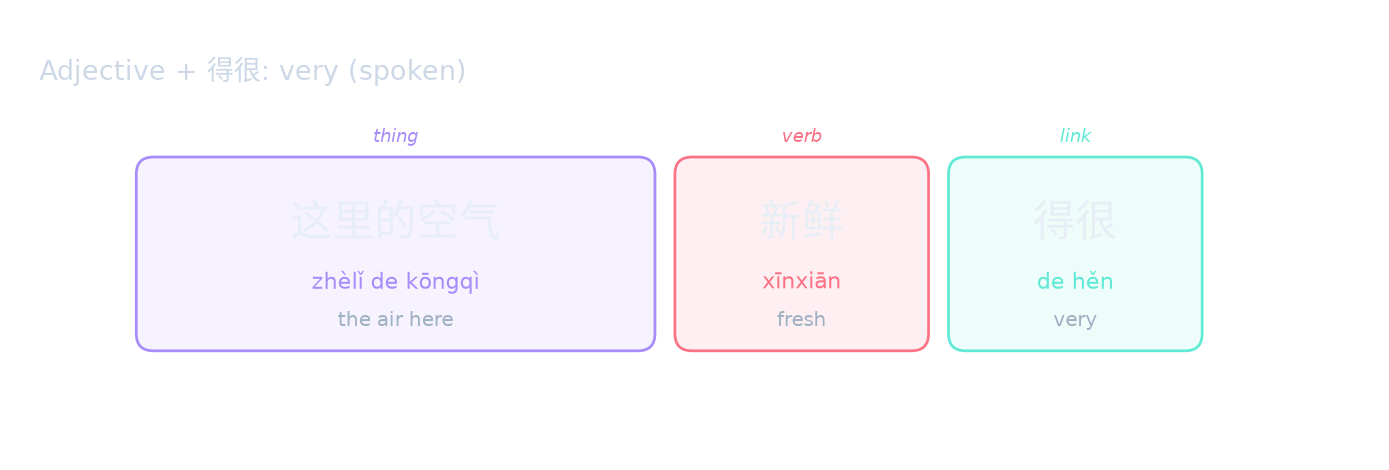
- here这里(modifier / structural particle)的air空气fresh新鲜(degree marker)得degree / adjective linker很。 — "The air here is really fresh."
- Goal: say "very" after the adjective with adjective + (degree marker)得degree / adjective linker很.
Adj + (degree marker)得degree / adjective linker很 = very, really
- Adj + (degree marker)得degree / adjective linker很 = "very, really", a little more emphatic and lively than degree / adjective linker很 + Adj.
- It ends the clause: good好(degree marker)得degree / adjective linker很, clear清楚(degree marker)得degree / adjective linker很, cheap便宜(degree marker)得degree / adjective linker很.
this这张map地图clear清楚very得很。
Complete: “This hotel is really cheap.” 这家酒店便宜____。
Dificuldade 1/5 · Moedas 100 + pequeno bônus na primeira conclusão hoje
Adj + 得很.
Confident comments
- his他(modifier / structural particle)的Chinese中文good好(degree marker)得degree / adjective linker很,you你need not不用anxious担心。 — "His Chinese is really good; don't worry."
- Said flatly, it can be ironic: good好(degree marker)得degree / adjective linker很,again又to arrive late迟到(completed / change)了! — "Great, late again!"
his他的Chinese中文good好very得很。
Build: “His Chinese is really good.”
Dificuldade 3/5 · Moedas 200 + pequeno bônus na primeira conclusão hoje
Subject + Adj + 得很.
degree / adjective linker很 after, not before
- Do not add degree / adjective linker很 before as well: fresh新鲜(degree marker)得degree / adjective linker很, not degree / adjective linker很fresh新鲜(degree marker)得degree / adjective linker很.
- Keep (degree marker)得: good好(degree marker)得degree / adjective linker很, not good好degree / adjective linker很.
- (degree marker)得degree / adjective linker很 is about degree, (degree marker)得degree / adjective linker很good好 is about how well: she / her她happy; glad高兴(degree marker)得degree / adjective linker很 — "She's very happy." she / her她to sing唱(degree marker)得degree / adjective linker很good好 — "She sings very well."
Which sentence is correct?
Dificuldade 1/5 · Moedas 100 + pequeno bônus na primeira conclusão hoje
空气新鲜得很 is right: a bare adjective + 得很. A second 很 is redundant, and 得 must follow the adjective.
(degree marker)得degree / adjective linker很 versus (degree marker)得extremely / terrible不得了 and degree / adjective linker很
- degree / adjective linker很fresh新鲜 is neutral; fresh新鲜(degree marker)得degree / adjective linker很 is more emphatic; fresh新鲜(degree marker)得extremely / terrible不得了 is the strongest.
- Verbs also take a (degree marker)得 complement, but (degree marker)得degree / adjective linker很 mostly follows adjectives and feeling verbs: his他likes it喜欢(degree marker)得degree / adjective linker很 — "He likes it very much."
he他likes it喜欢very much得很。
得不得了 is usually stronger than 得很.
Dificuldade 1/5 · Moedas 100 + pequeno bônus na primeira conclusão hoje
The scale is 很 → 得很 → 得不得了.
Recap
- Adj + (degree marker)得degree / adjective linker很 = very, really (emphatic, spoken).
- Scale: degree / adjective linker很 + Adj → Adj + (degree marker)得degree / adjective linker很 → Adj + (degree marker)得extremely / terrible不得了.
Read the full reference: HSK 5 grammar — Adjectives.
After a week in a smoggy city, you walk in a mountain park. Close the examples. Say a Mandarin response, then write it in Chinese. Explain briefly in English what the lesson’s pattern adds. Compare with the model, then change one detail and try again.
This is supported productive practice. Compare meaning and structure; your answer need not copy the model. A partner or teacher must hear the spoken response to comment on pronunciation.