Linear parameters, solution counts and inequalities
Introduced| English | Meaning |
|---|---|
| coefficient/ˌkəʊɪˈfɪʃənt/ | A numerical or constant factor multiplying a term in an expression. |
| parallel/ˈpærəlel/ | Describing lines in the same plane that never meet, however far extended. |
Same lines, no answer
- An SAT question gives $3x + 5 = 3x + k$ and asks for the value of $k$ that makes the equation have no solution.
- Some linear questions are not about finding $x$ but about how many solutions there are. The coefficients 系数 decide.
One, none or infinitely many
- Simplify to $ax = b$. If $a \ne 0$, there is exactly one solution. If $a = 0$ and $b \ne 0$, there is no solution. If $a = 0$ and $b = 0$, every $x$ works.
- For $3x + 5 = 3x + k$: the $x$ terms cancel, leaving $5 = k$. Any $k \ne 5$ gives no solution; $k = 5$ gives infinitely many.
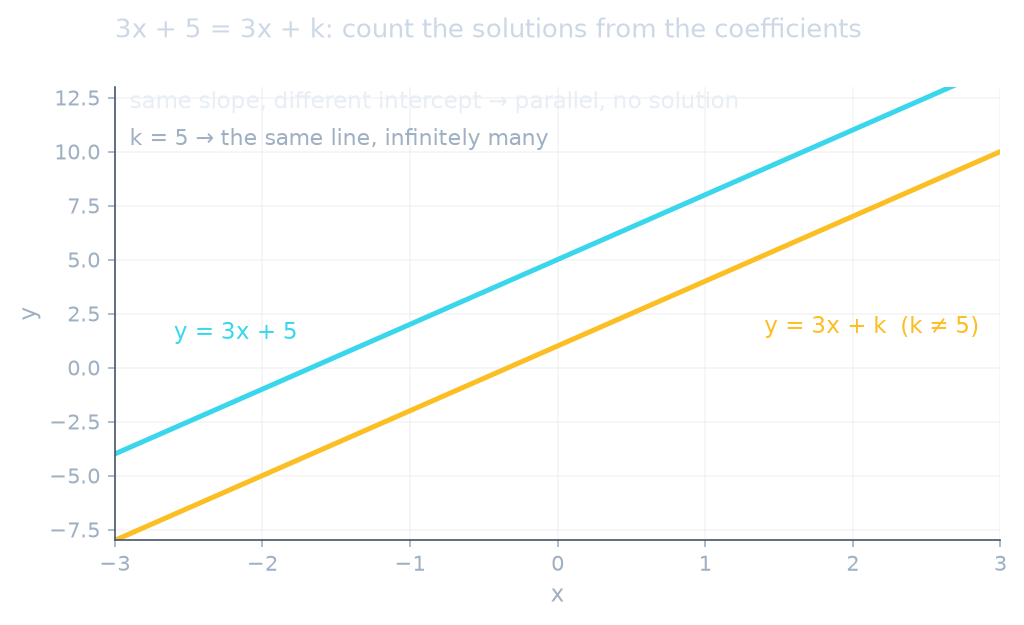
y = 3x + 5 and y = 3x + k are parallel 平行 unless k = 5, so the equation has no solution
For what value of $k$ does $4(x + 2) = 4x + k$ have infinitely many solutions?
Difficulty 2/5 · 140 coins + a small bonus on first completion today
$4x + 8 = 4x + k$ for every $x$ only if $k = 8$.
Systems of two lines
- Two lines with different slopes meet once (one solution). Same slope, different intercepts: parallel, no solution. Same line: infinitely many.
- $y = 2x + 1$ and $4x - 2y = 6$: the second is $y = 2x - 3$. Same slope, different intercept, so no solution.
For which $c$ does $\begin{cases} 2x + 3y = 7 \\ 4x + cy = 14 \end{cases}$ have infinitely many solutions? Doubling the first gives $4x + 6y = 14$, so $c = 6$.
How many solutions?
Classify linear equations and systems by their number of solutions.
How many solutions does the system $y = -x + 4$ and $2x + 2y = 10$ have?
Difficulty 1/5 · 100 coins + a small bonus on first completion today
The second line is $y = -x + 5$: same slope, different intercept, so the lines are parallel.
For what value of $c$ does $\begin{cases} x - 3y = 2 \\ 2x + cy = 4 \end{cases}$ have infinitely many solutions?
Difficulty 2/5 · 140 coins + a small bonus on first completion today
Doubling the first equation gives $2x - 6y = 4$, so $c = -6$.
Slope and intercept in context
- In $T = 15 + 0.8m$ (temperature after $m$ minutes), the slope $0.8$ is the change in degrees per minute; the intercept $15$ is the starting temperature.
- A point $(x, y)$ satisfies a two-variable equation if substituting it makes the equation true: $(2, 5)$ lies on $y = 3x - 1$.
The point $(3, 7)$ lies on the line $y = 2x + 1$.
Difficulty 1/5 · 100 coins + a small bonus on first completion today
$2(3) + 1 = 7$.
Traps
- No solution versus zero: "no solution" means no $x$ works; it does not mean $x = 0$.
- Comparing unsimplified equations: rewrite both lines as $y = mx + b$ (or match coefficients) before deciding.
An equation with no solution has the solution $x = 0$.
Difficulty 1/5 · 100 coins + a small bonus on first completion today
No solution means no value of $x$ works at all.
Recap
- $ax = b$: $a \ne 0$ one solution; $a = 0, b \ne 0$ none; $a = 0, b = 0$ infinitely many.
- Lines: different slopes → one; parallel → none; identical → infinitely many.