Equivalent expressions and domain restrictions
Introduced| English | Meaning |
|---|---|
| equivalent/ɪˈkwɪvələnt/ | Equal in value for every allowed input. |
| factor/ˈfæktə/ | A number that divides another number exactly, or an expression multiplied with others to form a product. |
| domain/dəˈmeɪn/ | The set of input values for which a function is defined. |
Which expression is equivalent 等价的?
- The SAT shows $\dfrac{x^2 - 9}{x - 3}$ and asks which expression is equivalent for $x \ne 3$.
- Equivalent expressions have the same value for every allowed input. You get there by factoring 因式, expanding or cancelling — without changing the value or the domain 定义域.
Factor and expand
- Key patterns: $a^2 - b^2 = (a - b)(a + b)$; $(a + b)^2 = a^2 + 2ab + b^2$; $x^2 + 5x + 6 = (x + 2)(x + 3)$.
- $\dfrac{x^2 - 9}{x - 3} = \dfrac{(x - 3)(x + 3)}{x - 3} = x + 3$ for $x \ne 3$.
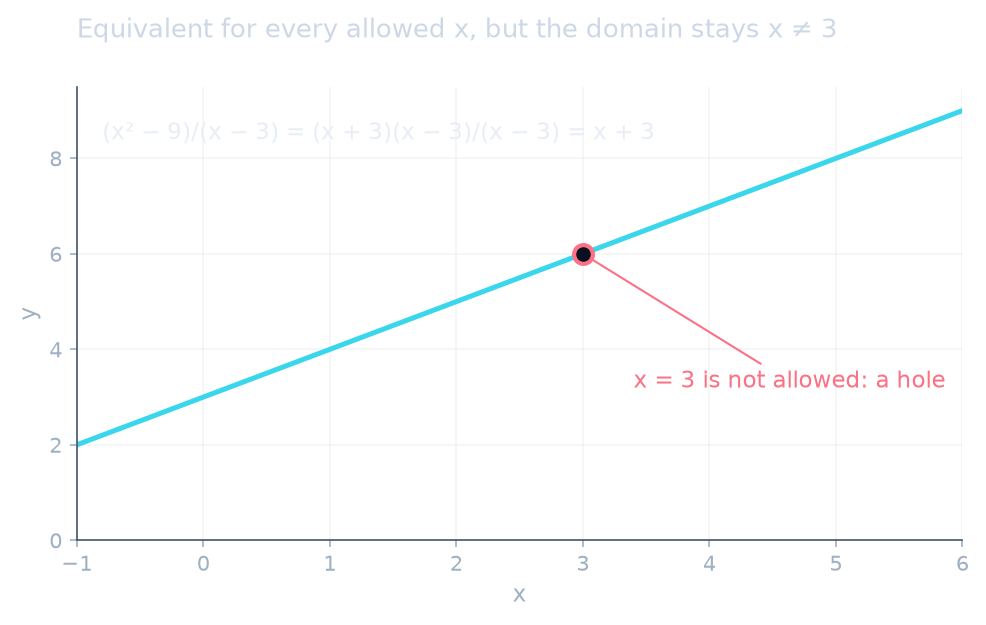
(x² − 9)/(x − 3) graphs as x + 3 with a hole at x = 3
Which expression is equivalent to $\dfrac{x^2 - 16}{x + 4}$ for $x \ne -4$?
Difficulty 1/5 · 100 coins + a small bonus on first completion today
$x^2 - 16 = (x - 4)(x + 4)$; cancel $x + 4$.
Rational expressions and the domain
- Cancelling a factor does not change the value, but the original expression is still undefined where its denominator was zero.
- $\dfrac{1}{x} + \dfrac{1}{2x} = \dfrac{2 + 1}{2x} = \dfrac{3}{2x}$, valid for $x \ne 0$.
Is $\sqrt{x^2} = x$ for all $x$? No: for $x = -4$, $\sqrt{16} = 4 \ne -4$. In fact $\sqrt{x^2} = |x|$.
Equivalent or not?
Decide whether two expressions are equal for every allowed input.
Put the steps to simplify $\dfrac{x^2 - 9}{x - 3}$ in order.
Difficulty 3/5 · 200 coins + a small bonus on first completion today
The restriction from the original denominator stays.
Structure reveals zeros and coefficients
- In $(2x - 5)(x + 1)$ the zeros are $x = \dfrac{5}{2}$ and $x = -1$; expanding gives $2x^2 - 3x - 5$, so the constant term is $-5$.
- To compare coefficients, expand fully and match like terms: if $(x + a)(x + 4) = x^2 + 7x + 12$, then $a = 3$.
If $(x + a)(x + 5) = x^2 + 8x + 15$ for all $x$, what is $a$?
Difficulty 2/5 · 140 coins + a small bonus on first completion today
Expanding gives $x^2 + (a + 5)x + 5a$; $5a = 15$, so $a = 3$.
When $(3x - 2)(x + 4)$ is expanded, what is the constant term?
Difficulty 2/5 · 140 coins + a small bonus on first completion today
$(-2)(4) = -8$.
Traps
- Cancelling terms, not factors: $\dfrac{x + 3}{x}$ is not $3$; only common factors cancel.
- Forgetting the middle term: $(x + 5)^2 = x^2 + 10x + 25$, not $x^2 + 25$.
$(x + 4)^2 = x^2 + 8x + 16$ for all $x$.
Difficulty 1/5 · 100 coins + a small bonus on first completion today
True. $(x + 4)(x + 4) = x^2 + 4x + 4x + 16$; the middle term $8x$ is easy to forget.
Recap
- Factor with the key patterns; cancel only common factors, and keep the original domain.
- Expand and match coefficients to find unknown constants.
- equivalent: Equal in value for every allowed input.