Charts and diagrams
Introduced| English | Meaning |
|---|---|
| bar chart/bɑː tʃɑːt/ | A graph using separate bars whose lengths represent the frequencies or amounts of categories. |
| pictogram/ˈpɪktəɡræm/ | pictogram |
| pie chart/paɪ tʃɑːt/ | A circular chart whose sectors represent proportions of a total. |
| stem-and-leaf/stem ænd liːf/ | Keeps every individual value while showing the shape. |
A picture is worth a thousand numbers
- The right chart makes patterns leap out. The wrong one hides them — or creates illusions.
- Choosing the right chart is a skill, not just a presentation trick.
Pie-chart angles
Each slice's angle is its share of the whole turned into degrees — frequency ÷ total × 360 — and the slices always add to 360°.
Chart choice lab
Choose the chart that fits the kind of data.
Bar charts 条形图 and pictograms 象形图
- Bar chart: one bar per category; height $=$ frequency. Bars don't touch.
- Pictogram: a symbol stands for a number of items (e.g. one smiley $= 10$ people).
A bar chart of favourite colours: red bar reaches $15$, blue reaches $22$, green reaches $8$. The heights tell you the frequencies directly.
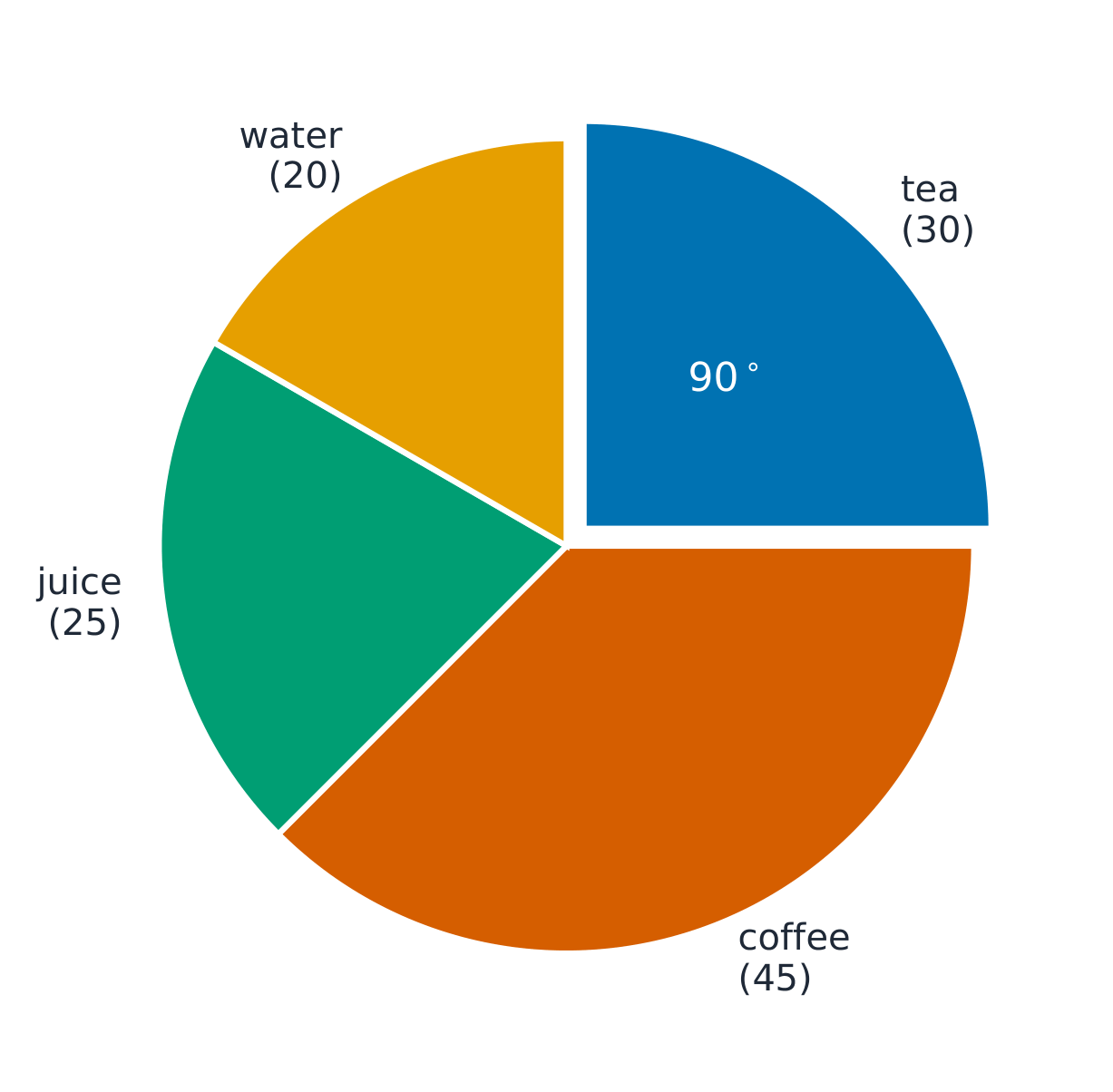
Each slice is its fraction of $360^\circ$: tea is $\tfrac{30}{120}\times360^\circ=90^\circ$
On a bar chart, the height of each bar shows the:
Difficulty 1/5 · 100 coins + a small bonus on first completion today
Bar height represents the frequency of that category.
Pie charts 饼图
- A circle split into slices. Each slice is a fraction of $360^{\circ}$.
Pie charts show proportions, not counts. A bigger pie doesn't mean more data — it might just show a bigger fraction of a smaller total.
Out of 120 people, 30 chose tea. Find the angle of the tea slice on a pie chart (degrees).
Difficulty 2/5 · 140 coins + a small bonus on first completion today
(30/120) × 360 = 90°.
Out of 160 people, 40 chose juice. Find the angle of the juice slice (degrees).
Difficulty 2/5 · 140 coins + a small bonus on first completion today
(40/160) × 360 = 90°.
A bigger pie chart always means more data than a smaller one.
Difficulty 1/5 · 100 coins + a small bonus on first completion today
Pie charts show proportions, not absolute counts. A bigger pie might just show a bigger fraction of a smaller total.
Out of 200 people, 50 chose coffee. Find the pie-chart angle for coffee (degrees).
Difficulty 2/5 · 140 coins + a small bonus on first completion today
(50/200) × 360 = 90°.
Stem-and-leaf 茎叶图 diagrams
- Keeps the digits of ordered data, with a key.
- Example: $23, 25, 31, 34, 37$ → stem $2$: $3, 5$; stem $3$: $1, 4, 7$.
- Advantage: you can read every individual value AND see the shape of the data.
A stem-and-leaf diagram keeps every individual ______ while showing the shape of the data.
Difficulty 1/5 · 100 coins + a small bonus on first completion today
Unlike grouped data, a stem-and-leaf preserves each original data point.
Worked example — pie chart
- Of $120$ people, $30$ chose tea. Slice $= \dfrac{30}{120} \times 360^{\circ} = 90^{\circ}$.
- Of $160$ people, $40$ chose juice. Slice $= \dfrac{40}{160} \times 360^{\circ} = 90^{\circ}$.
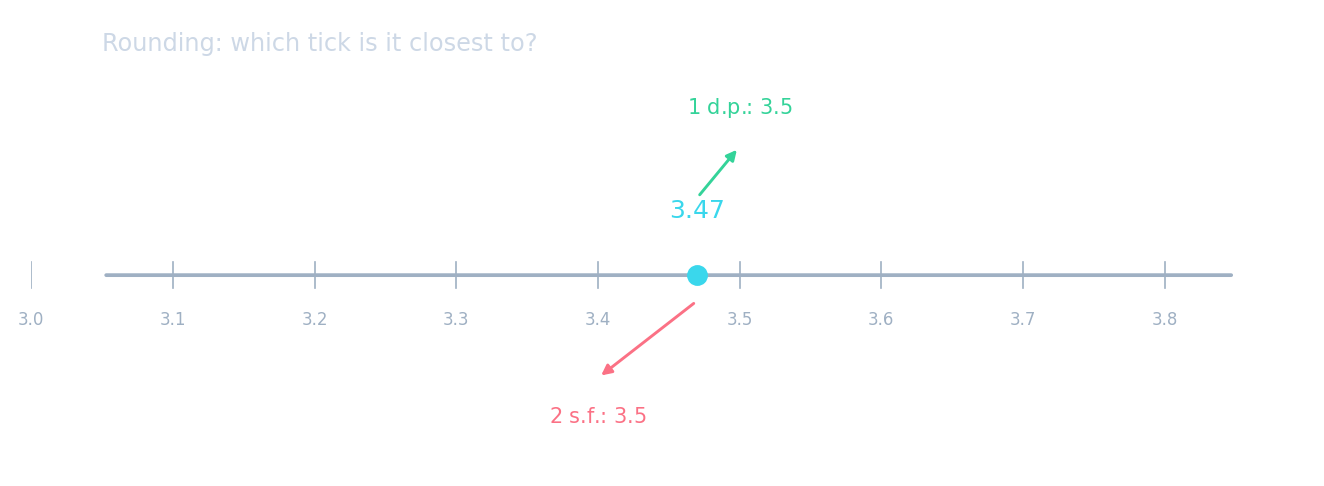
Charts use scales just like number lines — always check what each unit represents.
Paired bars, stacked bars and keys
- Classes A and B record walkers 12,10 and cyclists 8,14. A dual chart has adjacent A and B bars for each travel method; a stacked chart has total height 22 for walkers and 22 for cyclists, with each class labelled in the key.
- A pictogram key of one symbol = 8 items makes half a symbol worth 4. For stem-and-leaf data $14,17,17,21,23$, write stem 1 with leaves 4,7,7 and stem 2 with 1,3; include key $1|4=14$.
A stacked bar contains 12 class-A walkers and 10 class-B walkers. Find its total frequency.
Difficulty 2/5 · 140 coins + a small bonus on first completion today
Stacked components add: 12 + 10 = 22.
You've got it
- bar chart: height $=$ frequency; pictogram: symbol $=$ several items
- pie chart: each slice $= \dfrac{\text{part}}{\text{total}} \times 360^{\circ}$
- stem-and-leaf: keeps every individual value while showing the shape