Constructions, nets and solids
Introduced| English | Meaning |
|---|---|
| edge/edʒ/ | Connections between vertices in a graph, or boundary segments of a geometric shape. |
| scale drawing/skeɪl ˈdrɔːɪŋ/ | An accurate drawing in which every length is a fixed ratio of the real length. |
| net/net/ | A flat shape that folds up into a 3D solid — handy for surface area. |
| face/feɪs/ | A flat surface of a solid. |
| prism/ˈprɪzəm/ | A solid with two congruent, parallel polygonal bases joined by parallelogram faces. |
| pyramid/ˈpɪrəmɪd/ | A solid with a polygon base and triangular faces meeting at an apex. |
Building with ruler and compasses
- Ancient Greek geometers built every shape using just a straight edge 棱 and compasses — no rulers with markings, no protractors.
- Today, construction questions test whether you can use these tools precisely and leave your working visible.
Construction and solid lab
Classify geometry tasks by the tool or representation needed.
Constructing triangles
- To construct a triangle from three sides:
- 1. Draw the base with a ruler.
- 2. Set compasses to the second side length and swing an arc from one end.
- 3. Set compasses to the third side and swing from the other end.
- 4. The intersection is the third vertex. Leave the arcs showing.
Don't erase the arcs. The examiner needs to see your construction arcs to award marks. They prove you used compasses, not guesswork.
To construct a triangle from three given sides you mainly use a ruler and:
Difficulty 1/5 · 100 coins + a small bonus on first completion today
Compasses swing arcs of the correct length for the other two sides.
You should erase your construction arcs to keep the drawing neat.
Difficulty 1/5 · 100 coins + a small bonus on first completion today
Leave construction arcs visible — the examiner needs to see them to award marks.
Scale drawings 比例图
- A scale drawing represents a real object at a fixed ratio (e.g. $1\text{ cm}:5\text{ m}$).
- Measure on the drawing, then multiply by the scale factor to get the real measurement.
Scale $1:200$. A room measures $3.5\text{ cm}$ on the plan. Real length $= 3.5 \times 200 = 700\text{ cm} = 7\text{ m}$.
A scale drawing uses 1:200. A room measures 3.5 cm on the plan. What is the real length in metres?
Difficulty 2/5 · 140 coins + a small bonus on first completion today
3.5 × 200 = 700 cm = 7 m.
Nets 展开图 and solids
- A net is a flat shape that folds up into a 3D solid — handy for surface area.
- Face 面: a flat side. Edge: where two faces meet. Vertex: a corner.
- A cube has $6$ faces, $12$ edges, and $8$ vertices.
A flat shape that folds up into a solid is called a ______.
Difficulty 1/5 · 100 coins + a small bonus on first completion today
A net is the unfolded, flat version of a solid.
How many faces does a cube have?
Difficulty 2/5 · 140 coins + a small bonus on first completion today
A cube has 6 square faces (12 edges, 8 vertices).
How many edges does a cube have?
Difficulty 2/5 · 140 coins + a small bonus on first completion today
A cube has 12 edges (where two faces meet).
Naming solids
| Solid | Key property |
|---|---|
| cube / cuboid | box shapes (all flat faces) |
| prism 棱柱 | same cross-section all along |
| cylinder | circular prism |
| pyramid 棱锥 | comes to a point (apex) |
| cone | circular pyramid |
| sphere | perfectly round |
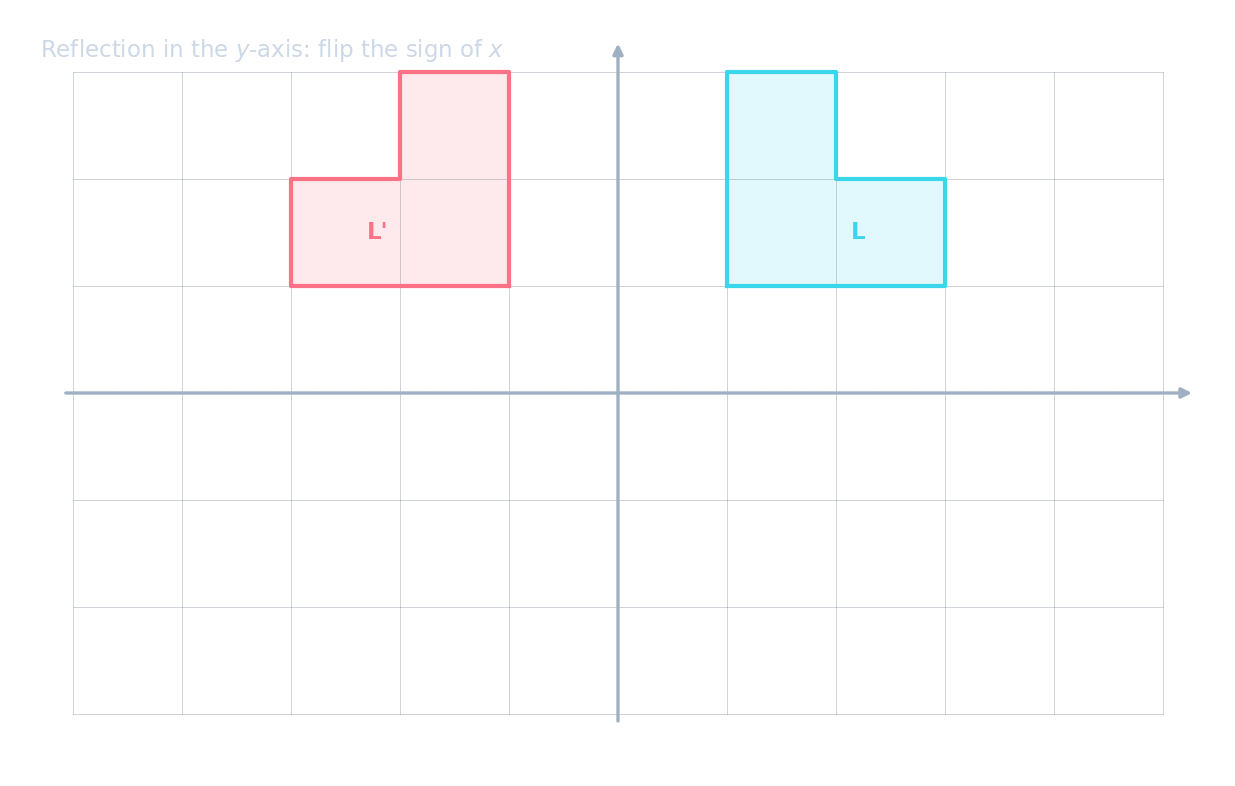
Coordinate grids help with accurate constructions — shapes can be placed, measured, and transformed precisely.
Use a net to calculate
- A $3\times2\times1$ cm cuboid needs two faces of each size $3\times2$, $3\times1$, $2\times1$. Surface area $S=2(6+3+2)=22\text{ cm}^2$; volume $V=3(2)(1)=6\text{ cm}^3$.
- A triangular prism net has two identical triangles and three rectangles. Their widths match the three triangle sides, and each rectangle length matches the prism length.
A cuboid is 3 cm by 2 cm by 1 cm. Find its surface area in cm².
Difficulty 2/5 · 140 coins + a small bonus on first completion today
There are two faces of each size: 2(6+3+2) = 22 cm².
A rhombus from two triangles
- Draw a 6 cm diagonal AB. Draw 5 cm radius arcs from A and B above and below it, meeting at C and D. Join A-C-B-D-A: all four edges are 5 cm, so the shape is a rhombus. Keep the arcs.
- For a square-based pyramid net, draw a square with one triangle attached to each edge. A base of side 4 cm and face height 3 cm has $S=b^2+4(bh/2)=16+24=40\text{ cm}^2$. Current Core and Extended construction outcomes do not require bisector constructions.
You've got it
- construct with ruler + compasses; leave the construction arcs
- a net folds into a solid (good for surface area)
- a cube: $6$ faces, $12$ edges, $8$ vertices