Gradient
Introduced| English | Meaning |
|---|---|
| rise/raɪz/ | The signed vertical change used when calculating a line’s gradient. |
| run/rʌn/ | The horizontal change used as the denominator when calculating a line’s gradient. |
| gradient/ˈɡreɪdɪənt/ | The change in the vertical coordinate divided by the change in the horizontal coordinate. |
Compare two model ramps
- A model ramp has a vertical rise 上升量 of $2$ units over a horizontal run 水平量 of $8$ units; another has the same rise over a run of $4$. The second is steeper because it gains the same height in less horizontal distance.
- That ratio, rise divided by run, is the gradient 斜率. Use horizontal distance, not the sloping length.
What gradient measures
- The gradient $m$ tells you two things about a straight line:
- How steep it is (larger absolute gradient = steeper).
- Which direction it goes (positive = up to the right, negative = down to the right).
- A gradient of $0$ means the line is perfectly horizontal — no rise at all.

A steep alpine pass: gradient measures steepness as rise over run
Gradient
y = ax + b
The gradient a measures steepness — rise over run.
A line that goes down as you move to the right has a gradient that is:
Difficulty 1/5 · 100 coins + a small bonus on first completion today
Falling to the right means the change in y is negative for a positive change in x, so the gradient is negative.
The gradient of a horizontal line is 0.
Difficulty 1/5 · 100 coins + a small bonus on first completion today
A horizontal line has no vertical change (rise = 0), so m = 0/run = 0.
Read a gradient from a grid
- Core and Extended: choose two clear grid intersections on the drawn line, preferably far apart. Draw a right-angled triangle: horizontal change across, vertical change up or down. Divide the signed vertical change by the horizontal change.
- Read changes in axis units, not just numbers of squares. Moving right gives positive horizontal change; a fall gives negative vertical change. A vertical line has no defined gradient because its horizontal change is zero.
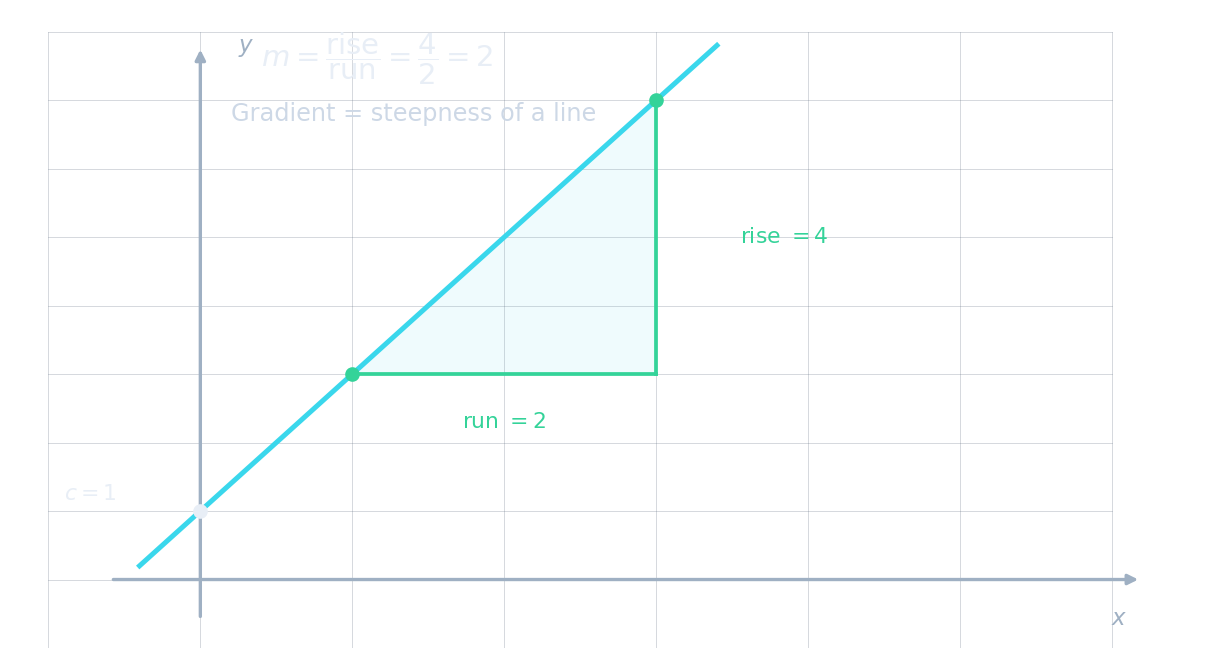
In this worked grid, the changes are $4$ vertical units and $2$ horizontal units: gradient $2$.
Calculate from two coordinate pairs (Extended)
- Extended: even without a grid, subtract coordinates in matching order: $m=\dfrac{y_2-y_1}{x_2-x_1}$, provided $x_2\ne x_1$.
- Through $(1,2)$ and $(4,11)$, the changes are $11-2=9$ and $4-1=3$, so $m=9/3=3$.
Through $(0,1)$ and $(2,7)$, $m=(7-1)/(2-0)=3$. This is a different line with the same gradient. Core learners practise the rise/run method on a drawn grid rather than being required to calculate from two given coordinate pairs.
Extended: Find the gradient of the line through (1, 2) and (4, 11).
Difficulty 2/5 · 140 coins + a small bonus on first completion today
(11 − 2)/(4 − 1) = 9/3 = 3.
Extended: Find the gradient of the line through (0, 1) and (2, 7).
Difficulty 2/5 · 140 coins + a small bonus on first completion today
(7 − 1)/(2 − 0) = 6/2 = 3.
Extended: Complete the formula: m = (y₂ − y₁) / (? − x₁).
Difficulty 1/5 · 100 coins + a small bonus on first completion today
The full formula is m = (y₂ − y₁) / (x₂ − x₁). The denominator is the change in x, which is x₂ − x₁.
The subtraction trap
- You must subtract in the same order for both coordinates:
- $(y_2 - y_1)$ paired with $(x_2 - x_1)$, or $(y_1 - y_2)$ paired with $(x_1 - x_2)$.
- Mixing the order flips the sign and gives the wrong gradient.
Common mistake. Through $(1, 2)$ and $(4, 11)$: if you write $\dfrac{11 - 2}{1 - 4} = \dfrac{9}{-3} = -3$ you mixed the order — you took $y_2 - y_1$ on top but $x_1 - x_2$ on the bottom. Pick one point to be "first" and stick with it.
Extended: find the gradient through A(−3,5) and B(1,−1). Repeat with the subtraction order reversed. Explain why the answers must agree.
Keep the same first point in numerator and denominator.
Read a new grid independently
- Use the graph below for the written task. Mark a large triangle on the line and label its changes in axis units. The numbered steps on the two axes differ.
- A gradient is unchanged when both chosen points move to other positions on the same straight line. Changing the drawing scale can change its visible angle, so judge the numerical gradient from the labels.

Choose clear points on $L$ and read the two scales before calculating.
Match each description to the correct gradient property.
Difficulty 2/5 · 140 coins + a small bonus on first completion today
Positive = rising rightward; zero = flat; negative = falling rightward; a larger magnitude means a steeper slope.
Core and Extended: use the new graph L above. Choose two clear grid intersections and draw a gradient triangle. Read both coordinate pairs, find the signed vertical change and horizontal change, then calculate the gradient. Explain why counting large squares alone gives a wrong answer here.
The graph is the source of the coordinates. A remembered equation or a visual angle is not a grid-reading method.
Core and Extended: sketch a horizontal line and a vertical line on a grid. Use rise/run to explain which has gradient zero and which has no defined gradient.
Zero gradient and undefined gradient are different statements.
You've got it
- Core and Extended: gradient is signed vertical change divided by horizontal change, read in grid units
- positive gradient → line goes up to the right; negative → down to the right; zero → horizontal
- subtract in the same order for both coordinates — mixing up the order flips the sign
- Extended: coordinate differences give $m=(y_2-y_1)/(x_2-x_1)$ when $x_2\ne x_1$
Calculate independently (Extended)
- The line passes through (1, 1) and (3, 9).
- Find the gradient.
Extended: What is the gradient of the line through (1, 1) and (3, 9)?
8 divided by 2 is 4.
Extended: find the gradient through (1,1) and (3,9).
Difficulty 1/5 · 100 coins + a small bonus on first completion today
Rise over run is 4. Other options — 3 (the lesson gradient); 8 (the rise).