Identification of ions and gases
Introduced| English | Meaning |
|---|---|
| chemical tests/ˈkemɪkl tests/ | chemical tests |
| flame tests/fleɪm tests/ | Lithium red, sodium yellow, potassium lilac, copper blue-green. |
| limewater/ˈlaɪmwɔːtə/ | An aqueous solution of calcium hydroxide that turns milky when carbon dioxide forms calcium carbonate. |
| sodium hydroxide/ˈsəʊdɪəm haɪˈdrɒksaɪd/ | The ionic compound NaOH, which forms a strongly alkaline solution in water. |
Identifying unknowns
- Given an unknown chemical, how do you find out what it is?
- A set of chemical tests 化学测试 identifies the ions and gases present.
Ion and gas test lab
Match test observations to the ion or gas present.
A sodium ion gives which flame colour?
Difficulty 1/5 · 100 coins + a small bonus on first completion today
Sodium burns with a yellow flame.
A potassium ion gives a ______ flame colour.
Difficulty 1/5 · 100 coins + a small bonus on first completion today
Potassium burns lilac.
Flame tests 焰色测试 for metal ions
- Some metal ions give a characteristic flame colour.
- Lithium = red, sodium = yellow, potassium = lilac, copper = blue-green.
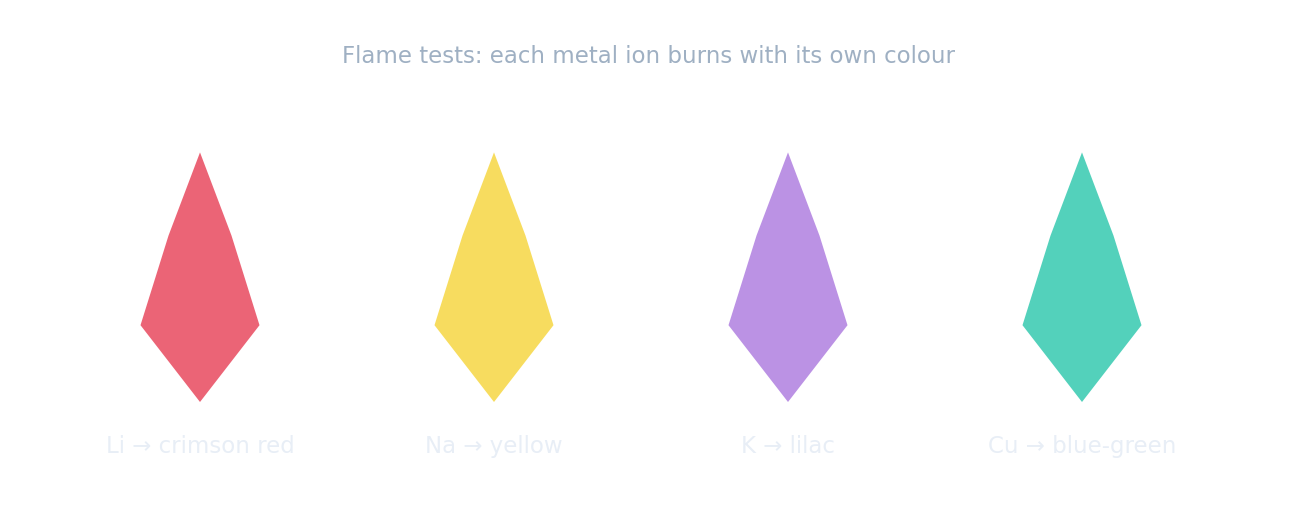
Flame tests: each metal ion burns with its own colour
The test for hydrogen gas is:
Difficulty 1/5 · 100 coins + a small bonus on first completion today
Hydrogen gives a squeaky pop.
Oxygen is identified because it:
Difficulty 1/5 · 100 coins + a small bonus on first completion today
Oxygen relights a glowing splint.
Carbon dioxide is identified because it:
Difficulty 1/5 · 100 coins + a small bonus on first completion today
CO₂ turns limewater milky.
Match each test to its result.
Difficulty 2/5 · 140 coins + a small bonus on first completion today
Flame colours identify metal ions; gas tests use a splint.
Tests for gases
- Hydrogen: a lit splint gives a squeaky pop.
- Oxygen: relights a glowing splint.
- Carbon dioxide: turns limewater 石灰水 milky.

Testing gases: hydrogen pops, oxygen relights a glowing splint
Tests for ions in solution
- Adding sodium hydroxide 氢氧化钠 gives coloured precipitates that identify metal ions.
- For example, copper(II) gives a blue precipitate; iron(III) gives a brown one.
Worked example. An unknown gas relights a glowing splint → it is oxygen. A solution gives a blue precipitate with sodium hydroxide → it contains copper(II) ions. Each test points to one answer.

Adding sodium hydroxide forms a coloured precipitate for some metal ions
You've got it
- flame tests: lithium red, sodium yellow, potassium lilac, copper blue-green
- gas tests: hydrogen squeaky pop, oxygen relights a splint, CO₂ limewater milky
- sodium hydroxide gives coloured precipitates that identify metal ions