Exothermic and endothermic reactions
Introduced| English | Meaning |
|---|---|
| exothermic/eɡzəˈðɜːmɪk/ | Describing a process that transfers heat to its surroundings. |
| endothermic/ˌendəʊˈθɜːmɪk/ | Describing a process that takes in heat from its surroundings. |
| combustion/kəmˈbʌstʃn/ | An exothermic reaction of a fuel with an oxidising agent, usually oxygen. |
| neutralisation/ˌnjuːtrəlaɪˈzeɪʃn/ | A reaction between an acid and a base that forms a salt, usually with water. |
| thermal decomposition/ˈθɜːml ˌdiːkɒmpəˈzɪʃn/ | The breakdown of a compound into simpler substances when heated. |
Reactions that heat or cool
- Strike a match and it gives out heat; dissolve some salts and the beaker turns cold.
- Reactions either release or absorb energy. These are exothermic 放热反应 and endothermic 吸热反应.
An exothermic reaction:
Difficulty 1/5 · 100 coins + a small bonus on first completion today
Exothermic reactions release energy.
Burning (combustion) is an example of a(n):
Difficulty 1/5 · 100 coins + a small bonus on first completion today
Combustion releases heat — exothermic.
In an exothermic reaction, the products are at a lower energy than the reactants.
Difficulty 1/5 · 100 coins + a small bonus on first completion today
The drop in energy is released to the surroundings.
Exothermic reactions
- An exothermic reaction releases energy to the surroundings (they get hotter).
- Examples: combustion 燃烧 (burning), neutralisation 中和, most everyday reactions.
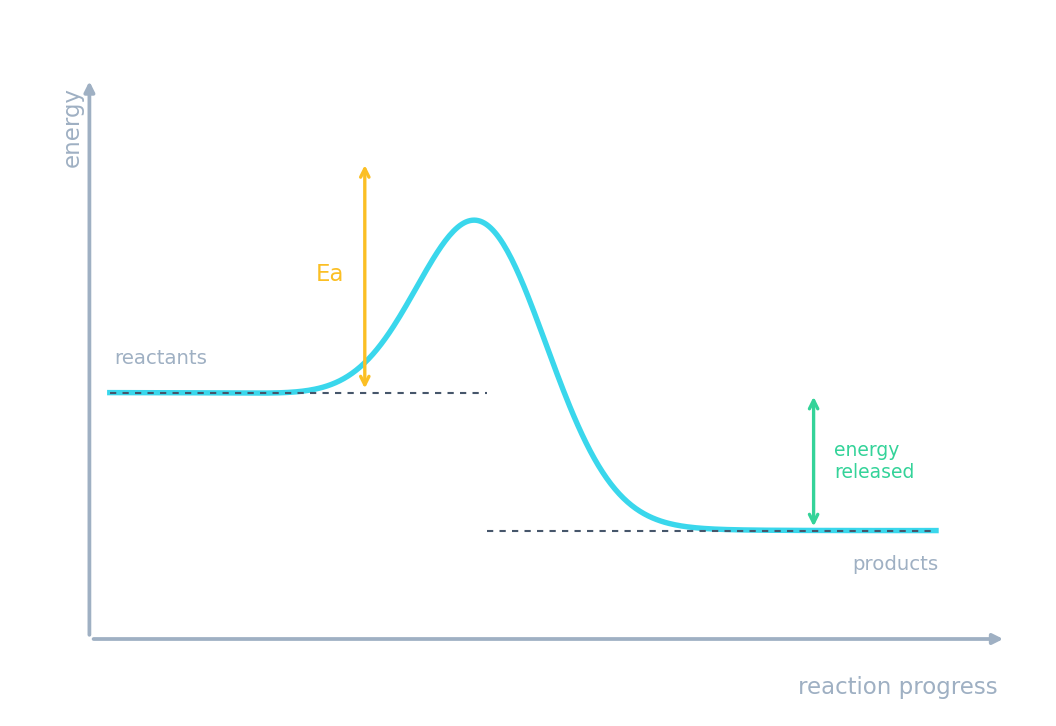
In an exothermic reaction, the products are at lower energy than the reactants — energy is released.
Exothermic & endothermic
ΔH = products − reactants
Exothermic drops to lower-energy products (releases heat); endothermic climbs to higher.
An endothermic reaction makes the surroundings:
Difficulty 1/5 · 100 coins + a small bonus on first completion today
It absorbs energy, cooling the surroundings.
A reaction that absorbs energy and cools its surroundings is ______.
Difficulty 1/5 · 100 coins + a small bonus on first completion today
Endothermic reactions take in energy.
Endothermic reactions
- An endothermic reaction absorbs energy from the surroundings (they get colder).
- Examples: thermal decomposition 热分解, photosynthesis, some dissolving.

Burning wood is exothermic, releasing heat to the surroundings
Telling them apart
- Exothermic: surroundings warm up; products at lower energy than reactants.
- Endothermic: surroundings cool down; products at higher energy than reactants.
Exothermic = exits (releases) energy; endothermic = enters (absorbs). A quick check: if the beaker gets hot, energy is leaving the reaction (exothermic); if it gets cold, energy is being taken in (endothermic).

An exothermic reaction warms the surroundings; an endothermic reaction cools them
You've got it
- exothermic reactions release energy (surroundings get hotter; products lower energy)
- endothermic reactions absorb energy (surroundings get colder; products higher energy)
- combustion is exothermic; thermal decomposition is endothermic