Marketing, competition and the customer
Introduced| English | Meaning |
|---|---|
| marketing/ˈmɑːkɪtɪŋ/ | marketing |
| customer needs/ˈkʌstəmə niːdz/ | Requirements or problems that customers seek to satisfy through a product or service. |
| demand/dɪˈmænd/ | The quantity of a good or service that buyers are willing and able to purchase at different prices over a period. |
| market share/ˈmɑːkɪt ʃeə/ | A business's sales as a proportion of total sales in its market, measured by value or volume. |
| market-oriented/ˈmɑːkɪt ˈɔːrɪəntɪd/ | Describing a business approach that uses information about customer needs and market conditions to guide decisions. |
| product-oriented/ˈprɒdʌkt ˈɔːrɪəntɪd/ | Describing a business approach that centres decisions on developing and supplying the product itself. |
| mass market/mæs ˈmɑːkɪt/ | A broad market of many potential customers, served with products intended to appeal to large numbers of people. |
| niche market/niːʃ ˈmɑːkɪt/ | A relatively small, specialised segment of customers with distinctive needs or preferences. |
More than advertising
- Marketing 营销 isn't just adverts — it's finding out what customers want and making sure the business provides it.
- Get it right and customers come to you.
Marketing mix lab
See which part of the marketing mix changes in each real decision.
Marketing is best described as:
Difficulty 1/5 · 100 coins + a small bonus on first completion today
Marketing meets customer needs at a profit.
What marketing does
- Marketing identifies and satisfies customer needs 客户需求 profitably.
- Its goals: understand customers, build demand 需求, and grow market share 市场份额.
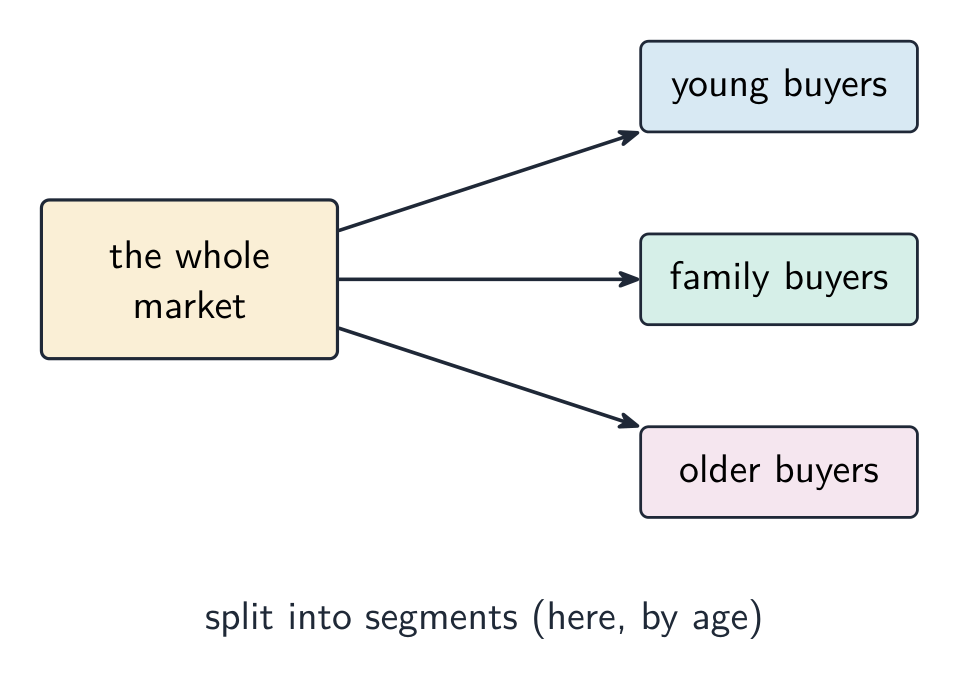
Segmentation splits a market into groups of similar buyers
A market-oriented business starts by:
Difficulty 1/5 · 100 coins + a small bonus on first completion today
Market orientation puts customer needs first.
A business that designs a product first, then looks for buyers, is ______-oriented.
Difficulty 1/5 · 100 coins + a small bonus on first completion today
Product orientation is riskier than market orientation.
Market vs product orientation
- Market-oriented 市场导向: start from what customers want, then make it. Lower risk.
- Product-oriented 产品导向: start from the product, then find buyers. Higher risk.

A branded shop window: branding helps a product stand out
A firm sells 20m in a market worth 80m. What is its market share (%)?
Difficulty 2/5 · 140 coins + a small bonus on first completion today
20 / 80 × 100 = 25%.
A niche market is a large market aimed at as many customers as possible.
Difficulty 1/5 · 100 coins + a small bonus on first completion today
False. That is a mass market. A niche market is a small, specific segment of a larger market, with less competition.
Niche vs mass markets 大众市场
- Mass market: a large, broad market (everyday products) — high sales, much competition.
- Niche market 利基市场: a small, specific segment — less competition, often higher prices.
Worked example. Market share = a firm's sales ÷ total market sales × 100. A firm selling 30m in a 150m market has a 20% market share — a key sign of marketing success.
You've got it
- marketing identifies and satisfies customer needs profitably
- market-oriented (customer-first) is lower-risk than product-oriented
- mass markets are large & competitive; niche markets are small & specific
Write from a market share of 15 percent
- A firm sells 12 million in a market worth 80 million.
- Find the market share. A niche is a small segment, not the whole market.
A firm sells 12 million in a market worth 80 million. What is its market share, and why is a niche not the same as that whole market?
Market share is the firm's sales as a percentage of total market sales. A niche is one specialised slice of that market.
What is the market share?
Difficulty 1/5 · 100 coins + a small bonus on first completion today
12 divided by 80 is 0.15, so the share is 15 percent. Other options — 25 percent (the lesson share of 20 million in an 80 million market); 12 million (the firm's sales).