Comparative literary argument
Introduced| English | Meaning |
|---|---|
| comparative essay | The Paper 2 essay comparing two literary works. |
| concept/ˈkɒnsept/ | One of the course's seven key ideas, such as identity or representation. |
| repetition/ˌrepəˈtɪʃn/ | The repeated use of an element, word or pattern to create an effect. |
| retrospective narration/ˌretrəʊˈspektɪv nəˈreɪʃn/ | narration by someone looking back on past events, who may revise or reinterpret them |
| integrated/ˈɪntɪɡreɪtɪd/ | an essay structure that compares both works within every paragraph, point by point |
A word chosen first, 1846
- In 1846 Edgar Allan Poe published "The Philosophy of Composition", explaining how he wrote "The Raven". He said he chose the refrain first: one sad, sounding word repeated at the end of each stanza — "Nevermore".
- Each return of the word drags the speaker back to the same loss. Form, not just content, carries the poem's meaning — and that gives you something to compare.
According to Poe's 1846 essay, what did he decide first when writing "The Raven"?
Difficulty 1/5 · 100 coins + a small bonus on first completion today
He said he chose the refrain first.
A comparative argument
- A comparative essay 比较论文 makes one argument about two works: how each treats a shared idea, and what the difference shows. A list of similarities is not an argument.
- Start from a shared concept 概念 or global issue — memory, power, identity — then compare how each work's form shapes it.
A list of similarities between two works is a comparative argument.
Difficulty 1/5 · 100 coins + a small bonus on first completion today
An argument makes one claim about how and why the works differ or agree.
Form shapes memory
- A poem can use repetition 重复 to return again and again to one moment, as "Nevermore" does.
- A novel can use retrospective narration 回顾式叙述 — a narrator looking back — to revise an event. In Kazuo Ishiguro's The Remains of the Day (1989) the butler Stevens retells his past and slowly lets slip what he regretted.
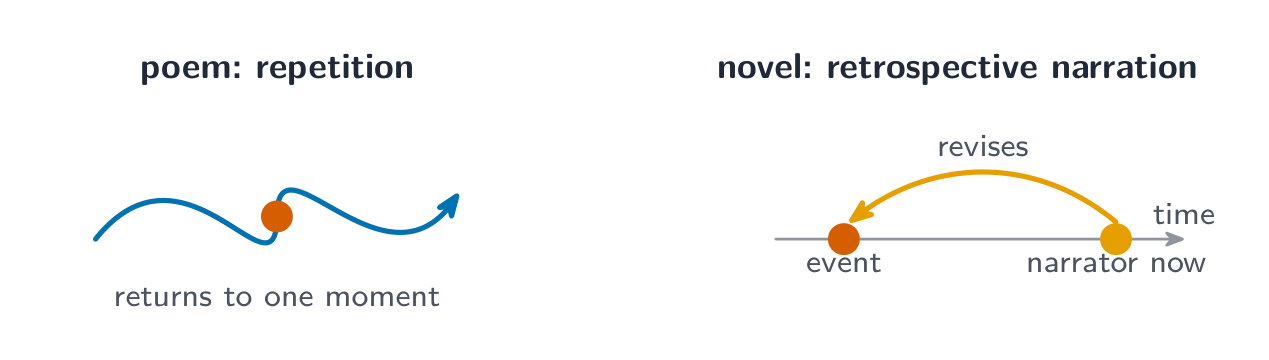
Match each form to how it treats memory.
Difficulty 2/5 · 140 coins + a small bonus on first completion today
Different forms shape the same concern differently.
Worked example: building a thesis
Compare how "The Raven" and The Remains of the Day present memory of loss.
- Weak thesis: "Both works are about memory." True, but it says nothing about how or why.
- Comparative thesis: "Poe's refrain traps his speaker in one moment of grief, while Ishiguro's narrator keeps rewriting his past to avoid it; both show memory as something a person cannot control, but one through repetition and one through revision."
- Evidence plan: for Poe, the refrain's return and the final stanza's "shall be lifted — nevermore!"; for Ishiguro, Stevens's corrections and hesitations when he describes Miss Kenton.
Which is the strongest comparative thesis?
Difficulty 1/5 · 100 coins + a small bonus on first completion today
It states how each work's form shapes the shared idea.
Structure: integrated, not separate
- An integrated 整合式 structure compares the works inside every paragraph, point by point. A "block" structure (all of work A, then all of work B) often turns into two separate essays.
- Each paragraph: one point of comparison, evidence from both works, and what the difference shows.
Why is an integrated structure usually stronger?
Difficulty 1/5 · 100 coins + a small bonus on first completion today
Block structures often become two separate essays.
Linking words
- Use comparative signposts: "whereas", "similarly", "by contrast", "both… but…".
- Make the difference meaningful: say why the poet and the novelist might choose different forms for the same concern.
Which are comparative signposts?
Difficulty 2/5 · 140 coins + a small bonus on first completion today
Signposts show the relationship between the two works.
Do not compare content alone. "Both texts have a sad character" misses the point. The examined skill is comparing how each writer's choices of form, structure and language shape a shared idea.
"Both texts have a sad character" is a strong point of comparison.
Difficulty 1/5 · 100 coins + a small bonus on first completion today
Compare how choices of form and language shape the idea.
A comparative argument makes one thesis about two works: a shared concept, and how each work's form shapes it differently. Integrate both works in every paragraph, use comparative signposts, and explain why the different choices matter.
Write a comparative thesis for two works you have studied that share a concept.
Concept, form, difference.