Global issue and works in translation
Introduced| English | Meaning |
|---|---|
| translator/trænˈsleɪtə/ | the person who renders a work from its original language into another |
| translation/trænˈsleɪʃn/ | Expressing the meaning of a message or text in another language. |
| global issue/ˈɡləʊbl ˈɪʃuː/ | An issue affecting people or environments across national boundaries and requiring attention at an international scale. |
| individual oral | the IB Literature oral assessment: 10 minutes of prepared analysis of two extracts on a global issue, then 5 minutes of questions |
One word, many insects, 1915
- Franz Kafka's The Metamorphosis (1915) opens with Gregor Samsa waking "zu einem ungeheueren Ungeziefer verwandelt". English translators have chosen "gigantic insect", "monstrous vermin" and "enormous bug".
- Ungeziefer means vermin — unwanted pests, a word also used for people treated as worthless. The choice of translation changes how strongly the reader feels Gregor's exclusion from the start.
Why does the translation of Ungeziefer matter?
Difficulty 1/5 · 100 coins + a small bonus on first completion today
Translators' choices change the force of the opening.
The global issue
- The individual oral 个人口头评论 is 15 minutes: 10 minutes of prepared analysis and 5 minutes of questions. You explore a global issue 全球性议题 through an extract from one work in translation and one originally written in your language.
- A global issue matters across places, affects many people and appears in daily life — for example exclusion, migration or power over the body.
How many minutes long is the IB Literature individual oral in total?
Difficulty 2/5 · 140 coins + a small bonus on first completion today
10 minutes of analysis and 5 minutes of questions.
Which features make a good global issue?
Difficulty 2/5 · 140 coins + a small bonus on first completion today
A global issue is wider than one character.
Exclusion through naming
- Look at how a work names people: the labels used, who is allowed to speak or narrate, and what happens to the person labelled.
- In The Metamorphosis the family moves from "Gregor" to "it". In the last part his sister says they must get rid of "it", and the family's relief after his death completes his exclusion.
Order the stages of Gregor's exclusion.
Difficulty 3/5 · 200 coins + a small bonus on first completion today
Naming moves from person to object to absence.
Worked example: planning an oral
Global issue: how families and societies exclude people who can no longer work.
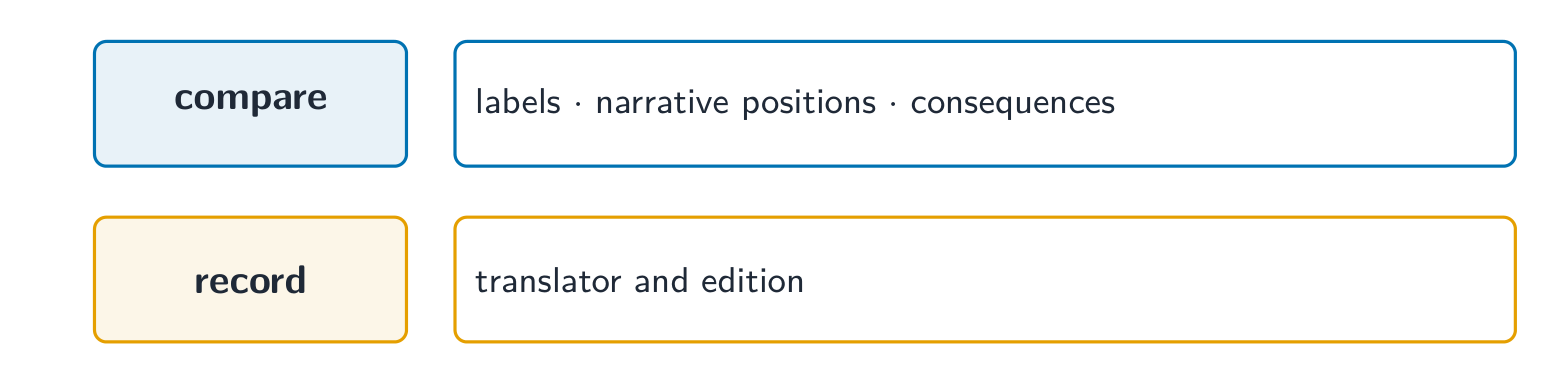
- Work in translation: The Metamorphosis, Part III — the sister's speech that "it" must go. Labels: "Gregor" becomes "it"; narrative position: Gregor hears but cannot answer; consequence: he dies and the family takes a tram trip into the country.
- Work in your language: an extract where a character is labelled and silenced — for example, Mr Thornton's workers in Gaskell's North and South, called "hands".
- Link: in both, a name reduces a person to their usefulness. Note the translator and edition, because "it" in English renders the German es, and other choices exist.
Reading in translation
- Record the translator 译者 and edition. A claim about a single word in a translated work is partly a claim about the translator's choice.
- Strongest claims rest on things that survive translation: structure, plot events, narrative point of view and repeated patterns.
Which claim depends least on one translator's choice?
Difficulty 1/5 · 100 coins + a small bonus on first completion today
Plot events and structure survive translation.
You should record the translator and edition of a work in translation.
Difficulty 1/5 · 100 coins + a small bonus on first completion today
A claim about a word is partly a claim about the translator.
Delivering the oral
- Begin with the global issue and a clear thesis; move between the two extracts and the wider works; finish by linking back to the issue.
- Use the extracts as evidence; do not retell the plot.
Do not build an argument on one translated word as if it were the author's. "Kafka's use of 'bug' shows…" is unsafe: Kafka wrote Ungeziefer. Name the translation, or argue from structure and events that do not depend on one English word.
"Kafka's use of the word bug shows…" is a safe claim.
Difficulty 1/5 · 100 coins + a small bonus on first completion today
Kafka wrote Ungeziefer; the English word is the translator's choice.
The individual oral explores one global issue through two extracts, one from a work in translation. Analyse labels, narrative positions and consequences, record the translator and edition, and rest your strongest claims on what survives translation.
Plan a 3-sentence opening for an individual oral on a global issue of your choice.
Issue, works, thesis.