From a source claim to a warranted conclusion
Introduced| English | Meaning |
|---|---|
| source claim/sɔːs kleɪm/ | What a document itself asserts, apart from the researcher's view. |
| scope/skəʊp/ | The extent, boundaries or range of material included in a task, investigation or subject. |
| measure/ˈmeʒə/ | The indicator used to judge whether something has changed. |
| warrant/ˈwɒrənt/ | The link that shows why a piece of evidence supports a claim. |
| limitation/ˌlɪmɪˈteɪʃn/ | A restriction or weakness that reduces what a method, result or system can establish or achieve. |
An announcement is not an outcome
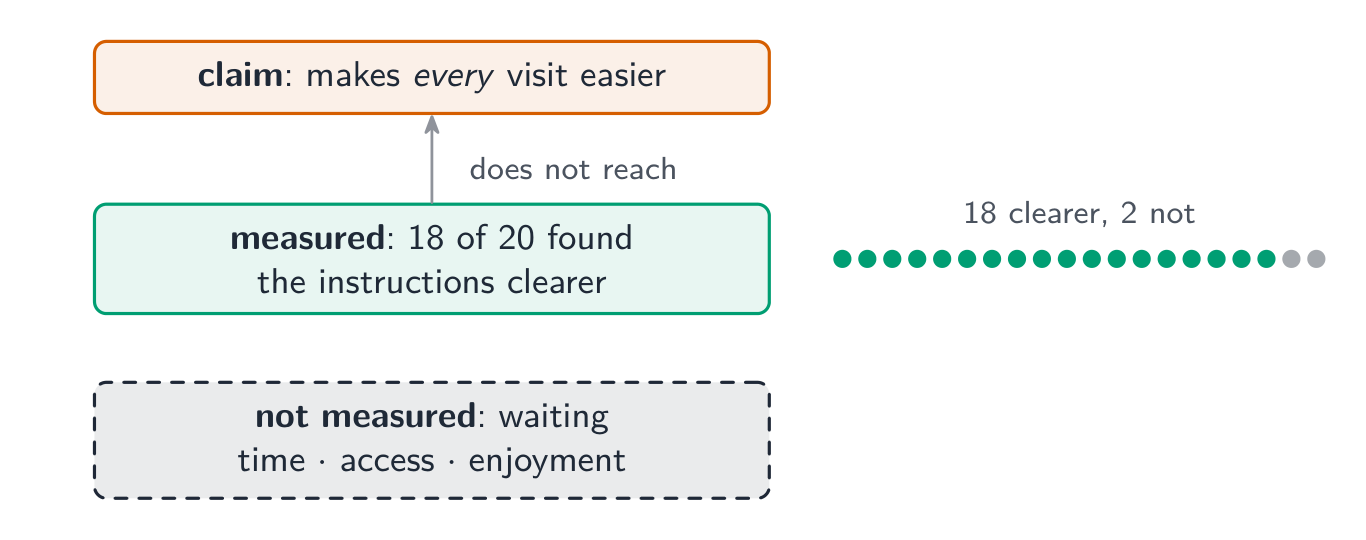
- A museum announces: “Our new audio guide makes every visit easier.” A later report says that 18 of 20 visitors who tried it found the instructions clearer. Does this establish an improvement for every visitor?
- A source claim 来源主张 records what its maker says. The announcement shows the museum made a promise; testing its effect needs evidence about actual visits. These statements are invented for this lesson.
What does the announcement directly establish?
Difficulty 1/5 · 100 coins + a small bonus on first completion today
An announcement records the promise, not its verified effect.
Identify who supplied the evidence
- The report concerns 20 users of the audio guide. It says nothing about visitors who did not use it, or why they did not. Keep the studied group visible when explaining the result.
- Scope 范围 is the range covered by a claim. “18 of these 20 users” fits the reported count. “Every visitor benefits” goes beyond it, even if the users gave honest answers.
The 18 positive reports establish that all museum visitors benefited.
Difficulty 1/5 · 100 coins + a small bonus on first completion today
The report covers the 20 guide users, not every visitor.
Read the measure before the conclusion
- “Instructions clearer” describes reported understanding of instructions. It does not measure waiting time, access to every exhibit or enjoyment of the whole visit. Decide what the question actually asks.
- A measure 衡量指标 must address the proposed outcome. More responses to the same narrow question would not automatically establish an improvement in all parts of a visit.
Which conclusion matches the stated measure?
Difficulty 1/5 · 100 coins + a small bonus on first completion today
The question concerns reported clarity of instructions.
Explain the evidence-to-claim connection
- A warrant 论证依据 explains why evidence supports a conclusion. Here, users' reports can support a limited claim about their experience of the instructions. Explain that connection rather than writing “the report proves success”.
- Consider what could change the interpretation. If staff invited only satisfied users to respond, selection may affect the finding. Investigate how the users were chosen; do not invent a selection problem as an established fact.
Match the part of the argument to its role.
Difficulty 2/5 · 140 coins + a small bonus on first completion today
Keep the claim, evidence and its coverage distinct.
State what remains unanswered
- A limitation 局限 matters when it changes what you can conclude. The missing non-user evidence prevents a conclusion about all museum visitors. It does not erase what the 20 users reported.
- An actual research plan needs traceable sources, a permitted subject method and supervisor review. This fictional practice case supplies no collected data, approved research question or completed essay paragraph.
Which next actions can improve the research decision?
Difficulty 2/5 · 140 coins + a small bonus on first completion today
Evaluate the collection method and outcome before broadening the answer.
How should you describe possible selection bias?
Difficulty 1/5 · 100 coins + a small bonus on first completion today
A possible concern needs investigation and a reasoned account of its effect.
The report states that 18 of 20 audio-guide users found the instructions clearer. This supports a claim about those users' reported understanding, provided the wording and collection process are checked. It does not establish that the guide improved every visit: non-users are absent, and other aspects of a visit were not measured. A next research decision is to define the intended outcome and check what evidence is accessible before widening the claim.
A source can be quoted accurately while the conclusion drawn from it is too broad. Check the group, measure and inference as well as the quotation.
Separate what a source says, what its evidence measures and what your argument can reasonably conclude.
Write from 18 of 20
- A museum says its audio guide makes every visit easier. 18 of 20 users found the instructions clearer.
- 18 of 20 is not every visitor, and clearer instructions are not the whole visit.
18 of 20 users found the audio-guide instructions clearer. The museum says every visit is easier. What can the 18 support?
A measure has to match the outcome. Scope is the group and the question actually reported.
Which claim fits the 18 of 20?
Difficulty 1/5 · 100 coins + a small bonus on first completion today
The count is about instructions among the 20 users. It is not every visitor, and the announcement is not that count.