Trace sources and preserve their meaning
Introduced| English | Meaning |
|---|---|
| source trail/sɔːs treɪl/ | The chain of documents that shows where a claim came from. |
| locator/ləʊˈkeɪtə/ | The page, line, or time mark that lets a reader find a passage again. |
| quotation/kwəʊˈteɪʃn/ | Words copied exactly, with the origin named. |
| paraphrase/ˈpærəfreɪz/ | A source restated in the writer's own words, still credited. |
| inference/ˈɪnfərəns/ | A conclusion drawn from evidence and reasoning rather than directly observed or stated. |
| comparison basis/kəmˈpærɪsn ˈbeɪsɪs/ | The shared feature on which two things are set side by side. |
| citation audit/saɪˈteɪʃn ˈɔːdɪt/ | A check that every borrowed idea can be traced to a source. |
Three pages can repeat one result
- A fictional student investigates how a town library changed its opening hours. A council note, newspaper article and campaign page all report the same survey. The student calls them three separate confirmations. What needs checking?
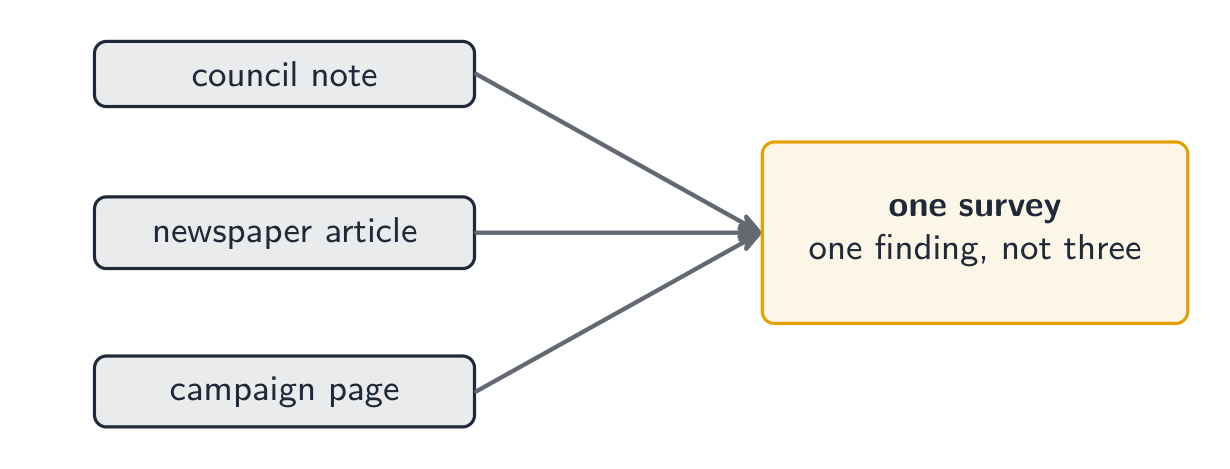
- A source trail 来源链 records where a statement came from. Follow each page back to its named survey. Three accounts of one survey can show different interpretations, but they do not create three independent sets of observations.
The council note and newspaper article quote the same survey. What do they provide?
Difficulty 1/5 · 100 coins + a small bonus on first completion today
Trace the original dataset before counting independent evidence.
Read the original finding
- The invented survey says 24 of 30 respondents preferred later closing on Fridays. Record the survey date, who could respond, the question wording and where this result appears. If the original report is unavailable, say which secondary account you actually read.
- A locator 来源定位信息 identifies a passage, table or section. Save enough information to find the evidence again. Do not invent a page number or cite an unseen report as if you inspected it.
If you could not access an original report, you should cite the secondary source you actually read.
Difficulty 1/5 · 100 coins + a small bonus on first completion today
True. State the secondary source you inspected and note the access limitation; citing an unread original would misrepresent your research.
Keep borrowed words visible
- Suppose the fictional report describes respondents as “users visiting after school”. Copying that phrase into a draft requires quotation marks and a traceable reference. Changing a few nearby words does not make the wording your own.
- A quotation 直接引文 preserves the source's actual words. Check its surrounding passage before using it. The phrase describes a particular group; it does not establish that all residents prefer later hours.
You keep the exact phrase users visiting after school. What should the draft show?
Difficulty 1/5 · 100 coins + a small bonus on first completion today
Exact borrowed wording must remain visible and traceable.
Paraphrase the idea accurately
- A paraphrase 转述 expresses a source's meaning in your own words and sentence structure. Read the passage, set it aside, write the meaning, then compare your version with the original. Keep the source credit because the idea is still borrowed.
- “Most respondents wanted a later Friday closing time” fits 24 of 30. “Most residents wanted the library open later every day” changes both the group and the days. A fluent sentence can still misrepresent the evidence.
Which paraphrase preserves the stated survey finding?
Difficulty 1/5 · 100 coins + a small bonus on first completion today
24 of 30 concerns respondents, Friday and closing time.
Separate the finding from your inference
- The reported preference may support discussing demand among these respondents. Whether longer hours would improve access also depends on other evidence, such as who cannot currently attend and what staffing is feasible. These are further questions, not supplied results.
- An inference 推论 connects evidence to a conclusion. Make that connection explicit in your own analysis. A reference credits the finding; it does not automatically justify every conclusion written after it.
Match each statement to its role.
Difficulty 2/5 · 140 coins + a small bonus on first completion today
Distinguish supplied observations from reasoning and further evidence needed.
Investigate an apparent disagreement
- A second fictional survey says 18 of 25 morning visitors preferred keeping the opening time unchanged. This does not directly contradict a preference for later Friday closing. The groups, questions and times differ.
- A comparison basis 比较依据 states what is being compared. Check the population, measure and period before calling sources inconsistent. Keep genuine disagreement visible when the same claim is tested; do not hide an inconvenient result.
Why do the morning and Friday surveys not establish a direct contradiction?
Difficulty 1/5 · 100 coins + a small bonus on first completion today
Compare the population, measure and time before deciding the results conflict.
Make each draft claim recoverable
- Keep a working record with the claim, source details, locator, exact words or your paraphrase, and your reason for using it. Mark any source you still need to inspect. Keep your interpretation separate from what the source states.
- A citation audit 引用核查 checks both directions: each borrowed claim has a source, and each reference points to evidence actually used. A long bibliography cannot repair an unsupported paragraph. Follow the citation convention required by the chosen subject and school.
Which actions belong in a citation audit?
Difficulty 2/5 · 140 coins + a small bonus on first completion today
Trace claims and references both ways; length is not evidence of accuracy.
Revise the conclusion and the next action
- A defensible draft says the first survey reports a Friday-closing preference among its respondents. The morning survey addresses a different decision. Check sampling and the original questions before making a wider claim about residents or changing the research question.
- Actual research needs permitted subject methods and supervisor review. This fictional case teaches source use; it supplies no genuine collected data or approved essay. Confirm the guide and requirements for your assessment session before submitting assessed work.
A citation alone establishes that the evidence justifies a claim about every resident.
Difficulty 1/5 · 100 coins + a small bonus on first completion today
The conclusion must still match the evidence and its scope.
Which next action best addresses the wider population claim?
Difficulty 1/5 · 100 coins + a small bonus on first completion today
Check coverage and the measure before broadening the conclusion.
The council note and newspaper article both refer to the same 30-person survey. I therefore treat them as accounts of one dataset rather than independent confirmations. The reported 24 positive responses concern later Friday closing. They support a limited claim about those respondents' preference. They do not establish a preference among all residents or a benefit from longer opening hours. I will inspect the original question wording and sampling method before widening the conclusion. The morning survey concerns keeping the opening time unchanged, so its result must be compared on that basis.
Credit the source of an idea even when you rewrite it. Check whether your rewrite preserves the group, measure and period; a correct reference can accompany an inaccurate paraphrase.
Trace the evidence, preserve its meaning, credit borrowed material and explain your own inference.
Write from two surveys
- 24 of 30 respondents preferred a later Friday closing. 18 of 25 morning visitors preferred the opening time unchanged.
- These questions differ. Three pages that repeat the first survey are not three surveys.
A council note, a newspaper and a campaign page all report one survey, 24 of 30 preferring a later Friday closing. A second survey says 18 of 25 morning visitors want the opening time unchanged. Are these three pages three findings, and do the surveys contradict?
A source trail stops a repeated report being counted three times. Comparison needs the same population, measure and period.
Which reading fits the two surveys?
Difficulty 1/5 · 100 coins + a small bonus on first completion today
The pages repeat one Friday finding. The morning result is a different decision, and residents every day widens both the group and the days.