Neural signalling: impulses and synapses
Introduced| English | Meaning |
|---|---|
| action potential/ˈækʃn pəˈtenʃl/ | A brief change in membrane potential involving voltage-gated ion channels. |
| synapse/ˈsɪnæps/ | A junction through which a neuron communicates with another cell, usually using a chemical transmitter. |
What would explain this observation?
- A stronger stimulus can increase impulse frequency while each action potential 动作电位 remains a similar size.
Build the model
- An action potential is a brief change in membrane potential involving voltage-gated ion channels.
- Depolarization followed by repolarization propagates along a neuron.
- At a chemical synapse 突触, transmitter release can alter the next cell membrane potential.
- action potential: A brief propagating change in membrane potential.
- synapse: A junction for communication between cells.

How can stimulus intensity affect an all-or-none signalling system?
Difficulty 1/5 · 100 coins + a small bonus on first completion today
Each action potential is all-or-none with fixed amplitude, so intensity is coded by how often impulses fire and how many neurons are recruited. Amplitude cannot grow, and removing ion gradients would abolish signalling.
Match each technical term to its precise meaning.
Difficulty 2/5 · 140 coins + a small bonus on first completion today
Use the definitions to distinguish related quantities and processes.
Choose evidence that can test it
- The all-or-none principle applies to an individual action potential.
- Stimulus information can be encoded by frequency and recruitment.
- Myelination permits saltatory conduction between nodes rather than making ions move freely through myelin.
In the lab: Interpret supplied voltage-time traces and compare time intervals. Identify threshold, rising phase and recovery before explaining ions. Use classroom models rather than electrical stimulation of people.
Which two habits make the investigation or model in this case more defensible?
Difficulty 2/5 · 140 coins + a small bonus on first completion today
Stating the conditions and assumptions lets others repeat the work exactly, and recording the supporting evidence lets them check the conclusion. Hiding disagreeing results removes the evidence that could challenge a wrong conclusion, and one measurement can never establish a wider claim.
Work from known quantities
- Known: 30 impulses occur in 0.50 s.
- Frequency = count/time = 30/0.50 = 60 Hz.
- This is impulse frequency, not an estimate of propagation speed.
Your turn: 24 impulses occur in 0.40 s. Find impulse frequency.
More frequent impulses, same impulse size
30 impulses in 0.50 s gives 60 Hz. Change the count and observation window while comparing equal-height event marks with a 60 Hz reference.
24 impulses occur in 0.40 s. Find impulse frequency.
Difficulty 2/5 · 140 coins + a small bonus on first completion today
The result is 60 Hz. Known: 24 impulses in 0.40 s. Use frequency = count / time. Frequency = 24/0.40 = 60 Hz. This is firing frequency, not conduction speed along the axon.
Check the conclusion and its limits
- A neurotransmitter diffuses across the synaptic cleft; an action potential does not jump intact through the liquid gap.
- Excitatory input does not guarantee the postsynaptic cell reaches threshold.
Not true: A stronger stimulus always makes each action potential larger. Action potentials are all-or-none: once threshold is reached, the impulse has a fixed size set by the ion gradients. A stronger stimulus raises the frequency of impulses, not their amplitude.
- An action potential is a brief change in membrane potential involving voltage-gated ion channels.
- The all-or-none principle applies to an individual action potential.
- Watch for: A neurotransmitter diffuses across the synaptic cleft; an action potential does not jump intact through the liquid gap.
A stronger stimulus always makes each action potential larger.
Difficulty 1/5 · 100 coins + a small bonus on first completion today
Action potentials are all-or-none: once threshold is reached, the impulse has a fixed size set by the ion gradients. A stronger stimulus raises the frequency of impulses, not their amplitude.
A brief propagating change in membrane potential: write the technical term.
Difficulty 1/5 · 100 coins + a small bonus on first completion today
action potential means A brief propagating change in membrane potential.
Write from an impulse frequency of 70 per second
- 21 impulses occur in 0.30 s.
- Find the frequency. This is not the propagation speed.
21 impulses occur in 0.30 s. What is the impulse frequency, and why is that not a propagation speed?
21 divided by 0.30 is 70. One action potential is all or none. The message can still vary in frequency.
The HL written case counts 21 impulses in 0.30 seconds. Find frequency.
Difficulty 1/5 · 100 coins + a small bonus on first completion today
21 divided by 0.30 is 70 per second.
Connect the regions of one neuron
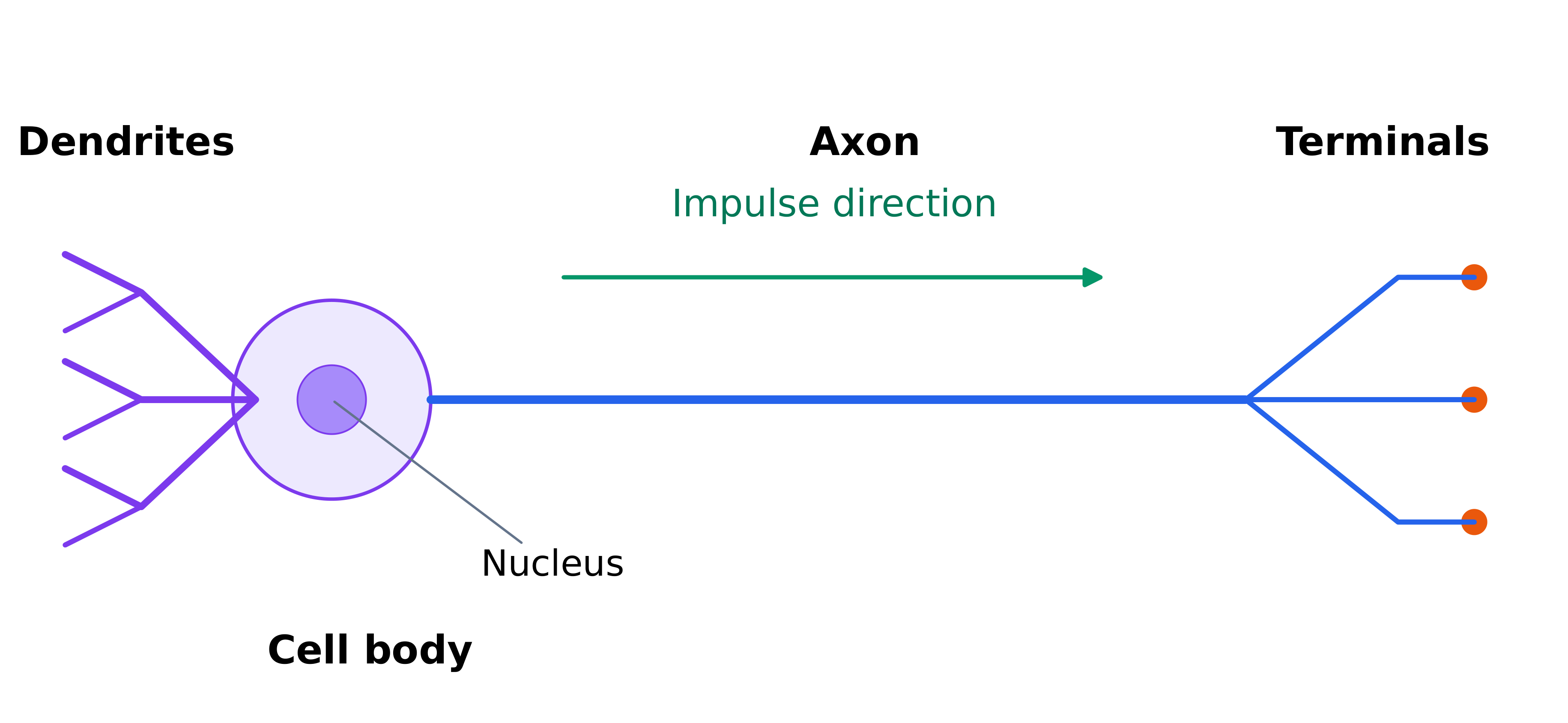
- A typical neuron has a cell body containing its nucleus, branching dendrites receiving inputs, and an axon conducting impulses towards terminal branches. These are connected regions of one cell, rather than a chain of separate cells. Shape and axon length vary between neuron types.
- Many inputs can converge on one neuron, and its branches can communicate with several targets. A nerve bundles nerve fibres with supporting tissues; it is not one large neuron. Ion movement in and across cell membranes carries the signal, rather than electrons travelling along a metal wire.
Explain a resting voltage without stopping transport
- Membrane potential compares the inside with the outside. A representative resting value of −70 mV means the interior is negative relative to the surrounding fluid, not that the cytoplasm contains only negative ions. Both bulk solutions remain close to electrically neutral, with a small charge separation near the membrane.
- ATP-dependent sodium–potassium pumping maintains high sodium outside and potassium inside. Greater resting potassium permeability permits potassium loss; electrical attraction increasingly opposes further loss. Selective permeability, gradients and trapped intracellular anions contribute to voltage. “Resting” does not mean the pump and channels have all stopped.
Count pump transfers without inventing a voltage
- The standard sodium–potassium pump exports three sodium ions and imports two potassium ions per ATP-driven cycle. Eight cycles therefore export 24 sodium, import 16 potassium and use eight ATP, moving a net eight positive charges outward.
- These counts do not calculate a particular membrane voltage: membrane area, capacitance, ion concentrations and permeability also matter. Nor does switching off a pump instantly erase every gradient. Pumps maintain conditions over time; rapid impulse phases involve changing channel currents.
In the standard pump model, each cycle exports three sodium and imports two potassium ions using one ATP. How many sodium ions are exported in eight cycles?
Difficulty 2/5 · 140 coins + a small bonus on first completion today
8 × 3 = 24 sodium exported. The separate totals are 16 potassium imported and eight ATP used; these counts alone do not specify a membrane voltage.
Keep individual impulses separate from the whole response
- For a given healthy fibre under stable conditions, reaching threshold initiates a full action potential; subthreshold stimulation does not send a smaller travelling impulse. Successive excitable regions regenerate the signal, rather than allowing it to fade continuously along a healthy axon.
- A stronger sustained stimulus can increase firing frequency or recruit more sensory neurons. A larger compound nerve recording can therefore reflect more active fibres. “All-or-none” does not require every neuron, temperature or physiological condition to produce an identical voltage trace; amplitude is not a universal constant across all conditions.
Distinguish frequency from propagation speed
- Thirty impulses counted in a defined 0.50-second window give 60 Hz, or impulses per second. An impulse travelling 0.80 m in 0.016 s instead has a speed of 50 metres per second. Counts and elapsed time give frequency; distance and travel time give speed.
- Keep the timing convention clear. Whole stimulus-to-muscle response time includes receptor, synaptic and muscle delays, so it does not isolate one axon's conduction time. For regular spikes, use peak spacing to find the period rather than dividing a peak count by an unrelated interval.
An invented impulse takes 0.016 seconds to travel 0.80 metres along an axon. Find conduction speed in metres per second.
Difficulty 2/5 · 140 coins + a small bonus on first completion today
0.80/0.016 = 50 metres per second. This is distance divided by propagation time, not impulse frequency or the speed inferred from a whole reflex delay.
Compare fibre structure under matched conditions
- Greater unmyelinated axon diameter lowers internal electrical resistance and can increase conduction speed. Giant squid axons illustrate this route. Myelin supplied by supporting cells can greatly increase speed without requiring giant diameter, so diameter alone cannot rank a mixture of myelinated and unmyelinated fibres.
- Control or record species, temperature and myelination, using independent fibres and reliable distance/timing measurements. Repeated timings of one fibre estimate its measurement variation; they do not sample variation among many fibres. Body size alone does not establish an animal's conduction speed.
Interpret a correlation coefficient before explaining a cause
- Pearson's r describes linear association from −1 to +1. A positive value indicates that larger values tend to occur together; a negative value indicates the opposite direction. A value near zero can still accompany a curved relationship, so inspect the plotted pairs.
- In a simple linear regression with an intercept, R-squared equals r squared. It describes how much sample variation the fitted linear relationship accounts for, not the fraction biologically caused by the explanatory variable. Confounding, limited ranges, outliers and small samples restrict inference.
Work through an invented diameter–speed dataset
- Four invented diameter–speed pairs are (10, 1), (20, 2), (30, 2) and (40, 5), with diameter in micrometres and speed in metres per second. Means are 25 and 2.5; the sums of paired deviation products, squared diameter deviations and squared speed deviations are 60, 500 and 9.
- Hence r is about 0.894 and R-squared is 0.80: a strong positive linear association in these four pairs. The fit accounts for 80% of sample speed variation; it does not prove that diameter causes 80% of any neuron's speed. If a different sample gives r = −0.70, its R-squared is 0.49 and the association remains negative.
An invented sample has Pearson r = −0.60. Find R-squared for a simple linear regression with an intercept; give a proportion rather than a percentage.
Difficulty 2/5 · 140 coins + a small bonus on first completion today
(−0.60)² = 0.36, or 36% of sample variation accounted for by the fitted linear relationship. The direction remains negative, and the fit does not establish causation.
Trace electrical arrival into chemical release
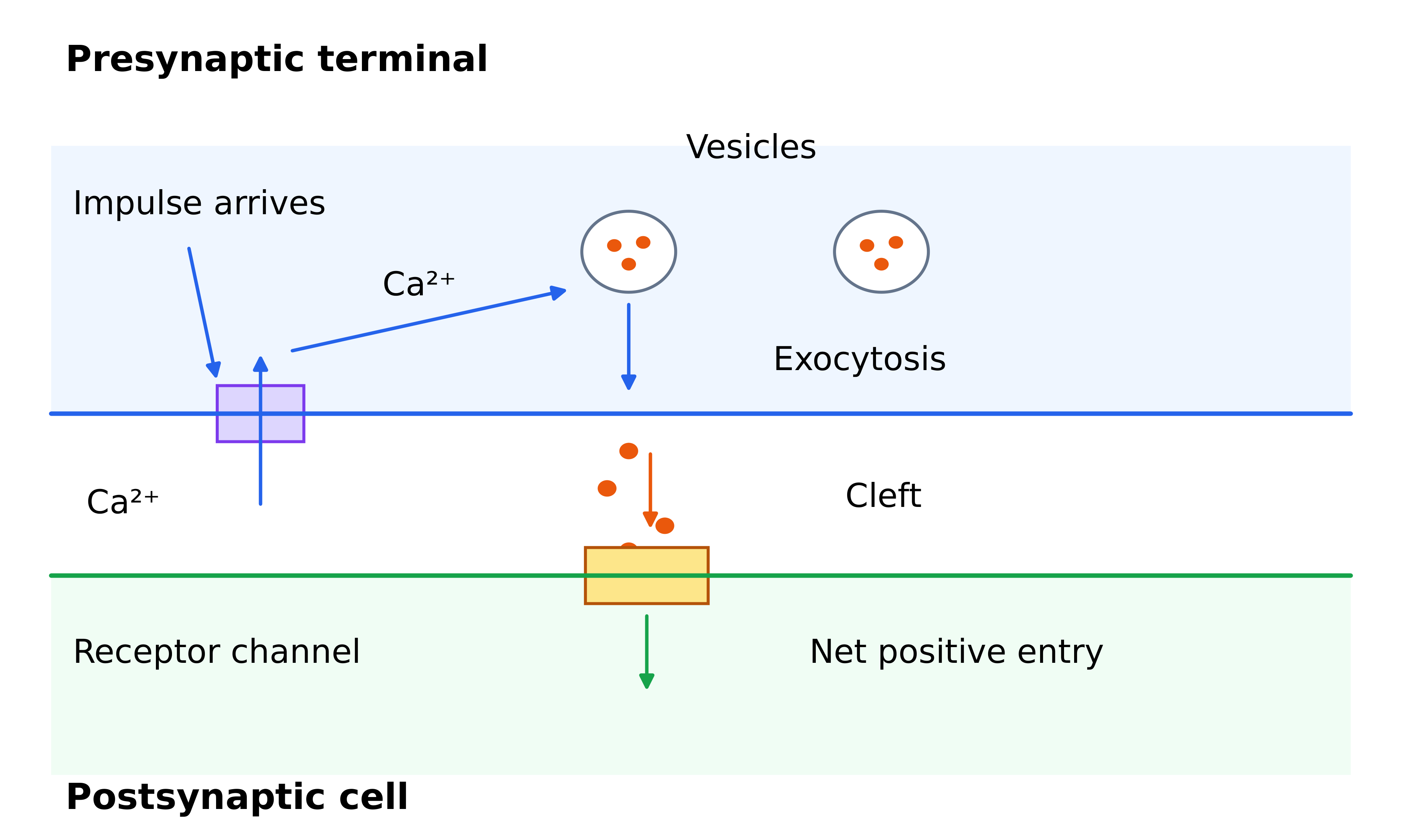
- At a chemical synapse, presynaptic depolarization opens voltage-gated calcium channels. Calcium entry down its electrochemical gradient raises cytosolic calcium, promoting vesicle fusion and neurotransmitter exocytosis. Sodium entry elsewhere in the impulse is not the same event as calcium-triggered release.
- Transmitter diffuses across the cleft and binds compatible receptors on the postsynaptic membrane. The action potential does not jump intact across the liquid gap. Release, diffusion and receptor activation introduce a delay, and the target needs the appropriate receptors to respond.
Which event directly links presynaptic depolarization with transmitter-vesicle fusion in the chemical-synapse model?
Difficulty 1/5 · 100 coins + a small bonus on first completion today
Calcium entry triggers the release machinery; transmitter then diffuses and binds target receptors. The presynaptic calcium channels and postsynaptic ligand-gated channels have different triggers and locations.
Distinguish a local excitatory response from an impulse
- At nicotinic acetylcholine receptors near resting voltage, ligand-gated cation channels allow net inward positive current, with sodium entry important. Potassium can also pass. The resulting excitatory postsynaptic potential, EPSP, is graded; it need not bring an excitable region to threshold.
- At a neuromuscular junction the target is muscle membrane, and its local response is an end-plate potential. Acetylcholinesterase hydrolyses acetylcholine into choline and acetate; choline can be taken back for reuse. This differs from removing every released acetylcholine molecule by intact reuptake, or using the same removal mechanism for all transmitters.
Explain the usual direction from synaptic structure
- A typical chemical synapse places release vesicles and their machinery on the presynaptic side and compatible target receptors on the postsynaptic side. This asymmetry organizes communication. Random molecular diffusion does not become a one-way conveyor; the release and reception sites create the functional direction.
- One arriving impulse does not guarantee one outgoing impulse in the target neuron. Inputs from several synapses can influence its voltage, and the target's state also matters. Separate transmitter release, a local voltage change and threshold crossing when explaining evidence.
Match a neural measurement to its claim
- For frequency, identify the fibre and counted time window. For speed, use conduction distance and propagation time, separating other delays. For diameter comparisons, plot independent paired observations under comparable conditions before calculating and interpreting r and R-squared.
- Explain a synaptic response through calcium entry, exocytosis, diffusion, receptor binding and target voltage change. Use supplied recordings or classroom models. Name what was measured before proposing a mechanism; a correlation or a larger compound recording alone does not identify every causal step.
A stronger stimulus produces a larger compound nerve recording and a sample shows a positive diameter–speed correlation. Explain what further distinctions are needed, then trace a chemical synaptic response.
Specify the measured signal and the cellular stage. Different measurements answer different questions even when they all concern neural communication.
AHL: Follow channel changes through a spike
- In the model, rest is −70 mV, threshold −55 mV, peak +30 mV and undershoot −80 mV. At threshold, voltage-gated sodium-channel opening increases sodium entry and depolarization, causing further opening: positive feedback. Peak minus rest is a 100 mV change, not 30 mV.
- Sodium-channel inactivation and delayed potassium-channel opening permit repolarization through potassium exit. Continued potassium conductance contributes to undershoot. The pump maintains gradients over time; it does not create the fast falling phase by suddenly pumping all sodium back out.
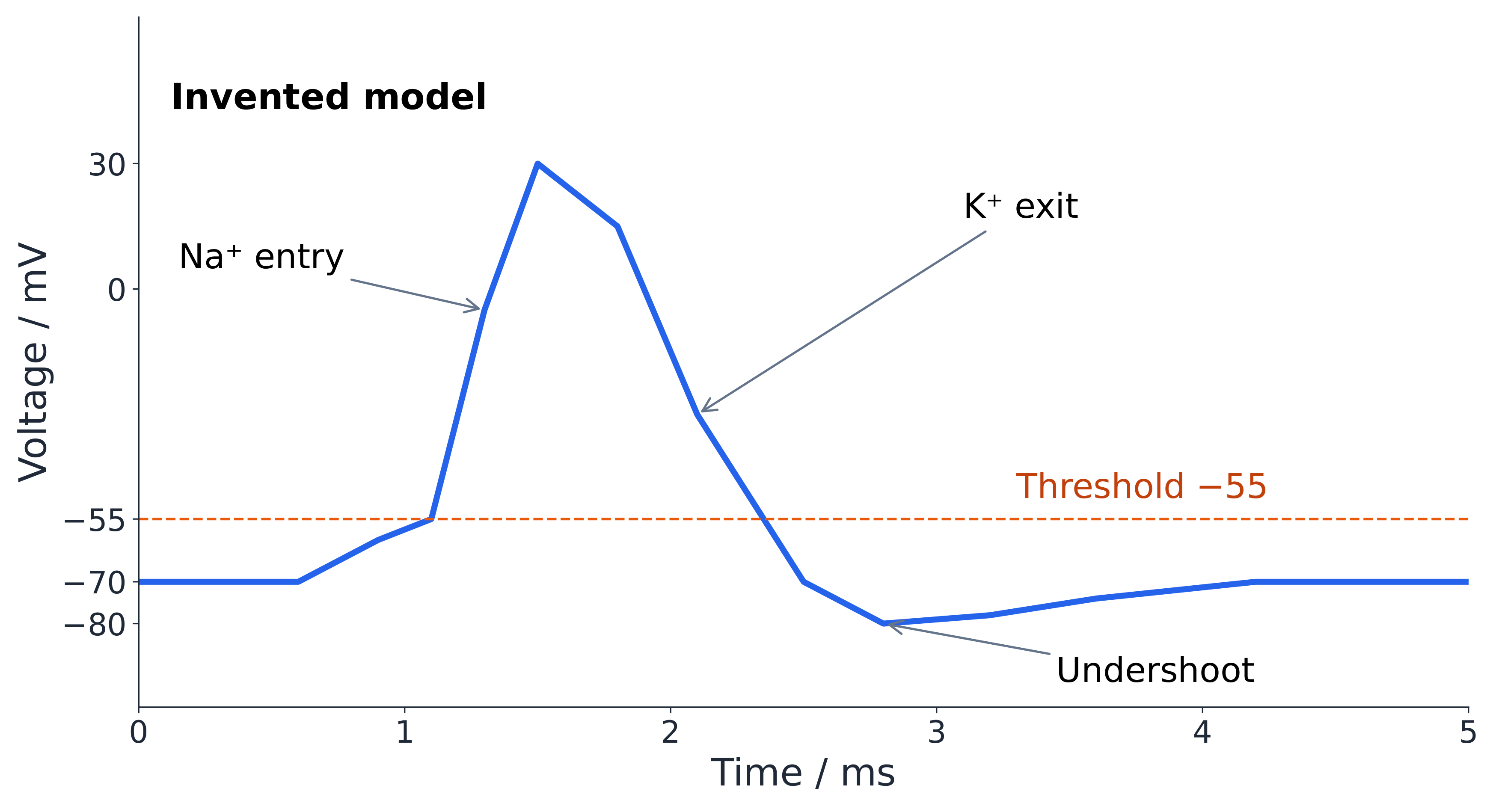
AHL: A model spike rises from −70 mV at rest to +30 mV at its peak. Find peak-minus-rest voltage change.
Difficulty 2/5 · 140 coins + a small bonus on first completion today
30 − (−70) = 100 mV. The peak relative to the outside is +30 mV; its change from rest is a different quantity.
AHL: Read a time scale and respect refractoriness
- If a trace uses 0.50 ms per horizontal division and regular peaks are six divisions apart, the period is 3.0 ms, or 0.0030 s. Frequency is about 333 Hz. Convert milliseconds to seconds before taking the reciprocal; a vertical voltage scale cannot supply the period.
- During absolute refractoriness, many sodium channels are inactivated and a second full action potential cannot be generated in that region. Later relative refractoriness may require stronger input because recovery is incomplete and potassium conductance remains high. These periods help constrain maximum firing frequency.
AHL: An invented regular trace has 0.50 milliseconds per horizontal division and six divisions between peaks. Calculate frequency in hertz.
Difficulty 2/5 · 140 coins + a small bonus on first completion today
Period = 6 × 0.50 = 3.0 ms = 0.0030 s. Frequency = 1/0.0030 ≈ 333 Hz, about 330 Hz to two significant figures.
AHL: Propagate a signal through local currents
- Positive charge entering an active region produces local currents in the cytoplasm and surrounding fluid. Nearby membrane depolarizes; if it reaches threshold, its own sodium channels open. Regeneration carries the signal forward without requiring one group of sodium ions to travel from cell body to terminal.
- Recently active membrane is refractory, favouring propagation into excitable membrane ahead. Normal initiation and connections establish the functional route. Artificial stimulation in the middle of an axon can launch impulses both ways, so an axon is not physically incapable of backward propagation.
AHL: Explain what saltatory conduction actually skips
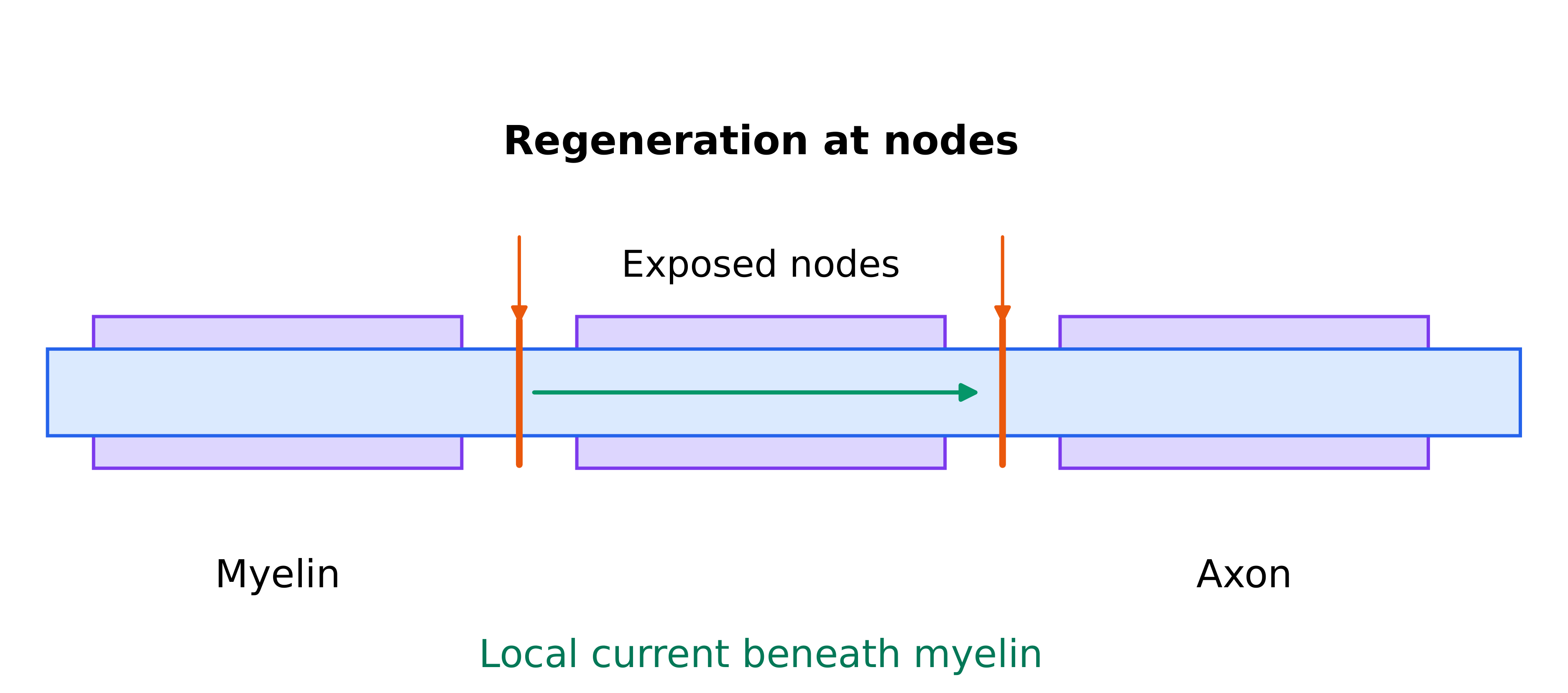
- Myelin limits current loss across internodes and reduces the membrane charging needed there. Local current spreads beneath it towards exposed nodes of Ranvier, where concentrated voltage-gated channels regenerate action potentials. This node-to-node pattern is saltatory conduction.
- “Jumping” describes the sites of regeneration. It does not mean sodium ions fly through the sheath or cross an empty gap; current spreads continuously through conducting fluids. Damaged insulation can slow or disrupt propagation, and pumps remain necessary for maintaining ion gradients.
AHL: Locate how an external chemical changes signalling
- Neonicotinoids act at insect nicotinic acetylcholine receptors; persistent activation can disrupt normal firing through sustained depolarization. Recordings from isolated honeybee brains showed depolarization block and inhibited nicotinic responses under the studied exposures. This cellular evidence alone does not quantify whole-population effects or make all compounds equivalent.
- Cocaine can inhibit dopamine-transporter-mediated reuptake, leaving dopamine available outside cells for longer. The transporter is a removal mechanism, distinct from the dopamine receptor. Research on dopamine uptake inhibition supports this target distinction; it differs from receptor agonism and acetylcholinesterase breakdown, and does not explain every cocaine effect.
AHL: Combine graded inputs before the all-or-none output
- An inhibitory input can hyperpolarize the target through chloride entry or potassium exit, depending on channels and gradients. Some inhibition instead weakens excitation through increased conductance without a large negative voltage shift. EPSPs and IPSPs are graded inputs, unlike the resulting action potential.
- In an explicitly additive model, −70 mV plus two overlapping +8 mV EPSPs gives −54 mV, beyond a −55 mV threshold. Adding a −6 mV IPSP gives −60 mV, below threshold. Temporal summation combines closely timed inputs from one source; spatial summation combines different locations. Real responses also depend on timing, location and driving forces, rather than always adding exactly.
AHL: In an explicitly additive model, resting potential is −70 mV. Two overlapping EPSPs each add +8 mV and one IPSP adds −6 mV. Find the predicted potential before deciding whether a −55 mV threshold is reached.
Difficulty 2/5 · 140 coins + a small bonus on first completion today
−70 + 8 + 8 − 6 = −60 mV, below the −55 mV threshold. Without the inhibitory contribution the model gives −54 mV. Exact addition is an assumption; real timing, locations and conductances matter.
AHL: Trace sensory transduction without equating it with experience
- Some skin free endings contain channels responsive to high temperature, acidity or capsaicin. Positive-ion entry can depolarize an ending; threshold crossing can initiate impulses that engage pathways towards the brain. Capsaicin does not need to travel along the axon to convey the signal.
- Detection of potentially damaging stimuli and conscious pain experience are related but distinct. Brain processing and context contribute to perception. Consciousness is described as an emergent property of interacting neuronal networks; one isolated spike is not a conscious thought, and the description does not claim that every mechanism of experience is solved.