Biological psychology
Introduced| English | Meaning |
|---|---|
| action potential/ˈækʃn pəˈtenʃl/ | An all-or-none electrical spike that travels along an axon. |
| hippocampus/ˈhɪpəkæmpəs/ | A brain structure important in forming certain new memories and in spatial learning. |
| sensitivity/ˌsensɪˈtɪvɪti/ | The ability to distinguish signal-plus-noise from noise in a detection task. |
Heard in one room, missed in another
- A faint beep is easier to notice in a quiet room than in a noisy one. A listener expecting an alarm may also report more beeps that were never played. Better hearing and a greater willingness to say “yes” are different explanations.
- Biological psychology connects neural activity, body regulation and behaviour. Compare what a study measures with what it changes before making a causal claim about a brain region or sensory ability.
Neural signals
- Many neurons have a resting membrane potential near −70 mV, but the value varies. Inputs combine, and reaching threshold usually triggers an action potential 动作电位 at the axon initial segment, close to the cell body.
- An action potential is an all-or-none electrical spike that travels along an axon. A stronger input does not simply make each spike taller. Information can be carried by firing rate and timing. Myelin helps signals travel rapidly between nodes of Ranvier by saltatory conduction.
The all-or-none electrical signal that travels down an axon is the ____ potential.
Difficulty 1/5 · 100 coins + a small bonus on first completion today
An action potential is the all-or-none spike. In many neurons it begins at the axon initial segment near the cell body, where inputs influence whether threshold is reached.
A stronger sustained input increases a neuron’s firing rate. Which interpretation is best?
Difficulty 1/5 · 100 coins + a small bonus on first completion today
All-or-none concerns whether individual spikes occur, not a fixed number or timing of spikes.
Transmitters and receptors
- At a chemical synapse, transmitter released from one cell binds to receptors on another. Glutamate is the major excitatory transmitter and GABA the major inhibitory transmitter in the adult brain; the effect depends on receptors, ion conditions and the circuit, not the name alone.
- Dopamine supports movement and aspects of reward learning and motivation; serotonin has several roles including sleep and mood; acetylcholine acts at skeletal-muscle junctions and in brain systems involved in attention and memory. None is a one-function “happiness” or “memory” chemical.
The major inhibitory neurotransmitter in the adult brain is
Difficulty 1/5 · 100 coins + a small bonus on first completion today
GABA is the standard answer for the adult brain; glutamate is the major excitatory transmitter. Effects still depend on receptors, ion conditions and circuits.
Brain regions work in networks
- Broca's and Wernicke's areas are classic landmarks for language production and comprehension, usually in the left hemisphere. Language uses a wider connected network. Occipital regions support vision, parietal regions touch and spatial processing, and the cerebellum coordination and timing; these are major associations, not exclusive jobs.
- The hippocampus 海马体 is a brain structure important for forming new declarative memories. H.M.'s bilateral medial temporal surgery caused severe difficulty forming new lasting memories while some skill learning remained possible. His damage extended beyond the hippocampus, so the case does not locate all memory in one structure.
Match each structure with a major contribution, rather than an exclusive function.
Difficulty 2/5 · 140 coins + a small bonus on first completion today
These are useful major associations. Each structure works in connected systems; the matches do not imply that the structure has only that function or that the whole function occurs there.
H.M. improved on a practised motor task while struggling to remember recent events. This most directly supports
Difficulty 1/5 · 100 coins + a small bonus on first completion today
The dissociation supports different memory processes. His broader medial temporal damage prevents treating him as a pure isolated hippocampal lesion.
Recording activity
- EEG records electrical potential differences at the scalp, mainly reflecting summed neural activity. It offers millisecond timing, but locating the sources is difficult. It does not read individual neurons or private thoughts directly.
- fMRI measures blood-oxygen-level-dependent (BOLD) changes, an indirect signal linked to neural activity. It usually gives finer spatial localisation than scalp EEG but follows a slower blood response. More BOLD signal during a task does not prove that a region alone causes the behaviour.
Which method typically offers the finest timing of neural activity among these choices?
Difficulty 1/5 · 100 coins + a small bonus on first completion today
EEG tracks scalp electrical potentials at millisecond resolution. fMRI and PET follow slower physiological signals; structural MRI mainly describes anatomy. EEG source localisation is harder than its timing measurement.
Damage, stimulation and causal claims
- Lesion studies connect damage with changed abilities. A selective deficit can support a region's contribution, but damage may affect neighbouring tissue and connections; prior differences and later compensation complicate interpretation. A deficit is not proof of a single isolated “centre”.
- TMS changes activity through magnetic stimulation and can test a region's contribution at a particular time. Effects depend on protocol and can spread through networks. Sham stimulation and control tasks or sites help distinguish the intended effect from clicks, scalp sensations, distraction and expectations.
What kind of evidence?
Distinguish methods by what is measured or changed.
TMS over a region slows a word task compared with no stimulation. Give two alternative explanations to control and a cautious conclusion.
Clicks or scalp sensations could distract participants; expectations or general motor slowing could also change responses. Use a suitable sham condition and a control task or site, with comparable timing and randomisation where possible. A selective controlled effect supports a contribution under those conditions, not the region as the sole language centre.
Sleep and biological timing
- Sleep includes non-REM stages N1, N2 and N3, and REM sleep. N3 has prominent slow waves; REM commonly combines rapid eye movements, relatively active EEG and reduced skeletal-muscle tone. Dreams are often vivid in REM but are not confined to it.
- Sleep timing reflects both a roughly daily circadian system, coordinated by the hypothalamic suprachiasmatic nucleus (SCN), and sleep pressure that builds during wakefulness. Light helps set the clock; being tired and being at the usual sleep time are related but distinct influences.
Which statement about sleep is best supported?
Difficulty 1/5 · 100 coins + a small bonus on first completion today
N3 is slow-wave sleep. REM commonly has vivid dreams, but dreams also occur in non-REM. Timing and sleep pressure are distinct influences.
Motivation, homeostasis and emotion
- The hypothalamus helps coordinate temperature, hormonal and autonomic regulation. Homeostasis uses feedback to keep internal conditions within workable ranges. Eating also depends on food cues, reward and social context, so hunger is not controlled by one simple on/off switch.
- The amygdala contributes to learning about significant events, including threats; it is not the sole location of fear. Body arousal and context both inform emotion. A faster heartbeat alone cannot tell a researcher whether someone is afraid, excited or exercising.
A study records a faster heartbeat while a participant views a picture. Explain why this does not by itself locate fear in the amygdala.
Heart rate measures body arousal rather than a unique emotion or a brain location. Fear, excitement and other states can raise it. The study needs relevant comparison conditions and other measures; even amygdala activity would not prove it alone generates fear.
Sensation and perception
- Sensation concerns detecting and encoding input; perception concerns organising and interpreting it. An absolute threshold is often defined as the intensity detected on 50% of trials under specified conditions, rather than a perfectly sharp boundary between sensing and not sensing.
- A difference threshold concerns detecting a change between stimuli. Weber's law describes an approximately constant change-to-background ratio over a suitable range: adding the same small mass is easier to notice on a light load than on a heavy one. The relation has limits and is not exact for every stimulus or intensity.
Under a Weber-law approximation, a 2 g addition is just noticeable on 100 g. What addition is predicted for 300 g in the same valid range?
Difficulty 1/5 · 100 coins + a small bonus on first completion today
The ratio is 2/100 = 0.02. Multiplying 300 g by 0.02 gives 6 g, conditional on the approximation and comparable testing conditions.
Signal detection: sensitivity and criterion
- Cross the actual signal state with the response: a hit is “yes” when present; a miss is “no” when present; a false alarm is “yes” when absent; a correct rejection is “no” when absent. Calculate hit rate among signal-present trials and false-alarm rate among signal-absent trials.
- Sensitivity 敏感性 is the ability to distinguish signal-plus-noise from noise in a detection task. $d'$ measures separation in a standard model. Criterion is the decision boundary. With the evidence distributions held fixed, a more liberal criterion raises both hit and false-alarm rates. Expectations can also change attention, so unchanged sensitivity must be checked rather than assumed.
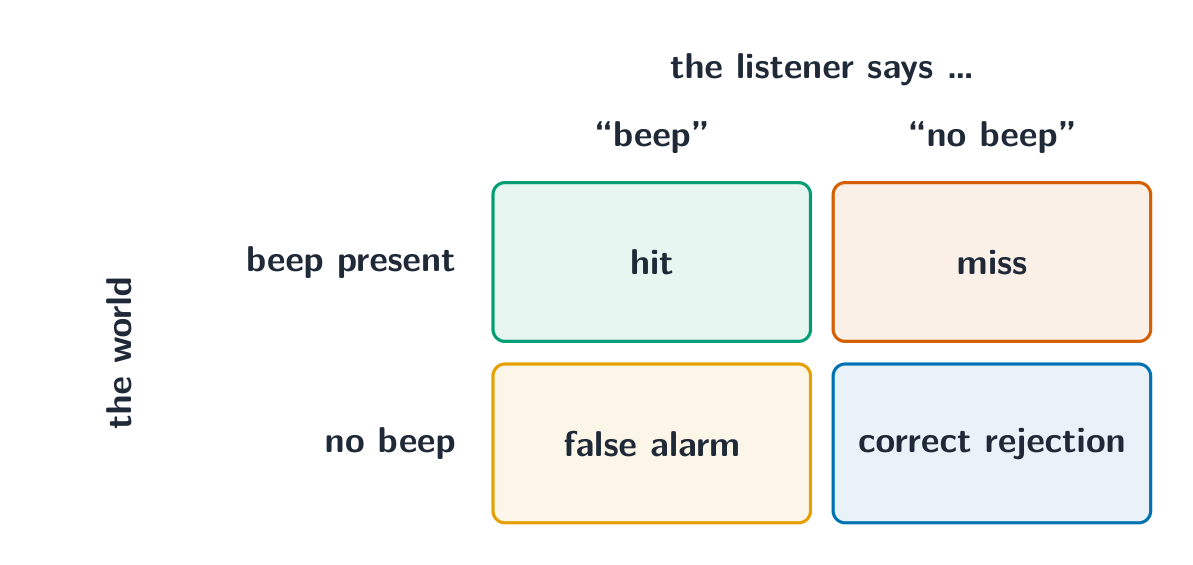
Hit, miss, false alarm or correct rejection?
Classify detection outcomes.
With signal and noise distributions held fixed, a more liberal criterion increases both hit and false-alarm rates.
Difficulty 1/5 · 100 coins + a small bonus on first completion today
True under the stated fixed-distribution model. Observing both rates rise in an actual study is compatible with a criterion shift, but does not establish that sensitivity is unchanged.
Work through a detection result
- In a fictional beep test, a listener reports 80 of 100 real beeps and says “yes” on 20 of 100 no-beep trials. Hit rate is 80%, miss rate 20%, false-alarm rate 20% and correct-rejection rate 80%. Overall accuracy is 160/200 = 80%; its value also depends on the mix of trial types.
- In a second block with the same trial counts, hits rise to 90 and false alarms to 40. The pattern is consistent with a more liberal criterion, but does not prove sensitivity stayed constant. Overall accuracy is now 150/200 = 75%: more hits alone does not establish better detection.

A block has 100 signal-present and 100 signal-absent trials, with 40 false alarms. What is the false-alarm rate?
Difficulty 1/5 · 100 coins + a small bonus on first completion today
False alarms are counted only among signal-absent opportunities: 40/100 = 40%. The 200-trial denominator answers a different question.
Block A has 80 hits and 20 false alarms; block B has 90 hits and 40 false alarms. Each has 100 signal-present and 100 signal-absent trials. Calculate accuracy and critique “hearing improved because hits rose”.
A has 80 hits plus 80 correct rejections, giving 160/200 = 80%. B has 90 hits plus 60 correct rejections, giving 150/200 = 75%. More hits accompany more false alarms. This is consistent with a more liberal response criterion, but both rates and a model are needed to assess sensitivity; hits alone do not prove improved hearing.
Build an explanation from evidence
- Neural effects depend on cells, receptors and connected systems. Memory and language findings support important regional contributions without assigning each ability to a single box.
- Specify the measure and comparison: scalp timing, blood-oxygen change, controlled stimulation, sleep stage, or separate detection rates. Distinguish a result compatible with an explanation from evidence that uniquely establishes it.
Critique: “Broca’s area produces all speech, the hippocampus stores every memory, and a bright fMRI region proves it causes the task.”
Language depends on a broader network. The hippocampus contributes importantly to new declarative memory, while some skill learning and other memory functions depend on other systems. fMRI measures an indirect blood-oxygen signal; an association with a task does not establish sole causation. Converging and controlled evidence is needed.