Your learning plan · Continue · Review →
have got
IntroducedYour saved position stays in this browser. Resuming does not complete the lesson or answer its questions.
Saying what you have
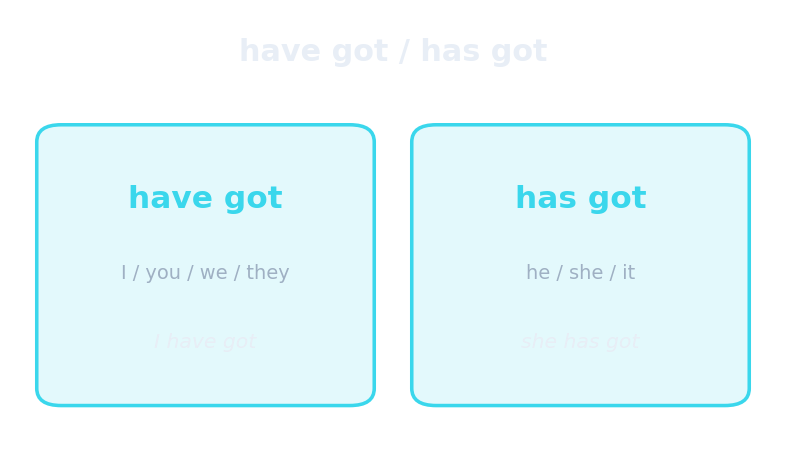
- Have got can describe something you have now: I've got a bike. It can also describe family or features: She's got two brothers. The bag has got a long handle.
- Outcome: say what someone has, ask about it and understand a reply. Start with pronouns and possessives. Starting check: does my sister use have got or has got? Use has got, like she.
I have got a bike. My dog has got my shoe.
have got / has got
- Use have got with I, you, we, they and plural subjects: The children have got bags. Use has got with he, she, it and a singular name or noun: Rae has got a bag.
- Short forms: I've got, she's got, they've got. In these sentences, she's got means she has got, not she is got.
have got or has got?
Use has got with a singular he/she/it-type subject; use have got with I/you/we/they or plural subjects.
Choose: He ___ got a new bike.
Difficulty 1/5 · 100 coins + a small bonus on first completion today
He takes has got in this present-possession pattern. A singular name or noun such as Kim or my brother also uses has got; the rule is not limited to three written pronouns.
Use the ordinary have-got form for a present family relationship: I ___ got two sisters.
Difficulty 1/5 · 100 coins + a small bonus on first completion today
Have completes I have got two sisters. The sisters are a family relationship, not objects bought or owned. A plural object does not change which form fits the subject I.
Translate into English: 她有一双蓝眼睛。
Difficulty 3/5 · 200 coins + a small bonus on first completion today
She has got blue eyes is the model. She has blue eyes or Her eyes are blue can also preserve this unrestricted translation. It describes a feature, not a purchase.
Negatives
- Use haven't got / hasn't got: I haven't got a pen. The car hasn't got a radio. Keep the form that fits the subject.
- I don't have a pen is another natural pattern. Keep each pattern complete: haven't got or don't have, not don't have got.
Is this correct? “She hasn't got a car.”
Difficulty 1/5 · 100 coins + a small bonus on first completion today
has not got → hasn't got. Correct.
Questions
- In this pattern, put Have / Has before the subject: Have you got a minute? Has Jo got a dog? With ordinary have, you can ask Does Jo have a dog?
- Short answers match the question: Have you got a pen? — Yes, I have. Does Jo have a pen? — Yes, she does. A full answer can be Yes, she has got a pen.
Common mistakes
- Say She has got long hair, not She have got long hair. A name works the same way: Mia has got long hair.
- Ask Have you got a pen? or Do you have a pen?, not Do you have got a pen? These are two complete patterns.
- For the short reply to Have you got a pen?, say Yes, I have. Yes, I have got a pen is a full reply; Yes, I have got leaves the object unfinished here.
Put the words in order to make a question.
Difficulty 3/5 · 200 coins + a small bonus on first completion today
The supplied words form Has your sister got a bike? The singular subject your sister takes Has, like she. Does your sister have a bike? is another frame, but it uses different supplied words.
Complete the matching short affirmative reply to the have-got question: “Have you got a pen?” — “Yes, I ___.”
Difficulty 1/5 · 100 coins + a small bonus on first completion today
Have matches Have you got ...? in this short reply. A full reply can include the object: Yes, I have got a pen. The rule for this short answer does not ban got from every longer reply.
- These examples describe what someone has now. Ben has got my bike does not say that Ben owns it; he may have borrowed it.
- Match the subject, negative and reply to the chosen pattern. For a past possession, use had: Last year I had a red bike. We practise present possession here, not every meaning of get.
Write one sentence about something you have, using “have got” or “has got”.
Difficulty 3/5 · 200 coins + a small bonus on first completion today
Example: “I have got a little dog.”
Three worked contrasts
- Name or pronoun: Amir has got a key. He has got a key. The name and he refer to one person. Amir and Jo have got keys has two people, so use have.
- Having or owning: Jo borrowed a coat. Jo has got my coat today says Jo has it now. It does not say Jo bought it or owns it. To explain ownership, add It is my coat.
- Question and reply: Has the room got a window? — Yes, it has. You can also ask Does the room have a window? — Yes, it does. Changing the question pattern changes the matching short reply; the window can be the same.
Choose have or has: Kim ___ got a map.
Difficulty 1/5 · 100 coins + a small bonus on first completion today
Kim is one person, like he or she, so use has got. Is got does not make this possession pattern. Try another singular name with has got.
Choose the complete sentence about two students.
Difficulty 1/5 · 100 coins + a small bonus on first completion today
Students is plural, so use have got. Has fits a singular subject; are does not replace have here. Check the subject before the verb.
Kim has no ruler. Choose a negative sentence with got.
Difficulty 1/5 · 100 coins + a small bonus on first completion today
Hasn’t got matches the singular name and the negative meaning. Doesn’t got mixes frames; haven’t does not agree with Kim. Try the same message with I haven’t got.
Choose the full have-got question about a classroom.
Difficulty 1/5 · 100 coins + a small bonus on first completion today
Has goes before the singular classroom in this question. Does ... have is another frame without got. Have would fit a plural subject such as the classrooms.
“Has Eva got a camera?” She has one. Choose the matching short reply.
Difficulty 1/5 · 100 coins + a small bonus on first completion today
Has in the question matches has in the short reply. Does matches Does she have ...? Is is not the verb used here. Keep the question and reply together.
Practise with new people and things
- Read the whole message in the next twenty decisions. Check who has something, how many things there are, and whether the message is positive or negative. A correct form can still give the wrong information.
- Try about half today and half in another session. Allow about 50 minutes across study, practice and writing if useful; this is a study suggestion, not a test time or a measured level.
“Nora has got my umbrella today.” What does this tell you?
Difficulty 1/5 · 100 coins + a small bonus on first completion today
The message says Nora has the umbrella today. My identifies it as the speaker’s umbrella; there is no purchase or ownership change stated. Ask how Nora got it if that matters.
A note says, “The room has got two doors.” Choose the same information.
Difficulty 1/5 · 100 coins + a small bonus on first completion today
Two doors belong to the described room. The other replies change the number of doors or rooms. Identify what the number counts before rewriting the message.
Use the ordinary have-got pattern: The twins ___ got a new teacher.
Difficulty 1/5 · 100 coins + a small bonus on first completion today
The twins means two people, so use have got. One teacher does not make the subject singular. Match the verb to who has the teacher, not to what follows got.
“The phone hasn’t got a camera.” Choose what the message says.
Difficulty 1/5 · 100 coins + a small bonus on first completion today
Hasn’t got a camera says the camera is absent from this phone. It gives no battery information. Keep both the negative and the named feature.
Choose a full ordinary-have question with the same meaning as “Has your brother got a laptop?”
Difficulty 1/5 · 100 coins + a small bonus on first completion today
Does your brother have uses the complete ordinary-have question frame. After does use have, not has; do not add got to this frame. Try the matching short reply Yes, he does.
“Our cat has got green eyes.” What do we learn?
Difficulty 1/5 · 100 coins + a small bonus on first completion today
This describes the cat’s appearance. Has got does not mean every object was bought, and eyes is plural. Keep the described feature when you explain the sentence.
Leo and I are speaking together. Choose the sentence about both of us.
Difficulty 1/5 · 100 coins + a small bonus on first completion today
We includes Leo and the speaker. He or I alone leaves out a person from the message. Pronouns change who the sentence describes, even when the verb form is correct.
Use have got: My aunt ___ a blue car.
Difficulty 1/5 · 100 coins + a small bonus on first completion today
My aunt is singular, like she, so has got fits. Have got fits I/you/we/they or plural subjects; is got is not this frame. A noun subject can take has just like a pronoun.
“Have your friends got tickets?” They have no tickets. Choose the matching short reply.
Difficulty 1/5 · 100 coins + a small bonus on first completion today
Haven’t matches Have ... got and the plural friends. Don’t would answer Do they have ...? Hasn’t does not agree with they. Preserve the no-tickets meaning.
Read: “I have got a key, but I haven’t got the address.” What is missing?
Difficulty 1/5 · 100 coins + a small bonus on first completion today
The first clause says the speaker has a key; the second says the address is missing. Read both clauses and keep their different positive/negative meanings.
Choose the expansion of “The shop’s got a new sign” in this possession sentence.
Difficulty 1/5 · 100 coins + a small bonus on first completion today
Before got in this pattern, ’s stands for has. It does not mean is got. The singular shop also needs has, not have. Read the full phrase before expanding a contraction.
Choose a full have-got question about two bags.
Difficulty 1/5 · 100 coins + a small bonus on first completion today
The bags is plural, so Have goes before it in the requested frame. Has fits one bag; Do ... have got mixes two frames. Ask about one bag next and change Have to Has.
Sara borrowed a dictionary from Tom. It is in Sara’s bag now. Choose a supported message.
Difficulty 1/5 · 100 coins + a small bonus on first completion today
Borrowing explains why Sara has the dictionary without owning it. The facts place it in her bag, not Tom’s. Having an object now does not by itself settle ownership.
“Does the hotel have a pool?” It does not. Choose the matching short reply.
Difficulty 1/5 · 100 coins + a small bonus on first completion today
Does in this ordinary-have question matches doesn’t. Hasn’t would answer Has the hotel got ...? Isn’t does not match either possession question. Keep each frame complete.
Choose a standard full sentence meaning the same as “They haven’t got a garden.”
Difficulty 1/5 · 100 coins + a small bonus on first completion today
Don’t have is a complete negative with ordinary have. Don’t have got mixes frames; hasn’t does not agree with they. The natural alternative preserves the missing garden.
Choose the standard past-possession sentence for this task: last summer I ___ a small boat.
Difficulty 1/5 · 100 coins + a small bonus on first completion today
Had expresses the requested past possession. Have got/has got in this possession lesson describe the present, not that past state. This task is not asking about another meaning of get.
“Has the bicycle got lights?” Choose a complete affirmative reply with got.
Difficulty 1/5 · 100 coins + a small bonus on first completion today
The full reply keeps has got and its object lights. Has got alone leaves the object unfinished here; have does not agree with it. The short reply would be Yes, it has.
Ali has two sisters and no brothers. Choose the accurate have-got sentence.
Difficulty 1/5 · 100 coins + a small bonus on first completion today
The first sentence keeps both the number and the family relationship. The others change sisters to brothers or reverse the positive meaning. A correct frame can still give wrong facts.
“We’ve got a table for six.” Choose the expansion of we’ve.
Difficulty 1/5 · 100 coins + a small bonus on first completion today
We’ve expands to we have. We are is we’re, and has does not agree with we. The sentence alone does not say that six people have already arrived.
The screen has a crack. Choose the standard have-got question asking about that feature.
Difficulty 1/5 · 100 coins + a small bonus on first completion today
The singular screen takes Has ... got in this question. Have would fit plural screens; Does ... has got mixes frames. Asking a question does not itself prove the answer.
Use it in a message
- Write a short English message about equipment for an activity. Keep the stated people, objects and quantities clear. Use the requested have got form, then compare with the hidden model and revise one mismatch.
- Have without got is also natural English. In a form-practice task, check which pattern the task asks you to use before you answer.
For a class trip, May has the map and Jun has the tickets. Choose the accurate message.
Difficulty 1/5 · 100 coins + a small bonus on first completion today
The first message keeps each object with the correct person. The second swaps them; the third denies both possessions. Check who has what before you send a practical message.
A borrowed speaker is with you, but its cable is missing. Which message fits?
Difficulty 1/5 · 100 coins + a small bonus on first completion today
The second message preserves what is present and what is missing without inventing ownership. The first adds ownership and a cable; the last reverses the facts. Ask for the missing cable next.
Facts: you have two balls for a school game. Your friend Ana has the net. You do not have the net. Write 2–3 English sentences using have got / has got and a negative. Keep the people and objects correct. Compare, then revise one form or fact.
Compare your English with the facts and checklist. Revise one real mismatch, or explain why no change is needed. Several answers can fit. This is written self-review, not automatic correctness or a speaking/proficiency result.
Review later
- Tomorrow, try the two review decisions before rereading. Ask a new Have/Has … got? question and write a matching short reply. Then try a different message.
- Continue with present simple. Review and self-comparison do not prove mastery; these are written practice tasks, not a speaking assessment.
Usage guidance checked 2026-10-20: British Council, present simple have got. The examples and practice here are original; independent language, key and learner review pending.
Use the have-got pattern: This box ___ got a lid.
Difficulty 1/5 · 100 coins + a small bonus on first completion today
This box is a singular noun subject, so has got fits. The rule is not limited to the written words he/she/it. Later, make the same question about several boxes.
“Have you got my notebook?” You have it. Choose the matching short reply.
Difficulty 1/5 · 100 coins + a small bonus on first completion today
Have ... got matches Yes, I have. Do matches an ordinary-have question; am matches a be question. Check the frame again later before opening the explanation.
Facts: you need a charger. Ask your friend in English whether they have one, using Have … got? Then write a possible short negative reply from your friend. This is an invented practice exchange, not a real report. Compare and revise your question or reply.
Compare your English with the facts and checklist. Revise one real mismatch, or explain why no change is needed. Several answers can fit. This is written self-review, not automatic correctness or a speaking/proficiency result.