Natural monopoly
Introduced| English | Meaning |
|---|---|
| natural monopoly/ˈnætʃərəl məˈnɒpəli/ | A market in which one firm can supply total demand at a lower average cost than competing firms could. |
| average-cost pricing/ˈævrɪdʒ kɒst ˈpraɪsɪŋ/ | Setting a product's price equal to average total cost, allowing the firm to cover its economic costs. |
One grid for a whole country
- State Grid runs the power lines that bring electricity to most of China. Building a second set of pylons and cables beside it would make no sense.
- When one firm can supply a whole market more cheaply than two or more, the market is a natural monopoly 自然垄断.
- Water pipes, rail tracks and gas networks are other examples.
Which are likely natural monopolies?
Difficulty 2/5 · 140 coins + a small bonus on first completion today
Restaurants have low fixed costs and many rivals.
Why costs keep falling
- These industries have huge fixed costs (the network) and low marginal costs (one more customer).
- Average cost keeps falling over the whole range of market demand. So one firm is cheapest.
Worked example: one network or two?
$\text{TC} = 1000 + 2Q$. Average cost: 12 at 100 units, 7 at 200, 4.5 at 400, about 3.7 at 600.
- One network serving 400: TC $= 1000 + 800 = 1800$.
- Two networks of 200 each: $2 \times (1000 + 400) = 2800$.
- Competition would waste 1000 on a duplicated network.
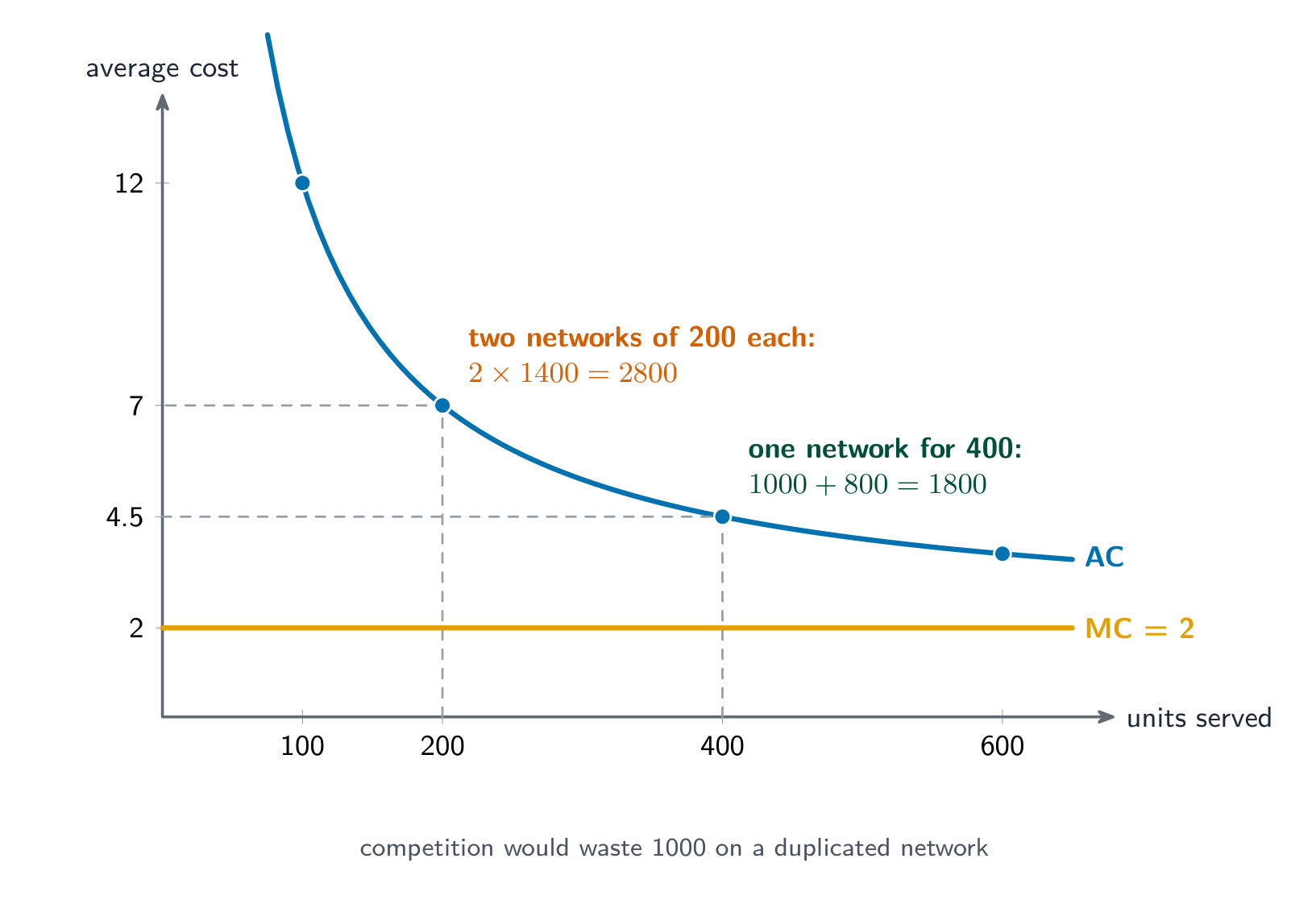
One network keeps getting cheaper per unit
With TC = 1000 + 2Q, average cost is 12, 7, 4.5 and about 3.7 at 100, 200, 400 and 600 units. It falls across the whole market, so one network serves 400 units for 1800, while two networks of 200 cost 2800.
$\text{TC} = 2000 + 5Q$. What is average cost at 500 units?
Difficulty 2/5 · 140 coins + a small bonus on first completion today
$\dfrac{2000 + 2500}{500} = 9$.
With the same costs, how much more does it cost for two networks to serve 250 units each than for one to serve 500?
Difficulty 2/5 · 140 coins + a small bonus on first completion today
Two networks: $2 \times (2000 + 1250) = 6500$; one: $4500$.
What price should it charge?
- Profit maximisation (MR = MC): high price, low output — the usual monopoly problem.
- Marginal-cost pricing ($P = \text{MC} = 2$): allocatively efficient, but because AC is above MC, the firm makes a loss and cannot pay for the network.
- Average-cost pricing 平均成本定价 ($P = \text{AC}$): the firm just covers its costs, with normal profit.
Match each pricing rule to its result.
Difficulty 2/5 · 140 coins + a small bonus on first completion today
Each rule has a different outcome.
Why does marginal-cost pricing cause a loss for a natural monopoly?
Difficulty 1/5 · 100 coins + a small bonus on first completion today
Pricing at MC does not cover average cost.
How governments respond
- State ownership: the government runs the network, as with many grids and railways.
- Regulation: a private owner, with prices capped by a regulator — like UK water companies.
- Subsidy: price at MC and pay the loss from taxes.
Breaking up a natural monopoly raises costs. Unlike other monopolies, splitting it into competing firms duplicates the network and pushes average cost up. The answer is usually regulation, not more competition in the network itself.
Splitting a natural monopoly into two competing firms lowers average cost.
Difficulty 1/5 · 100 coins + a small bonus on first completion today
It duplicates fixed costs.
A natural monopoly has average costs that fall across the whole market, so one firm is cheapest. Marginal-cost pricing is efficient but makes a loss; average-cost pricing breaks even. Governments own, regulate or subsidise such firms rather than breaking them up.
Explain why governments usually regulate natural monopolies instead of breaking them up.
Keep the economies of scale but control the price.