Price discrimination
Introduced| English | Meaning |
|---|---|
| third-degree price discrimination/θɜːd dɪˈɡriː praɪs dɪˌskrɪmɪˈneɪʃn/ | Charging different groups of buyers different prices. |
| monopoly power/məˈnɒpəli ˈpaʊə/ | A firm's ability to influence its selling price rather than accept a price set by market competition. |
| arbitrage/ˈɑːbɪtrɪdʒ/ | Buying a good where it is cheap and reselling it where it is dear. |
Same seat, different price
- Chinese students can buy discounted rail tickets during school holidays. Cinemas charge less on weekday mornings; airlines charge more for tickets bought the day before.
- The product is the same, but the price depends on who buys it and when.
- Charging different groups different prices for the same good, for reasons not linked to cost, is third-degree price discrimination 三级价格歧视.
Three conditions
- The firm must have monopoly power: it can set prices.
- It must be able to separate the groups — by age, student card, time or location.
- The groups must have different price elasticities of demand, and it must prevent arbitrage 套利转售 (cheap buyers reselling to dear ones).
Which conditions are needed for price discrimination?
Difficulty 2/5 · 140 coins + a small bonus on first completion today
Elasticities must differ.
Rail tickets with the passenger's name and ID make arbitrage harder.
Difficulty 1/5 · 100 coins + a small bonus on first completion today
Cheap tickets cannot be resold to other passengers.
Worked example: pricing two markets
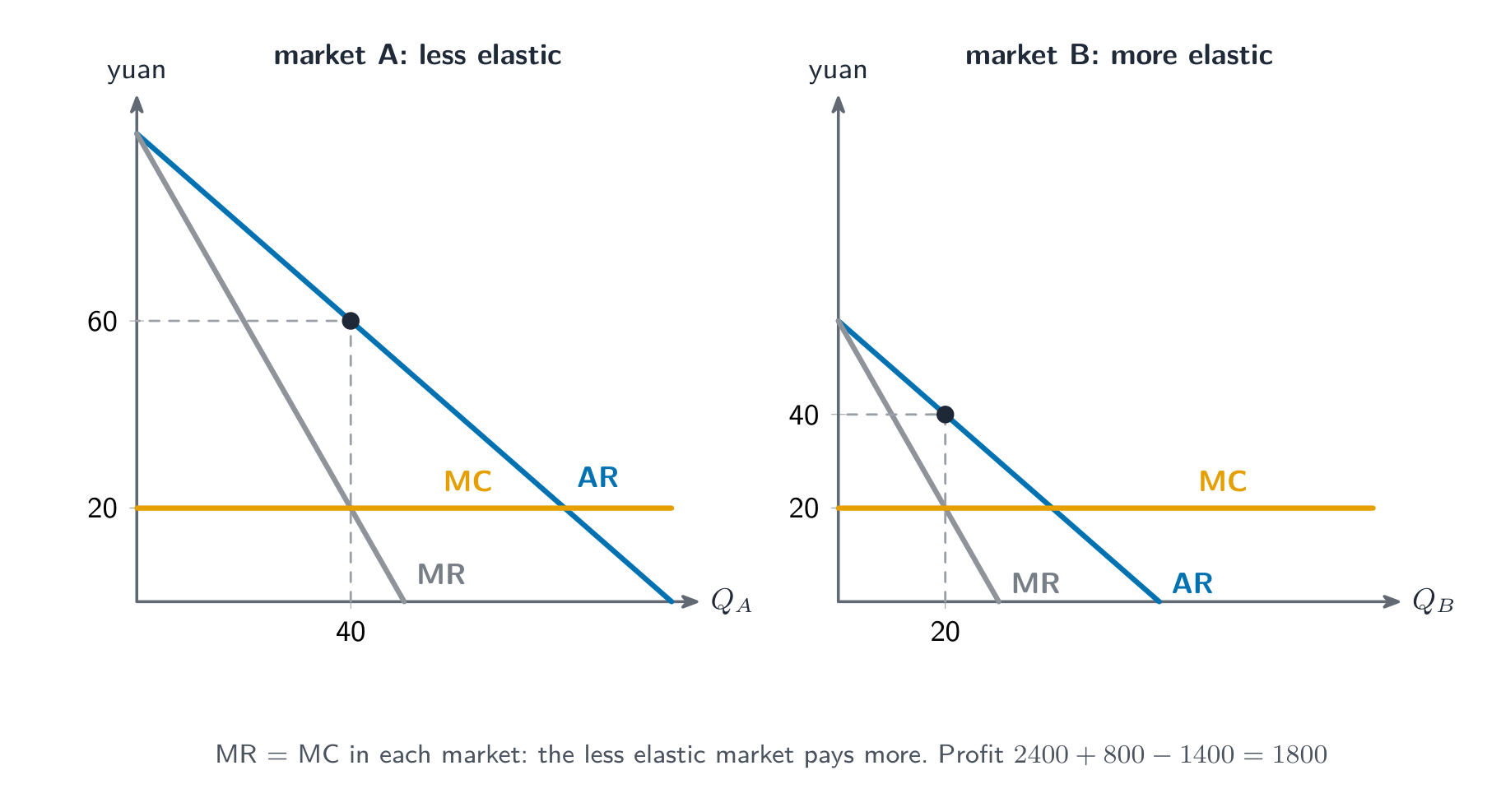
Market A: $P_A = 100 - Q_A$. Market B: $P_B = 60 - Q_B$. MC $= 20$ in both; fixed cost 200.
- A: $\text{MR} = 100 - 2Q_A = 20$, so $Q_A = 40$, $P_A = 60$. B: $60 - 2Q_B = 20$, so $Q_B = 20$, $P_B = 40$.
- Revenue $= 2400 + 800 = 3200$; cost $= 200 + 20 \times 60 = 1400$; profit $= 1800$.
- Elasticity at these points: A $-1.5$, B $-2$. The less elastic market pays the higher price.
Market A: $P = 80 - Q$, MC $= 10$. What price is charged in A?
Difficulty 2/5 · 140 coins + a small bonus on first completion today
$80 - 2Q = 10$ gives $Q = 35$, $P = 45$.
Market B: $P = 40 - Q$, same MC. What price is charged in B?
Difficulty 2/5 · 140 coins + a small bonus on first completion today
$40 - 2Q = 10$ gives $Q = 15$, $P = 25$.
Under price discrimination, which group pays the higher price?
Difficulty 1/5 · 100 coins + a small bonus on first completion today
Inelastic buyers respond less to a high price.
Who gains, who loses?
- The firm gains: it turns consumer surplus into profit.
- Consumers in the inelastic market pay more. Consumers in the elastic market — often students or the less well-off — may pay less, or be served at all.
- Extra profit can pay for investment or keep a service running, such as off-peak trains.
Different prices are not always price discrimination. A first-class seat costs more because it uses more space and service; that is a cost difference. Discrimination means different prices for the same good with the same cost.
Charging more for a first-class seat than a standard seat is always price discrimination.
Difficulty 1/5 · 100 coins + a small bonus on first completion today
First class costs more to provide.
Third-degree price discrimination charges groups different prices for the same good. It needs monopoly power, separable groups with different elasticities, and no resale. The firm sets MR = MC in each market, so the less elastic group pays more. Some consumers gain and some lose.
Evaluate whether price discrimination by rail companies is good for students.
Look at each group in turn.