Interpreting the Meaning of the Derivative in Context
Introduced 8:26
Interpreting the Derivative in Context
A tank is draining. A cup of coffee is cooling. A city is growing. Every one of those sentences hides the same phrase. The rate at which something changes. And…
English narration · English and 中文 subtitles you can switch
In this lesson
| English | Meaning |
|---|---|
| rate of change/reɪt ɒv tʃeɪndʒ/ | The change in one quantity divided by the corresponding change in another. |
| units/ˈjuːnɪts/ | Agreed reference quantities used to express measurements or counts. |
| increasing/ɪnˈkriːsɪŋ/ | Describing a function or sequence whose values rise as its input or index increases over a specified range. |
A derivative is a sentence, not just a number
- In context, $f'(a)$ is a rate of change 变化率 with units 单位. AP questions ask you to say what it means in a full sentence.
- If $V(t)$ is water in litres, $t$ in minutes, then $V'(3)=12$ means: "At $t=3$ minutes, the volume of water is increasing at 12 litres per minute."
The four parts of a full answer
- When (at $t=3$ minutes), what (the volume of water), which way (increasing 递增 or decreasing) and how fast, with units (12 L/min).
- Units of $f'$ are output units per input unit: L/min, °C/hour, dollars per item.
$V(t)$ is water volume in litres at time $t$ minutes. The units of $V'(t)$ are...
Difficulty 1/5 · 100 coins + a small bonus on first completion today
Output per input: litres per minute.
Value vs. rate: two different questions
- $f(a)$ says how much there is: $V(3)=50$ L. $f'(a)$ says how fast it is changing: $V'(3)=12$ L/min.
- They describe different things about the same instant. Read the question carefully: amount or rate?
Amount and rate at the same moment
y = −x² + 4x
Move the point. The height of the point is the amount $f(a)$; the slope of the tangent is the rate $f'(a)$. At the top of the hump the amount is largest, but the rate is 0.
"The population is growing by $200$ per year" describes...
Difficulty 1/5 · 100 coins + a small bonus on first completion today
A rate of change (per year) is the derivative.
Match each statement to what it describes.
Difficulty 2/5 · 140 coins + a small bonus on first completion today
Amount → value; rate → first derivative; change in the rate → second derivative.
A negative rate. $T(h)$ is the temperature in °C of a drink $h$ hours after it is poured, and $T'(2)=-4$.
- Units: °C per hour. The sign is negative, so the temperature is going down.
- Sentence: "Two hours after it is poured, the temperature of the drink is decreasing at 4 °C per hour."
If $f'(a)<0$, the quantity is decreasing at input $a$.
Difficulty 1/5 · 100 coins + a small bonus on first completion today
A negative derivative means the quantity is falling.
A positive derivative at $a$ means the quantity is ____ there.
Difficulty 1/5 · 100 coins + a small bonus on first completion today
Positive rate → increasing.
$R(t)$ is the number of litres of rain in a barrel, $t$ in hours, and $R'(4)=-3$. Which is the best interpretation?
Difficulty 1/5 · 100 coins + a small bonus on first completion today
It gives when, what, the direction (decreasing) and the rate with units. The others describe a total change, an amount, or have the wrong units.
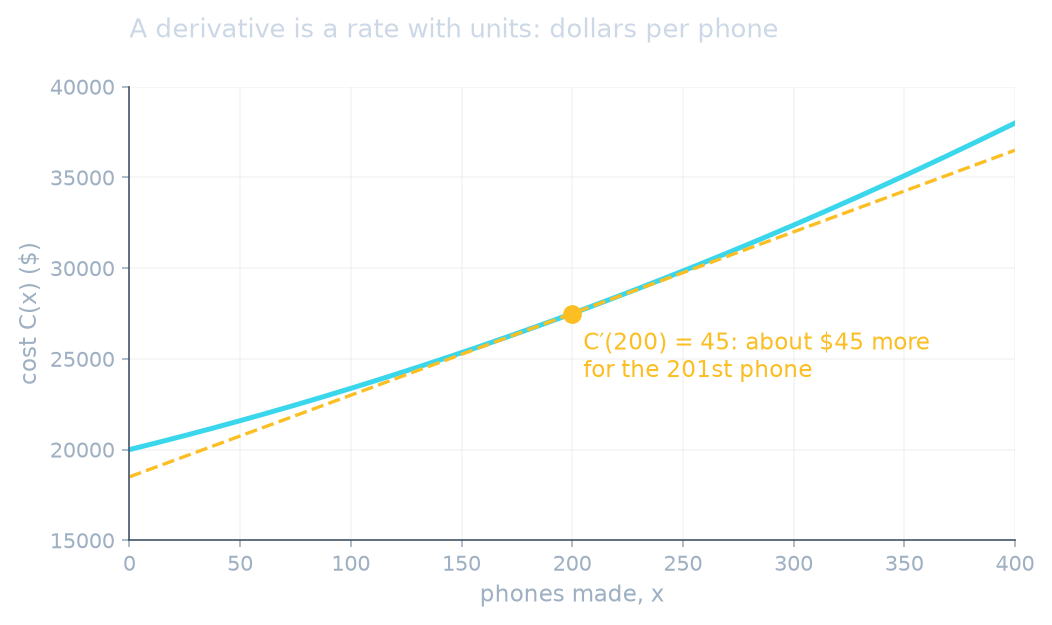
$C(x)$ is the cost in dollars to make $x$ phones, and $C'(200)=45$.
- Units: dollars per phone. Meaning: when 200 phones have been made, the cost rises by about $45 for one more phone.
- Economists call this the marginal cost.
$C(x)$ is cost in dollars for $x$ items and $C'(200)=45$. This means...
Difficulty 1/5 · 100 coins + a small bonus on first completion today
The derivative is the marginal (per-extra-item) cost near $x=200$.
The rate of the rate
- $f''(a)$ tells how the rate is changing. Its units are output units per input unit squared: m/s² is "metres per second, per second".
- $V''(3)=-2$ L/min²: at 3 minutes, the rate at which the water is coming in is decreasing by 2 L/min each minute.
$s(t)$ is position in metres, $t$ in seconds. What are the units of $s''(t)$?
Difficulty 1/5 · 100 coins + a small bonus on first completion today
$s'$ is in m/s. Its rate of change is m/s per second: m/s². It is the acceleration.
- Don't confuse value and rate. "The population is 8000" is $P(a)$; "it grows by 200 per year" is $P'(a)$.
- Say "at $t=3$", not "in 3 minutes": a derivative is about one instant, not a total.
- Write "decreasing at 4 °C per hour", not "increasing at −4 °C per hour".
In context, $f'(a)$ is a rate of change in output units per input unit. A full answer gives when, what, increasing or decreasing, and how fast with units. $f(a)$ is how much; $f''(a)$ is how the rate itself changes.
What went wrong? Only the site team sees this.