Selecting Procedures for Calculating Derivatives
Introduced 7:57
The Chain Rule
Think of two gears joined together. Turn the first one, and it drives the second. If the second turns three times as fast as the first, and the first turns…
English narration · English and 中文 subtitles you can switch
In this lesson
You have a toolbox: now choose the tool
- You know the power, sum, product, quotient and chain rules and the derivatives of $\sin$, $\cos$, $e^x$, $\ln x$. The skill is picking the right rule and using rules in the right order.
- A messy derivative is usually easy once you see its structure.
Read the outermost structure first
- Ask what the last operation would be if you calculated $y$ for a number: a sum, a product, a quotient or a composition (function of a function)?
- That last operation picks the first rule. Then each piece gets its own rule, working outside-in.
Which rule does $y=x^2\sin x$ need at the top level?
Difficulty 1/5 · 100 coins + a small bonus on first completion today
It is a product of $x^2$ and $\sin x$ → product rule.
The top-level structure of $\dfrac{\sin x}{x^2}$ is a...
Difficulty 1/5 · 100 coins + a small bonus on first completion today
It is $\sin x$ divided by $x^2$ — a quotient (or rewrite as $x^{-2}\sin x$).
Match each function to the top-level rule it needs.
Difficulty 2/5 · 140 coins + a small bonus on first completion today
Read the outermost operation: term-by-term, product, quotient, or composition.
Three structures. Name the top-level rule, then differentiate.
- $x^2\sin(3x)$: a product, and $\sin(3x)$ needs the chain rule: $2x\sin(3x)+3x^2\cos(3x)$.
- $\sin^2(3x)=\big(\sin(3x)\big)^2$: a composition three layers deep: $2\sin(3x)\cdot\cos(3x)\cdot3=6\sin(3x)\cos(3x)$.
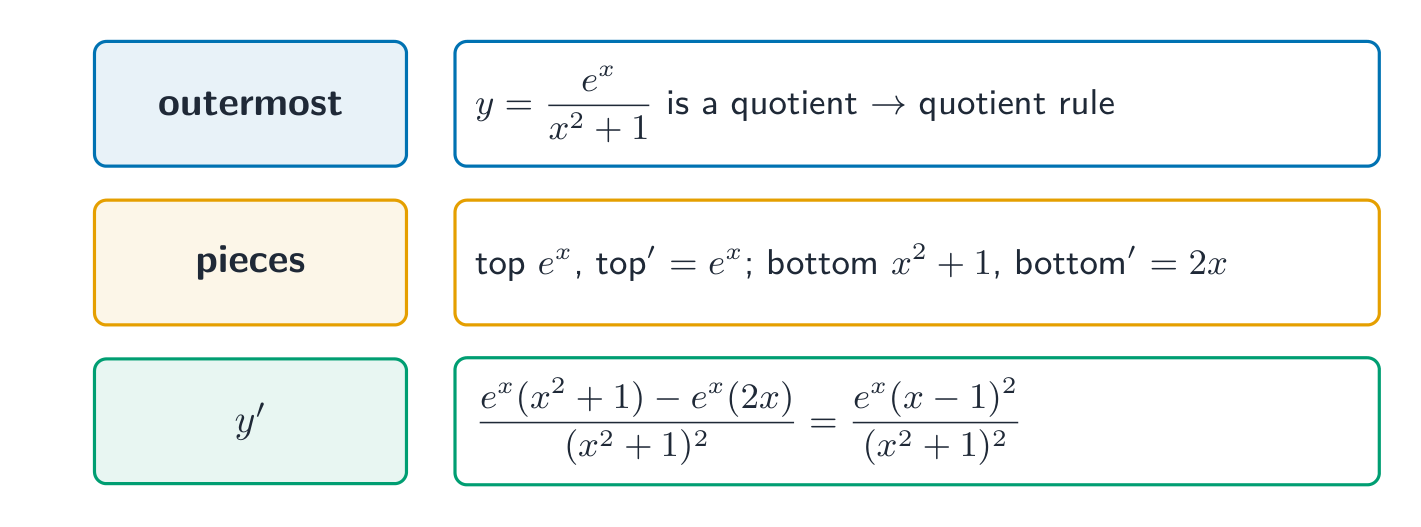
- $\dfrac{e^{x}}{x^2+1}$: a quotient: $\dfrac{e^x(x^2+1)-e^x(2x)}{(x^2+1)^2}=\dfrac{e^x(x-1)^2}{(x^2+1)^2}$.
For nested functions, apply rules working from the ____ level inward.
Difficulty 1/5 · 100 coins + a small bonus on first completion today
Handle the outermost structure first, then each sub-piece.
Find the derivative of $y=(x^2+1)^3$ at $x=1$.
Difficulty 2/5 · 140 coins + a small bonus on first completion today
A composition: $y'=3(x^2+1)^2\cdot2x$. At $x=1$: $3(2)^2(2)=24$.
Rewrite first when it is cheaper
- $\dfrac{5}{x^3}=5x^{-3}$ needs only the power rule: $-15x^{-4}$. $\dfrac{x^2+x}{x}=x+1$ (for $x\neq0$) has derivative 1.
- $\dfrac{\sin x}{x^2}$ can be a quotient, or the product $x^{-2}\sin x$. Choose the one you make fewer mistakes with.
Simplify $\dfrac{x^2+x}{x}$ first, then differentiate. What is the derivative?
Difficulty 2/5 · 140 coins + a small bonus on first completion today
$\frac{x^2+x}{x}=x+1$, so the derivative is $1$ — no quotient rule needed.
Rewrite, then differentiate. Find $\dfrac{d}{dx}\left[\dfrac{x^3-4\sqrt x}{x}\right]$.
- Split the fraction: $x^2-4x^{-1/2}$.
- Power rule on each term: $2x+2x^{-3/2}$. No quotient rule needed.
What is $\dfrac{d}{dx}\left[\dfrac{6}{x^2}\right]$?
Difficulty 1/5 · 100 coins + a small bonus on first completion today
Rewrite as $6x^{-2}$. Power rule: $-12x^{-3}=-\dfrac{12}{x^3}$. No quotient rule needed.
- Match the rule to the top-level structure, not the first symbol you see. $\dfrac{\sin x}{x^2}$ is a quotient, not "the derivative of $\sin$".
- Don't forget the inner derivative: $\dfrac{d}{dx}\sin(3x)$ is $3\cos(3x)$, not $\cos(3x)$.
- A constant over a function, like $\dfrac{5}{x^3}$, is easier as a power than with the quotient rule.
Find the last operation (sum, product, quotient, composition), apply that rule first, then handle each piece outside-in. Rewrite with powers or split fractions when that is cheaper. Check the result is reasonable.
After differentiating, checking the answer for reasonableness (term count, signs) is good practice.
Difficulty 1/5 · 100 coins + a small bonus on first completion today
A quick sanity check catches many slips.
What went wrong? Only the site team sees this.