Defining Average and Instantaneous Rates of Change at a Point
Introduced 7:51
Defining the Derivative
Draw a journey as a curve. Pick two points, join them with a straight line, and its slope gives the average rate over an interval. But we want the rate at one…
English narration · English and 中文 subtitles you can switch
In this lesson
| English | Meaning |
|---|---|
| average rate of change/ˈævrɪdʒ reɪt ɒv tʃeɪndʒ/ | The change in a function's output divided by the change in its input across an interval. |
| instantaneous rate of change/ˌɪnstənˈteɪnɪəs reɪt ɒv tʃeɪndʒ/ | The rate of change at a particular input value, given by the derivative where it exists. |
| difference quotient/ˈdɪfrəns ˈkwəʊʃənt/ | The change in a function's output divided by the corresponding change in its input over an interval. |
| secant line/ˈsiːkənt laɪn/ | A straight line passing through two distinct points on a curve. |
| tangent line/ˈtændʒənt laɪn/ | A straight line through a point on a curve with the same gradient as the curve at that point. |
From "over an interval" to "at an instant"
- A trip of 120 km in 2 hours has an average rate of change 平均变化率 of 60 km/h. The speedometer at one moment shows the instantaneous rate of change 瞬时变化率.
- Unit 2 builds the bridge between the two, and the bridge is a limit.
Average rate = slope of a secant
- From $x=a$ to $x=b$, the average rate is the difference quotient 差商 $\dfrac{f(b)-f(a)}{b-a}$: total change ÷ interval width.
- On the graph it is the slope of the secant line 割线 through $\big(a,f(a)\big)$ and $\big(b,f(b)\big)$.
Find the average rate of change of $f(x)=x^2$ on $[1,3]$.
Difficulty 2/5 · 140 coins + a small bonus on first completion today
$\dfrac{9-1}{3-1}=\dfrac{8}{2}=4$.
The average rate of change over an interval equals the slope of the...
Difficulty 1/5 · 100 coins + a small bonus on first completion today
Average rate = rise over run between the two endpoints = secant slope.
Shrink the interval
- Slide $b$ toward $a$. The secant pivots toward the tangent line 切线 at $a$.
- The limit of the secant slopes is the instantaneous rate at $a$.
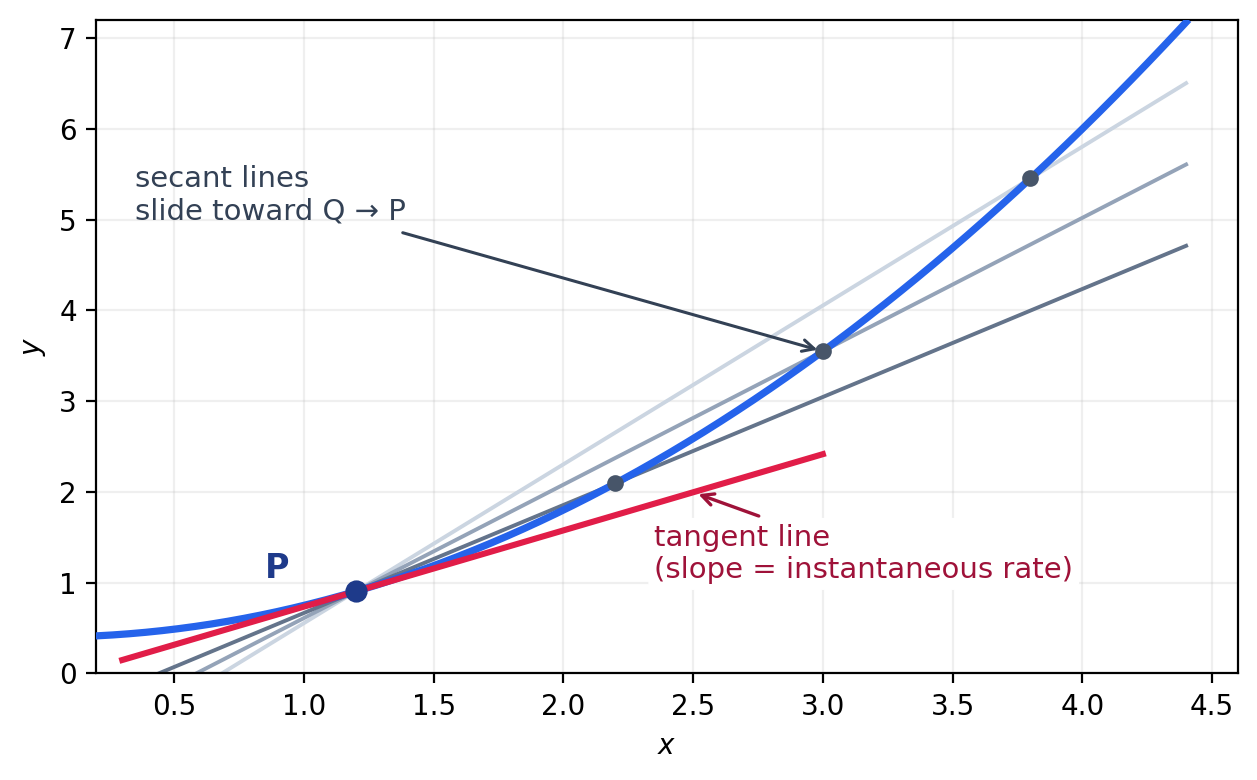
Slide the secant into a tangent
y = x²
Move the point along $y=x^2$ — the tangent slope you read off is the instantaneous rate, the limit of the secant slopes.
The instantaneous rate of change at a point equals the slope of the ____ line there.
Difficulty 1/5 · 100 coins + a small bonus on first completion today
It is the limit of secant slopes as the interval shrinks — the tangent slope.
For $f(x)=x^2$, find the average rate on $[2,4]$ and estimate the instantaneous rate at $x=2$.
- Average on $[2,4]$: $\dfrac{16-4}{2}=6$. On $[2,2.1]$: $\dfrac{4.41-4}{0.1}=4.1$. On $[2,2.01]$: $4.01$.
- The average rates close in on $4$, so the instantaneous rate at $x=2$ is $4$.
For $f(x)=x^2$, average rates on $[3,3.1]$ and $[3,3.01]$ are $6.1$ and $6.01$. Estimate the instantaneous rate at $x=3$.
Difficulty 2/5 · 140 coins + a small bonus on first completion today
The averages close in on $6$.
AP style: rates in context. Water in a tank, $W(t)$ litres, $t$ in minutes:
| $t$ (min) | 0 | 4 | 10 |
|---|---|---|---|
| $W(t)$ (L) | 120 | 96 | 84 |
- Average rate on $[0,10]$: $\dfrac{84-120}{10-0}=-3.6$ L/min.
- In words: "On average, the water in the tank decreases by 3.6 litres per minute over the first 10 minutes."
A town has $P(2)=350$ people in year 2 and $P(8)=410$ in year 8. Find the average rate of change of $P$ on $[2,8]$, in people per year.
Difficulty 2/5 · 140 coins + a small bonus on first completion today
$\dfrac{410-350}{8-2}=\dfrac{60}{6}=10$ people per year.
Reading a rate
- The sign gives direction (positive: increasing). The size gives speed.
- The units are (output units) per (input units): m/s, L/min, people per year.
A position function has instantaneous rate $-5\,\tfrac{\text{m}}{\text{s}}$ at time $t$. Select all correct readings.
Difficulty 2/5 · 140 coins + a small bonus on first completion today
Negative rate = moving in the negative direction (so position decreases); its magnitude is the speed; and it is the tangent slope.
For water depth $D(t)$ in cm, $t$ in hours, the average rate of change on $[1,5]$ is $-2$. Which sentence is correct?
Difficulty 1/5 · 100 coins + a small bonus on first completion today
An average rate is over the whole interval, in cm per hour. It is not the rate at one moment, and the total change is $-2\times4=-8$ cm.
- An average rate of 0 does not mean nothing changed in between. $(x-2)^2$ on $[0,4]$ goes down and then up again.
- Interpret with units, the time interval and increasing/decreasing. A bare number gets no AP credit.
If the average rate of change of $f$ on $[0,4]$ is $0$, then $f$ must be constant on $[0,4]$.
Difficulty 1/5 · 100 coins + a small bonus on first completion today
It only means $f(0)=f(4)$; $f$ could rise then fall (e.g. go out and come back).
Average rate on $[a,b]$ = $\frac{f(b)-f(a)}{b-a}$ = slope of a secant. Shrinking the interval turns the secant into the tangent, whose slope is the instantaneous rate. Always state units and direction.