Finding the Area Between Curves That Intersect at More Than Two Points
Introduced 6:03
Applications of Integration
What is the average value of a function? Not the average of a few points — the average across a whole interval. Picture the area under the curve. Now flatten…
English narration · English and 中文 subtitles you can switch
In this lesson
| English | Meaning |
|---|---|
| subintervals/ˌsʌbɪnˈtɜːvlz/ | Smaller intervals into which a larger interval is divided, for example to construct a Riemann sum. |
When the curves keep crossing
- Two curves can cross more than twice, so the "top" curve swaps along the way. One integral of top minus bottom would then be wrong on part of the region.
- The fix: find every crossing, split the region there, and add the pieces.
Find every intersection first
- Solve $f(x)=g(x)$ completely on the interval. The crossings cut it into subintervals 子区间 where one curve stays on top.
- On each subinterval, test one point to see which curve is on top, then integrate upper − lower there.
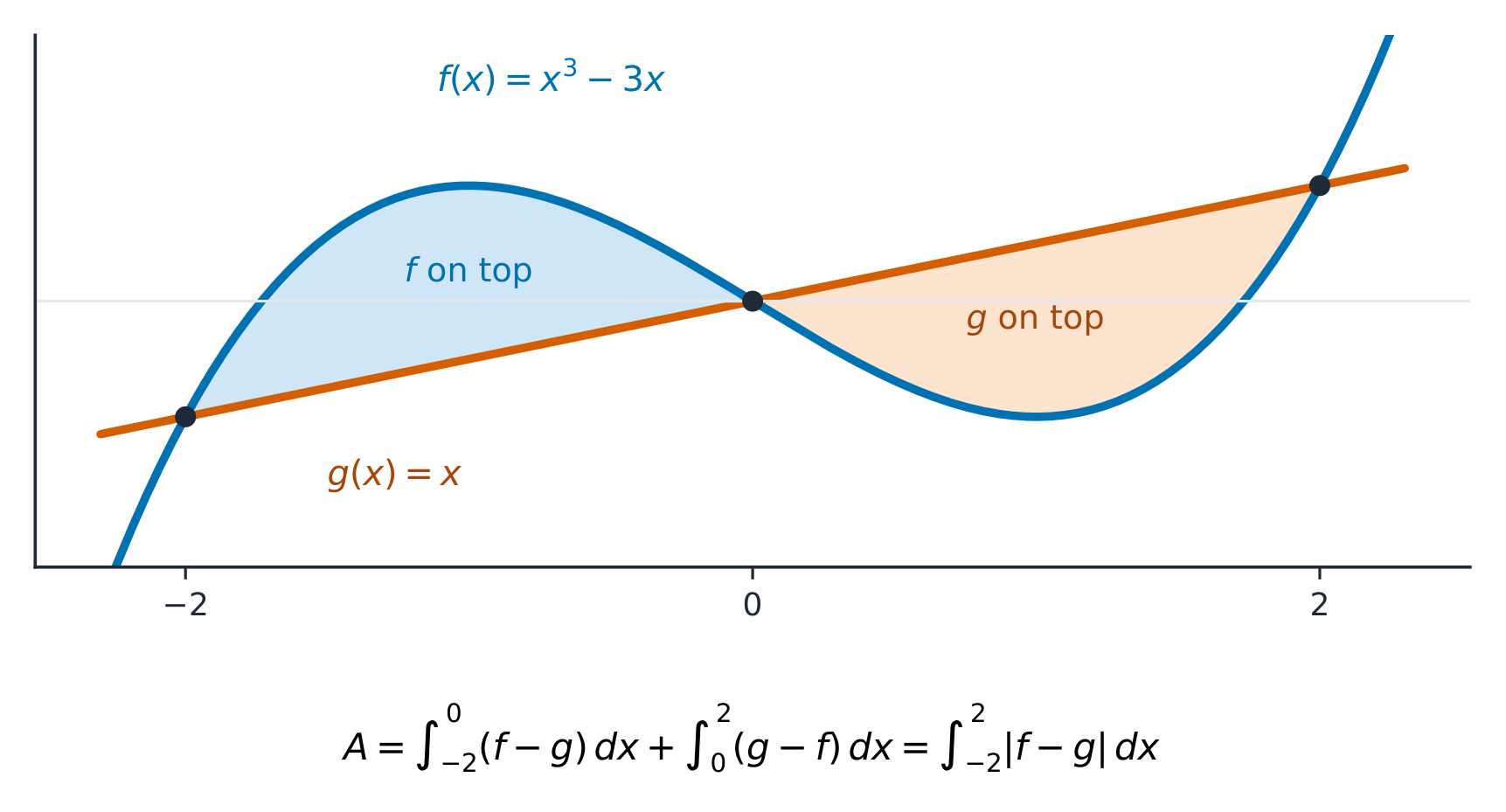
A cubic crossing a line 3 times
y = ax³ + bx
$y=x^3$ and $y=x$ cross at $-1,0,1$; the top curve switches at $0$, so the area needs two pieces.
Where do $y=x^3$ and $y=x$ cross?
Difficulty 2/5 · 140 coins + a small bonus on first completion today
$x^3=x\Rightarrow x(x-1)(x+1)=0$.
The intersection points divide the region into ____ where the ordering is fixed.
Difficulty 1/5 · 100 coins + a small bonus on first completion today
On each subinterval one curve is consistently on top.
Area between $y=x^3$ and $y=x$ on $[-1,1]$.
- $x^3=x\Rightarrow x(x-1)(x+1)=0$: $x=-1,0,1$. Test $-0.5$: $x^3>x$. Test $0.5$: $x>x^3$.
- $A=\displaystyle\int_{-1}^{0}(x^3-x)\,dx+\int_{0}^{1}(x-x^3)\,dx=\tfrac14+\tfrac14=\tfrac12$.
For $y=x^3$ and $y=x$ on $[-1,1]$, each piece has area $\tfrac14$. Find the total area.
Difficulty 2/5 · 140 coins + a small bonus on first completion today
$\tfrac14+\tfrac14=\tfrac12$.
Why one integral fails
- $\displaystyle\int_{-1}^{1}(x^3-x)\,dx=0$, but the area is $\tfrac12$. The two pieces have opposite signs and cancel.
- The safe single formula is $A=\displaystyle\int_a^b|f(x)-g(x)|\,dx$: the absolute gap. On the calculator section, enter exactly that.
You split the region at each intersection because...
Difficulty 1/5 · 100 coins + a small bonus on first completion today
Where curves swap, part of the region would count negative.
Integrating $|f(x)-g(x)|$ over the whole interval gives the same total area as splitting.
Difficulty 1/5 · 100 coins + a small bonus on first completion today
The absolute value handles the switching automatically.
Using one integral of $f-g$ across all crossings (curves swapping) gives...
Difficulty 1/5 · 100 coins + a small bonus on first completion today
Sign-cancellation understates the true area.
Trig curves. Find the area between $y=\sin x$ and $y=\cos x$ on $[0,\pi]$.
- $\sin x=\cos x$ at $x=\tfrac{\pi}{4}$ only. On $(0,\tfrac{\pi}{4})$, $\cos x$ is on top; on $(\tfrac{\pi}{4},\pi)$, $\sin x$ is.
- $A=\Big[\sin x+\cos x\Big]_0^{\pi/4}+\Big[-\cos x-\sin x\Big]_{\pi/4}^{\pi}$
- $=(\sqrt2-1)+(1+\sqrt2)=2\sqrt2\approx2.83$
Find the total area between $y=x^3-4x$ and the $x$-axis on $[-2,2]$.
Difficulty 2/5 · 140 coins + a small bonus on first completion today
$x^3-4x=x(x-2)(x+2)$ crosses at $-2,0,2$. $\int_{-2}^{0}(x^3-4x)\,dx=4$ and $\int_0^2(4x-x^3)\,dx=4$, so the area is $8$. (One integral over $[-2,2]$ gives 0.)
Two curves cross three times on $[a,b]$, so the top curve changes. How do you find the total area between them?
Each piece has its own top curve.
Two curves swap which one is on top. How is the total area found?
Difficulty 1/5 · 100 coins + a small bonus on first completion today
A single signed integral cancels the swapped pieces.
- Find all crossings, including ones inside the interval that the question does not mention.
- A point where the curves only touch (like $x^2$ and $0$ at $x=0$) does not swap the top curve. Test a point on each side.
- Each piece's integral should be positive. A negative piece means top and bottom are the wrong way round.
If two curves meet at $x=c$, the top curve always switches at $c$.
Difficulty 1/5 · 100 coins + a small bonus on first completion today
They may only touch: $y=x^2$ and $y=0$ meet at 0, but $x^2$ stays on top on both sides. Test a point on each side.
When curves intersect more than twice, find all intersections, split into subintervals, and integrate upper − lower on each. Or integrate $|f(x)-g(x)|$ in one go. A single integral of $f-g$ cancels area.
What went wrong? Only the site team sees this.